Zeiss Stopped Making Sporting Optics In Germany. I Reviewed the Company’s New Spotting Scope to Test Quality

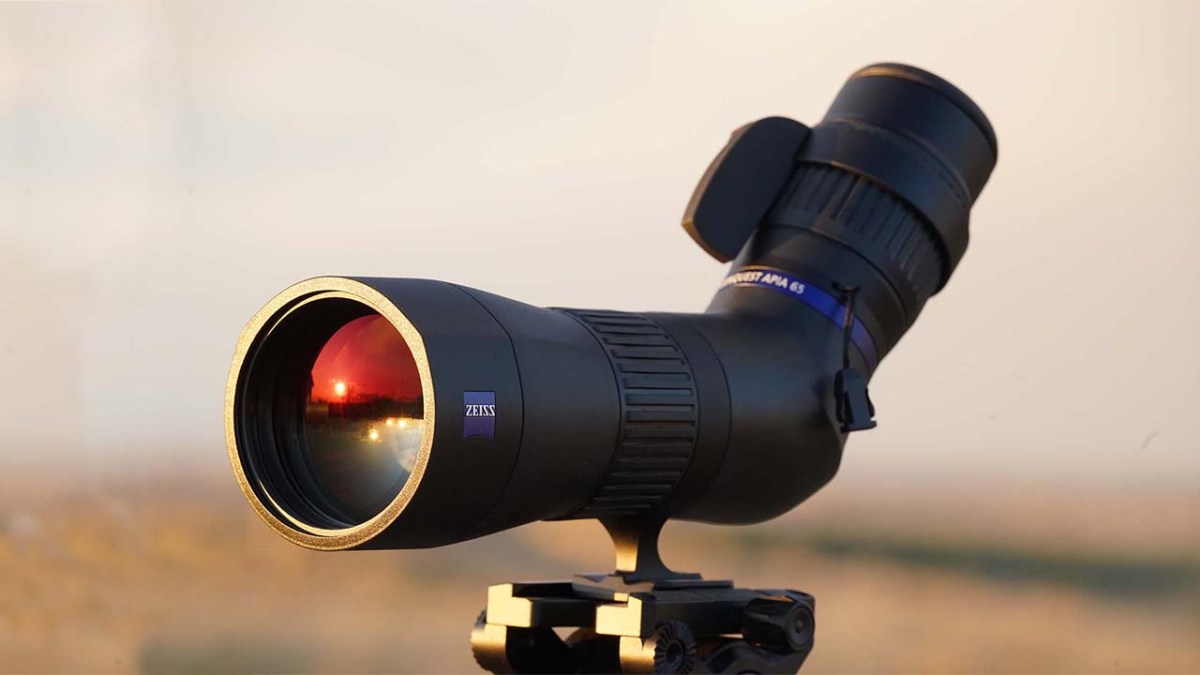

Zeiss, the venerable German optics brand, released a new spotting scope last week that demonstrates the company’s first-order optics and handling but with a significant twist: the semi-premium Conquest Apia spotter is made in China.
Unlike Zeiss’s most recent tilt to the East — the forgettable Terra line of binoculars and rifle scopes — the new Apia marries very good glass, responsive controls, and a lightweight, compact build that will appeal to backcountry hunters and serious travelers. Its $1,499 price fills a vacancy between premium — and pricey — European optics and price-point Asian products with disappointing performance. The Conquest Apia 20-50×65 will start showing up on big-box retailers’ shelves and in a wide range of other stores this month.
The Apia is more like Zeiss’s first “offshoring” effort, the original Conquest line of very capable optics that were designed in Germany but built mainly in Japan. Conquest rifle scopes and binoculars were similarly designed to appeal to hunters and shooters in that middle price range. The Apia shares the mannerly controls and good glass of its Conquest siblings. The question on my mind, before I handled the spotter: Would Zeiss be able to retain its reputation for consistent quality with a China-made product?
The Apia is the leading edge of a new era for Zeiss, which has been manufacturing precision optics since 1846, when Carl Zeiss opened a telescope repair shop in Jena, a pastoral German town that has become a crucible of optical innovation. Zeiss has expanded into high-tech semiconductors, nanotechnology, and digital imaging. The company’s sports optics division, which includes riflescope, binocular, and spotting scope production, represents a tiny fraction of Carl Zeiss’s global business, dominated by medical imaging and semiconductor manufacturing.
That helps explain why, in February, Zeiss announced that it was selling its “hunting and nature” division to palero (lower-case nomenclature is, maddeningly, intentional) a private equity group that invests in small to medium global companies that have been carved out of larger business units. More relevant to American hunters and shooters, the North American unit of palero will operate more independently of Zeiss’s German owners than at any time in the past century. That means you will see more American-oriented Zeiss-branded products on the market, says Brian Immel, Zeiss’s vice president for hunting, nature, and photo divisions in North America.
Buy From Midway USA
Buy From EuroOptic
Buy From Lancaster Archery
Key Features
-
Objective:
65mm -
Zoom Range:
20 to 50x -
Field of View:
144 – 81 ft at 1000 yards -
Weight:
3 pounds -
Price:
$1,500
Zeiss’s Pivot to China
While Zeiss’s corporate direction trends toward semiconductor manufacturing and medical imaging, conventional sports optics have been getting less internal investment and institutional prioritization over the past decade. That trend was confirmed by last year’s announcement that Zeiss’s Wetzlar facility, manufacturer of most of the company’s made-in-Germany riflescopes, binoculars, and spotting scopes, will cease production in 2026.
Under February’s agreement, expected to be effective this fall, palero will license Zeiss’s brand and technology but will be an autonomous company free of the overburden of an $11 billion global company for whom binoculars are a rounding error. For Zeiss, the spin-off of its hunting line of optics insulates the larger company from any reputational damage that could fall out from the use of its products in the blood sports.
The main goal, says Kyle Brown, director of marketing and products in North America, is for Zeiss under palero to become more nimble and competitive in every category of the sports optics business. That will be the conventional optics business for now, but likely to grow into electo-optics and digital optics platforms.
“Please don’t read into these press releases that Zeiss is getting out of the sports optics business,” Brown told a group of journalists this month. “We’re getting deeper into it, in both the conventional and the digital product lines. We have built equity over the past eight or nine years that proves that we know what we’re talking about and how to improve the trajectory of the North American market. Now we have to prove that to the new ownership.”
Zeiss Halts German Manufacturing
American hunters and shooters should expect to see a quickened cadence of Zeiss product introductions, but significantly none going forward will be made in Germany. They won’t be made in Portugal or the Czech Republic, either, two European Union states where many optics brands have opened factories that have lower production costs than Germany.
Brown said the new Conquest Apia, introduced today, is a good example of the new direction of Zeiss’s North American energy. Lower production costs, high quality expectations, and an appealing price for workaday hunters and shooters. Those are the same attributes that define Zeiss’s very good line of Pro Series tripods and optics supports, which launched last year. The MAX DUTY tripods, in particular, are among the best precision-shooting supports on the market.
Testing the Conquest Apia
As a conventionalist with a deep appreciation for the heritage and enduring value of Europe’s blue-blood optics, I faintly want Zeiss to stumble into this reinvention. But as a customer with strong allegiance to the brand’s performance standards, I winced at the introduction of the Terra line in 2013 as an unfortunate one-off, a cheap imitation that traded on Zeiss’s brand equity. While you can still find Terras on the market (optics snobs took to calling it “Terra-ble”), the disappointment was short-lived and doesn’t seem to have done enduring damage to Zeiss’s brand.
So, how does the Apia land between those polarized expectations of a Zeiss product’s performance and as an expression of a middle way.
The result is solid, and satisfying for a brand believer. The Conquest Apia has very good glass, not as bright or as crisp as Zeiss’s flagship SCHOTT glass, but on par with premium Japanese scopes. Its mid-barrel focus control is tight and precise, and its angled eyepiece magnification control is glove-grabbing large. The spotter ships with a smart and useful throw lever that simply screw-tightens onto the eyepiece and gives users the ability to make huge power changes quickly.
Its foot is compatible with ARCA-Swiss tripod heads, and its snug sunshade retracts over its 65mm lens. This is a well-proportioned compact spotter, measuring only 11.7 inches long and weighing under three pounds, that fits easily in backpack pockets or under the flap of a fanny pack. Its magnification range is useful, though it could have topped out at 45x and been just as good.
But it’s relatively easy to deliver svelte controls and a trim package with tight production tolerances. What really matters with compact spotters is their glass. Their mid-sized objective lenses aren’t big enough to pass abundant light, as big 80 and 85mm spotters often do to compensate for sub-par glass. But their magnification is so high that images from even premium scopes can appear especially dark in low light and grainy at higher powers. Here’s why: the exit pupil of a 20-50×65 spotter ranges from 3.25 to a puny 1.3mm between its lowest and highest magnifications. A 20-60x85mm spotter, in comparison, delivers exit pupils ranging between 4.5 and 1.4mm. That difference doesn’t matter so much in bright daylight but it can degrade images at higher magnification, and the degradation is especially noticeable at first and last light.
The Apia is no Harpia or Gavia, Zeiss’s German-made flagship spotters, but it’s better than most $1,000-plus scopes on the market in rendering color and resolving details. It delivers crisp, vibrant images at mid-day shooting ranges and while observing wildlife in decent light conditions. It delivers a dark and flat image in low-light conditions, about on par with its 65mm peers. But overall, its operation and image adequately answers that question I brought to the conversation about Apia: Zeiss has found a very good vendor in China that can deliver the quality a customer expects of the brand.
An interesting and useful feature of the Apia is its removable eyepiece. The eyepiece-to-body connection is a typical bayonet mount with a stainless-steel stud in the receiver that snaps into a recess on the eyepiece, making a decent lock that’s released with the press of a thumb latch. Zeiss plans to bring additional eyepieces to the platform, including 18-power versions with milling reticles in the field of view that will be boon companions for shooters, whether at the range or in competitions.
And Zeiss has previewed an accessory that’s expected to be available in the fall: an all-metal phone adapter that fits all brands of phones and connects via a strong magnet to the eyepiece of the scope. Zeiss has had earlier disappointing entries into the digiscoping world, but this new model is tough, adaptable, and smart enough to break into the American market. The smartphone adapter and eyepiece adapter are expected to sell together for about $250 later this year.
It’s an example of a cadence of introductions that should quicken later this year and into 2027, says Immel.
“This [corporate] transition should be invisible to consumers and dealers, but what should be visible is faster, more frequent product development,” he says. “You’ll see more products like the Apia. And you’ll see product extensions come in fast. The pace from Zeiss will be quite high.”
Read the full article here