I Raised 3 Kids Alone in the Heart of Wolf Country. These Are the Tough Lessons We Had to Learn

This story, “The Wolves Were the Worst,” appeared in the June 1967 issue of Outdoor Life. In her previous story in the May 1967 issue, Olive Fredrickson told of being left a widow at 26 on a homestead on the Stuart River in British Columbia with three young children to support when Walter Reamer, her trapper-husband, drowned; she told of hunting moose when success or failure meant food or hunger for her family; and she told of walking 58 miles in 36 hours, in the snow and cold of February, to get groceries on credit. Here, she tells of further adventures with moose and two hair-raising encounters with wolves.
Things went about the same the second summer after I lost my husband. That spring I had plowed 50 acres of land for our neighbor, Jack Hamilton. My two little girls, Olive and Vala, were six and five now, and Louis, the baby, was past two. The girls cleared and burned brush for Hamilton, and we all picked strawberries and raspberries for Joel Hammond. another neighbor. We got jobs putting up hay and digging potatoes and finally earned enough money to buy a cow. We had lots of milk and butter after that. I also bought 30 hens, and we had all the eggs we wanted. Vegetables and wild fruit were plentiful. I sold potatoes and garden stuff to pay for the other groceries we needed. Things looked bright for us Reamers — all three kids as healthy as young deer and just about as lively. I even built a wood shed and split the roof shakes out of blocks I cut with a crosscut saw myself.
Two summers later I traded two cows and a calf for a team of horses, wild and ornery as mules. But once we got them tamed down, they made a good work team. Land clearing and the rest of the work went a lot smoother after that.
Olive and Vala had started school by the second fall, in spite of a three-mile walk along the Stuart River each way. When it came time to kill a moose for our winter’s meat, I knew exactly what to do, or at least I thought I did. Leaving the three kids in the house late one afternoon as a cold drizzle came down, I paddled our big 30-foot dugout quietly up the river. At the mouth of Bear Creek I spotted a huge bull standing in the water.
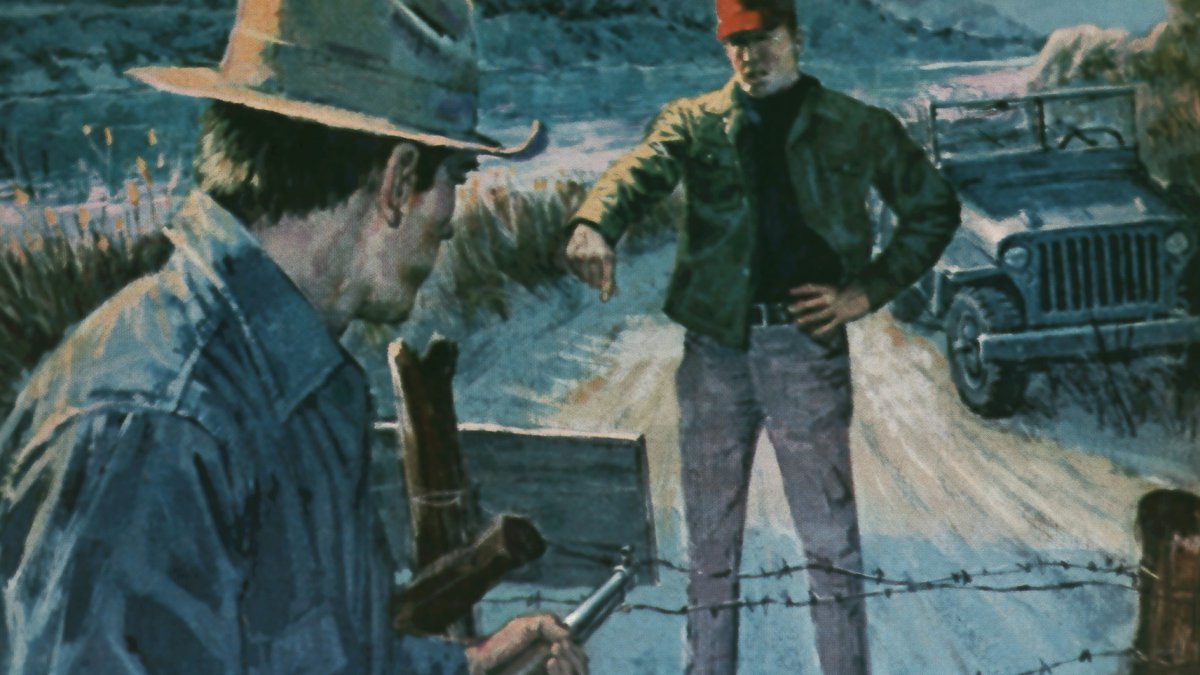
I had to stand up in the canoe to see enough of him to shoot. My rifle was a .30/30 Winchester Model 94, and I wondered what would happen when it went off. It didn’t kick much, but that heavy, Indian-made dugout would tip over if you breathed on it real hard. I finally pulled the trigger anyway, and the moose fell like a ton of bricks. Somewhat to my surprise, the canoe stayed right side up. But when I paddled to where the moose had dropped, he wasn’t there. I noticed a streak of blood leading up from the water toward the timber, and the next thing I knew a wild-eyed and ugly moose was looking down at me from the top of the bank 30 feet away.
I dropped the paddle and grabbed the rifle, but before I could get the sights on him he lifted his nose in the air and let out the worst groaning noise I ever heard. It made every hair on my head stand on end. I shot too soon, through some thick willows, and missed him. He whirled and ran, and the next I saw of him he was going along a hillside at very long range. I aimed the .30/30 about two feet over his shoulder and touched it off. He bunched himself up but kept going.
He lifted his nose in the air and let out the worst groaning noise I ever heard. It made every hair on my head stand on end.
The moose left a good blood trail, but by then it was raining hard and getting dark, so I quit and went home. The next morning I put Chum, our big dog, on the track, and he found my moose dead not far from where I had turned back the night before. He had been hit pretty well, one bullet high in the shoulder, the other above a kidney and up into his ribs. The second hit was probably an accident. At least I never did anything like it again at that range, but accident or not, I was well satisfied with my shooting.
Before we left the Stuart, I had two more moose experiences that I’ll never forget. Leaving the children at home one morning in May, I climbed on Shorty, one of our workhorses, and rode six miles to an abandoned hay meadow where a man by the name of Jim Fedderly had once lived. We called it Fedderly’s Meadow. Nobody had cut the hay for many years, and I thought we might cut and stack it to help out with our winter feeding.
I rode about five miles and pulled my horse up while I looked at some flowers beside the trail. I started to climb off and had one foot out of the stirrup when Shorty suddenly threw up his head and blasted out a frightened snort. Then I heard a strange noise almost like a growl behind us. I looked over my shoulder, and not more than 15 feet away stood a cow moose, her ears flattened back against her neck and her hair all standing up. I had never seen an animal look meaner.
She lunged for us as I heaved myself back into the saddle, and the horse jumped so hard he almost threw me off. He didn’t quite get clear. The cow clouted him on the hips with her forefeet, hard enough to drive his hindquarters almost to the ground, but the blow didn’t do him any serious damage. When we were out of range, I looked back and saw a newborn moose calf, still wet, lying where the cow had started her rush.
The next day I rode back to scout out a road into the hay meadow. I tied Shorty where he could graze on bluejoint, and sat down at the edge of the timber to rest. Pretty soon I heard a moose snort on the far side of the meadow. I knew the sound would spook Shorty after what had happened the day before, so I untied him and climbed back into the saddle in a hurry.
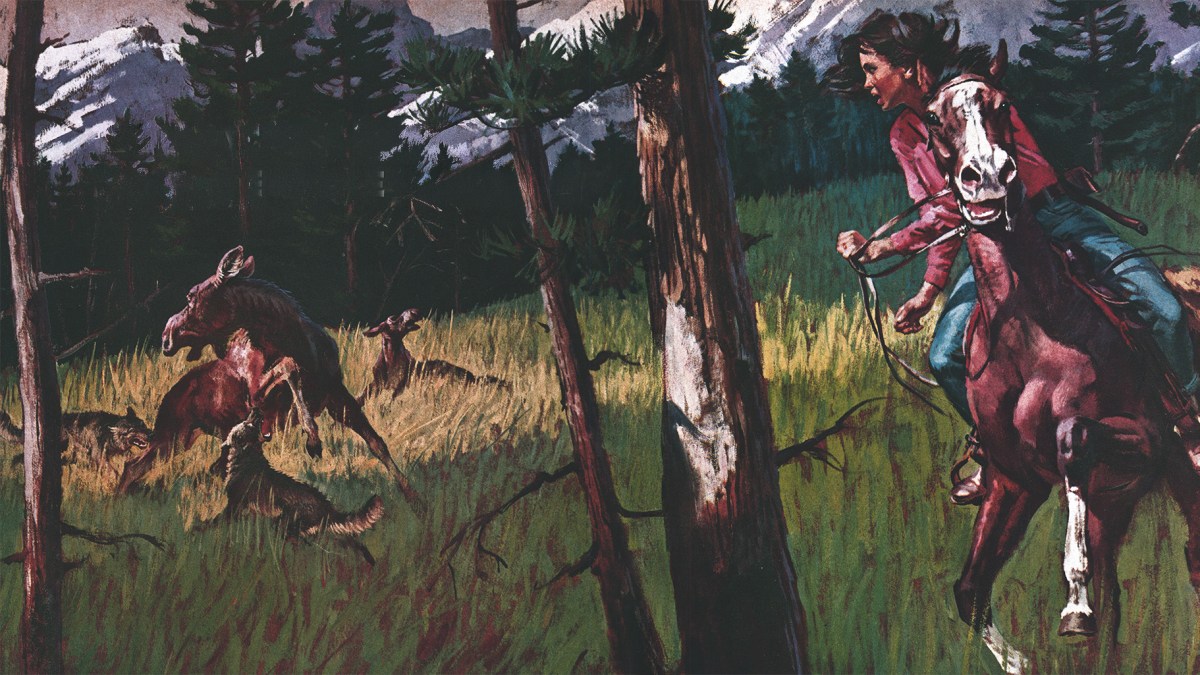
By that time my horse was crow-hopping and prancing like a purebred stallion, and when I looked across the meadow again, I saw a cow moose and her calf come running out of the brush, with two big timber wolves after them. One wolf snapped and lunged in front of the cow, just out of reach of her front feet, and while I watched, helpless, the other wolf went after the calf, hamstrung it with one bite, and pulled it down. Then it turned its attention to the cow, diving in and grabbing her by the hind legs.
My blood was boiling. I did my best to force Shorty across the meadow and break the thing up, but he’d have none of that. He pranced and waltzed the other way, and I began to shout to scare the wolves off. They ran into the brush, and I rode a circle around the two moose, yelling at the top of my lungs, hoping to spook those two gray devils out of the neighborhood.
Then I hit for home to get a gun. I didn’t have to urge Shorty. He did his level best the whole way. I suppose he thought the moose and the wolves were both after him.
I drank a glass of milk while Olive and Vala put my saddle on Ben, our other horse. Then I loaded the Winchester and rode back to Fedderly’s Meadow as fast as the fresh horse could go. But I’d been gone in all.
While I was still in the timber, I heard the cow moose blow her nose. I tied Ben and ran as fast and quietly as I could to the edge of the open field, and it’s hard to put into words the sight that met my eyes.
I tied Ben and ran as fast and quietly as I could to the edge of the open field, and it’s hard to put into words the sight that met my eyes.
That poor cow was still fighting for her calf, but there wasn’t much fight left in her. Her entrails were torn half out and were dragging on the ground as she turned this way and that, trying to trample the wolves with her front feet. But she was too near death to move fast enough. The hamstrung calf still lay off to one side, helpless, where I had seen it last.
The cow’s hind legs failed, and she went down on her haunches while I was sneaking from tree to tree to get within good shooting range. I wanted to be sure of hitting something when I shot.
When I reached an opening where I could see everything, one wolf was lapping blood at the cow’s flank, and the other was actually sitting on her hindquarters, his big red tongue lolling out from exertion. I was so furious while I made the last few yards of my stalk that I gritted my teeth until they hurt.
I drew a bead on the wolf that was sitting on the moose, and when the rifle cracked, he flew up in the air as if a bomb had hit him. My shot tore his whole back out just behind the shoulders, and he was dead when he hit the ground.
The second one didn’t know where the shot had come from, and he made a bad mistake: he ran straight toward me. I kept my sights on him and let him come until he swerved, 200 feet away, to streak for the brush. My shot cut across his chest, blew a good hole in him, and broke both front legs. At that I had to follow his blood trail for 400 feet through rose brambles and scrub trees. He was still trying to crawl off. But because he was almost dead, I let him suffer and saved the one shell I had left for the cow moose. After I had taken care of her, I put the calf out of its misery with my belt ax.
For a woman who dislikes killing things, I’d had quite a day. But I never felt the slightest regret where those two wolves were concerned. I made a vow: from that day on I’d shoot any wolf I could that I laid eyes on.
I hate wolves. I’ve seen a lot of their work since, on caribou, deer, and moose, and I’m convinced they kill for fun as well as for food. They run and play their victims as renegade dogs do sheep. I’ve known them to feed fully on a kill, leave it to pull down the next animal they came to, and go on without feeding. If they run across a bunch of deer or caribou, they don’t even take time to finish a kill. They pull it down, disable it, and go after another and another until they get tired. If there are one or two old wolves in the pack, with poor teeth, they’ll stay with the first kill, eat all they want, and then catch up with the rest. Every now and then the pack turns on those decrepit old-timers, too, and tears them to bits. You don’t often catch an old or crippled timber wolf in a trap, and I doubt if any ever died of old age.
I have no use for wolves, as I said, and of all the deviltry I have known them to be guilty of, none of it has haunted me down through the years more than the savagery of that pair in Fedderly’s Meadow on that spring day. A while after that, a pack of wolves gave me a fright that did nothing to endear them to me.
The years passed quickly, and one fall we sold five tons of potatoes at $2 a hundredweight. We had real money for the first time. Then the man who hauled the potatoes to a gold-mining company at Germansen Landing, 150 miles north of our place on the Stuart, brought back word that the mining camp wanted to hire a woman cook and would pay good wages.
We hated to leave the homestead, for we’d come to love everything about it by that time. But I knew the work would be easier than farming and the pay better, and Louis and the girls would have other people around them, even kids of their own ages to play with. So we sold some of the stock, left the rest with a neighbor, and got ready to move to Germansen Landing. But on the morning we were to leave, Vala came down with whooping cough, and a day later Olive and Louis also were sick with it. I sent a message to the boss of the camp, explaining the delay, but unfortunately he never got it. I presumed the job would still be open when I could get there. It was a month later, on October 25, before the children were well enough to travel.
The kids slept soundly that night, but I lay awake, worried that grizzlies might find our little camp.
We got a ride north, but the truck developed bad brakes, and the ride got so precarious that when we got along as far as a desolate place called Groundhog, 35 miles from our destination — it wasn’t even a wide spot in the road, just woods and mountains in the middle of a big burnthe driver dropped us off with our outfit, a loaf of bread, and three cans of beans, to wait for a second truck that would be along the next morning. He didn’t want to risk taking us any farther, brakeless, so he clattered off by himself.
We had a tent and a small ax, and there was plenty of dry firewood in the burn. I got the tent up all right, but I had been sick, along with the children, and had a touch of pleurisy. Chopping wood was a painful chore, but I had no choice, for t1J.e snow was six inches deep and the weather cold. The kids slept soundly that night, but I lay awake, worried that grizzlies might find our little camp.
No truck came the next day nor the day after. One went by going the wrong way, toward Fort St. James, and I flagged it down and told the driver we were nearly out of food. He left us more bread and a little canned stuff.
When we did not see another vehicle by noon the next day, we rolled our bedding and the tent, I put them on my back, and we trudged off on foot. But the kids were still weak from their sickness, and we made poor time. When night overtook us, we went on for an hour or two by moonlight, but the children played out, so I chopped some spruce branches and laid out the bedding. The night was clear, and I didn’t bother with the tent. Dry wood was plentiful again, and I sat up beside the fire and fed it until the first gray hint of daylight began to show. Then I roused Olive, Vala, and Louis. We ate what food we had left and started on.
We hadn’t walked 10 minutes when a timber wolf up on the mountain to one side of us howled. Another answered from the other side, and then there seemed to be wolves howling all around us. It wasn’t more than another five minutes before I saw two shadows slinking along through the brush only a short way off the road, keeping pace with us. Then I caught a glimpse of another behind us.
Shivers ran up and down my spine, and I wished fervently that we had stayed beside our fire until full daylight. We’d have to keep on and hope the wolves wouldn’t muster enough nerve to close in on us. All I could think of was the way I had seen those two go after that cow moose in the meadow. I had the .30/30 and was ready for them, but I didn’t dare use the rifle unless I had to, for fear shooting might provoke an attack.
We walked a mile and a half, and my blood ran cold every minute. Every now and then I’d get a glimpse of a shadowy form in the brush to one side, or I’d see a wolf lope across the road back of us, furtive and sinister. I was desperate with fear, and finally I told the kids I was going to use the rifle the next chance I got. But still I held off, afraid of the consequences.
The morning brightened slowly, and it seemed full daylight would never come. But at last it did, and then the wolves were gone. I didn’t see them leave; they just melted out of sight and weren’t around us anymore short distance farther on we found the explanation. New tracks showed that three caribou had crossed the road, heading east toward the Wolverine Mountains.
The wolves had picked up the caribou scent before reaching the tracks, and they had taken off as hounds do after a rabbit. Off to the right of the road, their tracks covered those of the caribou. Wolves and caribou were going at a full run.
I counted the sign, and there were seven in the pack. I shuddered to think of the horrid death that awaited the caribou when those seven wolves caught up to them, but I couldn’t help being thankful that they had pulled the pack away from the children and me. I guess in a wolf’s book caribou are safer game than a woman and three kids.
In all the years I have lived in the mountains of British Columbia, where wolves are still fairly numerous, I have never known of an authenticated case of an actual wolf attack on humans. That’s more than I can say for either bears or cougars, incidentally. But it is fairly common for a wolf pack to follow people as they did us that morning, and if they are made bold by hunger, they’ll crowd in within 30 or 40 feet. So far as I’m concerned, that’s too close.
Maybe we were in no real danger from those seven that skulked along after us for that mile and a half, but being trailed in that fashion is a hair-raising experience, and I’ve never been more frightened in my life. Years ago, a newspaper editor in eastern Canada who didn’t think wolves were dangerous coined the phrase, “Any man that says he’s been et by a wolf is a liar.” I guess that’s true, but even if they don’t hurt you they can sure scare you to death. That early-morning encounter is just one more reason why I don’t like them.
Arriving at the mining camp, I discovered the cook’s job filled. The Chinese cook who had been hired, when we failed to show up on time and the boss did not get my message, was a good one and couldn’t very well be dismissed to make room for me. So there we were, stranded in a mining camp with everything back at the homestead disposed of. We were all tired out from the trip north, and I was so discouraged I could have cried my eyes out.
The boss of the camp put us up in an empty house. The first night, mice played tag across the beds and all over the floor. But the next morning things looked better. We were staked to firewood and the supplies we needed, and I was offered a job doing washings for the miners.
Being trailed in that fashion is a hair-raising experience, and I’ve never been more frightened in my life.
I accepted the job, and we cleaned the house up and made it livable. The rest of the winter I washed clothes on a washboard every day, with the girls helping. We stayed on there until the gold camp dosed the following fall, and by that time I had enough of a stake to go to Prince George, where I got work. That all happened a good many years ago, but I still recall in vivid detail the scare those wolves gave us that cold morning, and I still hate those darned
wolves.
While I’m on the subject, I might as well say that I’m not fond of eagles, either. They’re about as merciless as wolves with anything they can handle. They are rough on fawns and moose calves, as well as partridge, ducks, and geese. My present husband and I once saw a pair of eagles even make a successful attack on a yearling buck mule deer.
We were on a fishing-and-camping trip on the Stuart River, years after I had moved away from the homestead. As we rounded a bend in our boat, we saw two eagles swooping down, one after the other, on the deer at the water’s edge. They must have surprised the deer while it was drinking and stunned it with the first blow they struck so that it could not fight them off. The buck ran this way and that, stumbling to its knees, backing into brush and logs, rearing on its hind legs to strike out with its forefeet, but never could connect.
John rowed as hard as he could, hoping to break up the attack, but before we could get within shooting range, the deer went down in the mud with both eagles on top of it. John rammed the boat ashore, grabbed his rifle, and ran along the bank. The birds flew off but were reluctant to leave and lit in a tree nearby. John shot one eagle, and then the other cleared out. He killed that one, too, the next morning. When we got to the deer, its head was torn and bloody. It was holding its neck at a twisted angle and seemed too dazed to see us. It was badly hurt and exhausted. We carried it to the boat, took it back to our camp, and nursed it as you would a pet lamb. We kept the deer for two days and two nights before it recovered. It showed no fear of us all that time. But finally, when John hit a dry tree a good hard whack with the ax as he cut the evening’s firewood, the buck suddenly seemed to remember that it was a wild animal and bounded out of sight in the brush.
That was a very unusual incident, for the buck was an average-size yearling. It’s extremely rare for eagles to attack a full-grown deer, of course, but this pair must have caught their victim unawares, and when we came along they were certainly intent on killing him. I never had liked eagles, and after that I liked them even less.
Neither eagles nor wolves, however, had anything to do with the hardest blow we suffered in those years. We had the sad misfortune to lose Louis when he contracted spinal meningitis not many years after he started school. Aside from that, looking back on my life of hardship and struggle on the Stuart, I can only say that everything turned out at least as well as I hoped, maybe better. Olive and Vala grew into pretty, fun-loving young women and made happy marriages when the time came.
It was shortly after Olive married an airline captain, while I was working in Prince George, that I met a big, gentle, soft-spoken man named John Fredrickson. Big John, his friends called him, and it fitted him to a T. Things got to a point where I couldn’t dance with him without seeing stars, and after a year we were married.
The years since I married John have been very good indeed. He and I both love hunting, fishing, camping, prospecting, hiking — anything that has to do with the outdoors. We also love the back country of northern British Columbia, and we have made some fine trips into it.
Read Next: I Raised 3 Kids Alone in the Wilderness. Surviving Bear and Moose Attacks Was (Almost) Routine
We’re in our 60’s now, living in a pleasant house in Vanderhoof. And when we kill a moose — we get one every fall — it’s because we want to and not purely a matter of necessity.
But those early years at the homestead, when I hunted from a cumbersome Indian dugout, knowing our winter meals depended on my luck and skill, weren’t half bad when I stop to think about it.
Read the full article here