
This story, “Encounters with Diamondbacks,” appeared in the March 1970 issue of Outdoor Life.
It has been close to 70 years since I heard Henrietta Manigault say calmly, “He often rattled at my baby.” But I remember it as vividly as if it had happened yesterday.
Henrietta was talking about a diamondback rattlesnake eight feet four inches in length. The circumstances would have chilled most people to the bone, but she was unruffled when she told me about it.
I had heard that Henrietta had killed a great diamondback in her yard. I had the habit of investigating every exciting wildlife story that came to me, and I also had a good riding horse, so I was soon in the saddle and on my way to get the full story.
It was a seven-mile ride. The house was humble but immaculately clean. I found Henrietta rocking in a chair on the front porch, singing softly to herself. As I entered the yard I saw a little dog lying dead at the corner of the house. About 20 feet from the front steps was an old pine stump. Between it and the steps was a monstrous dead diamondback.
Henrietta greeted me with a casual, “I thought you’d be a-comin’.” She knew my interests.
“You killed that?” I asked, pointing to the snake.
“Yes, sir,” she said, still casual.
“Tell me about it.”
“Well, my little dog, he started it. He went to the stump and began to bark down that hole under it. Every time the snake struck at him, he’d jump back. I got tired of that, so I went over to my brother’s house. I told him to bring his gun and shoot the snake. He shot down the hole, but my brother, he never could shoot, and he missed. When the dog heard the gun go off, he thought the snake was dead, but he made a mistake. That’s why he’s lying dead now by the corner of the house. I got me a hoe and dug the snake out and killed him.”
“But Henrietta,” I protested, “do you mean to tell me you knew that thing had a den right here in your yard?”
It was then she said with no show of fear, “I sure did. He often rattled at my baby.”
I still think that was a classic example of poise and composure.
I measured the rattler carefully. He was eight feet four inches long, and I judged his weight to be about 18 pounds. The strike of such a snake together with the terror of the experience could knock a grown man down. Since earliest boyhood I have had the privilege (or misfortune) of frequent encounters with diamondbacks.
Henrietta’s snake was among the early ones.
They’re impressive serpents, known to grow to a length of nine feet. Though exceeded in length by the terrible bushmaster of Latin America, the Eastern diamondback is the heaviest of all the venomous snakes of the Western Hemisphere. It is also one of the deadliest in all the world, almost as much to be feared as the king cobra of Asia or the tiger snake of Australia.
Read Next: Our Professor Gives Extra Credit for Catching Live Rattlesnakes. That’s How We Stumbled into a Snake Den
For some reason, perhaps because of favorable conditions and an abundant supply of cottontail rabbits and other food, the diamondbacks of the low country along the South Carolina coast, where I have dealt with them all my life, seem to attain a greater length and weight than those of any other area I know about.
It is wild country, but there is ample evidence that it was once cleared and plowed. Stately homes have become ruins, old cemeteries with their crumbling brick tombs are scattered here and there, countless huge stumps show where the lumbermen passed. Those places all make ideal homes for the diamondbacks, and that is probably another reason why they thrive. It is gruesome, but one of the very best places to find them is a long-deserted cemetery.
The largest one I have ever seen was over nine feet long. At the time, I was living not far from McClellanville near the mouth of the Santee River north of Charleston. A farmer and woodsman by the name of Claude Marlowe lived about four miles from my place. Word came to me one day that he had killed an exceptional diamondback in his cotton field. I was not too surprised. The neighborhood had an evil reputation for snakes.
I drove to Claude’s home in a buggy. He was standing by the gate as though he expected me.
“I want you to see what I run across this morning,” he said. “He made so ugly at me I had to shoot his head off.”
Claude took me about 50 yards into his cotton field.
There in a sandy row lay a rattlesnake bigger than any other I had ever seen. I took hold of the rattler and stretched him out full length, and it was easy to see that he was more than eight feet long.
“Arch, do you want it?” Claude asked me.
I did. I put the snake in the buggy and drove into McClellanville, where my older brother lived. He was an engineer, and I wanted him to do the measuring.
I drove into his yard and called him out, asking him to bring his steel tape. He was an experienced woodsman, but he was unprepared for what I showed him.
We stretched the snake out in the sandy road, and as the steel tape ran out, my brother gave a low whistle and I heard him mutter, “I don’t believe it.”
That diamondback was eight feet, 11¾ inches long, even without his head. His length alive had been over nine feet. So far as I know, he was the biggest ever measured. My friend Raymond Ditmars, long one of the country’s foremost authorities on reptiles, recorded one from Florida eight feet eight inches long and another eight feet six inches. Those are commonly regarded as maximum diamondback lengths.
I think it’s no wonder that the Seminole name for this terrible snake means The Great King.
Later I mentioned Claude Marlowe’s rattler in a magazine article, and shortly after it appeared a letter came to me from Ross Allen, who operates a widely known reptile institute at Silver Springs, Florida.
“I’ll pay you $200 if you can get me a live nine-foot diamondback,” Ross wrote.
I called in one of my lifelong friends. I read Allen’s letter to him and then said, “Steve, if you can catch a rattler that long, I’ll give you half the money. Here’s your chance to make $100.”
For a few seconds Steve was buried in thought. Then he very quietly asked a question I have never forgotten: “Cap’n, don’t you think some things are not meant to be caught alive?”
I agreed. I had taken a good many diamondbacks, and I knew the almost unbelievable strength of their heavy, muscular bodies.
Like every other wild creature, the diamondback has his enemies. Man stands first. Wild hogs kill a good many diamondbacks. Deer kill them by leaping on them with all four feet bunched together. I have com2 upon several snakes killed that way, and the signs were unmistakable. The tracks of sharp hoofs were printed deep in the sand all around the dead rattlers.
Read Next: 7 Ways Not To Die From A Rattlesnake Bite
The kingsnake is an inveterate enemy of the diamondback but probably never attacks a really big one. Another major enemy is forest fire, worst if it happens in the winter when the snakes are in hibernation. The fire eats into a pine stump and deep into the roots. If a dormant rattler is curled up underneath the stump, he is doomed.
Large fish and certain birds such as hawks, owls, and eagles carry off small rattlesnakes and feed on them. I have seen a swallowtail kite on the wing pick up a small rattler and soar away with him.
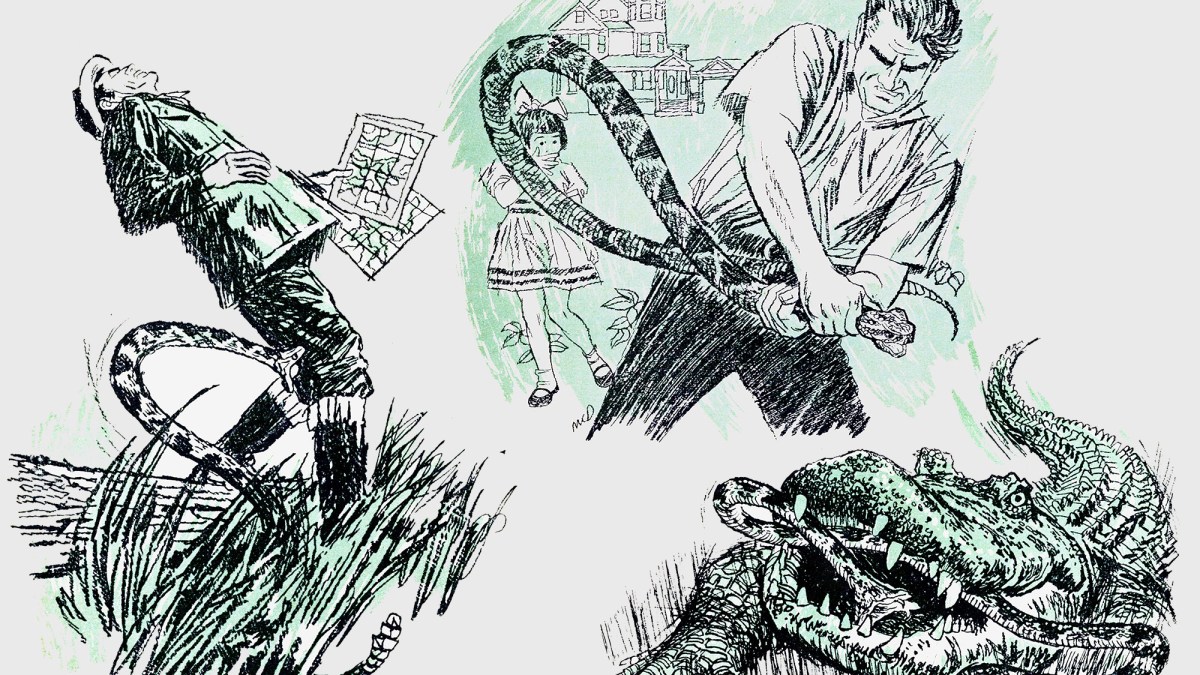
An alligator will take on the biggest diamondback, on land or in the water. While I was walking through short marsh grass one day, I came upon a 12-foot bull alligator that had just tackled a big rattler.
The snake was fighting furiously. The gator gaped his jaws open as if to shift his grip, and instantly the diamondback buried its fangs in his tongue with a lightning-fast stab. That tongue must have been a tender target, and a dose of venom there might have been expected to have serious consequences, but if the alligator felt the strike, he didn’t show it at the time.
Some reptiles, including many snakes, have a high degree of immunity to rattler venom, and that was probably true of the gator. When I came close, he crawled ponderously off toward a nearby river with the snake festooning his jaws. They disappeared under the water together, and that was the end of the diamondback. What may have happened to the gator later on I never learned, but I doubt he suffered any ill effects.
Another time I witnessed a curious performance in a pond, one that introduced me to a new and totally unexpected enemy of this big rattlesnake.
I was fishing from a small boat. The pond was supposed to be fresh, but it was near a river only seven miles from the ocean and the water was brackish. Sea crabs had entered the pond through a drain that connected it with the river.
I saw a big diamondback swimming across the pond, and when he came near my boat I could see that he was in trouble. Something beneath him was trying to pull him down. He reared his head repeatedly and struck viciously at something in the water alongside him.
When he got close enough I saw that five or six crabs were tearing his belly open. They could get at the snake, but the water protected them. Big as he was, he simply could not fight them off. It was not long before they pulled him out of sight.
In my many encounters with diamondbacks, I have found that the females are far more aggressive than the males. I still recall a six-foot female that I kept in a box with a screen top after a battle royal to get her into it. I wanted to study her ways, and for a start I put a live rat into the box. He ran around the sides, and the snake watched him with crafty deliberation until she had him exactly where she wanted him. Her strike was a blur of movement, and the rat fell dead on his back without even struggling.
The most tragic rattler experience of my life happened many years ago. A young timber estimator came to see me. His company had bought a tract of longleaf pine near my place, and he wanted me to show him the property.
We came to a grassy savanna where a huge old pine had fallen. My companion stepped up on the log and walked the length of it, studying the trees around us. I followed him.
Read Next: The Best First Aid Kits of 2026
He reached the end of the log, stepped down, and collapsed on the ground without so much as an outcry. I ran to him, and as I caught him under the arms, I heard the dry, chilling buzz of a rattler.
I dragged the lumberman back and propped him against the trunk of a pine. His eyes were closed, his head drooped, and he did not speak.
I left him for a minute or two and killed the snake. It was a seven-footer, as wicked a snake as I had ever tackled. I did away with it, and hurried back to the victim. He was dead. The whole affair had taken less than 10 minutes.
I learned later that as the young timber cruiser stepped off the log the snake buried its fangs in his femoral artery just behind and above the left knee. The terrible jolt of venom injected directly into his bloodstream killed him almost as quickly as a lightning bolt.
Another time, two friends came to I see me, bringing their little five-year- old daughter. After the parents had toured my ancient home, they were tired and wanted to rest, so I offered to walk the child through the camellia garden. I had laid it out with brick paths. Here and there, unused bricks were heaped in piles.
We were walking hand-in-hand past one of the piles when I saw something move at the top of it, only three feet away. A heavy-bodied diamond-back lay there, half hidden among the loose bricks, its head and neck reared in the death-dealings from which the snake delivers its strike.
The thing happened far faster than I can tell it. I didn’t pause to think what I was doing. I acted by instinct. I shot out my right hand and caught the brute from behind, just below the jaws. In a fraction of a second I had my left hand around his neck, along-side the right.
He fought and whipped in blind rage, his whole body like one long powerful muscle. For a minute or two it was a grim battle. Then I heard a dull snap and he went limp in my grasp. He had broken his own neck by thrashing. That is something professional snake hunters must guard against when they want to catch big rattlers alive. The instant they pin one with a snake hook, they grip it behind the jaws with one hand, drop the hook, and pinion the body with the other hand to prevent violent whipping. Otherwise the snake is almost certain to die of a broken neck as my snake did.
That diamondback had just shed his skin, and his colors were clean and new. My little guest’s reaction was a delighted, “Isn’t he pretty!”
I took her mind off the episode during the rest of our walk, and I never· told her parents what had happened.
Anybody who has dealt with rattlesnakes knows that even a dead one can be dangerous. The severed head of a rattler is still capable of biting and embedding the fangs deeply, though it cannot strike, of course.
We had that lesson driven home forcibly in our town many summers ago. A group of boys killed a diamondback, carried it out of the woods, and began to play with it, tossing it back and forth. As one boy reached out to catch it, the fangs snagged him in the hand. He spent months in a Charleston hospital and escaped death narrowly. One of the diamondbacks I remember best was a seven-footer I killed in a sawdust pile.
We found him on a sunny day in March when he had just come out of hibernation. That, incidentally, is a time when you are very likely to come across these snakes.
My foreman Will and his brother Prince were roaming the woods to see if they could pick up some wild-turkey sign. I was sitting by the fireplace in the house when the door opened and Will stuck his head in. I knew from his face that he had Big News.
“Turkeys?” I asked.
“Rattlesnake,” he replied, shaking his head.
“Big one. I almost stepped on him. He got back in his den, but I left Prince to watch the hole. We can dig him out.”
He got two hoes, I got my .22, and we went back to the scene. The hole went down into an old sawdust pile. Will and Prince went to work with the hoes. I waited with the rifle.
It was easy digging in the sawdust. After about 10 minutes, we heard a muffled rattle, deep underground. A minute later it sounded more clearly, and we knew the snake had decided to come out.
Then the flat, evil-looking head appeared at the mouth of the hole, black-forked tongue flicking in and out, while the dull buzz of the rattle sounded incessantly. Behind the head the body came slithering slowly forth, thick and heavy, fold on fold.
When it was all over, that snake measured seven feet five inches, and it takes quite a long time for that much diamondback to emerge from a place of that kind. I thought he’d never get through coming. He had just shed his skin, and there was a deadly beauty about him — a beauty to make the blood run cold. When he was all out of the hole, I ended things by drilling him through the head with a bullet from the .22. That was many years ago, but the picture of the slow and ominous way he crawled forth is clear in my mind to the present day.
Diamondbacks have struck at me several times but I was never hurt, thanks to the precautions I have always taken in snake country. All my life, I have avoided snaky places whenever I could. If I had to enter a danger zone, however, I wore leather boots that came up over my knees and heavy flannel or corduroy trousers outside the boots. The thick cloth and boots together always kept the fangs out of my legs.
Only once did a rattler ever make good a strike at me. That time I got a light dose of venom in the back of my left hand. Fortunately it was a shallow bite from a small snake. It gave me a bad time for an hour or two, and I still carry the scars of the incisions· I made to drain the venom. The hand bothered me for two weeks, but I got off easier than I expected.
I knew a young squirrel hunter who was struck on the back of a hand by a diamondback when he reached into brush to retrieve a squirrel. Panic got the best of him, and he did the worst thing possible. He ran all the way home, a distance of three miles, and was dead before a doctor could reach him.
One of the great dangers in rattlesnake bite is hysteria. In our country, even people who have been struck by non-venomous snakes have actually been known to die of fright.
What may prove to be my last encounter with a diamondback — I’m 85 now — occurred a few years ago while I was attempting the restoration of my old plantation home.
I was spending the nights in McClellanville, eight miles away. Late one August afternoon, as I drove the two miles down the sandy road that leads from my gate to the main highway, I saw something stretched across the road from wheel track to wheel track and almost a foot beyond on both sides.
Related: The Top 10 Venomous Snakes You Might Encounter on a Hunting Trip
Killing him by driving over him on pavement would have been easy, but I knew it wouldn’t work on the soft sand unless I could skid the rear wheels at the right instant and pin him down.
I was so fascinated by his size, however, that I failed to tromp on the brake just when I needed to. I felt the bump as the wheels went over him, but when I got out of the car, there was no snake in sight.
It sometimes happens that a snake run over that way gets caught under the car. Right then I remembered an acquaintance who had driven into his yard after such an encounter.
He stopped and got out, but he leaped back horrified when the rattler dropped to the ground and came crawling out. It was my ticklish job to kneel down and peer under the car to see if my run-over snake was lurking there. I saw nothing, so I walked around the car in the hope of picking up his broad track in the sand.
Sure enough, it was there. The track crossed a shallow ditch and then led into a low growth of gallberry bushes. Should I be sensible and drive on, or should I follow him into the bushes and try to rid the countryside of a very dangerous snake, I asked myself. I finally decided to go after him.
I armed myself with a long pole and then probed and tapped with it to locate him. For some he did not. rattle, infuriated as he must have been after having been run over. My first warning came when I saw him coiled up close to my left leg.
At such a time, nature gives a man a shot of adrenaline. I must have had a big one, for I made a standing broad jump of about 10 feet.
Once in the clear, I cut a tough hickory shoot long enough for what I had in mind. Then I went cautiously back. He was still in his coil, neck arched, with his head a foot off the ground, tongue flicking out, a grim picture of sudden death. And now he rattled.
I got where I wanted to be and lashed him hard across the neck with my hickory whip. A couple of blows were all it took. He uncoiled, writhed and stretched out full length. I had broken his neck. I prodded him to make sure he was dead, dragged him to the car, and put him in the trunk.
I had a friend in McClellanville who had often teased me about my stories of big diamondbacks. I drove into his yard and sounded the horn. It was dark by then. He turned on a floodlight and came out.
Read Next: The Last Time I Saw My Friend Alive, He Told Me About the Black Bears Getting into His Garbage
I opened the trunk, picked the snake up by the neck and held him as high as I could. His rattles still brushed the ground.
My friend couldn’t have summed up his feelings any better. He touched the rattler gingerly and shook his head. “The man who killed that thing is a liar,” he declared.
Read the full article here