My Secret Guide to the Legendary Catskill Streams Where American Dry Fly Fishing Was Born


This story, “Charmed Circle of the Catskills,” appeared in the March 1969 issue of Outdoor Life.
“Sonny you’ve caught a German brown trout.”
The way the big man strode over from the porch of Sheely’s Hotel scared me. Maybe catching a “German” trout was against the law; maybe I’d have to put the fish back. A dismal thought to a small boy with pounding heart and bursting pride.
The big fellow was joined by two men who came out of the tap room. “Mighty nice fish, boy,” one of them said, wiping the froth from a handlebar moustache. “Look at that belly — shaped like a shad. Probably go a pound.”
I let out my breath with a whoosh.
The year was 1910; the stream, Rondout Creek; the locale, Lackawack, New York. A recent graduate of “sunfish prep” at nearby Honk Lake, I had just caught my first trout — a milestone in any young angler’s life.
What a break for me, starting my fishing career in what I call the Charmed Circle. Within a radius of 50 miles, such celebrated streams as the Esopus, Schoharie, Neversink, Willowemoc, the Beaver Kill, and the East and West branches of the Delaware wind down from Catskill peaks. These topdrawer streams — birthplace of dry-fly fishing in America bailiwick of talented fly-tyers, and proving grounds for custom-rod makers — have lured fishermen from all corners of the world to the Charmed Circle for more than half a century.
I call this region charmed because its fine fishing in wild, forested settings has survived even though it is within a day’s drive of one-sixth of the total population of the United States and Canada. The Charmed Circle has not only survived in the face of outdoor-hungry hordes, superhighways, floods, hurricanes, New York City’s expanding water system, and even U.S. Supreme Court decisions, but it also offers a whole new generation of fishermen a taste of angling as it used to be.
The story of the Charmed Circle is touched with a mystical quality, trademark of the Catskills since the days of Rip Van Winkle. For me, the enchantment began the day I caught that brown trout.
When I was growing up, our family lived at Napanoch on the Rondout, about 75 miles from Manhattan’s skyscrapers. My father was a country doctor, and we shared many horse-and-buggy journeys. My favorite trips were up the Rondout Valley. When Father would say, “Tomorrow we’re going to Sundown,” I would scamper down to Farrington’s Livery Stable for a supply cf worms. Izaak Walton extolled the virtues of cow-dung worms, but I found that the equine variety were pretty darned good too. I liked to go along with my father because the mountain folks knew the things that were close to the heart of a young boy. While father treated his patients, I learned to shoot a .22 rifle and set a muskrat trap. And I was let in on the best fishing holes.
“That pole and winder sure work slick as a mink,” the boys exclaimed when they saw my “store tackle” — actually my father’s Abbey & Imbrie fly rod and Hawkeye reel, both of which eventually became mine through what lawyers call “adverse possession.”
At dinner one day, father said quietly, “We are moving upstate to Auburn next month.” This news really shook me. Although I found that the Finger Lakes country opened up new outdoor worlds to me, memories of Catskill trout streams lingered. I had no way of knowing that the Napanoch days were just the first installment in the serial of my attachment to the Charmed Circle.
Some 30 years later, in 1946, the Rondout and all the other famous streams in the Charmed Circle became part of my beat as a fisheries biologist for the New York State Conservation Department. Then I began to find out what made the great streams tick. I measured flows, recorded temperatures, rated riffs and pools, and took readings on fish-food production. In estimating fish populations with an electro-fishing device, I got to know many of the trout by their first names.
I also got to know some of them on the business end of a line. Roy Steenrod — conservation officer, fellow worker, and friend — showed me how to cast a dry fly, and other tricks of the trade. Roy is 86 years young and still eager to talk fishing at the drop of a hackle feather.
During the years I’d spent upstate, a new chapter had been written in the Charmed Circle story. When I left Napanoch, there were no New York City reservoirs west of the Hudson; when I returned, Ashokan and Schoharie had been in operation for many years, Rondout and Neversink were under construction, and Pepacton and Cannonsville were just coming off the drawing board.
Part of my fascinating job was to make pre-impoundment and post-impoundment studies. I say fascinating not only because of my boyhood memories but also because of the challenges created by the face-lifting changes.
Schoharie Creek was dammed, forming Schoharie Reservoir. Engineering genius reversed the stream’s natural flow, sending millions of gallons of water through the Shandaken Tunnel and emptying it into the Esopus at the Allaben Portal. This extra water changed the Esopus from a spritely mountain brook to a brawling, bullying stream.
The Neversink impoundment swallowed up some of the best fishing sections on that stream.
The East Branch, the West Branch, and part of the main Delaware River became Jekyll-Hydes when cold-water releases below the new dams transformed bass habitat into trout environment. The Beaver Kill and the Willowemoc are now the only major trout streams in the Charmed Circle that remain free-flowing from source to mouth.
As for my first love, the Rondout, a short cast from the spot where I caught my first trout stands the Merriman Dam, which submerged the stream to Lowes Corner.
A pleasant byproduct of my job of evaluating the changes was learning all over again where to fish on the Rondout and the other Charmed Circle streams. Fortunately there is still some open water, part of it controlled by New York City. Fishing is allowed on most city-owned waters to holders of permits issued without charge by the New York City Department of Water Supply, Gas and Electricity at most boroughs and upstate field offices.
On Rondout Creek, though there is some trout fishing just below Merriman Dam, most of the trout water is above the reservoir. In searching out good fishing spots, I found old friends. The late Fred Eck, who had been a patient of my father’s, tipped me off to a good stretch.
“You remember where you used to fish across from my place,” he told me. “Go downstream a hoot ‘n’ holler toward the old ball field. If you ‘re kind of careful fishing under those banks, you might tie into a real lunker.”
I never found a Junker. Rondout fishing, in fact, is no great shakes these days, but my memories are a powerful magnet that keep me coming back.
Above the hamlet of Sundown, still as unspoiled as when I was a boy, brook trout are dominant. A mile of open water flows through land recently acquired by the state and earmarked for a public campsite. On the state-forest land below Peekamoose is another mile of open water. Here bottom rocks are covered with a lush growth of green algae. I’ve taken many a spill on those “greased cannonballs,” as my field crew called them. As a fisheries biologist I learned to think in terms of stream systems, not just the main stem. This thinking has paid off. Rondout tributaries that have yielded unexpected dividends to me are Chestnut Creek, west of Grahamsville; Sugarloaf, north from Lowes Corner; the East Branch; and Bear Hole and Stone Cabin brooks on state-forest land. When I fish the headwaters of the Rondout, I often continue on the road past Peekamoose, dropping down to the Esopus Creek watershed. Off Route 28A, at Five Arch Bridge, a path on New York City property leads to the Chimney Hole, on the Esopus at the head of Ashokan Reservoir. Chimney Hole is a legendary spot where browns and rainbows in the large economy size are frequently taken.
Years ago, when I compiled the Conservation Department’s first official list of record New York State fish, I discovered that the biggest brown had come from the Chimney Hole. Caught by T. F. Spenser in 1923, this 19-pound 14-ounce whopper held the record for 31 years and is still a cracker-barrel topic in this neck of the woods.
From the Chimney Hole to the Allaben Portal, the Esopus fluctuates with the needs of thirsty New Yorkers. To fish the stream when the water is running full pipe is to live dangerously.
The Esopus is big-league stuff. It’s a favorite of my longtime associate William Goodman, assistant director for law enforcement and field services in the State Conservation Department. Aware of my close bond with the Rondout, Bill ribs me this way: “The Rondout is just a ministream. For sissies. The Esopus separates the men from the boys.”
Bill should know — he used to be head of the department’s law-enforcement office in that region. To add to his authority, he learned his fly-fishing at the knee of George M. La Branche, champion tournament caster, skillful angler, charming gentleman, fascinating writer. La Branche wrote The Dry Fly and Fast Water, which tells how he adapted English chalk-stream methods to American conditions.
“George was a perfectionist,” says Bill. “He’d watch my every cast like a hawk, and if he spotted a sloppy one he’d shout, ‘Dammit, I showed you how to do that right last week!’”
The Esopus, because it was more accessible, became the first trout capital of the Charmed Circle. Phoenicia is its nerve center — the place to get the latest piscatorial intelligence.
Phoenicia is also the birthplace of one of the most seductive dry flies. In 1917 Thomas Mills of the New York tackle shop William Mills & Son, established in 1822, was staying at the old Kincaid House with his son Chester and Hiram Leonard, pioneer rod builder.
Stephen Mills, now at the firm’s helm, recalls the story this way: “The men were relaxing after a day’s fishing, and the talk got around to the new fly patterns. In the middle of the discussion, Tom and Chester left the group. When they came back they had a brand-new fly, the Fanwing Royal Coachman. My father often says that 90 percent of the trout he caught were taken on the Fanwing.”
The Esopus was also where the dry-fly rod was born. The time was ripe: here was a great trout stream and here were expert dry-fly fishermen, including the topnotch custom-rod makers Hiram Leonard and Ed and Jim Payne.
Jim Payne and Roy Steenrod, with Roy’s inseparable fishing buddies A. E. Hendrickson and George Stevenson, were fishing the Esopus. Roy, blessed with total recall of Charmed Circle happenings, recounts:
“It was back in the spring of 1918. We were on the porch at Susie Winchell’s Four Maples at Coldbrook, talking rods and how they should have more pep. A. E. spoke up and said he had a salmon rod that might be right. We tried it, but it was too much rod.
“Then we tried using its second joint and the tip, and we decided that was much better than the rods we were using. Jim Payne said, ‘I can make a better rod than that.’ And he did. He made a rod for each of us and used different-colored silk on the windings so we could tell them apart. I still have my rod.”
Roy remembers that the first rods were nine feet long and weighed about six ounces.
“There was a lot more water in those days,” he says, “so a longer rod helped to reach out. And very often we were into rainbows of 18 and 20 inches. Jim made a good many rods after that, changing the action to meet the water, the fish, and the fisherman’s ideas. We tried out and used a great number of Payne rods over the years, but we feel quite sure that our talk that day was the real start of a wonderful rod.”
The Esopus still offers good fishing in spite of fluctuating flows, droughts, floods, and heavy fishing pressure.
In 1950 the Esopus was hit by a fall hurricane. Bridges were washed out, stream banks cut back, and houses swept away. Pools were filled with shifting gravel, the bottom was scoured, and fish and fish forage were destroyed. And then, six months later, another flood hit the valley. A new record was set at the U.S. Gauging Station at Coldbrook — 59,500 cubic feet per second, as contrasted with the stream’s minimum flow, 9.3 c.f.s.!
I had 20 years’ experience in evaluating stream ecology to back me up, so I did not hesitate to stick my professional neck out and say, “No stream can take this.” My crew, fellow fishermen, and favorite bartenders were in agreement that this was the end of the Esopus.
By coincidence, a fisheries survey had been made just prior to the 1950 storm. To get a before-and-after picture, another survey was made the following summer. I was astounded to find insect life already coming back. Electro-fishing checks actually showed an increase in yearling browns and rainbows! No dethroned heavyweight ever made a more spectacular comeback.
A few years later big rainbows and browns were again thrilling Esopus fishermen.
Lawrence Decker, a veteran Esopus angler who favors minnows for bait, is not likely to forget an April day in 1955 on the Mother Pool. For openers, he creeled a 20-inch brown and lost a huge rainbow when the hook pulled out.
He went back to the head of the pool. On the second cast, made at about 2:30, he had a smashing strike. The fish refused to show, but Decker knew he had a big one on. For an hour or so he played the fish up and down the pool, his rod bending almost double.
To add to his problems, a crowd of kibitzing fishermen gathered, making wild swipes with their nets. Eventually, however, all the kibitzers except one diehard retired to the bank, where they were joined by motorists who pulled off nearby Route 28 to watch the show. Decker estimates that 100 people were on the bank.
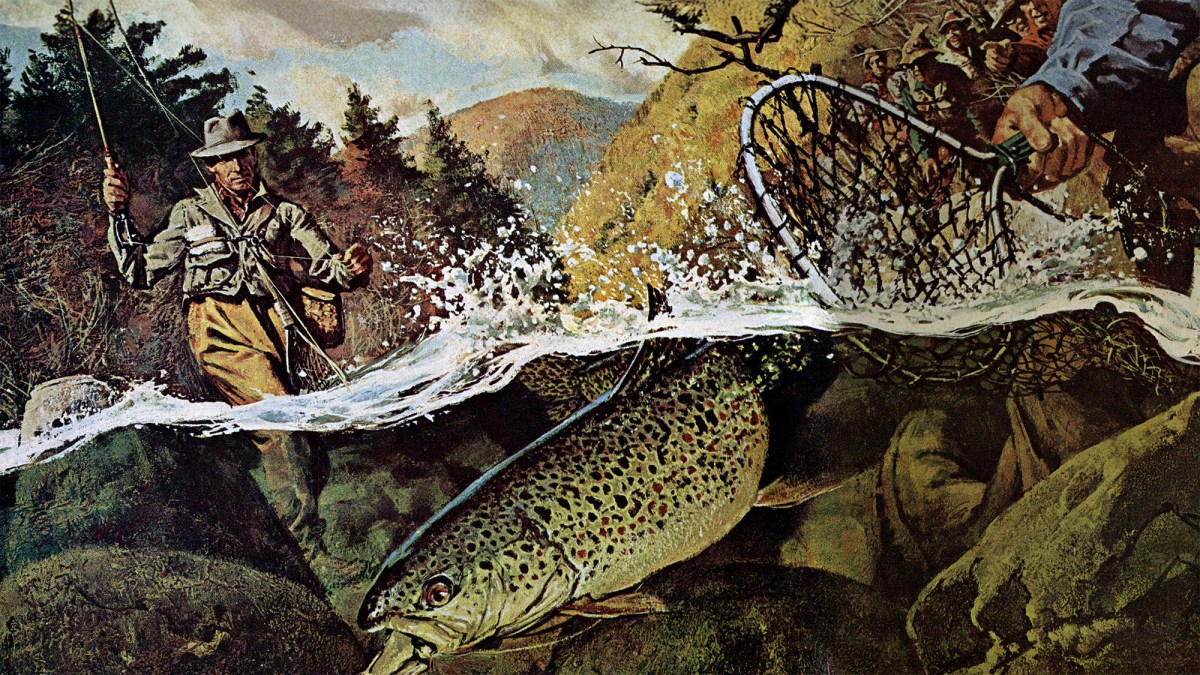
At 3:30 the trout was just about licked, but the self-appointed netter was still trying vainly to scoop it up. Finally Decker got his own net under the fish — a brown trout that measured 30¾, inches and weighed nine pounds 10 1/2 ounces!
Such sensational fishing doesn’t happen every day, but it does bring the loyal and hopeful Esopus clan back season after season.
Although flies are in common use there, the Esopus angler is not in disgrace if he uses other lures. That April day, Decker used a Jive minnow, an ancient and honorable method on this stream. To keep the bait down, Decker attaches seven BB shots. Not six. Not eight. Exactly seven. When the Esopus is running high, spinning lures often raise the success ratio. “Spinner Sanctum,” Bill Goodman calls the stream at those times.
When the Portal is discharging heavily, I fish the Esopus above the Portal. Or I work some of these feeders: Woodland Valley, above Phoenicia, where there is a state-owned public campsite; the Chichester or Stony Clove, north from Phoenicia; and the Beaver Kill and Little Beaver Kill. (Those last two streams should not be confused with the streams of the same name in the Delaware watershed.)
Characteristic of the Charmed Circle are the mountain roads leading from one great stream to another. A well-beaten trail of mine is Route 42 out of Shandaken, around the shoulder of Balsam Mountain, and into the Schoharie valley. Schoharie Creek rises in the highlands not far from the Hudson River. After flowing westerly for more than a dozen miles, it turns north at Lexington and heads toward the Mohawk River. At Prattsville, Gilboa Darn bottles up the Schoharie, and its flow is reversed and sent through an underground aqueduct to the Esopus.
Route 42 was formerly the shortest way for me to get to Art Flick’s West Kill Tavern Club. The Tavern is no more, but Art is — he lives on the streams in the spring and on the mountainsides in the fall when grouse are flying, or later when snowshoe hares are running.
Art is best known as the author of A Streamside Guide To The Naturals and Their Imitations. This book, bible not only of Charmed Circle anglers but also of fishermen everywhere, is now a collectors’ item.
Not so well known is the major role that Art played in getting public fishing rights on the Schoharie in the 1930’s, the first acquired in New York State. Public fishing rights are easements acquired by the Conservation Department through purchase or gift to provide permanent access to streams and fishing privileges. Art was a supersalesman for the idea and did much of the legwork in getting the program started. To date, 1,000 miles of rights have been acquired on 76 of the best trout streams in the state.
Art remembers the Schoharie before Gilboa Dam formed Schoharie Reservoir: “It was some stream in those days. Practically a pure culture of trout. Devasego Falls kept the darned bass down where they belonged. But just as soon as the reservoir filled and the falls were swallowed up, the bass really moved in.”
To keep more bass from migrating upstream, the Conservation Department built the Barrier Dam at Prattsville. But some bass had already become established above the dam. Art says, “The worst of it is that those bass aren’t worth catching. Even after six years they’re stunted little runts — none of them over 10 inches.”
Art got some action in this matter, too. The department put in special regulations allowing bass of any size and in any number to be taken by angling in the Schoharie and its tributaries above Barrier Dam from April 1 through November 30.
There are about 12 miles of public fishing rights, well marked by roadside signs, in the Schoharie system. Incidentally, public fishing rights, here and elsewhere, are seldom in solid blocks but rather are interspersed with privately owned sections, some of which are posted.
Near the Schoharie’s headwaters, close to Rip Van Winkle country, is North Lake State Public Campsite; Devil’s Tombstone, another state campsite, is four miles south of Hunter on Route 214. State campsites are good places for fishermen who like to camp out in tents.
In line with my bent for checking feeders, I’ve found good Schoharie bets to be: Batavia Kill, East Kill, and Gooseberry.
And Art Flick’s pride and joy, the West Kill. With a little nudging from Art, the Conservation Department got , a large-scale rehabilitation project going there. Result: long sections of rip-rapping between the villages of West Kill and Lexington to control erosion and stabilize the stream bed.
The willows around Spruceton were planted by Art and his son Bill.
“We had a rule,” said Art. time we fished up there, we’d willow.”
Oddly enough, I remember the Schoharie for what I didn’t catch there. Since the days of Dame Juliana Berners, who wrote the first book on fishing in the English language in 1496, every fisherman has been permitted the luxury of telling a one-that-got-away story. Here is mine.
I was on my favorite stretch of the Schoharie, the boulder section below Mosquito Point. A chilly May rain was falling — not enough to make a roil but enough to tickle things up a bit. I caught and released several nine-inchers. Then I bumbled a cast. The fly struck the top of a boulder, slid off, and disappeared instantly into the huge maw of a real buster. The line throbbed, giving me the unnerving sensation of being attached to an outboard motor.
My wife, who was reading in the car, looked up just as the action started. She jumped out, leaving the door open to the driving rain, and raced across the meadow to lend me a bit of moral support.
A fleeting look told me that the fish was a brown. A real sulker, boring deep to get back to his home under the boulder. A fisherman goes where the fish goes. But what do you do when he doesn’t go anywhere?
A quiet pool downstream was a natural place to lead him, but he was not to be led. I got above him, hoping to wear him out, but he was not to be worn out. I tried to horse him to shore, fully intending to give him the coup de grace with a flying tackle.
Just as I was making progress, the hook pulled out.
So it wouldn’t be a total loss, I drove a stake into the bank opposite the boulder where the bruiser hung out. I told Art Flick about the stake, hoping that his superior skill would pay off. Art raised the brown once, but that is all the cooperation he got.
Read the full article here