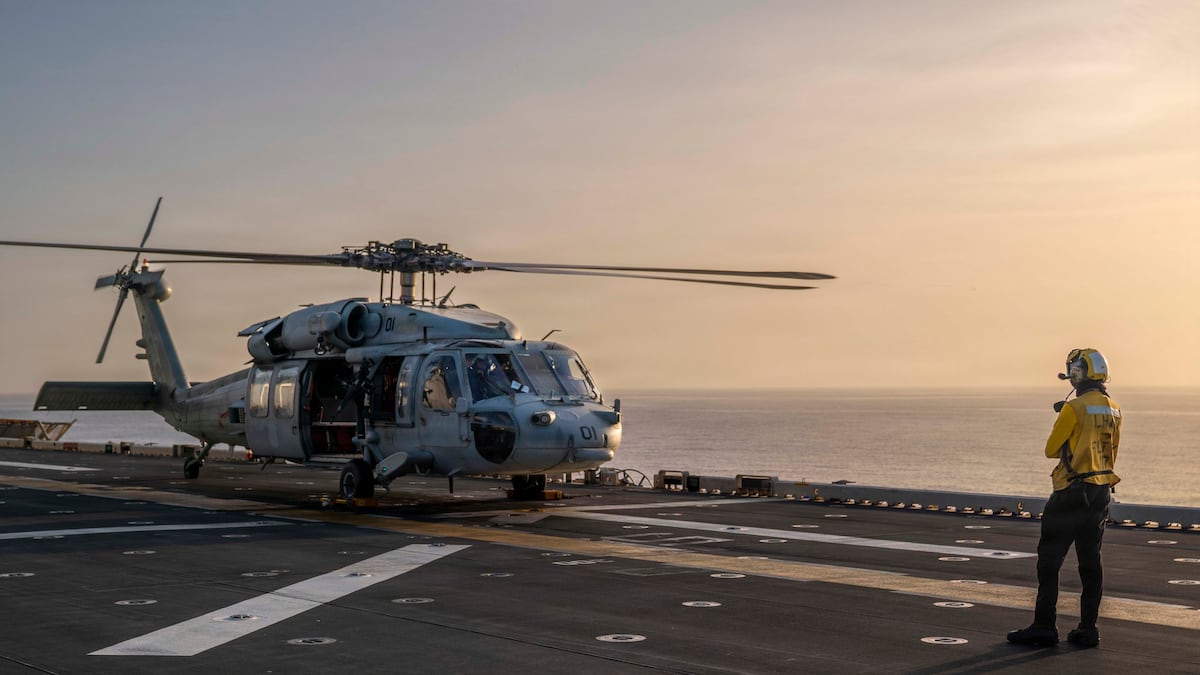

Surface warfare officers will soon assume command of all amphibious warships, bumping naval aviators from their previous positions as commanding officers, according to a Navy memo.
The April 24 directive, seen on Reddit and confirmed by the U.S. Navy, cites issues with amphibious ship readiness and operational availability as catalysts for removing naval aviators from their previous positions as commanding officers of specialized vessels that transport Marine Expeditionary Units.
“Given the challenges that reside with the amphibious fleet, the current major command construct underutilizes and fails to properly leverage the depth of mariner expertise resident in the SWO community,” the memo reads.
Starting in fiscal 2028, surface warfare officers will become the only officers authorized to command America-class and Wasp-class amphibious assault ships, San-Antonio-class amphibious transport dock ships, and Harpers Ferry-class and Whidbey Island-class dock landing ships.
The service said it has spent two years assessing the root causes of a dip in readiness for amphibious ships and that among the many improvements needed is time. The memo noted that it typically takes at least two years for an officer to begin to possesses the “exquisite knowledge” of an amphibious ship’s operational and maintenance procedures.
A defense official told Military Times in August 2025 that the readiness rate of amphibious ships had dropped to 41% despite the Marine Corps previously stating that the amphibious readiness rate needed to remain at 80% or higher to complete missions.
RELATED
The vice chief of naval operations, chief of naval personnel and naval reactors and lead surface type commander will help restructure amphibious major command by developing a timeline for the process to be completed and assessing any necessary changes to surface warfare officer billet structure.
The lead aviation type command will create a plan to shift command to SWOs and produce a review of how the change might affect the aviation community, providing potential solutions to any problems that may arise.
The Navy will leverage surface warfare officers’ career-long technical knowledge of amphibious operations and maintenance nuances to improve amphibious ship availability, according to Chief of Naval Operations Adm. Daryl Caudle, who provided an emailed statement to Military Times.
“This change enables commanding officers to stay in place longer in order to provide more command stability, focused oversight, and solution ownership required to drive measurable performance,” Caudle said.
Importantly, the Navy aviation community will experience no loss in major command opportunities, the CNO stressed, with the service reviewing the community’s “career pipelines to improve major command quality of assignment.”
Naval aviators will still be allowed to command aircraft carriers and submarine tenders, if nuclear trained, as well as expeditionary sea bases and amphibious command ships, the memo said.
The Navy holds an inventory of 32 amphibious warfare ships, but half of the fleet is in substandard condition and poorly maintained, according to a 2024 report from the U.S. Government Accountability Office.
Amphibious ships were at the forefront of discussion last week at the Modern Day Marine exposition in Washington.
Marine Corps Commandant Gen. Eric Smith both exalted the capabilities of the amphibious fleet while decrying the readiness issue that has plagued the ships.
Smith said the Marine Corps was attempting to mitigate the problem by optimizing maintenance schedules, buying new ships and investing in service life extensions, especially as U.S. combatant chiefs were requesting the support of more amphibious ready groups.
Riley Ceder is a reporter at Military Times, where he covers breaking news, criminal justice, investigations, and cyber. He previously worked as an investigative practicum student at The Washington Post, where he contributed to the Abused by the Badge investigation.
Read the full article here