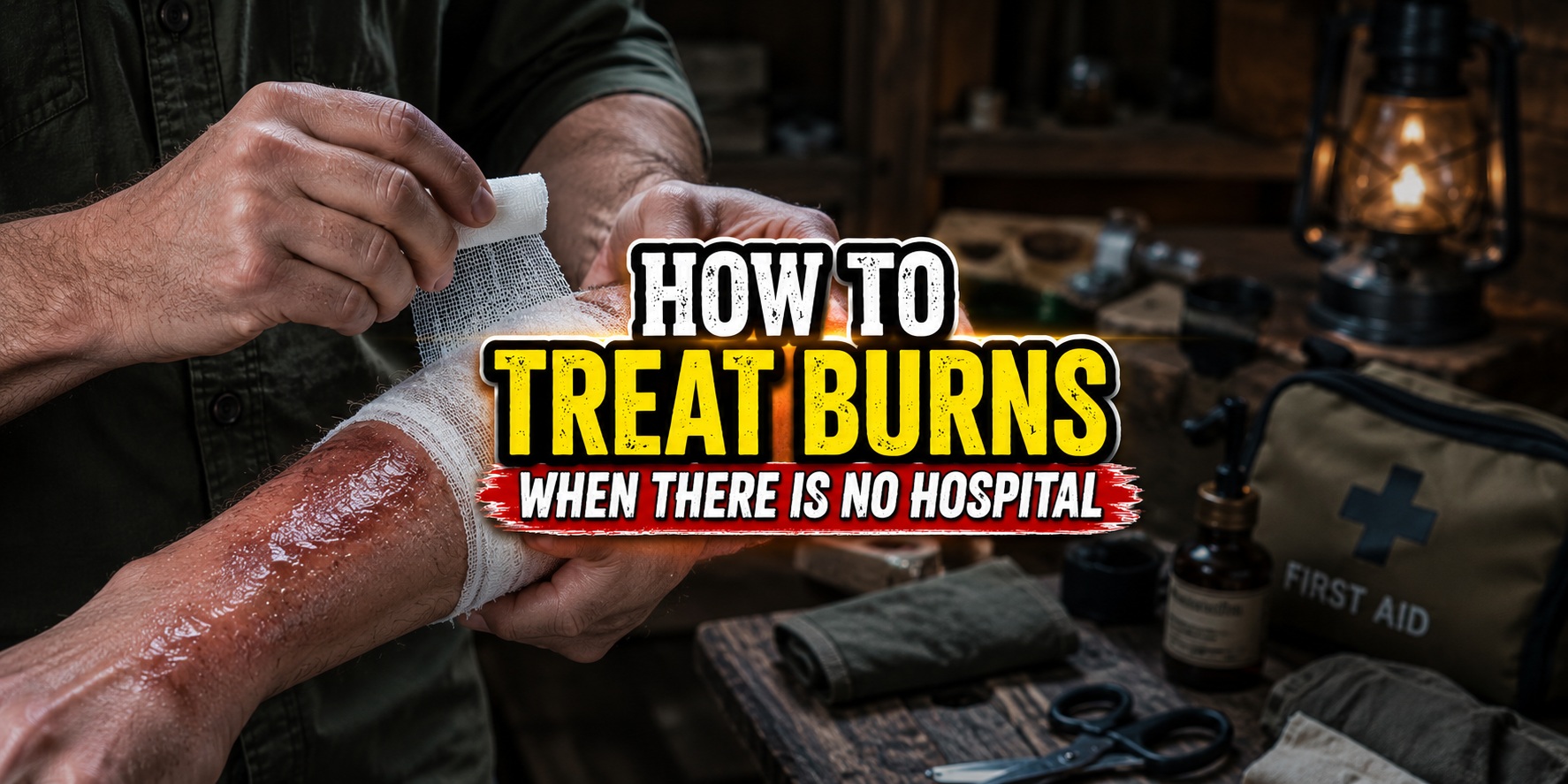

Burns are one of the most common serious injuries in any survival or grid-down scenario. Open fire cooking, camp stoves, improvised heating, chemical handling, and the general increase in manual labor that accompanies off-grid living all raise the risk significantly above what most people experience in normal modern life. And unlike a laceration or a sprain, a serious burn that is managed incorrectly does not just heal poorly. It becomes infected, it goes septic, and it kills.
The gap between what most people think they know about treating burns and what actually works in a field medicine context is wide. Most of the popular home remedies for burns, butter, toothpaste, ice, egg whites, are not just ineffective. They are actively dangerous in ways that become critical when no hospital is available to correct the damage they cause.
This guide covers burn treatment from the ground up: how to assess what you are dealing with, the correct immediate treatment protocol that field medics and wilderness medicine practitioners use, what to do in the days following a serious burn when infection risk peaks, and which herbal and natural remedies have genuine evidence behind them for burn healing. Read it now. Practice the protocol mentally. Have the supplies. Burns do not wait for you to look it up.
How to Assess Burn Severity: The Classification You Need to Know
Before you treat anything, you need to classify the burn correctly. Treatment decisions, supply requirements, infection risk, and the likelihood of survival without professional care all depend on burn depth and total body surface area involved.
- First-degree burns affect only the outermost layer of skin, the epidermis. The skin is red, painful, dry, and intact with no blistering. Sunburn is the most common example. First-degree burns are painful but heal reliably within three to five days with basic care. They do not produce significant infection risk and do not require the same urgency as deeper burns.
- Second-degree burns penetrate into the dermis layer beneath the epidermis. They are characterized by blistering, intense pain, wet or weeping appearance, and significant swelling. Superficial second-degree burns heal within two to three weeks if infection is prevented. Deep second-degree burns, which extend further into the dermis, take four to six weeks, are at significantly higher infection risk, and may produce permanent scarring. Second-degree burns are where field medicine management becomes genuinely critical.
- Third-degree burns destroy the full thickness of the skin, including nerve endings. They are paradoxically less painful than second-degree burns because the nerves have been destroyed. The burned area appears white, brown, black, or leathery and waxy. Third-degree burns cannot heal without skin grafting in a medical facility. In a true off-grid scenario, third-degree burns present a severe infection and fluid loss risk that is extremely difficult to manage without professional intervention. Survival depends on aggressive wound management and infection control while attempting to reach care.
Body surface area matters as much as depth. The Rule of Nines is the standard field assessment: each arm is nine percent of body surface area, each leg is 18 percent, the front torso is 18 percent, the back torso is 18 percent, the head is nine percent, and the groin is one percent. According to the American Burn Association, burns covering more than 20 percent of body surface area in adults, or 15 percent in children, represent major burns requiring aggressive fluid resuscitation that is extremely difficult to perform without medical equipment. Know these numbers before you need them.
Critical locations add urgency regardless of burn depth or area. Burns on the face, hands, feet, genitals, major joints, or that encircle a limb completely (circumferential burns) are significantly more dangerous and complex than burns of equivalent size elsewhere on the body. Facial burns suggest possible airway involvement, which is a life-threatening emergency.
Immediate Treatment: The First Ten Minutes
What you do in the first ten minutes after a burn occurs has more impact on the outcome than almost anything you do afterward. The correct immediate steps are simple, well-established, and very different from what most people instinctively do.
Cool the burn with cool running water immediately. Not cold water, not ice, not an ice pack. Cool water, between 59 and 77 degrees Fahrenheit, applied continuously for a minimum of twenty minutes. This is the single most important immediate intervention for a burn. Cooling arrests the ongoing tissue damage that continues after the heat source is removed, reduces pain significantly, and decreases the depth the burn ultimately reaches. Starting cooling within three minutes of the burn injury produces the best outcomes. Cooling started up to three hours after a burn still reduces damage, though the benefit decreases with time.
The twenty-minute duration is critical and frequently ignored. Most people cool a burn for two or three minutes and stop. The burn tissue continues conducting heat inward for far longer than it feels, and inadequate cooling time allows that heat to keep damaging deeper tissue after the immediate pain subsides. Set a timer. Do the full twenty minutes.
Remove jewelry, watches, and clothing from around the burned area immediately, before swelling begins. Swelling after a significant burn is rapid and severe. A ring on a burned hand can become a tourniquet within an hour of injury. Remove everything from the area as the first step, before even beginning the water cooling.
Do not apply anything to the burn during or immediately after cooling. No butter, no oil, no toothpaste, no egg white, no honey yet. Nothing. These substances trap heat in the tissue, introduce bacteria, and contaminate the wound in ways that complicate assessment and dramatically increase infection risk. The desire to apply something soothing is understandable but incorrect for the first twenty minutes.
After cooling is complete, cover the burn loosely with a clean, non-fluffy material. Cling film (plastic wrap) is the first-choice burn covering in emergency medicine precisely because it is clean, non-adherent, transparent for monitoring, and readily available. Lay it over the burn without wrapping it tightly. A clean plastic bag works for hand burns. In the absence of plastic wrap, a clean non-fluffy cloth or non-stick dressing is appropriate. Never use fluffy materials like cotton wool, regular towels, or adhesive bandages directly on a burn wound, as the fibers embed in the wound and cause severe pain and damage on removal.
What Not to Do: The Dangerous Myths That Make Burns Worse
This section may be the most important in the guide. The popular mythology around burn treatment contains several interventions that are not merely useless but actively worsen outcomes, particularly in the absence of hospital care to correct the damage.
Ice and ice packs cause frostbite on top of burn injury. The extreme cold of ice damages tissue that has already been damaged by heat, deepening the wound and extending the area of injury. The vasoconstriction ice causes also reduces blood flow to the area precisely when circulation is needed most for healing. Ice feels effective because it numbs pain aggressively, which is why the intuition to use it is so persistent. The pain relief is real. The tissue damage is also real.
Butter, oil, and any food-based fat should never be applied to a burn. Fats trap heat in the tissue, continuing the thermal damage after the heat source is removed. They also create an ideal growth medium for bacteria in a wound that is already highly vulnerable to infection. This is one of the oldest and most dangerous burn treatment myths across cultures worldwide.
Popping blisters intentionally removes the best wound covering nature provides. Intact blisters form a sterile, fluid-filled barrier over the damaged dermis that protects against infection and maintains the moist environment wounds need to heal. A burn blister that breaks on its own should be managed as an open wound. A blister that is deliberately popped has been converted from a protected wound into an open one with no benefit.
Toothpaste, egg white, and soy sauce are internet-era myths with no evidence behind them and documented cases of increased infection and scarring when applied to burns. The World Health Organization and burn care organizations globally identify home remedy application as one of the primary contributors to preventable burn complications in settings where hospital care is delayed.
Tight bandaging over a burn wound is dangerous. Swelling in burned tissue is rapid and significant. A bandage applied at a snug but comfortable tension at the time of dressing can become a constricting tourniquet within hours. All burn dressings must be applied loosely and monitored closely for increasing tightness as swelling develops.
Managing Second-Degree Burns Over Days and Weeks
A significant second-degree burn without access to hospital care requires daily wound management for two to six weeks. This is where preparation, supplies, and knowledge all converge. The goal is to keep the wound moist, clean, and protected from infection long enough for the body to rebuild the skin layers that were destroyed.
Daily wound cleaning is non-negotiable. Use clean water or a saline solution made from one teaspoon of non-iodized salt dissolved in one liter of boiled and cooled water. Gently irrigate the wound to remove debris, old dressing material, and any discharge. Do not scrub. Scrubbing disrupts the fragile new tissue forming at the wound edges and base and significantly increases healing time and scarring.
After cleaning, apply a non-adherent wound covering. Purpose-made non-stick dressings such as Telfa pads or petrolatum-impregnated gauze are the gold standard. In their absence, a very thin layer of plain white petroleum jelly applied directly to the wound surface before covering with clean gauze achieves the same non-adherent effect. The petroleum jelly prevents the gauze from bonding to the wound surface, which makes dressing changes possible without tearing away newly forming tissue.
Change dressings daily, or immediately if the dressing becomes saturated, dirty, or shows signs of infection. Each dressing change is an opportunity to assess the wound for healing progress and early infection signs. Wound inspection is not optional. Infection in a burn wound progresses rapidly, and catching it early is the difference between manageable and life-threatening.
Fluid intake must increase significantly after a major burn. Burned tissue loses fluid at a dramatically accelerated rate, and dehydration compounds every other aspect of the recovery. The Parkland Formula, used in hospital burn care for fluid resuscitation, calculates fluid needs based on burn area and body weight. For field reference: a significant burn requires roughly two to four times normal daily fluid intake. Push fluids aggressively and continuously in the first 24 to 48 hours after a major burn.
Pain management without pharmaceutical options is a genuine challenge in a grid-down burn scenario. Keeping the wound covered and moist reduces pain significantly compared to an exposed wound. Willow bark tea, which contains salicin, the precursor to aspirin, provides mild to moderate pain relief and anti-inflammatory activity. Valerian root can be used for its mild sedative effect to allow sleep. These are not equivalent to pharmaceutical analgesia, but they provide meaningful support in their absence.
Infection: The Burn Complication That Kills
In a hospital, burn infection is managed with systemic antibiotics, wound debridement, and in severe cases surgical intervention. Without those tools, burn wound infection is the most common cause of death from burns that were initially survivable. Learning to recognize it early and respond immediately is not optional knowledge.
Normal wound appearance during healing includes pink or red wound edges, clear to slightly yellow wound fluid (serous exudate), and gradual reduction in wound size as new skin forms from the edges inward. These are positive signs.
Early infection signs include increasing redness that spreads beyond the wound edge, warmth that extends beyond the wound margins, swelling that is increasing rather than decreasing after the first 48 hours, and wound discharge that changes from clear to cloudy, green, or foul-smelling. The wound may develop a grayish or greenish discoloration. The person may develop fever, increased heart rate, and general deterioration in wellbeing.
Systemic infection (sepsis) signs are the emergency within the emergency: high fever above 103 degrees Fahrenheit or paradoxically very low temperature, confusion or altered mental status, rapid heart rate, rapid breathing, and a sense of severe illness disproportionate to the visible wound. Burn sepsis without hospital-level intervention has a very high mortality rate.
In a grid-down scenario with no antibiotics, the response to early wound infection is aggressive wound irrigation, increasing the frequency of dressing changes, applying any available topical antimicrobials, and escalating the use of herbal antimicrobial preparations. Honey application becomes first-line treatment, not a supplementary option, once infection is suspected. Garlic preparations have documented activity against the organisms most commonly responsible for burn wound infection. According to the National Institutes of Health, Pseudomonas aeruginosa and Staphylococcus aureus are the primary bacterial culprits in burn wound infection, and both have demonstrated sensitivity to allicin, the active compound in garlic, in laboratory studies.
Raw Honey: The Most Evidence-Backed Natural Burn Treatment
Of all the natural remedies proposed for burn care, raw honey has the most substantial evidence base and the closest alignment with the requirements of field medicine burn management. It is not a folk remedy that happens to feel soothing. It is a clinically studied wound treatment with documented mechanisms of action that directly address the needs of a healing burn wound.
Honey maintains a moist wound environment, which clinical research has consistently shown accelerates wound healing compared to dry wound management. It is naturally non-adherent to wound tissue, meaning dressings incorporating honey can be removed without tearing newly forming skin. It has a pH of between 3.2 and 4.5, which is acidic enough to inhibit the growth of most wound pathogens. It produces low levels of hydrogen peroxide through enzymatic activity, providing sustained low-level antimicrobial action without the tissue toxicity of direct hydrogen peroxide application. And it contains defensins and other antimicrobial proteins that provide additional pathogen inhibition.
Manuka honey, produced from the nectar of the manuka tree in New Zealand and Australia, has the highest documented antimicrobial activity of any commercially available honey and has been the subject of the most burn and wound care research. It is rated by its Unique Manuka Factor (UMF) or methylglyoxal (MGO) content. UMF 10 or higher, or MGO 250 or higher, is the range used in wound care research. Standard raw local honey is also effective, though somewhat less potent in its antimicrobial activity than high-UMF manuka.
Application method: after wound cleaning, apply a thin layer of raw honey directly to the wound surface or to a clean gauze pad that is then applied to the wound. Cover with a secondary absorbent dressing and secure loosely. Change daily. Honey dressings for burns have been the subject of multiple randomized controlled trials, with a systematic review published in research indexed by the National Library of Medicine concluding that honey dressings reduced healing time and infection rates in superficial and partial thickness burns compared to conventional dressings.
Aloe Vera: First Aid for First-Degree and Superficial Burns
Aloe vera gel is the most widely used natural remedy for minor burns, and for first-degree and superficial second-degree burns it has genuine evidence behind it. Its active compounds include glucomannans, gibberellins, and acemannan, which promote wound healing through fibroblast stimulation and collagen synthesis. Aloe also has anti-inflammatory activity through inhibition of thromboxane B2 and prostaglandin production, and it maintains the moist wound environment that accelerates epithelial healing.
A meta-analysis published in peer-reviewed literature found that aloe vera gel reduced healing time in first and second-degree burns compared to silver sulfadiazine cream, which is a pharmaceutical standard for burn care. This is a meaningful comparison that puts aloe vera’s performance in clinical context rather than simply asserting that it helps.
For field use, fresh aloe vera gel from a freshly cut leaf is the most potent preparation. Split a thick aloe leaf lengthwise and scrape the clear inner gel directly onto the burn surface. Apply two to three times daily for first-degree burns. For superficial second-degree burns, aloe can be applied between honey dressing changes but should not replace the honey dressings, which provide better antimicrobial protection and wound environment management for deeper wounds.
Every homestead and prepper property should have at least one mature aloe vera plant growing in a pot that can be brought indoors in cold weather. It is a zero-maintenance plant that provides immediate first aid for burns, sunburn, minor skin wounds, and several other applications. This is one of the highest-value medicinal plants you can grow relative to the effort required.
Plantain Leaf: The Field Dressing Hiding in Plain Sight
Common plantain (Plantago major and Plantago lanceolata) grows as a weed in virtually every temperate climate lawn, field, and roadside. Its leaves contain allantoin, which promotes cell proliferation and tissue regeneration, aucubin, which has anti-inflammatory and antimicrobial activity, and mucilage, which soothes and protects damaged tissue surfaces. It is the field medicine burn and wound herb of the natural world: available without preparation anywhere it grows, applied directly, and effective for the immediate soothing and early protection of minor burns when nothing else is available.
Fresh plantain leaf poultice for a minor burn: crush or chew several fresh plantain leaves to release the juice and break down the cell structure, apply the mashed leaf material directly to the burn surface, and hold in place with a cloth. The allantoin and mucilage contact the wound immediately. This is appropriate for first-degree burns and as a temporary measure for minor second-degree burns while better dressing materials are being located. It is not a substitute for honey dressings in ongoing wound management.
Plantain leaf tea made from dried leaves can also be used as a wound irrigation solution, providing the anti-inflammatory and antimicrobial compounds in a liquid form suitable for washing deeper wounds. Two teaspoons of dried leaf steeped in just-boiled water for fifteen minutes, cooled completely, and used as a wound rinse provides a gentle, mildly antimicrobial irrigation solution.
Supplies to Stock Before You Need Them
The difference between managing a serious burn and watching it become fatal in a grid-down scenario is almost entirely determined by what you have on hand before the injury occurs. Treatment improvised from whatever is available is always inferior to treatment performed with correct supplies. Stock these now.
- Non-adherent wound dressings (Telfa pads or equivalent) in multiple sizes. These are the single most important supply for burn wound management. Without them, every dressing change becomes a wound-damaging event.
- Medical-grade petroleum jelly (plain Vaseline, unscented). A backup for creating non-adherent dressings when purpose-made products run out.
- Cling film or plastic wrap. Identified by the UK’s National Health Service as the recommended immediate burn covering in field settings. Multiple rolls.
- Sterile gauze pads and rolls in multiple sizes. Secondary dressing material for covering and securing primary wound dressings.
- Medical tape that is hypoallergenic and removable without skin damage.
- High-UMF manuka honey, sealed and shelf-stable. Several jars. This is your primary topical antimicrobial for infected or at-risk burn wounds.
- Saline solution or the supplies to make it: non-iodized salt and the ability to boil water.
- Oral rehydration salts for fluid replacement in major burns.
- A mature aloe vera plant in a pot at your primary location.
- Dried plantain leaf for wound irrigation tea and as a supplementary poultice material.
- A thermometer for monitoring fever as an infection indicator.
The American Burn Association provides resource guides for burn prevention and emergency care that are worth downloading and including in your printed preparedness reference library before grid-down conditions make internet access unavailable.
When to Make Every Effort to Reach Professional Care
This guide is written for scenarios where professional medical care genuinely is not accessible. It is not an argument for avoiding hospitals when hospitals are available. Knowing when a burn exceeds what field management can reliably address is as important as knowing how to manage what it can.
Make every possible effort to reach professional care for any third-degree burn regardless of size, any burn covering more than ten percent of body surface area, any burn involving the face or airway, any burn that encircles a limb completely, any burn in a child under five or an adult over 60, any burn with signs of inhalation injury including singed nasal hairs, hoarse voice, or soot in the airway, and any burn wound showing systemic signs of infection such as fever, confusion, or rapid deterioration.
The techniques in this guide can buy time, reduce damage, and in some cases manage minor burns to full recovery. They are not equivalent to hospital-level burn care for serious injuries. Use this knowledge as what it is: the best available option when no better option exists, and a bridge to professional care whenever professional care can be reached.
The Medical Knowledge You Cannot Afford To Lose
Most people assume hospitals, pharmacies, and emergency services will always be there when something goes wrong. But serious burns are exactly the kind of injury that become life-threatening fast when professional care is delayed, overwhelmed, or unavailable.
That is why practical medical knowledge matters so much.
The Home Doctor was created to help ordinary people handle real medical emergencies at home using step-by-step guidance designed for situations where help may not arrive quickly. It covers burns, infections, wounds, fractures, respiratory emergencies, dehydration, shock, and dozens of other critical situations that become far more dangerous during disasters or grid-down conditions.
Inside, you will find practical treatment protocols, emergency medical procedures, survival-focused healthcare knowledge, and easy-to-understand illustrations written for normal people — not medical professionals.
If you care about preparedness, self-reliance, and protecting your family when modern systems fail, this is one of the most valuable references you can own!
Final Thoughts
Burns are a high-probability injury in any scenario that involves increased reliance on fire, fuel, and manual processes. They are also one of the injuries where the gap between correct and incorrect immediate treatment is widest in its consequences. Ice or cool water. Butter or nothing. Popped blisters or protected ones. These are not equivalent choices. The wrong one can convert a manageable wound into a life-threatening one within days.
Know the classification system before you are standing over an injured person trying to remember it. Have the supplies before the injury occurs. Practice the immediate protocol until it is instinctive. Cool water, twenty minutes, cover loosely, no home remedies on open wounds, honey for infection control, and daily wound assessment until healed.
This is not complicated medicine. It is disciplined application of established field medicine principles with the tools available. The preparation and the knowledge together are what make it work.
You may also like:
 Don’t Forget To Join Our WhatsApp Community For Valuable Survival Knowledge You Will Not Find Anywhere Else!
5 Ingenious Ways To Refrigerate Your Food Without Electricity (VIDEO)
10 DIY Skills Worth Learning Before the Next Economic Downturn
Seniors Won’t Survive Without This in a Crisis
Is Honey Flammable? What Every Prepper Needs to Know
Read the full article here