
You already know why prepping matters. You’ve probably been doing some version of it for years – maybe decades. You understand water storage, you’ve got food rotation down, and you don’t need anyone explaining what a bug-out bag is.
So let’s skip the 101 stuff and talk about the real challenge: how do you keep building and maintaining your prepping strategy when you’re living on a fixed income, dealing with rising costs, and facing the physical realities that come with getting older?
Prepping on a tight budget in your 60s, 70s, or beyond is a completely different game than prepping on a tight budget at 35. The priorities shift, the strategies need to be smarter, and some of the advice floating around online just doesn’t apply to your situation.
Rethinking Your Preps Around What Your Body Needs Now
Here’s something that doesn’t get talked about enough in prepping circles: your supply list from ten years ago might not match your reality today. If your knees aren’t what they used to be, that bug-out plan involving a five-mile hike with a 40-pound pack needs an honest second look. If your diet has changed because of blood pressure, diabetes, or heart issues, that stockpile of high-sodium canned goods might actually work against you in a long-term situation.
Take a hard look at your food stores with your current health in mind. Low-sodium options, foods that are easy to chew and digest, and meals that don’t require a lot of physical effort to prepare all deserve a spot in your rotation.
Think about calorie density too, but through the lens of what your body can actually use. Younger preppers can get away with living on rice and beans for weeks. If you’re managing blood sugar levels or need to maintain muscle mass to stay mobile, you need more protein and healthy fats in your stockpile.
Some of the best budget options for that include:
- Canned fish (tuna, salmon, sardines) – high in protein, long shelf life, and often on sale for around a dollar per can. Sardines, in particular pack a lot of nutrition into a tiny, cheap package.
- Peanut butter and other nut butters – calorie-dense, full of healthy fats, and they don’t need refrigeration until opened. A great source of steady energy that won’t spike your blood sugar.
- Shelf-stable protein drinks – not the cheapest option per unit, but worth picking up when they go on clearance.
- Powdered eggs and powdered milk are versatile, lightweight, and they last for years when stored properly. Both give you solid protein without taking up much space.
- Canned beans and lentils – you already know these, but they’re worth mentioning because they offer one of the best protein-per-dollar ratios of any shelf-stable food out there.
If you haven’t come across it yet, Joel Lambert – a former Navy SEAL – put together an affordable 90-day meal plan built around the kind of practical thinking he picked up during his military career. It’s designed to help you build up your food supply gradually without blowing your budget, so if you’re looking for a structured way to stock up over time rather than all at once, it’s worth checking it out. 👉 Take me to the plan!
The Medication Problem (And How to Get Ahead of It)
 If you’re on daily medications, you already know this is your biggest vulnerability.
A two-week grid-down situation is manageable on stored food and water.
Running out of blood pressure meds, insulin, or blood thinners during that same two weeks could put you in the ground.
A few strategies worth exploring if you haven’t already:
- Discount pharmacy programs like Mark Cuban’s Cost Plus Drugs sometimes beat insurance prices on generics. It’s worth checking your specific medications against these programs, because the savings on certain drugs can be big enough to let you buy an extra month’s supply out of pocket.
- Pill-splitting with your doctor’s approval can stretch your budget further. Some drugs come in double-strength tablets for nearly the same price as the regular dose, which effectively cuts your per-dose cost in half. Not all medications are safe to split, so this is a conversation to have with your doctor, not something to try on your own.
- Manufacturer assistance programs are underused by a lot of people who actually qualify. Most major pharmaceutical companies have patient assistance programs for people on fixed incomes, and the application process is usually simpler than you’d expect.
- A medication triage list is something every prepper with prescriptions should have. Go beyond just listing drug names and doses – write down what each medication is for, what happens if you miss doses, and which ones are absolutely critical versus which ones you could temporarily do without. That kind of information could be vital if someone else needs to make decisions about your care during an emergency.
Strategic Stockpiling
You already know the basics of building a food supply. The question at this stage is how to do it efficiently when every dollar counts and prices keep climbing. A few approaches that experienced preppers on fixed incomes have found effective:
- Track loss leader sales cycles. Grocery stores regularly sell staples below cost to get you in the door. These sales tend to repeat every 6 to 8 weeks for most items. If canned vegetables go on sale for $0.50 this week, buy as many as your budget allows, because you know the regular price is $1.29 and you won’t see that deal again for a month and a half.
- Shop at ethnic and international grocery stores. These often have much better prices on rice, beans, spices, cooking oils, and other staples compared to regular supermarkets. A 25-pound bag of rice at an Asian grocery store can cost half of what you’d pay at a chain store for the same quality.
- Hit the dented can shelves and clearance sections. A lot of preppers overlook these because they’re focused on buying “prepping food” from specialty retailers. A dented can of beef stew for $0.75 is the same food as the $3.49 one on the regular shelf – the contents don’t care about cosmetic damage to the packaging.
- Don’t overlook grocery store loyalty programs and coupon apps. Stacking a digital coupon on top of a sale price on top of a loyalty discount can get you food at close to free. Apps like Ibotta or store-specific apps can give you cash back that adds up over time.
- Try Amish bulk stores. Their prices on dry goods like oats, flour, sugar, powdered milk, and spices are often significantly lower than any grocery chain because they buy in bulk and operate with almost no overhead. A pound of rolled oats that costs $4 at a supermarket might run you $0.80 at an Amish store. If you’ve never been to one, it’s worth the trip just to see what’s available.
Physical Security When You Can’t Rely on Speed or Strength
This is a topic that a lot of prepping content dances around, but it matters. In a serious emergency, you need to be able to protect yourself and your supplies, and the physical realities of aging mean your security approach needs to be different than someone half your age.
Layered home security doesn’t have to be expensive, and the best part is that most of these measures work around the clock without requiring you to do anything:
- Reinforce your door frames and swap in 3-inch screws on your strike plates. This costs almost nothing and makes it much harder for someone to kick in a door. It’s one of the highest-value security upgrades you can make for under $10.
- Apply window security film to ground-floor windows. It won’t make them unbreakable, but it turns a one-kick entry into a noisy, time-consuming process that most intruders won’t bother with.
- Install motion-activated solar lights around entry points. Solar means no wiring and no electricity cost, and bright light is one of the best deterrents there is.
- Plant thorny bushes under windows – roses, barberry, hawthorn, or holly. It sounds old-fashioned, but a dense, spiky hedge under a window is a real physical barrier that maintains itself year after year.
- Get a loud, battery-operated door alarm for a few dollars. These work even when the power is out and can alert you (and the whole neighborhood) if someone tries to force entry.
- Consider the Anti-Looter Kit for an all-in-one off-grid security package. Designed by former CIA officer Jason Hanson, it comes in a waterproof tactical case and includes a perimeter tripwire, motion sensors, window alarms, a door jammer with built-in siren, and a solar-powered floodlight shaped like a surveillance camera. Everything runs on batteries, so it keeps working when the grid goes down and traditional alarm systems don’t. If you’d rather not piece together your security setup one item at a time, this anti-looter kit covers a lot of ground in one purchase.
If you’re a firearm owner, make sure you can still operate your chosen weapon comfortably and accurately. Grip strength, recoil management, and fine motor skills change over time, and there’s no shame in switching to something that works better for you now. A firearm you can handle well is always better than one that’s technically more powerful but harder for you to use effectively.
Energy Independence on a Shoestring
Power outages hit harder when you’re older. Temperature regulation becomes a real health concern, medical devices need electricity, and getting around in the dark with limited mobility is a recipe for a fall that could be more dangerous than the emergency itself.
If a whole-house generator is out of your price range (and for most people on fixed incomes, it is), think in tiers:
- Tier 1 – the basics (under $50): Flashlights, extra batteries, a battery-powered or hand-crank radio, and a few USB battery banks to keep your phone alive. You probably already have most of this, but check that everything still works and that your batteries are fresh.
- Tier 2 – extended capability ($100-300): A portable power station in the 300-500 watt-hour range can keep phones charged, run a CPAP machine, and power LED lights for several days. These have come down in price over the past couple of years. Pair one with a small folding solar panel and you’ve got a renewable charging solution that doesn’t require fuel.
- Tier 3 – serious backup ($300+): A dual-fuel generator (gasoline and propane) gives you real power when you need it. This is a bigger investment, but if you watch for end-of-season sales or refurbished units, you can sometimes find a solid one for half the retail price.
- The Modular Backyard Power Plant ($37 for the guide + component costs): If you’d rather ditch fuel-dependent generators altogether, this DIY solar system designed by Ron Melchiore lets you build your own backup power in modules. Start with the first module to cover basics like a small fridge, phone charging, and lights for three days, then add a second or third module later as your budget allows. The panels fold up, the battery bank rolls on wheels, and the whole thing runs on sunshine with zero maintenance and zero fuel costs. Also, if you go on this link, you can get a bundle deal – for the same $37 you get the guide, step-by-step build videos, and three additional prepping e-books.
For heating in cold climates, a Mr. Buddy-style propane heater with a carbon monoxide detector is a proven combination that a lot of preppers rely on. The upfront cost is moderate, and small propane canisters are easy to stockpile gradually. Just make sure you’re following the ventilation requirements – carbon monoxide doesn’t care how experienced you are.
Cooking without power is another area where you can save money by keeping it simple. A single-burner butane stove with a case of fuel canisters runs about $25-30 total and will give you weeks of cooking capability. If you already have a good camp stove, you’re set – just make sure you’re maintaining it and rotating your fuel.
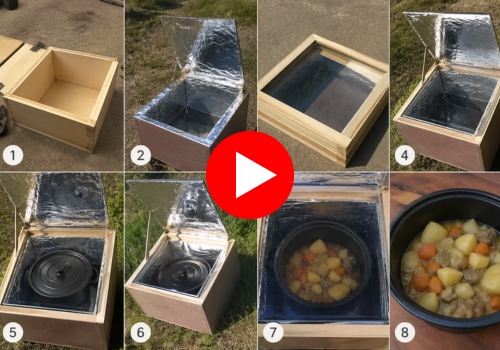
And if you want a cooking option that costs nothing to run after the initial purchase, a solar oven is hard to beat. You can buy a decent one for around $50-150.
An even better option is to build your own with cardboard, aluminum foil, and a piece of glass if you’re feeling handy – you can find a tutorial here. They won’t give you a fast sear on a steak, but they’ll slow-cook soups, stews, rice, beans, and even bake bread using nothing but sunlight. On a clear day, you can reach temperatures between 250°F and 350°F, which is plenty for most meals.
Here’s the solar oven I made + the instructions:
Community Is a Force Multiplier
You’ve heard “community is the best prep” a thousand times, and it’s true, but let’s talk about it in practical terms rather than warm fuzzy ones. On a fixed income, you can’t buy your way to full self-sufficiency. Nobody can, really, but limited funds make it even more obvious. What you can do is build mutual aid relationships that fill gaps in your preps without costing money.
Who Will Betray You First When SHTF
Think about what you bring to the table. Years of experience, knowledge, and skills have real value in a crisis. Maybe you know how to preserve food, repair small engines, sew, or handle basic medical situations. These skills are worth bartering, and they position you as someone worth helping rather than someone who only needs help.
If you’re part of a church, a veteran’s organization, a ham radio club, or any other group, those relationships are already partially built. Strengthening them with an eye toward mutual support during emergencies is one of the highest-value, lowest-cost things you can do.
Keep It Going Without Burning Out or Going Broke
You’ve been at this long enough to know that perfect preparedness doesn’t exist. Focus your limited resources on the most likely emergencies in your area and the scenarios that would hit you hardest given your specific health, mobility, and living situation.
Set a small monthly prepping budget – even $20 or $30 – and stick to it. That’s $240-360 a year, and if you’re spending it wisely based on actual needs rather than impulse buys from prepping websites, it goes a lot further than you might expect.
Now, I know you’ve probably collected your share of prepping books and guides over the years. But be honest – how many of them were actually written with your life in mind? Most prepping content is aimed at younger folks with bigger budgets, stronger backs, and fewer medications to manage.
That’s what makes The Lost Frontier Handbook different. It was put together around the kind of knowledge that our grandparents and great-grandparents lived by even when they were 90 years old – practical and low-cost skills that don’t require peak physical condition.
We’re talking about building a food stockpile that won’t spoil on you, sourcing clean water completely off-grid, rediscovering powerful natural remedies that modern medicine left behind, and knowing exactly how to stretch every dollar if the economy takes another hard turn.

You might think you already know most of this. And maybe you do. But every time I go through it, I find something I hadn’t considered – a better method, a simpler approach, a trick that saves money I didn’t know I was wasting. Good information has a way of doing that.
The Lost Frontier Handbook is one of the more affordable prepping resources out there, and it reads like it was written for people who’ve already been through a thing or two in life. Do yourself a favor and grab a copy – the kind of knowledge in this book isn’t the sort that stays available forever!
You may also like:
 Seniors Won’t Survive Without This in a Crisis
3 Signs You Are Going to End Up in the Poor House when SHTF (VIDEO)
The Hidden Tax Loophole They Don’t Want You to Know
25 Health Issues That Will Kill You Post-SHTF
5 Home Defense Tips for Seniors
Read the full article here