
This story, “Comedown,” appeared in the November 1955 issue of Outdoor Life.
The basin lay in a mood of chill inactivity. Once in a while the old mountain goat chewing his cud on the broken face of the cliff opposite us looked around and lowered his chin whiskers into yawning space. Apparently we and the goat had the basin to ourselves. I’d flushed its every inch with my glasses a dozen or more times in the past two hours, and after each slow, cautious probe the glasses ever came back to the goat. We didn’t need the billy any more than Croesus needed copper. The Englishman I was guiding had already taken his limit of two for this season.
For the last five minutes the Englishman’s eye had been glued to the eyepiece of his telescope. Now he lowered the spyglass and sighed, “Nary a ram here.”
I agreed and began to flex my cramped right leg. There wasn’t much room on our ledge for my six foot two. My hunter stretched his own lank frame and yawned. “Bit of a waste of time lying here any longer, don’t you think?”
I flicked an eye at the sun, or what was left of it — just a splash of yellow on the western rirmrock. Then for the umpteenth time since sneaking up to the outcrop I played my 8X’s on the goat. “Why not,” I suggested, “wait a few more minutes until old whitey gets up out of bed?”
“Why wait on the goat?” the Englishman asked a bit peevishly. “I’m for going back to camp and brewing a pot of tea.”
I lifted my shoulders and explained, “Bighorn or goat, they’ve much the same habits — feed with the sun in the morning, bed through the heat of the day, then up again come nightfall. It’s pretty near evening now.”
And when that brought no response I rolled over on my back, closed my eyes, and went to mooding over why any guy in his right senses would try to make a living guiding big-game hunters in the first place.
We were at about 10,000 feet in British Columbia’s Coast Mountain range. Taseko Lake lay 35 miles east and some 5,000 feet below us. Now there’s a hunting and fishing lodge on the east shore of Taseko, but in the 1930’s I had all of this area to myself, where guiding is concerned. In those halcyon days my wife and I — with assistant guide and horse wrangler — drove a four-horse freight wagon and a string of 12 or 15 pack and saddle horses 125-odd miles from Riske Creek, on the main Chilcotin drag, to Taseko Lake. There we left the wagon and shifted the load to packhorses, which took us back where bighorn sheep were plentiful.
These bighorns had, in late summer of 1937, fetched the hunter at my side across an ocean and a continent. Of course he also had more than passing interest in moose, goat, and bear — this being his first hunt in Canada — but a trophy ram was the main dish, and so far he hadn’t received taste of it.
We’d glassed many a flock of ewes and lambs at the 8,000-foot level and sighted a few two-year-old rams among them. But in September the old-timers, the busters with the trophy heads, range high above the ewes. You have to hoist up into thinning air to locate them.
Now September was half gone and the Englishman’s license was filled on moose, goat, and bear. He wasn’t interested in mule deer. “I can hunt stags in Scotland,” he informed me, “and without paying head premium on them.” A canny lad with his pounds, shillings, and pence was the Englishman.
Yesterday morning the two of us left base camp in the high basin of Yohetta Lake and back-packed to the edge of timberline, where we pitched two pup tents. We packed up enough grub to see us over three or four days of hunting, and if I couldn’t get him within range of trophy rams in that time I’d no business with a guide’s license. At least, that’s the way I had it figured.
A two-hour trek through the ram pastures beginning at daylight this morning seemed to vindicate my optimism. We cut tracks that wandered up and over a hogback with spine as sharp as the ridge of a roof. The sheep had single-filed down into the basin in which we now sprawled, leaving tracks as fresh as the morning dew.
“Not a young ram in the lot,” I commented, after studying the imprints in the damp earth. “Eight of them ranging together and every mother’s one four years old or better.”
So we had bellied down on the spine of the ridge and glassed the terrain beneath us for most of an hour — without spotting horn or hair of sheep.
“They’ve bedded,” I decided then. “Maybe in the heart of those junipers down there, or among that jumble of rocks below the bluff. As they’ll likely stay bedded until late afternoon, our best bet is to back-track out of here, work around into the mouth of the basin, and bed somewhere ourselves until it’s time for them to start feeding again.”
We were now lying on an outcrop of rock just made to order. From it we could glass all of the basin in front without being seen. If the sheep were indeed in the junipers, or in the shade of countless chunks of rock beneath the goat’s ledge, we’d spot them as, soon as they moved. After long waiting I was half asleep when the Englishman’s elbow nudged my ribs. I heard him drag at his breath and blurt out a single electrifying word: “Sheep!”
I jerked over onto my belly and inched my binoculars to the top of the rock. Failing to find anything at the bottom of the basin, I was scanning the face of the precipice when my companion whispered, “On top of the hogback to our right. A lone ram!”
I skidded my glasses over to the ridge. A ram was silhouetted against the coppery flare of sun on the skyline. The beat of my heart picked up tempo as the glasses steadied and fixed on the animal’s horns. “They’re dubbed off at the points,” I murmured, “but even at that they should go 40 inches or better along the curl.”
We snuggled tight against the rock, scarce daring to move. While the ram was at least 1,000 feet above us and close to a mile away, he had a bird’s-eye view of all that lay beneath him. A groundhog couldn’t have moved on the floor of the basin without having the bighorn spot it.
By now the flare of the sun was gone, shadows were licking out across the rimrocks. The ram remained statue-like for a long 10 minutes. With my powerful glasses I could see his nostrils sucking at the air. Then, dropping the weight of his huge horns back on his shoulders, he cautiously began the steep descent to the bottom. Immediately seven more of his kind trooped out on the ridge behind him, standing there a moment before trailing down in his tracks.
We watched the band spread out at the bottom and start grazing. They were, I judged, almost 2,000 yards
from us. The index finger of the Englishman’s right hand drummed a nervous tattoo on the stock of his rifle.
“No possible chance of getting in range before dark, is there?” he asked.
There certainly was not. It would be dark in half an hour, and the stalk would take double that time. A premature attempt now would only botch the whole deal, perhaps put the rams clean out of the country.
“Better if we get out of here now and come back with the daylight in the morning,” I replied. “They’ll not move far tonight if they’re not spooked.”
We slid back from the outcrop until reaching a low dune of moraine litter that shielded us as we stood upright. Then we followed it down to the scattered evergreens where we had our overnight camp.
We doused the campfire at daybreak next morning and started climbing. eventually easing up the moraine debris to our outcrop. North and east the sky was a pale, untroubled blue, but to the south and west ragged purple clouds jostled one another above the rimrocks, cloaking the higher peaks with mist. If ever cloud formations were loaded with threat of storm, those were.
Our glasses riveted on the rams as soon as we peered over the top of the rock. They’d already fed and watered and were trailing away from the bottom toward the slope of the barren ridge on our right. We lay tight against the rock, watching them make the ascent and troop out of view on the skyline. Then, coming cautiously upright, I said, “We’ll allow them 15 or 20 minutes to bed down and then get going ourselves. If they bed out on the open ridge there’ll be boulders aplenty to cover our stalk.”
The slope up which we had to climb was split by a deep gulch, whittled down to bedrock by centuries of melting snow and summer rains. The cut began as a narrow trench at the spine of the ridge but widened into a miniature basin of its own where it met the valley floor.
”No trouble at all getting across to it,” I reasoned aloud, while the Englishman’s telescope played on the gulch.
“None whatsoever,” he agreed. “Nor in following it to the top.”
“Then let’s get going,” I suggested with sudden urgency. For now everything hinged on the wind. At 10,000 feet the wind seldom blows from any one direction for long. The peaks trap it as it whips down over their brows. hold it a while, then turn it loose to search frantically for some avenue of escape. Now it was out of the southwest, gently fanning our faces. But the elements in the high country can shift as suddenly as a snowshoe rabbit fleeing from a weasel.
We worked up to the mouth of the gulch and rested there a moment. The overhead was now blotted out by swift-moving clouds. A flake of wet snow came slanting against my face on a wind that had shifted almost due north.
“It is going to storm,” I exclaimed. “And if it breaks before we get on top, devil a ram will we find bedded in the open. They’ll hit for shelter and—“
But I was wasting my breath. The Englishman was already 10 yards ahead of me, clawing up the cut.
We were halfway up to the hogback when the storm broke. A rush of mixed snow and hail beat in against us, shutting visibility to a scant 50 yards. Though the gulch sheltered us from the full blast of the wind. we could hear its strident clamor as it pounded the ridge above.
“It will be hell out on that ridge,” I muttered grimly.
“Still a chance if we hurry,” the Englishman urged.
Yes, there was still a chance if we hurried — one in 1,000. But we couldn’t hurry. The last 200 yards up the cut was almost perpendicular.
When we did finally get on top, the force of that snow-laden wind almost lifted us off our feet. And we hunched behind a rock, trying to peer through a curtain of snow.
“The rams could be 100 yards from us and we’d know nothing about it,” I said dejectedly.
A wan smile lit the Englishman’s face. “We’re licked, by Joshua,” he admitted.
“For the time being, yes.” I felt with numb fingers for my watch. It was still only 10:30 a.m. We could either head for camp and try again in the morning or climb back into the cut and sit the snowstorm out.
While the warmth of a campfire was far more enticing than the bleak hospitality of the gulch, I let my hunter make the decision.
“Now that we’re up here,” he said, “let’s wait a while. Perhaps the storm will blow over.” So back into the cut we trailed.
For the next two hours earth and sky were blotted out in the driving whirl of snow. It was impossible to keep warm, even in the shelter of the gulch, and we were both getting discouraged when I sensed a change in the wind.
“Getting warmer,” I announced. “Let”s crawl back on top and see how it looks up there. If nothing else, the movement will warm our feet.”
Eighteen inches of wet snow covered the crest of the ridge when we pulled out on top. The wind no longer blew from the north but sheer out of the south. It felt warm and clammy against my cheek. Westward, the mountain-tops thrust up into a sky that was slowly clearing and a watery sun gaped from behind the breaking clouds at a white world beneath. The wind got warmer by the minute.
“A real honest to goodness chinook, that’s what it’s turning into,” I said. “Another two hours and this”‘ (churning the snow with my boot) “will all be turning to water.”
We squatted out on the ridge, glassing the white landscape about us without finding shape or tracks of life. Even the goats on the bluffs had sought less exposed positions. If we were lucky enough to find the tracks of the rams again today it would be in some secluded spot shut away from the wind. As we dallied out on the ridge, trying to figure the deal as the rams themselves would, the snow turned to a fine, drizzling rain, but only a few remnants of clouds straggled by overhead. The storm would put the sheep off the ridges, of that much I was certain. But where? Within range of our naked eyes were a score of narrow, twisting gashes in the mountains, any one of which would make ideal sheep shelter in adverse weather. But we couldn’t see what might be in them.
The Englishman kneeled down in the snow and steadied his telescope against a rock. Then, looking back over his shoulder at me, he said, “Put your glasses on that cleft in the bluff at the head of this ridge. ‘Pon my soul, I believe something tracked through the snow up there while it was still falling.”
I focused my binoculars where he indicated. “Darned if I see anything,” I said.
“Here.” He handed me the telescope. “Try with this.”
To focus it properly took me half a minute, but then I saw faint scuffle marks in the snow that might once have been tracks. I still wasn’t sure, however, so said, “Let’s climb up and have a look.”
We moved steadily higher into a world that is never altogether silent, never altogether still — where rocks and boulders suddenly lose balance and tumble and where at any moment a field of hard-packed snow might start to slither forward, bulldozing all in its path as it hurtles toward timberline.
The warm chinook was melting the new snow almost as quickly as it had piled up. Every fold in the hogback became a miniature creek, spewing mud and water into the valley. A stream of shale and rubble cascaded down the bluff ahead of us, and once in a while a weighty slab of the snow overhanging its eaves broke loose and crashed to the bottom.
It took a little while to sort and read the tracks, but yes — eight sheep had trailed through here, into a cleft that was more gorge than basin, fenced off at head and flanks by sheer rock walls.
I felt a vague uneasiness. My stride slackened, dragged to a halt. I cleared my throat and suggested casually, “Maybe we should get out of here and come back tomorrow.”
The Englishman’s eyebrows shot up. “Quit now after sitting out the confounded snowstorm in that miserable gulch! Why?”
My mouth opened to reply, then clamped shut again. I wanted to tell him of how, when I was new to the peaks, I staked a wrangle horse on a small bunch-grass bench at the foot of just such a bluff as the one ahead of us. During the night a rockslide smashed my horse as a rolling wagon wheel squashes a grasshopper.
But I knew it would be a waste of breath to tell the Englishman that story. What was happening now — the hunter knowing better than the chap he’s hired to guide him — has often happened before and will happen lots more. So I simply hefted my gun and began climbing.
Though the snow was about gone when we came to the rift in the bluff, we could still see the faint drag marks made while snow was still falling. It took a little while to sort and read the tracks, but yes — eight sheep had trailed through here, into a cleft that was more gorge than basin, fenced off at head and flanks by sheer rock walls. There were goat trails too, corkscrewing up the cliffs to the skyline above.
I breathed “Whoa” to my hunter and went down on one knee, investigating the trails through the glasses. One in particular, 300 yards ahead of us, held my attention. About 100 feet up it became a roomy ledge where many a goat could escape heat and glare on sunny days.
My glasses skipped away from the goat trail and began raking the bottom. The floor was l!ttle over 100 yards wide, the bluff at its head half a mile away. There was no browse of any kind for game at the bottom, just a hodgepodge of debris that had tumbled from above. A hundred or more sheep could bed in hidden seclusion on the floor of this rock-littered gorge.
After a final, lingering look at the goat-trail ledge, I cased the glasses and we advanced almost to the foot of the goat trail. There I again shuffled to a halt. “Let’s lie down ourselves,” I suggested. “If the rams are still in here they should be moving again pretty soon.”
As the Englishman’s telescope began sweeping the bottom of the cut I played my own glasses steadily on a pouting lip of snow and ice that jutted over the edge of the cliff ahead. I knew the overhang might still be there when freeze-up came, perhaps holding 12 more feet of snow without budging an inch, but eventually it must break and crash to the bottom, engulfing the narrow width of the gorge in a cataclysm of snow, ice, and dislodged rocks.
The goat trail was now about 65 yards to our left. There was something reassuring about that ledge, for it would be sanctuary of sorts if things did chance to go wrong in the bottom. “By jove, I believe there’s something lying down by one of those rocks up there,” the Englishman suddenly declared. “It’s a sheep; I can spy its white backside.”
I forgot about the giant lip of snow poised above us and asked, “Where?”
“See that triangular boulder up there?” He pointed at a place a quarter of a mile ahead. “Look at the foot of it.”
“Ah-h!” I trailed out my breath as a chocolate-coated ram heaved from his bed by the rock and stood there. Sizing up his head, I saw the horns were heavy at the base but badly broomed at the tips. It was a trophy one might settle for if nothing better was in sight, but within seconds there should be others — seven of them.
After nosing the wind a moment the ram began stepping slowly down toward us. The Englishman clutched at his breath and I heard his safety click off. “He’s good enough,” he decided. “I can take the beggar from here if he comes a little closer.”
Then seven more rams hoisted from behind the rocks and began trailing the leader. All eight jerked to a halt when they were still 300 yards away and stood in single file, gazing down the gorge. I inspected them individually through the glasses, to see which carried the best trophy, then nudged the Englishman. “The third one — he’s your baby. A few more seconds, and maybe—“
The words sheered off in my throat.
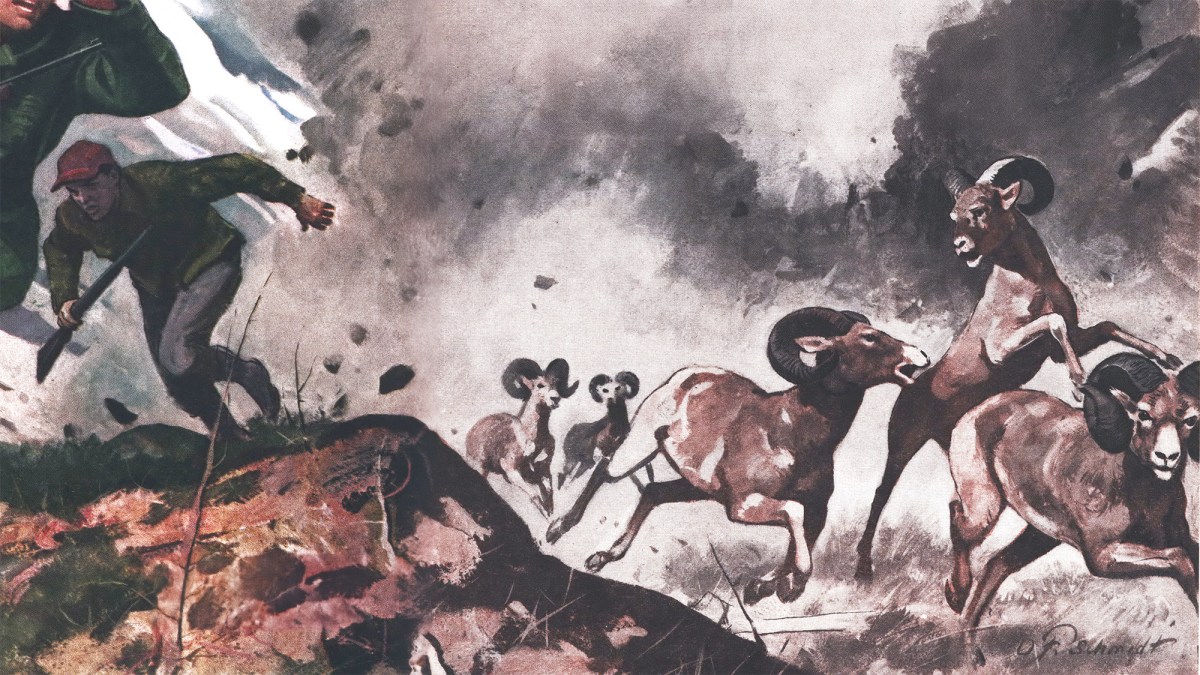
Several hundred tons of snow at the top of the bluff jarred loose and came thundering down. I lay frozen by the rock, eyes gaping in horror at an avalanche of mud, rock, and churning snow pouring down toward us over the narrow floor of the gorge. I had a glimpse of eight rams streaking straight for the rock where we crouched. The sight of those fleeing gray wraiths thawed my senses again, and I lurched away from the rock bellowing. “That goat trail over there!”
With about 30 seconds to beat the slide, we ran for the trail.
Several hundred tons of snow at the top of the bluff jarred loose and came thundering down. I lay frozen by the rock, eyes gaping in horror at an avalanche of mud, rock, and churning snow pouring down toward us.
The grind and roar of the slide came thundering down the gorge. Eight rams spurted from the cloud of choking dust, so close to us that I could plainly see their fear-bulged eyes and flaring nostrils. Just short of colliding with us, the sheep veered to the left, aiming for the other side of the gorge.
A few slabs of jagged shale were almost at our heels as we came panting to the foot of the goat trail. Within two or three seconds the main body of the slide would be on top of us. “You first,” I shouted, “And for God’s sake don’t slip back!”
The Englishman hurled at the trail, clawing at the rock, and pulled up to the ledge. I followed and sprawled flat on my back at his side, gulping air. Beneath us swept the full tide of the avalanche, filling the floor of the gorge from wall to wall, grinding inexorably clown to the mouth.
I suddenly heaved up on one elbow, exclaiming, “The rams!” I thought the slide had swallowed them, but there they were, halfway up the face of the rock across from where we lay. Higher and higher their white backsides streaked, but they paused when they reached the top and looked back to the bottom. Then their horns went back on their shoulders and they trooped out of sight.
The slide gushed on beneath us. Finally only a trickle of rubble spewed from the face of the precipice.
By the Same Author: Is It a Guide’s Job to Risk His Life for a Client?
The Englishman’s eyes wandered to the skyline, to the spot where a moment ago eight trophy rams had melted from our gaze. He cleared his throat. “We’ll not follow them, will we?” Though the words framed a question they seemed to voice an accepted fact.
“No,” I replied, gingerly peering out over the ledge. “Not that band.” I hefted my Ross rifle, shrugged into the sling. “In the morning we’ll pack back to base camp. Shave and rest up a day. Then hit out toward Chilko Lake, where there are other sheep basins, other rams.”
And we crawled down from our perch and began the long drag back.
Read the full article here