
This story, “Smallmouth Boom,” appeared in the July 1962 issue of Outdoor Life.
The best smallmouth-bass fishing on this continent, I believe, is where it isn’t thought to be — in the big border lakes of the Superior-Quetico forests of Minnesota and Ontario.
That area has a reputation for good northern pike and walleye fishing. But bass, it was thought, were designed for small lakes. The smallmouth has upset this theory. He has invaded the big waters with such a rush that he’s threatening the thrones of the walleye and the northern. And wherever the smallmouth goes, there, too, goes excitement.
The smallmouth has lifted the month of August right out of the “fishing doldrum” class in these boundary waters. On a trip to that region last August, I had the best smallmouth fishing of my life. We threw back four-pound bass, sometimes two at once. During our week’s fishing, we caught and released at least 40 bass that weighed four pounds or more. We didn’t bother to count the smaller ones.
We found these big bass in swift currents, making the fishing exceptionally sporting. Each put up a spectacular battle: diving, twisting, darting, using flat sides against us in the fast water, frequently blasting out in tail-twisting endeavors to get loose. My wife Vera declared that her first fish “just has to be” a big pike; no bass could be that tough.
Related: The Best Pike Lures
She was casting a red plastic worm with a lead head into a current that swept it past a toothlike exposed rock. When she was sure the lure was on the bottom, she lifted it off and reeled ever so slowly, vibrating her 6½-foot glass rod. This maneuver made the worm wiggle as if it were alive. The worm abruptly halted as a fish grabbed it and ran. Vera heaved back on the rod. This should have been the signal for the bass to bounce into the air. Instead, it dived to the bottom and swooshed downstream, tugging and jerking. Vera wound steadily on her spin-cast reel, but the fish took out line faster than she could take it in. Since she was using four-pound-test monofilament, we began to worry. And properly so. The line snapped when the fish made a final dive deep under the boat.
“That was no bass,” Vera mourned. “That was a 20-pound northern pike.”
Stanley Owl, our clean-cut Chippewa guide, shook his head: “No northern pike,” he said calmly. “That was big bass.”
We were skeptical, but a few minutes later Stanley cast a blue jig fly and nailed a fish that fought the same way. Sure enough, it was a smallmouth bass — one that weighed 4¾ pounds.
“Could be our biggest fish,” I predicted.
Stanley grinned: “Maybe you catch bigger.”
He was a prophet. Within five minutes, we almost proved it. It took just that long for both Vera and me to tie into 4¼-pounders.
This big-fish action occurred on 22-mile-long Crooked Lake, which is split lengthwise by the Canadian boundary north of Ely, Minnesota. Such thrilling smallmouth fishing hasn’t always been the ticket on Crooked Lake. Until four years ago, local fishermen didn’t know the lake contained any quantity of smallmouths. I was on Crooked when the first good bass catch was made — by accident.
The accident happened on Labor Day, 1957. Bob Cary, tall and husky outdoor editor of the Chicago Daily News, was there with his family, staying at the lake’s only resort, where Vera and I also were staying. The Carys set out from the camp at the west end, near Curtain Falls, to explore the lake, which comprises a main channel plus a number of large bays ballooning out on each side, several of them named after the days of the week. In the east half of the lake, east of Thursday Bay, the channel necks down to a width of 30 to 40 yards between bays, and the water pours fast through these necks. They are called currents: Big Current, Second Current, on up to Seventh Current.
Bob, his wife Lily, and their two daughters stopped for lunch on a large flat rock in the middle of Big Current, the first they came to. After eating, the Carys went ashore and one of the girls caught a green leopard frog.
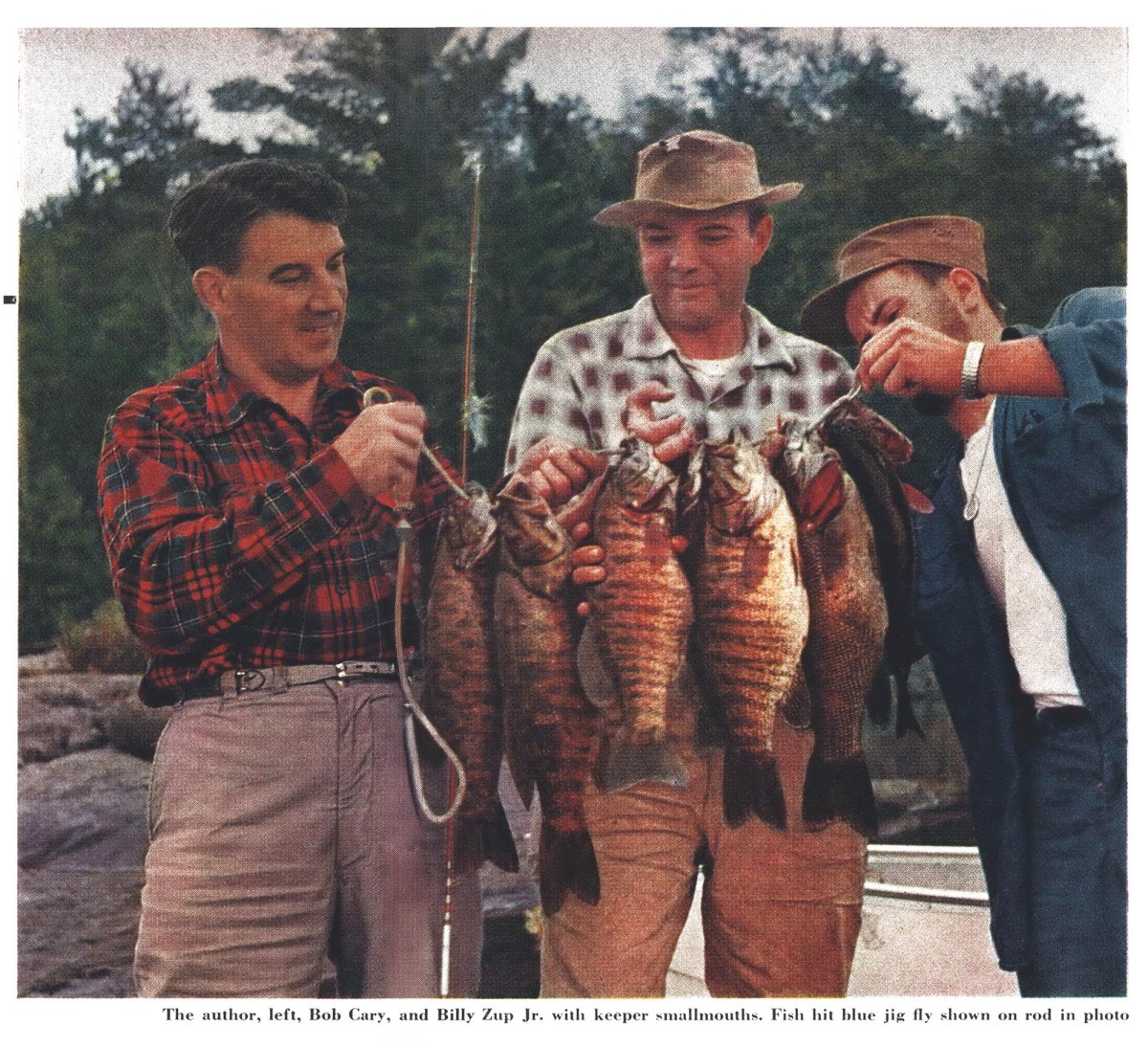
This inspired Bob to try to catch a fish with the frog. Back on the big rock, he cast into the current, hooked and landed a five-pound smallmouth bass. Agog, the family went ashore and caught a sackful of frogs. And they caught more bass. When the frogs ran out, they used deep-running artificial bass baits, finishing out the afternoon by catching 55 smallmouths, releasing all but six that weighed over 4½ pounds each. The largest was a six-pounder which won a seasonal contest in Ely, Minnesota.
When Bob brought these six smallmouths into camp, you’d have thought he had just discovered gold. No one — me included — had ever seen such a string of smallmouths.
Bob accommodatingly directed me to the spot where he’d caught them. Next day Stanley Owl and I went there and made another haul. In succeeding years, so many big bass have come out of these currents that they have infused more guides with bass fever. These guides have been able to lure visiting anglers away from Crooked’s well-known walleyes and northerns, and the lake trout of nearby waters, to the husky smallmouth bass of the currents.
Some canoe campers, most of whom come into Crooked Lake from the east end, have stumbled onto the bass hideouts. But most canoeists unwittingly pass right over them.
Last August Vera and I made the trip to Crooked for the prime purpose of tangling with those lunker bass. By chance, Bob Cary and his wife were there again. They’d come to Curtain Falls before jumping off on a canoe-camping jaunt into the Canadian wilderness. But first they, too, wanted another whirl at those bass.
So Vera and I toured up the lake with the Carys, they in their outboard-powered canoe, we in an outboard boat with guide Billy Zup Jr., heir-apparent to the resort.
We arrived at Big Current first. Billy sidled our boat up to the toothlike rock in the current. It was a still, sunswept morning, and the big pines that overhung the narrow neck of water seemed to be watchfully waiting for what was to come. It came quickly. By the time the Carys rounded the bend from Thursday Bay, Vera had outbattled her five-pound smallmouth and one that weighed 4½. So fierce had been the struggles that she had put her rod aside and was resting.
Lily Cary yelled across as Bob killed his motor: “Vera, aren’t you going to fish?”
That was all the opening Vera needed to lift the stringer and exhibit her two big smallmouth bass.
The Carys took one look at Vera’s fish, then began to cast feverishly. “They’re in here, are they?” Bob said, flicking out a jig-type blue fly.
Seconds later Bob reared back on his seven-foot spinning rod and shouted, “Whoa there, buddy!”
I grabbed a camera just before Bob’s buster jumped, red gills spread, tail lashing. A full foot and a half he leaped above the water, flopping back with a noise like a beaver slapping its tail. Another four-pounder.
Lily, using a deep-running plug, couldn’t seem to keep the “luncher-size” walleyes off her hooks, but Vera, Billy, Bob, and I all caught bass with plastic worms and jig flies.
By noon we’d thrown back a dozen. Lily finally tied on a yellow jig and took a couple of big bass. But it was her walleyes that we ate for lunch, cooking them over an open fire on a rocky point.
After lunch, we found that the bass had quit biting. “Nobody home,” said Billy.
Not even live frogs worked. So we motored to Bart Bay to cast for northerns. But August is a lousy month for northerns and — in the border lakes — for big walleyes. There are plenty of little walleyes, but the big ones strike earlier and later. This August slump is one of the reasons the smallmouth bass are here.
Some years ago resorters in the Superior National Forest noted that August fishing in the walleye and northern-pike lakes was dead, while lakes containing smallmouth bass had plenty of activity. So the resorters on walleye and pike waters began to yell to the Minnesota Department of Conservation to stock their lakes with smallmouth bass. And the department, after analyzing the lakes to determine which ones had enough shallow water to permit the bass to spawn, stocked some of them, including Basswood Lake, the easternmost big border lake in the Ely area. The stocking was done in 1941 and ’42.
If the smallmouths had been content to bite only in August and let the rest of the year go by, they probably would have received more than passing attention. But the smallmouths, in lakes to their liking, grew like grass in the spring. They fed on the young of the walleyes and northern pike, particularly walleyes. At the same time the pugnacious bass did a good job of protecting their own offspring.
The upshot has been that Basswood Lake and some of the others have become noted more for their smallmouth bass than for their walleyes, not only in August, but any time from June until mid-September, when bass grow lazy. The lake-trout lakes, such as Argo, with steep, rocky shores and deep waters, didn’t appeal to the smallmouth, so the reign of the trout there has been unchallenged.
Related: Why Smallmouth Bass Are One of the Most Problematic Fish in the Country
From Basswood Lake, it may be assumed, smallmouth bass entered Crooked Lake by way of Basswood Falls. We caught big bass last year at the foot of Lower Basswood Falls, at the extreme east end of Crooked Lake. The morning we fished there, we saw a dozen canoe parties use the portage.
“This is the best place on the lake for canoeists to catch fish,” Billy explained. “The water area is small, so fish are easy to locate. Chances are they’ll be in the fast water at the foot of the falls. In the evening, the bass and northerns may work out into the shallows of the bay.”
Prior to 1961, we hadn’t noted that the smallmouths had moved any farther west than Big Current and shallow Gardner Bay (in recent springs, surface plugging in Gardner Bay has been sensational). But in ’61 evening casting for bass was good as far west as the lip of Curtain Falls.
To my knowledge, few smallmouths have yet been caught in Iron Lake, a wonderful northern-pike lake opening below Curtain Falls. But McAree Lake, which lies on the Ontario side of Iron and is fed from Iron through the picturesque twin chutes of Rebecca Falls, has become almost entirely a bass lake. Half an hour north by five-horse outboard, McAree empties into Lac La Croix. At this outlet — a falls made of lacy terraces — Duke Kobe, our 19-year-old guide that day, caught his 5¼-pounder. I don’t know how widespread bass are in La Croix.
But we do know that the currents of Crooked Lake are teeming, and we proved it again later the same day we fished with the Carys. About 4 p.m. we returned from Bart Bay to Big Current. The sun was low, and the wind was tailing off. The pines turned from green to black, becoming silhouettes, and little bays in the rocky western shoreline were deep in shadow. The only sound was water rushing past upthrust rocks.
To check the bass schedule quickly, our boat cast live frogs, while the Carys stuck with artificials.
“Bet I’ll catch the first,” yelled Bob Cary.
“You’re too late already,” I shouted back. Something had grabbed my frog and was running for deep water. I thought he’d never stop. When he did, I knew he was turning the frog in his mouth to head it down his gullet. As he took off again, I set the hook. When the fight was over Billy lifted the bass from the water. It scaled 4¾ pounds.
On his next cast, Billy hooked one. I had a better angle of light than Billy, and I saw his fish first. “It’s a three-jumper,” I said. And Billy knew he had a twin to mine. By this time, we were designating the size of the bass by the number of times they could be expected to break water. The little ones usually jumped once, the medium-size fish twice, and the big boys three times.
Sure enough, Billy’s bass exploded about 30 feet from the boat. It sprinted around the stern and leaped again, then broke for the last time just before we netted it.
Related: The Best Frog Lures
The Carys were connecting just as fast, so we switched to artificials. We even caught bass on bottom-running plugs, particularly the sharply vibrating kind. Weighted spinner-fly combinations worked, too. Bob and Lily caught several on their black worms. The Carys, who camped at our lunch spot that evening, told us later that the bass came to the surface and bashed surface plugs near nightfall.
For the balance of the week, Vera, Billy, and I caught bass in every one of the seven currents between Big Current and Basswood Falls. We found that our experience with the Carys was the regular thing: the bass were on a time table, hitting until noon daily, then sleeping until 4 o’clock. We fished on the same schedule.
Big Current proved to be our favorite, although Fifth and Seventh currents also produced well. So it was only logical that on our last day of fishing we were back at Big Current in time for the 4 o’clock rush, standing on the flat, midstream rock, casting. Faintly, then louder, we heard a little outboard motor. Then around the bend came the Carys in their canoe.
“We tried to forget these big bass,” Lily explained, “but we couldn’t. So we cut short our canoe trip, and here we are.”
The Carys stayed in their canoe and cast across the current. We worked the head, letting our lures drift before retrieving. By this time, Vera’s red worm — our only one — had taken such a beating that it was coming to pieces. The lead head had been chewed loose and now, on an exceptionally tough bass, the front hook broke off.
Billy, frowning at the lure, said, “You gotta catch ’em with the back hook, Vera.”
So on her next cast Vera latched onto one with the back hook. He broke water near Cary’s canoe.
While Vera battled this husky, Billy caught one on the other side with his blue fly. As both were struggling, I cast out to a rock where I’d seen a bass splashing after minnows — and he grabbed my plug. All three of us were fighting four-pound bass.
How do you get to this fabulous fishing hideaway?
There are three methods: boat, canoe, horseback. The five-hour boat trip ($15 per person round trip) is operated by Bill Zup and originates at Crane Lake. From Zup’s camp, you may fish Crooked Lake by rowboat or outboard motor. There are no other rental boats or resorts on the lake.
If you prefer to fish from and travel by canoe, camping out at the good U.S. Forest Service campsites on Crooked and enroute to it, you may reach the lake by several different routes that can be mapped for you by the Minnesota Department of Conservation or by canoe outfitters at Ely, Minnesota. Better figure it will take two days.
If you don’t have your own canoe and equipment, you may outfit for about $6.25 per person per day in Ely, Minnesota, receiving as part of your package, a detailed map with a marked route. Most Ely guides work through the outfitters and charge $20 per day, plus $6.25 keep. But most canoeists travel without guides.
Read Next: Twin Metals Paid Former Trump Officials $380K. Their Controversial Mine Proposal Near the Boundary Waters Is Now Advancing Against Public Opinion
The third method, horseback pack train, leaves from a resort operated by Wayne Berry on the Echo Trail northwest of Ely. He travels the old Lac La Croix trail in about five hours, including a stop at Stuart Lake for lunch. The trail emerges on Iron Lake. Cost is $17.50 per person, round trip.
However you travel, you’ll be in wilderness from start to finish — a big, soothing country. Swing your elbows any way you please, you won’t bump anyone.
Read the full article here