It’s a Dark Day for the Boundary Waters and the Future of Public Lands. Here’s How We Got Here


Today the U.S. Senate voted to roll back key protections for the Boundary Waters, opening the door (again) to a major copper-nickel mine at the headwaters of the Boundary Waters Canoe Area Wilderness. The Senate voted 50-49 in favor of House Joint Resolution 140, which passed the House of Representatives in January and relied on an unprecedented use of the Congressional Review Act to overturn a 20-year mineral withdrawal enacted in 2023.
Breaking: Senate Votes 50 to 49 to Strip Boundary Waters Protections in Defiance of Public Opinion, Science
“Paving the way for the Twin Metals mine does little, if anything, to satisfy the America First agenda, and is a direct assault on our outdoor heritage and public lands nationwide,” Lukas Leaf, the executive director of Sportsmen for the Boundary Waters, said in a statement Thursday. “When will we realize that we simply cannot just create more of these critical landscapes? Our collective legacy, our responsibility, is to leave behind protected places like the Boundary Waters, not to bend the knee to a foreign mining company for short-term gain. This battle is far from over, and our resolve is stronger than ever.”
The Department of the Interior enabled these legislative maneuvers by transferring the 2023 Public Lands Order to Congress in December — a legally questionable move that will likely be challenged in court, according to policy experts. This was after the Trump administration signaled its intentions in June to roll back the Biden-era mineral withdrawal covering 225,504 acres in the Superior National Forest.
These maneuvers on the Hill are being made despite vocal opposition from America’s conservation community. This includes the same sportsmen’s groups and wilderness advocates who have long pointed to the existential risk that the Twin Metals mine would pose to our country’s most popular wilderness area and its vast freshwater resources.
“A vote like this really does ignore, and even silence, the American people. The reality of the situation is that people from all across partisan divides, from every state in the country, were calling. The phone lines were so busy that people couldn’t get through … And it’s because people care so deeply about this place,” Save the Boundary Waters executive director Ingrid Lyons told Outdoor Life soon after Thursday’s Senate vote. “To me, this was a demonstration that the elected officials who are in office to represent their constituents don’t actually represent them. What they represent is an allegiance to the White House and to a Chilean mining company.”
Other influential Americans had chimed in as well. In a rare joint letter sent to the U.S. Senate in February, four descendants of Teddy Roosevelt collectively called on Senators to vote no on H.J. Res 140. They called the effort to roll back mining protections “misguided and harmful,” and they criticized the resolution as one that TR would have found appalling.
“The four of us below have never collectively co-signed a letter together,” the descendants wrote, “which should give an indication of how strongly we support voting no on this resolution.”
Long-term, the resolution’s passage could also signal a new era for America’s public lands. One where Congressional oversight and executive action can steamroll science, ignore the public, and unwind the rules and processes that guide public-land management.
“Let’s just be open and fair about it. These are political decisions,” says former chief forester Tom Tidwell, who led the U.S. Forest Service from 2009 to 2017. “And that’s why people now spend billions of dollars to get people elected.”
The Wrong Place for a Mine
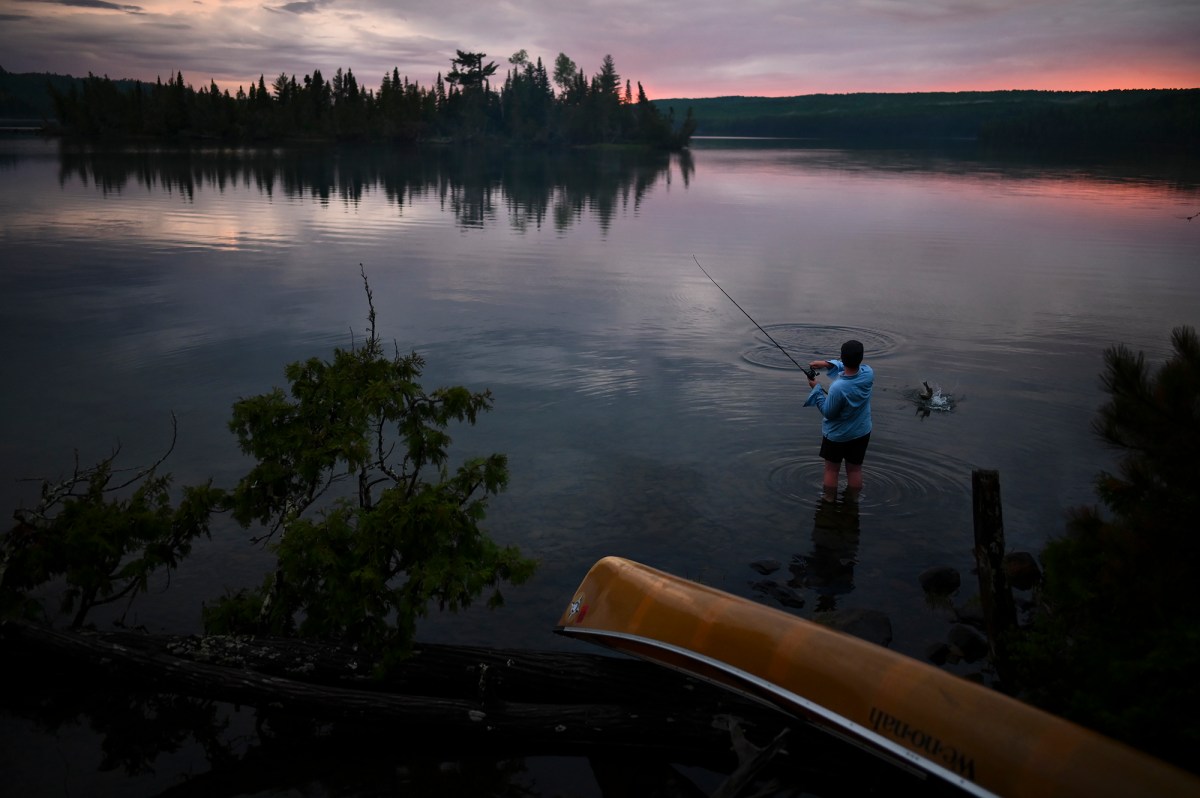
The Boundary Waters Canoe Area Wilderness consists of more than 1 million acres of glacial lakes and unspoiled North Woods forests that provide world-class fishing, hunting, camping, and paddling. It is the singular destination for traditional canoe trips and the most visited wilderness area in the country, contributing more than $78 million a year to the state’s outdoor economy. It is also a hydrological wonder. The BWCA’s interconnected lakes, streams, and wetlands represent one the most pristine water sources in America.
Congress recognized these attributes in 1964, when the Boundary Waters were incorporated into the Wilderness Act as one of America’s original wilderness areas. The BWCA was then expanded and further protected from activities like mining in 1978, with the passage of the Boundary Waters Wilderness Act.
Those protections, however, do not extend to neighboring areas of public land, like the Rainy River watershed in the Superior National Forest, which flows into the BWCA. The Bureau of Land Management first granted mineral leases in the watershed in 1966. Those leases were extended multiple times but had expired by 2012, when Twin Metals, a Minnesota-based mining company owned by Antofogasta, a Chilean corporation, applied to renew the leases.
At that time, Tidwell was serving as Chief of the U.S. Forest Service after being appointed by then-President Obama in 2009. He brought with him more than 30 years experience with the agency, including a stint in legislative affairs at the Washington D.C. office, where he says he gained “almost too much experience with rule making.”
In 2016, as Twin Metals was proposing to renew the mining leases on Superior National Forest land, the USFS was given consent authority to reject or approve the proposal. This launched a series of scientific studies and environmental assessments, which clearly showed the risks that a copper-nickel-sulfide mine would pose to water quality in the BWCA.
Because of the unique hydrology of the Boundary Waters and the kind of mine that is being proposed, scientists have concluded in multiple studies that the mine would inevitably impair water quality and could lead to long-term, irreversible damage. As conservation groups have continued to point out today, this type of mine has never been dug in Minnesota before, and it’s never been built anywhere without creating pollution in some form.
Tidwell, who approved plenty of mining projects in Nevada and other Western states during his 41-year career, says there are ways to safely mine copper and other minerals in more arid parts of the country. This includes sulfide-ore mining, which generates acid when the ore is exposed to air and inevitably leads to acid mine drainage.
This drainage can be mitigated in the desert, Tidwell explains. But it’s difficult to contain in a place like the Boundary Waters, where pollutants could leach into the groundwater and then spread throughout the system. Tidwell says that at a minimum, Twin Metals’ proposed mine would degrade water quality. The worst case scenario is a spill or failure, which would cause long-term damage that would be almost impossible to clean up or control.
“So I made the determination [to deny the renewal of the leases] based on the science and input from mining experts. There is just no way you could have an operating copper-sulfide mine in this location without degrading the water.”
—Tom Tidwell, former u.s. Forest Service chief
“So I made the determination [to deny the renewal of the leases] based on the science and input from mining experts. There is just no way you could have an operating copper-sulfide mine in this location without degrading the water,” Tidwell says. “When I looked at all this, it was so obvious to me that this is one of the worst places I could imagine to try and do this kind of large-scale mining operation.”
The process that led to Tidwell’s 2016 decision also involved a 30-day public comment period. He says that of all the mining projects he was involved with, no other area has had so much public support for protections.
“The United States needs minerals,” he says. “This is just the wrong place.”
On Again, Off Again
In part because of Tidwell’s determination, the USFS submitted an application to the Interior Secretary in December 2016 to withdraw portions of the Rainy River watershed from mineral leases for a period of 20 years. This launched a more extensive scientific study that would take place over two years, along with a 30-day public comment period, in which 98 percent of the roughly 180,000 comments supported a mineral withdrawal.
In 2018, however, with only four months left to complete the two-year study, the first Trump administration’s Interior Secretary Sonny Perdue terminated the study and cancelled the withdrawal request. Although Tidwell had already retired in 2017, he says he’s still disappointed by the decision to quash the study.
A second attempt at securing a 20-year mineral withdrawal in the watershed took place under the Biden Administration starting in 2021. The withdrawal was, again, supported by the science, which showed the risks the Twin Metals mine would pose to water quality in the BWCA. (That study has since vanished from the USDA’s website.) It was also supported, again, by 98 percent of Americans during a public-comment period that brought in roughly 675,000 comments.
“It’s a pretty straightforward process,” says Robert Anderson, who served as solicitor of the Interior during the Biden administration and helped establish the mineral withdrawal. “And that’s exactly what we followed.”
Interior Secretary Deb Haaland signed the 20-year mineral withdrawal in 2023, thereby enacting the most significant protections for the Boundary Waters to date.
In June 2025, however, just five months into Trump’s second term, his administration announced in an X post that it was committed to overturning the Biden-era mineral withdrawal and granting mining leases back to Twin Metals. That post was made by Agriculture Secretary Brooke Rollins, who oversees the USFS. Rollins wrote on social media that “after careful review, including extensive public input, the US Forest Service has enough information to know the withdrawal was never needed.”
Interior Secretary Doug Burgum confirmed the administration’s intentions during a House subcommittee meeting in June, and then he transferred the 2023 Public Lands Order that Haaland signed to Congress. In doing so, the administration and some members of Congress have purported that the Biden-era mineral withdrawal was filed improperly, and that it should now be subject to revision under the Congressional Review Act. This allowed Rep. Pete Stauber (R-Minn.), one of the mine’s biggest supporters, to introduce a joint resolution in January to officially repeal the 2023 mineral withdrawal.
Chile First, America Second
Stauber’s resolution — the one that just passed Congress — not only repeals the protections that 98 percent of Americans have supported through public comment. It also prevents future administrations from enacting similar mineral withdrawals within the Rainy River watershed. While Twin Metals mining permits would still need to be approved at the state level, Congress has effectively already green-lit the mine without any scientific or public input to support the move.
What’s even more concerning, according to policy experts and conservation groups like Sportsmen for the Boundary Waters, is the new precedent that Congress is setting. The Congressional Review Act, which was used only sporadically until recently, has never been utilized to overturn mineral withdrawals. That process is guided by the Federal Land Policy Management Act, according to Anderson, the former DOI solicitor. He says he’s not even sure if the CRA could legally apply to this situation, and that it will almost certainly lead to further litigation.
“[This] is an unprecedented maneuver that threatens the future of the Boundary Waters,” Leaf told Outdoor Life in January. “A decision to allow this to move forward could have dangerous implications not only for the BWCA but also for similar protections for wild landscapes across the country.”
Tidwell, too, is concerned for the future of public-land management. He says that in his view, the moves that were made in 2018, along with the legislative maneuvers we’ve seen over the last eight months, have happened “above the Forest Service.” He worries that with the CRA being wielded in new ways, Congress could keep contorting the rule-making process to gut any decisions by federal land managers that don’t align with its agenda.
“It basically opens up everything to [Congressional oversight], whether it’s a mineral withdrawal, a military withdrawal, or really any decision that’s made by a Secretary. So, where does it stop?” Tidwell asks. “The shortsightedness of all this is just — it’s very, very concerning.”
There’s also the troubling question of who benefits the most from the proposed mine. Stauber has said the project would bring jobs to Minnesota and provide critical minerals “that will allow the United States to compete and win in the 21st Century.” And while the mine would further the current administration’s goal to make mining and resource extraction the primary uses of our public lands and waters, the resources in this case would be ultimately controlled by a foreign-owned corporation.
Once out of the ground, the majority of those minerals would almost assuredly leave the country. Due to the large amount of copper the U.S. produces, and the limited capacity we have for processing it, we currently export around 50 percent of our raw copper to countries like China, Canada, and Mexico. Antofagasta exports most of what it mines to smelters in China, according to Rep. Betty McCollum (D-Minn.) and Sen. Tina Smith (D-Minn.), both of whom voted against the resolution.
Although her pleas were ignored by all but two Republican senators (Sen. Collins of Maine and Sen. Tillis of North Carolina), Sen. Smith gave an impassioned speech on the Senate floor late Wednesday night and Thursday morning. For more than three hours, Smith urged her colleagues to vote against HJR 140. She hit on all the key reasons this mine is a bad trade for Americans: It would jeopardize the BWCA’s water and wildlife, threaten its outdoor economy, ignore public opinion, violate tribal treaties, support foreign mining interests over those of American citizens, ship raw ore overseas, and guarantee pollution of some of the most pristine waters in America.
Read Next: As Trump Attempts to Reform Federal Government, Hunters and Anglers Face ‘Unintended Consequences’
“Even if I wasn’t concerned with the outdoors or the environment, this idea that we would be okay with sending our natural resources to a foreign country?” Tidwell says. “As an American, it just doesn’t make any sense to me that Congress would be okay with this.”
Read the full article here