

I Missed My Father’s Funeral to Take My Daughter on the Paddle Trip of a Lifetime

We’d walked for hours, breaking the portage into stages, shuttling loads back and forth. Four trips per stage. Nine stages total.
Black flies sounded like rain landing on my hood. My daughter was ahead with a dry bag, picking her way through dog-hair spruce. The canoe bit into my shoulders. Wind turned our 17-foot boat into a weathervane, forcing me to stop every few minutes.
Twelve days into our trip, we were carrying our boat and gear 36 miles around the Thelon Canyon. My hands had cracked and scabbed from being on the water nearly two weeks. We were desperate to find a place to camp. And I could feel my impatience rising. But that’s not where this story starts.
The News
The night before we flew into Lynx Lake, I gave my daughter the queen-sized bed in our basement vacation rental in Yellowknife. I claimed the two-seater couch against the wall. My phone rang after 10 pm. I stepped outside so my daughter wouldn’t hear. My brother’s voice was measured and flat, separated by thousands of miles.
“Dad died.”
The questions I asked were procedural: When? How? What happens next? The questions I didn’t ask: Should I come back? Should I tell her? How can I keep this secret?
Rubye only saw my dad once a year, at best. Mostly over the holidays when we flew back east over a meal where he made small talk about sports or school. She called him Granddaddy because that’s what you’re supposed to call your grandfather where I grew up, but they didn’t have a relationship. When she asked about him, I told her stories that softened who he really was, and rarely the whole truth.
Standing in a stranger’s backyard in Yellowknife under a gray sky, I decided: we would go anyway. I wouldn’t tell her about her granddad’s death until we pulled back into our driveway in Montana.
In the morning, pre-dawn birds interrupted my preoccupation with last night’s news. I finished my first cup of coffee by five. Sleep-deprived, my hands shook as I sealed our dry bags.
By mid-afternoon, we had untied our canoe from the strut of the float plane and unloaded our gear on a small island on Lynx Lake. Then we watched it take off and disappear into the fog. We were alone: my 12-year-old daughter, Rubye, and me, hundreds of miles from anywhere, with news she didn’t yet know.
Lynx Lake was a tempest the day we arrived. Low, heavy clouds scudded over the water. The long-range forecast for Canada’s Northwest Territories promised more of the same: cold, wet, and windy.
We should have waited. Our landing spot was tucked out of the wind in the lee of dense black spruce, a perfect place to stay sheltered and dry. But my nerves and impatience pushed us onto the water.
Within an hour of watching the de Havilland disappear, we’d eaten lunch, stuffed our pockets with snacks, loaded our old canoe with 17 days of food and gear, and shoved off.
From the water, Lynx Lake was more confusing to navigate than the map suggested. Land and water mixed incoherently. Once offshore, the wind drowned my daughter’s words, but the tone was unmistakable: “Are we lost?”
We labored across the lake as waves built, our not-yet calloused hands tearing at the paddles. We used islands to break the wind and stayed near shore in case we needed to pull over. We rounded our final, nameless island. Ahead, somewhere, the lake became a river. But wind built swells and whitecaps too big to push through.
We retreated to the nearest small stand of trees. Cobbled shore, awkward landing, caribou fur hanging in the needles and fluttering in the breeze like tinsel. By day’s end, my hands blistered. Rain seeped into our layers. Water pooled inside our tent. We fell asleep to rain drumming the fly and waves grinding stones on the shore.
Before I was 12, my daughter’s age now, I learned that the woods were the only place my father’s voice couldn’t find me. The summer he put me in charge of getting the hay to the barn, I worked in silence under the hot sun, then a full load of hay spilled off the trailer, undoing an hour’s worth of work. I could see his jaw tighten from across the field. “Boy, can’t you do anything right?” The crack of his hand on the back of my neck. The relief when I made it back to the creek with my dog.
My dad grew up the same way. His parents were rural, Southern products of the Depression. Folks like my grandparents were reflective of that era, necessarily hardened, with no idea how to be soft. His father worked the farm, ran a building supply store, and came home exhausted. My dad just didn’t know any other way to be a father. And by the time I was old enough to see that, I had already learned to keep my distance, and to make myself small. To follow.
Out here, 3,000 miles and three decades from those woods, my daughter was doing something different. She wasn’t using the farthest corner on the map to escape. She was here to be found. This was a place to find her strengths. Her fears. And a place to be together, not alone.
Over the next few days, we found our rhythm. No matter how early we woke, this far north, we never woke in the dark. Every morning, we’d mark the map with yesterday’s miles and scan for the nearest esker, our favorite place to camp.
Sand was where we wanted to be at the end of the day. Easy to sleep on, good for tracking wildlife, and open enough to let the breeze keep bugs at bay. Once we settled, we fell into our rhythm: shelter, water, fire, food. Most nights, we’d cook over an open flame to conserve fuel. Dessert was mandatory, our end-of-day reward.
Before bed, we’d run practice laps around the tent, unzipping it for one another to keep the hordes of flies and mosquitoes out. The number of laps depended on how bad the swarm was: anywhere from one to four. A clean entry and quick zip earned high-fives and laughter. Most nights, I zipped Rubye in first. When I was ready to join her, she’d scrutinize how many bugs were circling me and assign laps accordingly. “Looks like it’s a four-lap night for you, old man.” She was exceptionally attentive and always quick with her dry sense of humor. And she always put me through my paces, assigning at least one additional lap than she ran.
We were practicing something. Not just how to build a fire, survive the bugs, or travel alone in one of the world’s most remote landscapes, but how to be together. My dad taught me that mistakes meant consequences. But on this trip, we were learning that mistakes meant we needed to try again, and we were better off laughing while doing it.
Most nights, we stayed up too late, reading to each other aloud or playing cards until we needed headlamps. Sleep was as deep as the sky was wide.
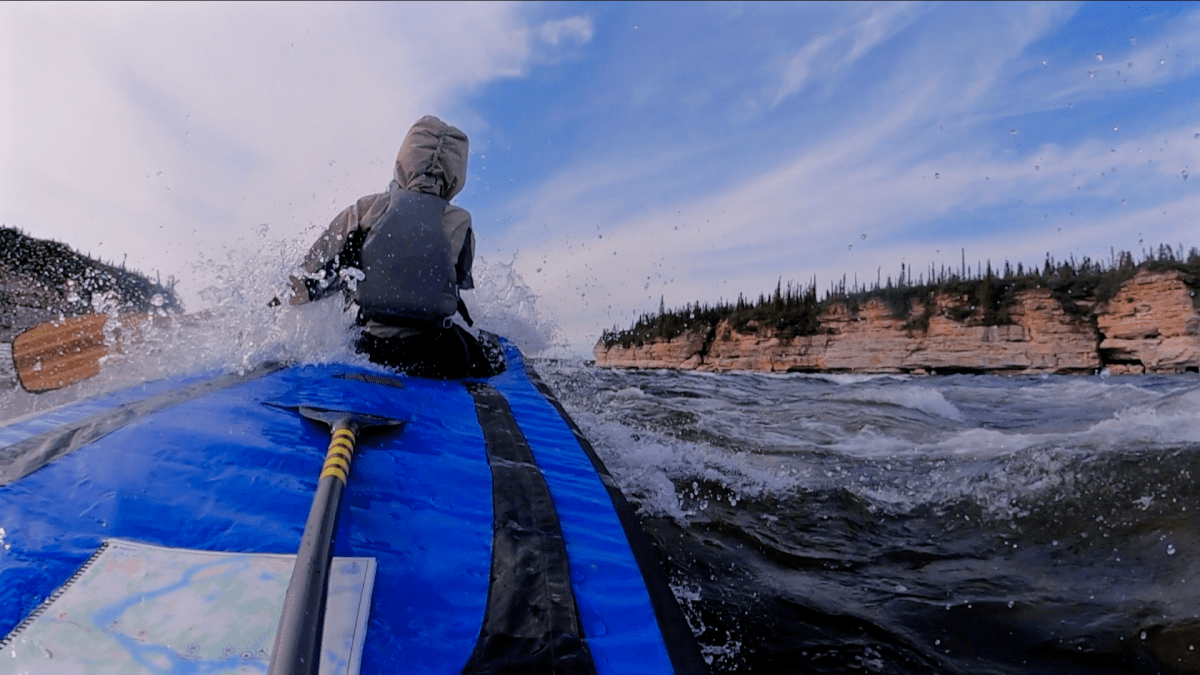
Two days later, we paddled up to the edge of Thelon Canyon. The thundering water disappeared abruptly over angled shelves: a series of low falls followed by big, standing waves. We climbed to the rim and looked down.
I’d picked the Northwest Territory’s Thelon for its remoteness, one of the last true wild rivers in North America, where you could paddle a full season and never see another person. I wanted a place where there was nothing between us and the work of being together. No distractions. No escape routes. Just the river, the portages, and each other. Where the only way out was through.
We’d planned for this carry since winter, poring over maps in a coffee shop back home. Trip reports were vague but full of warnings about steep canyon walls and boat-eating holes. Some paddlers risked lining their boats through sections. Others walked portions and paddled others.
Being alone, without another boat to assist, we decided to walk the entire thing. Thirty-six miles on foot, carrying everything. Four trips per stage, every stage.
My daughter would decide how long each stage would be and when we would stop.
I would follow.
The Anvil
We had four portages in the first five days, our introduction to carrying. At each rapid that we walked around, we’d scout the carry, decide on a route, then return to unload the boat. There were rarely trails. We’d stuff our pants into our socks to keep the bugs out, burden ourselves with as much as we could carry, and crash through the bush.
There’s a thin, invisible line between adversity and suffering. We knew we’d put our toes right up to that line—work, endure, and still find beauty.
If the river was our smithy, portaging was the anvil on which we were hammered.
On our second day, we ran our first rapid downstream from the landing and watched a herd of 20-some muskox. We startled a lone bull in the willows, less than 30 feet away, while scouting our line through boulders and waves. Back in the boat, another bull stood on the shore across the river sounding its prehistoric bellow as we sped past. “A muskox just watched us run that rapid! That’s wild,” I shouted in the eddy below. We high-fived across the boat and pulled out in the big pool below, replaying the whole scene.
The Thelon made its most precipitous drop nearly 50 miles downstream from Lynx Lake. This point marked our second to last portage before reaching the much longer carry around the canyon a week later. The river dropped 60 feet between boulders in a series of falls and continued downstream in a dangerous half mile of holes and boils. Peregrine falcons nested in the cliffs. And on warm days such as ours, the bugs were merciless. But the landscape was stunning.
She grinned, still catching her breath from climbing up the steep bank. “We could run that,” she said flatly and only half joking.
“Negative,” I said.
Together, we climbed the steep bank above the falls and watched steam rise. We picked landmarks to guide us over the treeless ridge. Then we climbed down the downstream side. Exhausted at the end of the portage, any doubt about finishing this trip left us. We had big lakes to cross, blank spots on the map to fill, and one long final portage. But more importantly, we had confidence.
At the bottom of that portage, exhausted and proud, I looked at my daughter and said, “We crushed that portage in two hours! Nice work, lady.” My dad would have just moved on to the next thing. I was learning to do something different.
The next few days were some of our favorites. We walked among ancient campsites at the Elk River, paddled past cairns used to funnel caribou, and passed moose and muskox that barely noticed us. On Double Barrel Lake, we built a driftwood fire after a hailstorm left us hypothermic. Halfway across, we paddled through low clouds on water so still it looked frozen. A rainbow blistered up over our shoulders.
We coasted into camp late and tired on the far side of Double Barrel. The next day was a zero-day, one of our few rest days of the trip.
That night, the temperatures dipped to the mid-30s, our coldest of the trip. The next morning, the wind whipped the lake to a froth, making the crossing to the river’s outlet impossible. We settled in under our tarp to read and watch storms roll in.
My brothers put our dad in the ground on day nine of our 17-day trip on the Thelon. It was the same day my daughter and I put 30 miles under our boat, our best mileage day so far. Swift current made the miles melt away, something rare on that upper stretch of the river.
My dad’s service was graveside and small. It was already well into the 80s when the mid-morning ceremony started. The few photos I have show flushed, solemn faces, many of which I hadn’t seen since moving out west to Montana.
I moved to Montana for college over 25 years ago. My dad never came to visit. He wasn’t there for any of the important moments. He never walked my daughters to school, never saw them play sports. That’s what I was interrupting. That pattern of absence.
Part of me knew I should have flown back for the funeral. My brothers were there. My family back east needed me. But another part, the part that spent 30 years learning to breathe without his weight on my chest, couldn’t do it. Couldn’t miss this trip with my daughter to stand at his grave and pretend we’d been close. Couldn’t call off this trip at the last minute when I was there doing something with her that he never did with me.
We dodged rocks, rode over wave trains, and ferried across the river regularly to avoid frequent ledges. There were two rapids to scout that afternoon. Above one, we found the desiccated remains of a rabbit’s foot and decided it was a good omen. At the next, we avoided a class III-IV hole by hugging limestone cliffs on river left. At one point, we eddied out to watch peregrine falcons circle above us while their distinctive call of kek-kek-kek echoed down the river.
That night, we made camp across from the Mary Frances River confluence near a creek flowing noisily over the glacial till. Arctic terns clicked disapprovingly at our arrival. We set our tent on top of a pair of fresh wolf prints. Bear tracks weren’t far away. As the sun made a slow arc toward the horizon, we fell asleep talking about the first town food we’d eat back in Yellowknife.
The next day, we paddled through scattered herds of muskox where the river emptied into Eyeberry Lake, our last big open water. The wind shifted from the south, now at our backs, making the crossing to the north outlet feel possible.
By afternoon, the wind had built waves big enough to surf, occasionally breaking over the gunwale. We’d rest behind boulders, catch our breath, then white-knuckle the next crossing. When the outlet finally appeared, we’d covered in a few hours what should have taken all day.
The south wind had brought smoke from fires in northern Manitoba, turning the light flat and gray. In camp that afternoon, the wind relented, and the heat settled in for the first time. With time to spare, we fished. After a few casts, Rubye’s rod bent, and the reel whined as line spooled out. “Dad! DAD!” She fought it to shore, and when she finally dragged a northern pike as long as her leg onto the stones, she screamed. “Look at this thing!” She was breathless, laughing, and terrified at the same time. “Can we eat it tonight? Please?”
Later that evening, we found a knapping site just above our camp. Sharp flakes of white stone littered the sand. Someone had sat here centuries ago, working stone under this same late sun. “Was someone making arrowheads here a long time ago?” Rubye asked, crouching to examine the flakes. Then she found it: a bird point, nearly perfect, half-buried in the sand. She picked it up carefully, turned it over in her hand. “Can we keep it?” she asked.
I shook my head. “It belongs here.” She nodded. “Yeah. I know it does.”
The point stayed with us through the night, resting on our overturned canoe. In the morning, she scattered the flakes where she found them. Then Rubye dug a hole in the cool sand and returned the arrowhead. She covered it gently, the way you’d tuck something precious away for safekeeping.
The Carry
Two days below Eyeberry Lake, we paddled up to the edge of the Thelon Canyon. We listened to the thundering water disappear over angled shelves. Clouds mixed with smoke from distant wildfires moved in after lunch, turning the light sepia.
It was late by the time we had unloaded our boat. And the steep, loose bank crumbled underfoot as we carried our boat and dry bags to the canyon rim.
We walked 36 miles over the next two days to the confluence with the Clarke River, breaking the carry into four-trip stages. My daughter decided how long each stage would be and when and where we would stop. I followed.
As a kid, I never would have walked in front of my dad. I wouldn’t have had the courage. Here, three thousand miles from where I learned to make myself small, my daughter was learning to lead.
Our first load was always our lightest, allowing us to break a trail and find the easiest path. She set the pace, walking as far as she could. Then we’d stop, make a pile of our gear, and head back for the next, heavier load. A stage ranged from a quarter mile to three-quarters of a mile.
The canoe dug into the top of my spine, biting harder every step. With my hands full, sweat ran freely into my eyes. The barrens challenged each step: sometimes boot-sucking bog, sometimes ankle-turning rocks. The black flies found every gap in our clothing. We’d walk until our legs shook and arms burned, then walk back and do it again.
Cairns lined the high points, leading us away from the river. Falcons guarded nests. The smell of Labrador tea rose as we clambered through the tundra. Our course occasionally disappeared into dog hair spruce. We negotiated ravines so steep that we had to lower the canoe by hand. Wind caught the boat on my shoulders at times, forcing us to stop. Other times she steadied the stern while I pushed ahead.
I watched her keenly, noticing every missed step and stumble, and wondering if she would break. We were right on the edge. Sometimes a hundred pounds on my shoulders, but in my head, I was deciding: when to encourage, when to rest, when to stay quiet. The question endlessly scrolled across my brain like a ticker as I watched her collapse at the end of another lap: Did I make the right call bringing her here?
After our first day of carrying, we struggled to find a place to camp for the night. Well past dinner time, we were still walking. My frustration grew as hunger and exhaustion deepened. “What are we even doing here?” kept scrolling through my head as my concern deepened. My jaw tightened. The instinct rose: push harder, make her move faster, turn fatigue into command.
I could feel it rising: the same impatience that filled my childhood. The words were right there: ‘We should have been done by now.’ My mouth opened. I could see myself doing it. Making this her fault, the way I’d been made to feel small a thousand times.
But she wasn’t me. And I wasn’t him.
I’d brought her here because I’d seen her handle hard things before. This was her third multi-week river trip north of the 60th parallel. There were also backpacking excursions into Montana’s mountains and rambles in the Utah desert where she’d kept going long after her feet blistered. She didn’t quit. She stayed curious, finding happiness, even in tough spots. I believed those qualities would be enough for this trip. But I’d never asked her to carry this much, this far, this tired.
Rubye was ten feet ahead, bent under the weight of a dry bag, in a cloud of black flies. She saw me standing there. “You okay, Dad?” she asked. Her face was open. No blame, no impatience, just checking on me.
I stopped. Took my pack off. Took a breath. “Yeah. Wanna find a spot to camp.” She just nodded.
Around 11:00 pm, the sun dipped below the horizon near the maw of the canyon, giving us one of our best sunsets. She didn’t know what I’d just chosen not to do. Didn’t know I’d stood at the same crossroads my father always got wrong. She just knew we’d stopped, made camp, and the sunset was beautiful.
With the end of the portage in sight, we hugged, high-fived, and screamed into the wind. When all our gear was finally shuttled to the end of the portage, Rubye collapsed and lay there like she’d been dropped from the sky.
“I can’t believe we just did that,” she said to no one in particular.
“Me neither.”
“We walked over thirty miles,” I said. “That’s like… more than a marathon,” she said after doing the math in her head.
“Way more. I’m so proud of you.” She stayed quiet, and I wasn’t sure she heard me. Then, after a few minutes, I noticed her picking blueberries, still flat on her back, smiling and reaching for the nearest bush without getting up.
The bank down to the river was so steep that we lowered the canoe by rope and slid down with the heavier bags. By four o’clock, everything was loaded, and we pushed off a limestone slab into the current as a gull wheeled overhead.
It took us two full days to carry our boat and gear around the canyon. When we finished, I realized I hadn’t clenched my jaw in frustration. Hadn’t turned my exhaustion into her failure.
For two days, I’d carried hundreds of pounds and left the other weight behind. And I watched my daughter look at hardship without blinking.
In the first days on the river, I’d waited for something to go wrong. Now, back on the water after the portage, something had changed. That feeling faded with each paddle stroke.
The miles that evening went quickly. We fell back into our rhythm as we slipped past golden cliffs lit by low sun. We picked our line differently now, dodging rocks, avoiding ledges, and riding through wave trains. We’d built trust over two weeks in the barrens, a quiet reassurance that showed in every paddle stroke.
Passing those last cliffs, I no longer needed to point out our line ahead or call for specific paddle strokes. At one point, a rock loomed on our right that I hadn’t seen from the back of the boat. Without a word, she switched paddle sides and took two draw strokes, pulling the bow cleanly left. She didn’t look back. She just knew.
She trusted herself. And she was learning how to solve problems because we spent time together, not despite it.
As we drifted farther, we peered into small caves and limestone overhangs, spotted nests tucked into unreachable shelves.
The ease of that evening was broken as we approached the last rapid of the trip. The same gull that watched us load our canoe had followed us downstream, perching on boulders as we scouted the rapid. We pulled off our bug nets and squinted downstream to get a better view.
Her face was sun-kissed from days spent outdoors; dirt- and sand-lined creases made her look older than her 12 years. We were nicked up from all the work of getting 200 miles downriver. Black-fly bites from the week before had crusted near our hairlines and circled our wrists. Our hands had cracked and scabbed several times over again from being in and out of the water. But by now, our bodies had adjusted—had hardened.
Back in the boat, we plunged into the irregular waves of that last rapid, soaking ourselves before we paddle-slapped in celebration. The gull gave up, banking one last time overhead.
We passed the mouth of the Hanbury River and began to look for a camp. The river widened with the added flow that afternoon. It also slowed. Away from the canyon and the last rapid, a quiet settled over the landscape.
Now heading north again, the Thelon cut through the soft sand of a high esker. We pulled into a low, handsome island, a slight downstream breeze keeping the bugs at bay as we set up camp. Moose and caribou tracks crisscrossed the flats. Bear tracks showed where a pair of grizzlies had traversed our island and swum to the far shore. Camp came together quickly that night. We cooked our favorite dinner over an open fire.
That night, we celebrated again by playing music downloaded to my phone and holding a dance party for two in the sand. The barefoot prints we left could easily have been mistaken for evidence of a fight between two people who’d finally had enough and come to blows in the wilderness.
It was late, but by then the time of day no longer mattered. The sun lingered late, sleep came easily, and—for the first time on the trip—the guilt about not flying back for the funeral relented.
The Wolf
On the map, our takeout was labeled ‘The Gap,’ a place where the Thelon cut through a high ridge of talus. Our pick-up coordinates were tucked on the leeward side of a granite wall facing north.
The night before our scheduled pick-up, we indulged in what we called “Campsgiving,” a hodgepodge of favorite foods saved for this moment. We ate triple the calories of a normal dinner, then finished every cookie and gummy bear we had left.
Rubye fell asleep first while I read. It was late. I’d just set my book down and drifted into that space between waking and sleep when I heard a long, haunting sound. It took me a moment to realize a wolf was just outside our tent, howling. It took her less time.
“Dad.” Rubye’s shaky voice was barely audible. “Dad, is that—”
“Yeah,” I whispered back.
Her hand found mine in the dark and squeezed. Hard. We lay still, whispering, holding hands, every hair from the backs of our necks to our wrists standing on end.
When I was her age, fear meant silence and separation. In our tent, it meant whispering and being close. Showing fear in front of my dad was a mistake and only made him give me a genuine reason to be scared. So I learned to hide it, to disappear into the woods.
Lying there in the dark, holding her hand at the end of our trip, fear didn’t feel lonely. We could be scared together.
The wolf called again and again until, from the ridge above, the rest of the pack answered, their voices echoing off the talus-covered hills. Then, all was quiet.
We were up early the next morning. In the sand, the wolf’s tracks showed where it had walked just feet from our tent, stopping long enough to bay at our intrusion.
It was pick-up day, and before breakfast, we were already concerned about the weather. Fog settled in by eight. By nine, visibility was zero. Then more rain fell than we’d seen on the entire trip. Our beach quickly turned into a morass of clay, cut through by dozens of fast-flowing rivulets.
We hunkered under the tarp with a pile of dry sticks for the stove, throwing dice, telling stories, and taking turns reading aloud.
The weather broke, and the sky cleared about 30 minutes after we received confirmation that the plane wouldn’t be coming that day. I took a deep breath and went to tell my daughter, bracing for big emotions.
Instead, she was immediately solving the problems at hand: “What do we do about dessert?” She wasn’t worried about another night of wolves and bugs, missing a hot shower, or the delay getting home. She wasn’t concerned about spending one more night alone with her old man. My dad would have made the weather delay feel like punishment, but she wasn’t afraid of my disappointment. Wasn’t bracing for anger or blame. She just moved to the next problem, making it feel like one more thing we would figure out together.
Our last night turned out to be the best of the entire trip. After supper, we set our chairs at the water’s edge and watched towering thunderheads melt into the horizon. Later, we wandered up the hill behind camp to collect cloudberries and blueberries. She led the way.
I woke before five to what sounded like rain. It wasn’t; a sandstorm was building. Still in our sleeping bags, we pulled our neck gaiters over our mouths and noses. Sand blew under the rain fly and sifted through the bug net. By seven, half an inch of sand coated the tent floor, and whitecaps marched down the river.
By mid-morning, we had confirmation that our plane was on its way. The wind still tore through The Gap, piling waves onto the shore and driving sand across camp. We found shelter behind willows, built a small fire, and drank the last of our coffee over a late breakfast with fresh blueberries.
We were starting to pile our gear by the river when Rubye shouted, “Wolverine!”
We’d camped there for two nights. I hadn’t expected to see anything but barren ground and wind. I turned to find her jumping up and down and pointing across the river. “Wolverine, Dad!”
On the opposite bank, the animal moved over the talus and in and out of the willows, thick-bodied and deliberate, before disappearing over the shoulder of the ridge. We stood there a long moment after it vanished.
A wolverine, an animal most people will never see, appeared at the last moment on the river. Not earned, just given. Like so much of this trip: moments I couldn’t have planned, given to us because we showed up and stayed.
Five minutes later, we heard the faint drone of our plane.
The Epilogue
The flight back was a blur. We were back in Yellowknife and transferring our gear to the truck just before 10:00 pm. It was too late for pizza, and the grocery store was the only thing still open. We raided the ice cream freezer and grinned as the cashier smirked at our absurd purchases.
Four days later, in our driveway in Montana, I told her. I kept it simple: I found out that Granddaddy died the night before we flew in. I didn’t tell her he was difficult, or complicated, or that I’d spent 17 days thinking about him while she didn’t know he was gone. I just told her he died, and I’d decided we should still go.
She was quiet for a long time as tears dropped audibly onto her sweatshirt. “You knew the whole time?” she finally asked. “Yeah,” I nodded.
Another long silence. Then: “I’m sorry. Are you sad?”
I said yes. “Me too,” Rubye said.
“I’m glad we went,” she said.
“Same,” I said.
It’s December now. I caught her pulling her sleeping bag from storage and using it instead of her comforter. A map of our route is nailed to her wall, and a photo from our final camp hangs beside her bed.
“Would you want to do another trip next summer?” I asked.
“Maybe,” she said. Then she smiled. “Yes, but only if we can find one without a two-day portage.”
Last week, I picked her up from volleyball practice. She was quiet on the drive home. “I feel like I’m letting my team down, Dad,” she finally said.
My dad would have made the drive home a review of every mistake. Instead, I said, “You showed up. You work hard. You learn. That’s what matters.”
“Ice cream?” I asked. She nodded.
Shelter, water, fire, food. Dance parties when we get it right. Trying again when we don’t. She leads. I follow.
Read the full article here
