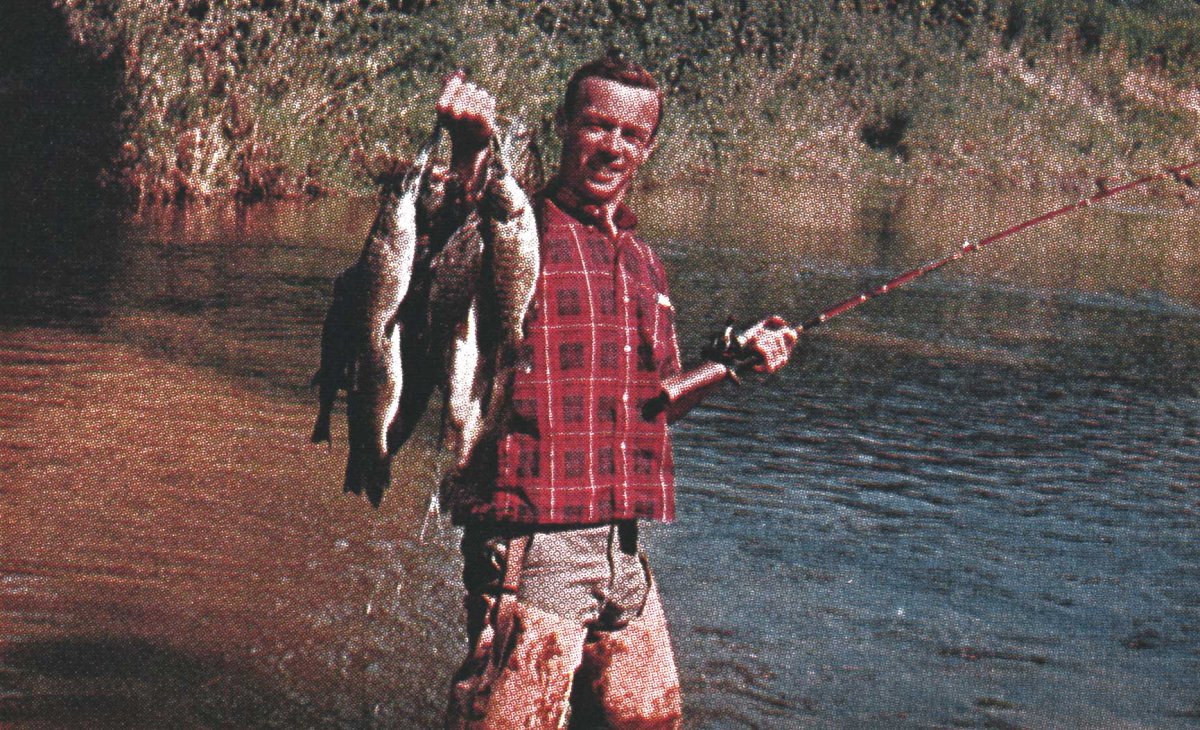

THE AUGUST SUN BLAZED DOWN and turned the wooded ravine into a long green oven. Even the sound of water tumbling over rocks didn’t relieve the sensation of humidity and heat.
I gave the oars a pull and guided the aluminum boat down the last few yards of a riffle into a quiet, shady pool. Visions of frosty glasses of beer danced through my head as I cast a floating plug toward the limestone bluff bordering one side of the pool.
What happened next made me forget beer. The plug was sideswiped by a streak of bronze, and my spinning rod began to dance. The fish, a smallmouth bass of about two pounds, caromed around the pool. That fish’s endurance was surprising. Even as I wrestled the bass into the net, it tried to dive under the boat.
“They never quit, do they?” Tom Rogge remarked from the bow. His shirt, like mine, was dark between the shoulders. He lifted a stringer of five bass, all as big as the one I’d just landed, or bigger.
“No room left,” Tom said. “I’ve already limited out.”
I raised my own chain stringer and waited for the fish on it to quiet down. There were four of them, and they were all in the two to three-pound class. The fish I’d just landed belonged in that company, and when I clipped it onto my stringer, the sight was as pretty as any a bass fisherman could hope for.
“If I wasn’t here to see these stringers for myself,” I said, “I’d swear we were a couple of liars.”
We were enjoying the second day of a three-day fishing trip. The previous day, both of us had taken five-fish limits of smallmouths up to 3½ pounds. On the second day, we strung five bass apiece so early that we spent the rest of the afternoon fishing strictly for fun, and our last day would match the first two. The bass hit during a heat wave, and some of the best strikes came on top-water lures.
This excellent fishing did not take place, as you might imagine, in some north-woods region accessible only by float plane. We found the fish just a 3½-hour drive from our suburban Chicago homes, and our success proved that some exceptional summer bass fishing is within reach of a great many Midwestern anglers.
Fishing like that is of special interest to me because I’m always on the lookout for new material on fishing or hunting. I’m a free-lance outdoor writer, and I live in the town of Half Day, Illinois. Tom Rogge, a frequent angling sidekick, is a lieutenant with the Deerfield, Illinois, police force.
We made our bass discovery in an unlikely setting—the rolling dairy country of southwestern Wisconsin. Checkered by corn fields and pastures, devoid of lakes, this region is usually bypassed by fishermen traveling to the popular lake country farther north, or westward to the nearby Mississippi.
Those who pause in towns like Lead Mine and Mineral Point learn that a flourishing mining industry was centered here in bygone days. Now the mines are abandoned, but another treasure exists in the streams that wind through the countryside. Smallmouth bass are the prize, and they live in cool, well-aerated water that keeps them full of pep in the summer.
Look at the lower-left corner of a Wisconsin map, and you’ll find a number of streams flowing southwest into the Mississippi River or into Illinois. Among the better smallmouth waters are the Grant River, the Platte River, and several branches of the Pecatonica River. These and other streams in the area also support trout in their upper tributaries. While the trout lie low in summer, however, the bass find July and August temperatures just right.
A surprising aspect of the stream fishing in this region is lack of angling pressure. There’s some local interest—farmers and other residents who fish stretches of stream that run close to their properties or cross nearby roads. Visiting fishermen are few indeed, and there are sizable stretches of highly productive water that are fished so seldom they seem like wilderness streams.
An angler is apt to have a stretch to himself because the streams are often hard to reach. The surrounding terrain is mostly rolling farmland, but these streams wind through thickly wooded valleys and ravines, well back from the roads. Where bridges do cross them, their banks are usually steep.
Float trips are the only practical way to reach much of the better water, but access points are often widely separated and difficult to negotiate. On top of all this, the bass tend to spook easily in the shallow water. Good smallmouth fishing in the streams of southwestern Wisconsin doesn’t come easily. It requires planning, hard work, and a certain amount of care when fishing, but the results are worth the effort.
During our first day of fishing on the Grant River a dozen miles from the Wisconsin town of Cassville, Tom and I learned that these stream bass are choosy. With the help of Stan Schnering, whose resort fronts on the Mississippi River at Cassville, we left one car at a back-road bridge across the Grant and then launched my boat by driving another car several miles to another bridge upstream. At both places, the steep clay banks were a challenge, but there were no other access points between the two bridges. We would be floating water that gets few fishermen a season.
Just downstream from the put-in point, the stream wound into a shaded ravine. Limestone ledges and clay banks alternated along the shore. The water swirled through green pools separated by tumbling riffles.
Occasionally I stepped over the side in my hip boots to coax the boat down shallow runs where the hull scraped on moss-covered rocks. The Grant averages about 30 feet across, and we had little difficulty casting to likely spots as we drifted along.
Tom was using a brass spinner while I worked a red-and-white spoon. Everywhere we looked, there was promising water, but the only fish we caught during the first hour was one six-inch bass. The fishing could hardly have been slower.
Then, at the tail of a long, deep pool, matters took an abrupt turn for the better. I had unclipped my spoon and was using a balsa-wood plug that’s a fine imitation of a minnow. There was a submerged rock pile a few yards above the riffle leading to the next pool, and I dropped the lure just beyond this natural shelter. I hadn’t even begun to retrieve when something smacked the plug. As Tom and I stared, the water split and a sizable dark fish plowed across the pool.
“For gosh sake, play him easy,” Tom cautioned.
I had little control over the touchy situation. For 10 minutes, the fish played me. That bass didn’t jump—it made relentless runs from one side of the pool to the other. Several times, I felt the line sawing across rocks. All I could do was slack off a little and hope. Eventually I got the fish in close enough for Tom to scoop it up with the net. My pocket scales said the smallmouth weighed 3½ pounds—a nice catch even in most lakes. In that small stream, it was astounding.
What followed was the kind of bass fishing most of us dream about. We both used balsa plugs, and we started raising fish every fourth or fifth cast. Smallmouths seemed to be everywhere—in the pools, beneath undercut banks, and behind rocks in the riffles.
Every so often, we’d spot a smallmouth swimming along in a shallow run, and one of us would cast five or six feet in front of him. The fish would turn and fan its tail with excitement. Then it would open its mouth and attack the lure. Fish of one pound and under were plentiful, but strikes from bigger ones came often enough to keep us eager. Smallmouths being what they are, the stage was set for some strange incidents.
Once, a wild-eyed bass walloped Tom’s plug and tailwalked the length of a pool. Then the line went slack.
“Oh, no!” Tom wailed. “The line broke, and that was the only one of those plugs I had.”
I had only one myself. The situation looked bleak. We began drifting into the riffle that led into the next pool, and I was reaching for the oars to keep the boat straight when I spotted something floating next to the boat. By some chance, Tom’s plug had come loose and had caught up with us in the current. I reached down and lifted it from the water.
“Here’s your lure,” I said casually and handed it over.
“How do you like that!” Tom said with a smile. “The fish in this river even return lost lures.”
The smallmouths were obliging, all right, but only when we gave them exactly what they wanted. And that was subject to change.
As our third day on the Grant began, we learned that the fish had become fickle about our balsa plugs. We got only a few half-hearted follows with the lure during the first hour. Then I happened to try a noisy topwater lure, and the go signal came back on. The moment the plug hit the water, a two-pound bass boiled out from behind a log and latched onto it.
Surface lures proved to be the specialty of the day, and once more the action was hectic. In fact, the fishing almost got out of control. As we drifted down a smooth glide, I spotted an undercut bank ahead and dropped my floater a few inches beyond the natural bass lair. What happened next is hard to describe. It seemed like a whole series of strikes all at once.
My rod tip was pulled first one way, then another. I found not one, but two bass securely pinned to the lure. A third fish was swimming close by, looking for an opening so he could add his two cents’ worth. I boated the pair of one-pounders and turned them loose. I figured we could limit out with larger fish, and I was right. By late afternoon, we both had limits of bass averaging two to three pounds.
Biggest bass of the day and of the trip was a four-pound lunker that nearly made spaghetti out of Tom’s ultralight spinning rod. I have fished some celebrated smallmouth waters, but I have seldom seen stringers to compare with those we brought back three days in a row from the Grant River.
We concluded that stream bass are likely to be a better bet than lake bass during hot weather. The time-honored rule that smallmouths head for deep holes in the summer is probably true for lakes, but fast-water fishermen everywhere know that bright, low water and warm weather often mean good bass fishing in streams.
In many lakes, surface temperatures become uncomfortable for bass, but stream temperatures are more stable. Cool springs, the current, and shady banks hold temperatures down. In August, a shallow stream may register about 65°, and that keeps bass active and near the top while a nearby lake will have surface readings of 70 to 75° and the bass will be in the cooler depths.
Tom and I talked with a few local fishermen, and they supported these theories. One farmer, who lives a short cast away from a bassy riffle of the Grant, told us that he always finds the fishing best when the sun is warm and shining directly on the water. Such weather may be hot and uncomfortable for fishermen, but it is apparently made to order for the fish.
In late September when lake fishing for smallmouths is frequently good, I returned to the Grant. The water was cold, and the fish were slow to strike and sluggish on the end of a line. I became convinced that stream fishing for bass is best in the summer.
Though floating these waters is probably the best way to fish, an angler could also find good sport by wading. A detailed topographic map would be a big help in locating promising stretches and finding the most convenient access points.
State conservation departments often publish lists of good streams. Wisconsin, for instance, has a booklet entitled Smallmouth Bass Streams, which pinpoints all the bass rivers in the state. From it, I learned that Grant, Iowa, and Lafayette counties, in the southwestern corner of Wisconsin, have close to 700 miles of smallmouth streams, not including the Wisconsin River. These counties, though not widely heralded as fishing country, are the state’s richest in bass streams. Copies of the booklet are available through the mail from the Wisconsin Conservation Department at Madison.
For best results with stream bass, fishermen would do well to imitate the techniques of trout specialists. Fine terminal tackle and a stealthy approach are important in low, clear water. The most versatile outfit would be a lightweight spinning or spin-casting rig capable of handling an assortment of lures in different weights and sizes. Six-pound-test monofilament is the heaviest you’ll need and it should be tied directly to the lure or to a small snap swivel.
Fly fishing also can be deadly with stream bass. I took some nice fish from the Grant on bugs and streamers worked in fast riffles.
Smallmouth bass are prized for their spirit and for their table qualities. To catch them during the summer, it’s not necessary to take a long trip to the north woods or play a waiting game with bait in a deep hole in the bottom of a lake or reservoir.
Read the full article here