
- Epic salmonfly hatch draws anglers. The salmonfly hatch is a highly anticipated event in the West, attracting fishermen from around the world.
- Timing is crucial for success. Monitoring water temperature and flow is key, with prime conditions around 55-56 degrees and 3,500 cubic feet per second.
- Surface action offers thrilling fishing. Big salmonflies create topwater excitement. Patterns like Chubby Chernobyls and Water Walkers (see below for more) are often effective.
- Focus on presentation and location. Casting near banks and using a twitching technique can increase success during the hatch.
Bottom line: The salmonfly hatch is a must-experience event for fly anglers, offering thrilling fishing opportunities with the right timing and technique.
Aquatic insects make up the backbone of a trout’s diet, which is why most trout fishermen (myself included) inevitably turn into bug geeks. We’ll plan our calendars around certain hatches, when various insects emerge from their pupal stage and transform into winged adults. These hatches are cyclical, and they take place on rivers year-round. But for the bug wonks out West, there is one entomological event that is easily the most hyped and highly awaited: the salmonfly hatch.
Part of the appeal is the timing. Giant salmonflies (Pteronarcys californica) typically hatch in May and early June, when the rivers are rising and the fishing season is ramping up in earnest. The real draw, however, is their size. These are the biggest stoneflies in the West, and they’re some of the largest bugs a trout will see all season. When they start emerging in big numbers to mate and lay their eggs on the water’s surface, the feeding frenzies that follow can be legendary.
I’ve fished this hatch more than a few times in different places over the years, but there is one afternoon in particular that stands out. It was early May on Oregon’s Lower Deschutes River — my home water at the time — and I was sitting on the bank after an epic morning. I’d caught so many rainbows out of one run that I was finally content to sit back and watch.
I can still remember how the slower seams and back eddies boiled with rising fish, some feeding just inches off the bank I was on. Overhead, squadrons of seagulls and other birds snatched bug after bug out of midair. I found this aerial melee especially educational, since I had never seen that many seagulls on this stretch of river before. (The Lower Deschutes flows into the Columbia River, and their confluence lies more than 200 miles upstream from where the Columbia meets the Pacific.)
“Ospreys will eat salmonflies, too,” says Elke Littleleaf, a veteran guide and Warm Springs tribal member who runs trips on the Lower Deschutes along with his wife, Alysia. “I remember about six years ago, I was watching a client fish, and there were salmonflies all over the place — hundreds of them … I’d seen this osprey hovering there over to my left, and all the sudden, I watched his legs go up as he grabbed a salmonfly. He finished eating that one in mid-flight and then I watched him grab three more.”
Timing and Locating Salmonflies
The Littleleafs are one of the only outfitters on the Lower Deschutes with rights to fish the Warm Springs Reservation side of the river. They’ve been guiding on this iconic stretch near Maupin for around 15 years, targeting trout, salmon, and steelhead. And while the river’s steelhead run is one of the biggest draws for fly anglers during the fall months, Elke says the annual salmonfly hatch is the “heart and soul” of their summer fishing program. They’ve had people from across the country and around the world who come specifically to fish the hatch.
“We have some regular clients who book a full seven or eight days during this time of year,” Alysia says. “That way they can spread out their days in case they get here toward the beginning or end [of the hatch.]”
When I spoke with the Littleleafs on May 14, they were right in the heart of their salmonfly hatch. They’d had consistent dry-fly action for four or five days in a row. Elke and Alysia started seeing the big bugs fluttering around in late April, and as their numbers grew through early May, the native rainbows started keying in on them more and more.
Read Next: How to Fish the Cicada Hatch
In terms of timing the hatch, the Littleleafs say the biggest things to track are water temperature and flow. Since the Lower Deschutes is dam-controlled, they’re able to check the USGS gauge daily to see these readings. A prime water temperature window, according to Alysia, is right around 55 to 56 degrees, and a good fishing flow on their stretch is somewhere around 3,500 cubic feet per second. Salmonflies will still hatch at higher flows, but this tends to spread out the fish more and makes wading more difficult.
As with most other aquatic insects, a salmonfly hatch tends to progress upstream as it develops, starting in the lower, warmer reaches of a river and moving up toward the colder headwaters.
“When the fish are in their usual, accustomed feeding areas, it can be like boom, boom, boom,” Alysia says. “If you hook each fish that eats [your fly], you can easily have twenty five, fifty, or a hundred fish a day.”
Another rule of thumb, Elke says, is that the hatch tends to kick off sooner during drought and low-water years (which would include 2026). And because of changes to Pelton Dam, which now releases warmer water from the surface of Lake Billy Chinook, the bugs tend to come off earlier than they did a decade ago.
“When we first started guiding, we’d have to go way down to the bottom end of our reservation and look for the salmonflies,” Elke explains. “But now that we’ve had these bigger changes [with the dam], the whole river heats up quicker.”
The Deschutes is also just one of many Western rivers with a strong salmonfly hatch. A very general list would have to include some of the bigger streams in Montana — like the Madison, the Gallatin, and the Yellowstone — along with the Henry’s Fork of the Snake River in Idaho. Down in Colorado, the Gunnison River and Rio Grande are two other bucket-list destinations for anglers chasing the big bugs.
- Madison River, Montana
- Gallatin River, Montana
- Yellowstone River, Montana
- Henry’s Fork of the Snake River, Idaho
- Gunnison River, Colorado
- Rio Grande, Colorado
Tips for Fishing the Salmonfly Hatch
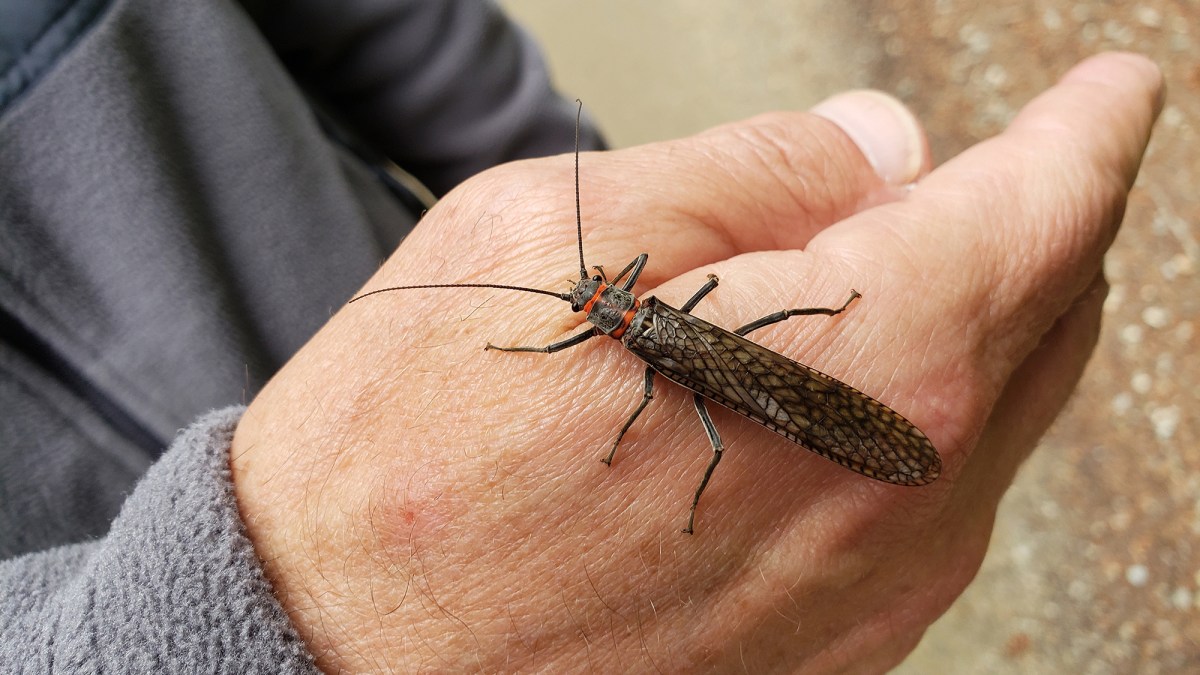
Most stonefly species have one-, two-, or three-year lifecycles, with salmonflies living in four-year broods. This means they spend the majority of their lives in the water as nymphs, where they crawl among the rocks and get pushed around in the current. Then, during that fourth year, they’ll migrate toward the banks and streamside bushes, where they break out of their exoskeletons and emerge as big dark-colored bugs with orange highlights and brownish-gray wings. This is the actual “hatch.” The bugs then only have a few days to fly around and mate before they die.
Understanding this basic life cycle is important for fly fishermen. Because while the actual emergence might only last a week or two, salmonfly and other stonefly nymphs are always in the water, making them an important, year-round food source for trout. During the weeks before and after a big hatch, you can have some epic days using weighted nymph rigs as the fish are gorging subsurface. Dead drifting a Pat’s Rubberlegs or another heavy stonefly nymph in the riffles and deep runs can be deadly around this time.
The real show, however, takes place on the surface, as the big, meaty bugs stimulate some of the hottest topwater action of the year. Although Elke and Alysia tie most of their own flies to better match their local bugs, they also rely on a handful of tried-and-true patterns to keep their clients into fish. A good starter box of dry flies would include some of the following patterns in sizes 4 to 12:
The bigger foam bugs are popular with a lot of anglers nowadays because of how durable and buoyant they are. But Elke and Alysia have found that when the wind is down, some of the more traditional patterns, like Norm Woods Specials and Stimulators, will often out-fish the bigger, gaudier patterns.
“There’s all sorts of colors and variations, and I’d say almost any fly works. They all give off the same silhouette,” Elke says. “The trick is the presentation.”
When it comes to technique, presenting a salmonfly is similar in many ways to imitating other adult insects. Ideally, you want to cast upstream of a rising fish or a prime lie, and then let your fly drift down naturally in the current. Salmonflies, however, are bigger and clumsier than smaller insects like mayflies. They move more (and with less grace) on the water’s surface. With this in mind, it can help to twitch, bump, and skitter your dry fly, as opposed to a true dead drift where the bug floats calmly like a leaf on the water.
Another key presentation tip goes back to the life cycle of salmonflies, which hatch among streamside rocks and on vegetation outside of the actual water. (This is different than, say, caddisflies, which like to hatch in the middle of riffles.) For anglers, this means shifting your focus to the soft-water seams, eddies, and other areas right up against the bank.
“One of the biggest mistakes green anglers make is wanting to bomb their fly out into the middle of the river,” Alysia says. “Most of these fish are really along the shorelines and undercut banks, which are much closer to their feet … People get in the habit of just peeling off their fly line. When a lot of the time, a quick flick with a nine-foot leader is all you need.”
As far as tackle goes, floating lines are standard. A basic 9-foot 5-weight rod will get the job done, but 6-weights are better for casting big dries into the wind. Elke says they’ll usually fish 3X tippet around the start of the salmonfly hatch, but will bump up to 1X or 2X as the trout grow fatter and stronger.
Read Next: Fly Fishing: A Complete Guide to the Most Fun and Frustrating Way to Catch Fish
The redside rainbows native to the Deschutes are some of the hardest fighting trout you’ll find anywhere, and when they turn and run in the current, they can break you off in a hurry. It’s also easy to get hung up in the grass or bushes when you’re trying to put your fly right on the bank. With these considerations in mind, it helps to have plenty of flies on hand that you can swap out with confidence.
“I put a little prayer into each fly, too. We try to give good medicine to our clientele — that’s just our Native way,” Elke says. “For us, it’s a spiritual connection. We consider it a very honorable thing to be able to take people out and catch fish this way.”
Read the full article here