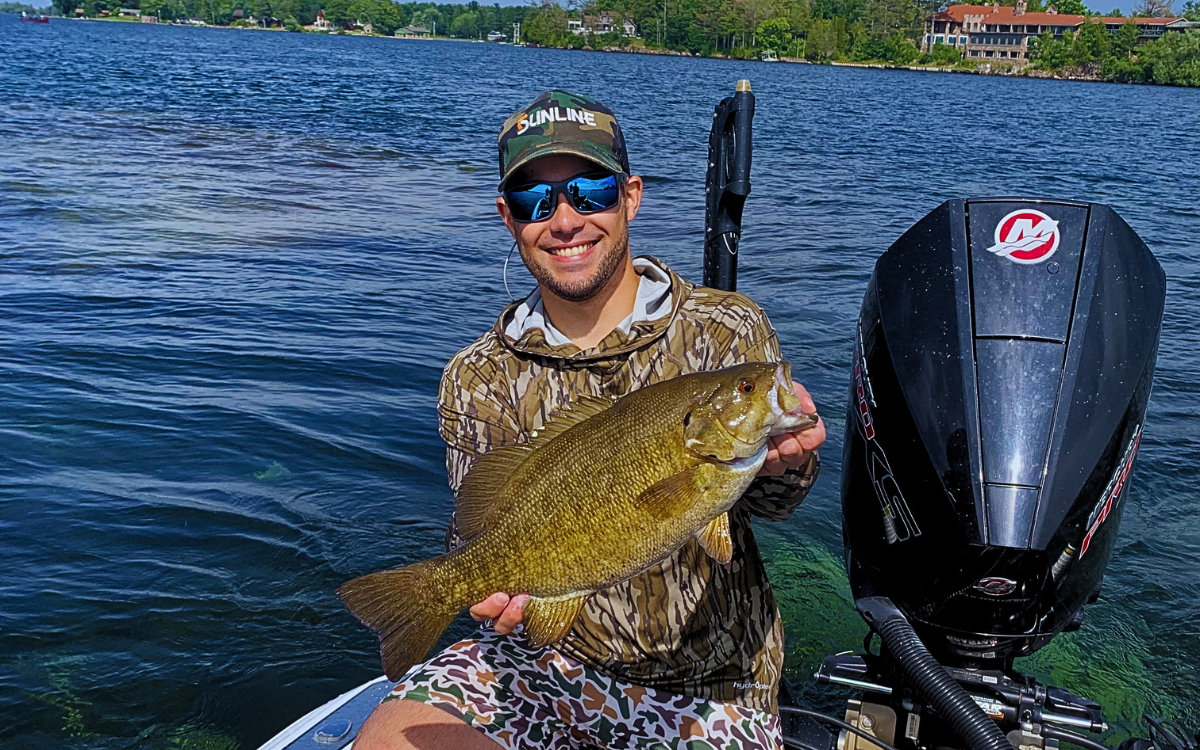

Love it or hate it, forward-facing sonar has become an undeniable part of bass fishing. You certainly don’t need it to go out and catch some bass, but it has become a tool that I use interchangeably with the “old school” methods. By reading the water and topographic maps, I know where to start, and when I get there and drop my FFS transducer in the water, I can make sure each cast is in the vicinity of a smallmouth.
While this style of fishing can be used during any time of year for almost any species, I’ve found it to be most effective for locating and catching post-spawn, roaming smallmouth that otherwise would require a heck of a lot of luck to trick into biting. Post-spawn summer largemouth typically lock down on deep structure, however summer smallmouth prefer to roam the depths in pursuit of bait balls that suspend in cooler water.
Here are three tips for catching smallmouth with forward-facing sonar this summer.
Tip #1: Go Old School to Find the Bait and Bass
To efficiently target summer smallmouth, you first need to understand their preferences during the dog days of summer. For the most part, smallmouth are a cold water species, or at least they prefer colder water over their largemouth counterparts. So, as the water temperatures spike in the middle of July, it’s safe to say the smallmouth won’t want to be shallow for very long. Rather, they’ll be headed to the depths where the water temperatures remain cool even as the brutal heat waves roll in. Just like the smallmouth, balls of bait like shad, alewives, smelt, and other schooling baitfish will seek the cooler water temperatures. This offers smallmouth an easy meal to chase around.
I rely on free mapping options like the Garmin Marine Maps Web Viewer. Almost every major lake and river has topographic data available, giving you an easy button for finding the deep water before you dump your boat or kayak in.
As you can see in the image above, these deep bowls are pretty easy to spot in the app. Once you’ve located one, all you really need to do is know where the wind is coming from and set up your boat downwind of the bowl. This will allow your bait to look more natural when you’re ready to make your first cast.
Tip #2: Learn How to Identify a Smallmouth on Your FFS
This tip might not be necessary if you’ve been doing your homework and spending a lot of time on the water with FFS. But if you haven’t then you’ll quickly realize that identifying bass on the screen isn’t as easy as you might think. Your boat is moving, the fish are moving, and your bait is moving, so it’ll take a lot of patience and practice to finally get everything lined up and ready for your first cast at a smallmouth.
The key to finding the bait and smallmouth is to cover water efficiently. Turn your trolling motor up and scan left and right while watching your screen. The bait will typically be easier to locate due to the sheer number of baitfish that constitutes a bait ball. Once you find a blotchy return, scan just to the left or right of the bait and you’ll see one (or hopefully several harder, bigger marks). That will be the smallmouth you’re looking to target.
Once you’ve found your quarry, you’ll want to cast quickly, but also accurately past the bass. If you miss your mark, reel in quickly and cast again. You might only get one or two good shots at this before the bait and bass move out of view. Once you get a cast on the right line and out past your target, let the bait sink down to fish’s level and begin to reel and bounce your minnow or lure of choice toward the mark. As you approach, ensure that your bait stays just above the mark, otherwise the smallmouth will question the unnatural presentation. Once your bait and the mark collide, you’ll likely see the bass begin to chase the bait. That’s your signal to speed up your retrieve and continue adding a pulsing action through your rod tip.
This fleeing motion triggers the smallmouth to bite before the opportunity slips away. When the bite occurs, I’m going to assume you can take care of the rest. If everything goes to plan, but the smallmouth doesn’t commit to biting, you’ll want to make a bait change and try again. These summer smallmouth are incredibly aggressive when you offer the right selection, so listen to them if they refuse a certain color or bait profile.
Tip #3: Bait Size and Jighead Selection Are Critical
Unlike certain bottom dragging techniques where you can throw with a ⅜ ounce offering or a ½ ounce offering without really changing up the presentation, strolling for smallmouth while using FFS is very different. I’ve noticed that a ¼ ounce jighead could be perfect one day, but far too slow the next. Having the ability and forethought to have a variety of weight options is the key for piecing the FFS puzzle together each time you hit the water.
The same can be said for bait sizes. Sometimes the smallmouth will be chasing larger bait, so throwing 5” or 6” soft plastic minnow will be necessary to match the hatch. Other times, you’ll need to downsize to a 3” minnow style bait to get a bite. The only real way to find out is to experiment and listen to what the fish are telling you.
To ensure I have a variety of options each time I hit the water, I have a Plano StowAway 3500 packed to the gills with every size of Berkley Fusion19 Hybrid Jighead imaginable. This lets me fish for bass that are staged high in the water column, or target deep bass chasing bait in 50 to 60 feet of water.
As for the bait offerings, I’ve leaned heavily on four different options in a variety of colors and sizes from 2.5” up to 6.25”. The Rapala Crush City Freeloader, the Rapala Crush City Mooch Minnow, the Berkley PowerBait Drip Minnow, and the Strike King Z Too. These options allow me to offer a hungry summer smallmouth whatever they might want on any given day, without having to buy an entire tackle store to throw at them.
Final Thoughts on Catching Summer Smallmouth with Forward-Facing Sonar
Regardless of what the old-school fishermen might say, catching bass with FFS isn’t as easy as they claim. What I’ve found after four seasons of fishing with FFS is that it’s a very effective tool that requires plenty of practice to become remotely efficient at. But once you start to figure it out, it can be a ton of fun for you and your fishing partners.
If you’re looking for some mid-summer smallmouth action, there’s not a more reliable way to locate and fish for them than with FFS over deep water while they gorge on bait. Prior to FFS, these smallmouth spent months without seeing a lure, but now, you can capitalize on the new technology and have a banner day of smallmouth fishing, even during the dog days of summer.
Read the full article here