

The Best Cellular Trail Cameras: The Complete Guide to Cell Cams and Subscription Plans


Some hunting gear doesn’t change much year-to-year. Things like ladder stands and even crossbows aren’t making innovative leaps every 365 days. But, trail cameras are constantly evolving and far from a performance plateau. The new cameras and their compatible apps have batteries that last an entire season, use AI to parse data, have GPS so you don’t lose a camera, and the affordable cameras are actually reliable.
The latest offerings solve all the problems we had with past cameras and add on features you never knew you needed. We tested eight new cameras for 2026 with our walkthrough test and in the field to help you figure out which cellular trail camera is right for you.
In This Article
Trail Cameras Reviewed
Test Info
Cellular Trail Cameras Compared
| Camera | Price | Plans from | Trigger | Night flash | Power | Walk-through test (10 / 60 / 110 ft) |
|---|---|---|---|---|---|---|
| Tactacam Reveal Pro 4.0 Solar | $200 | $5/mo | 0.4s | Low-glow or no-glow (you choose in the app) | Solar panel + R5 pack included | ✅ / ✅ / ❌ day and night |
| Stealth Cam Fusion Max 3 | $75 each in a 2-pack | $5/mo | <0.4s | Low-glow | 16 AA or lithium pack | ✅ / ✅ / ❌ day and night |
| Stealth Cam Deceptor Max 3 | $120 | $5/mo | <0.3s | No-glow | 16 AA or lithium pack + solar | ✅ / ✅ / ✅ day and night |
| Stealth Cam Revolver Pro 3.0 | $130 | $5/mo | <0.4s | Infrared | 16 AA | ✅ / ✅ / ❌ day and night |
| Moultrie Edge 4 Solar | $170 | $8.99/mo | 0.4s | Low-glow | Built-in solar + rechargeable battery | ✅ / ✅ / ❌ |
| SpyPoint Flex-M2 | $100 for a 2-pack, $130 for a 3-pack | Free (100 photos) | 0.4s | Low-glow | 8 AA or rechargeable pack | ✅ / ✅ / ❌ |
| Spartan GoLive 2 | $190 | $15.99/mo | 0.4s | No-glow | Internal battery; AA, 12V or solar | Day ✅ / ✅ / ✅, night ✅ / ✅ / ❌ |
The Best Trail Cameras: Reviews and Recommendations
Best Overall: Tactacam REVEAL Pro 4.0 Solar
Get the Solar from Bass Pro
See the Whole 4.0 Lineup
Pros
- A $290 package for $200
- Good battery life
- Good image quality
- Capable app
Cons
- Camera is not compatible with previous lithium cartridge models
Key Features
-
Warranty:
1 year from activation date -
Photo Definition:
4K (UHD), 2.5K (WQHD) -
Flash Range:
Low Glow – 96 feet; No Glow – 80 feet -
Memory:
8GB internal storage with optional SD card slot -
Power:
12 AA batteries (not included); optional external power source (5K External Battery Pack or solar panel included) -
External Power:
DC 12V-2A input -
Live video -
Built-in monitor -
Built-in GPS -
Two-axis tree mount -
Includes:
REVEAL Pro 4.0, solar panel and R5 battery -
Price:
$200
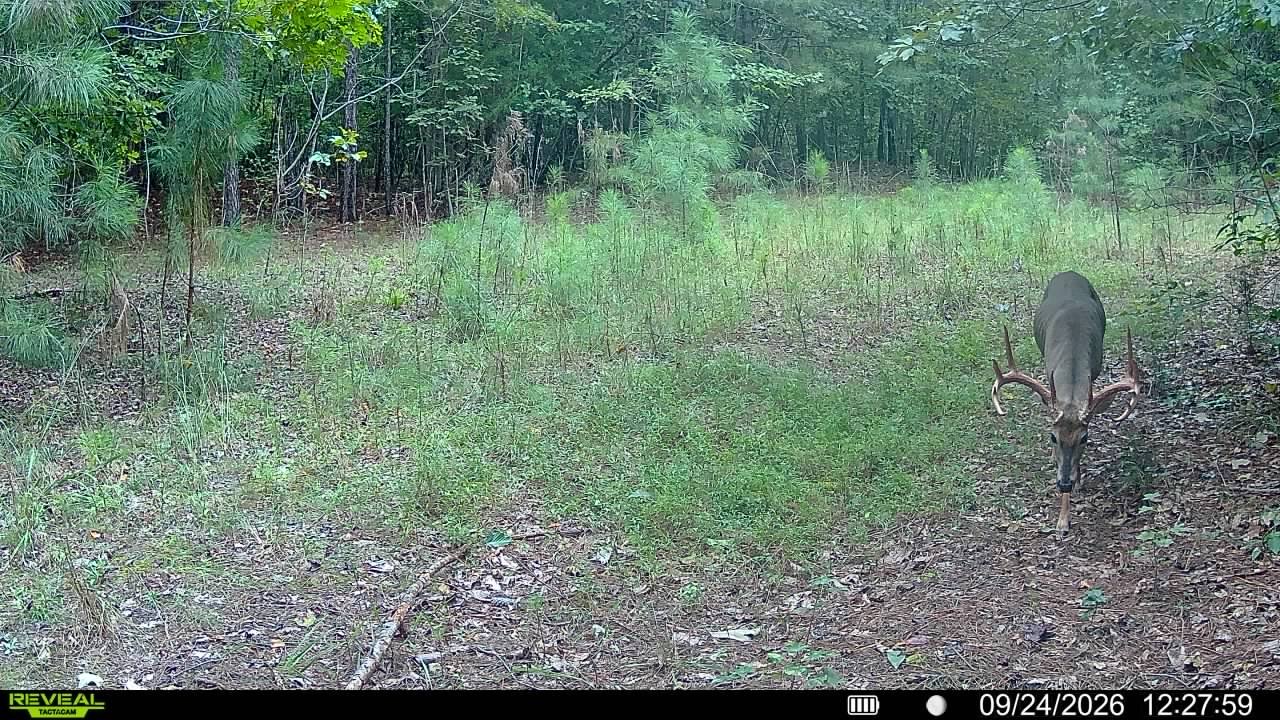
In the walkthrough test the Pro 4.0 triggered with 100 percent reliability at 10 and 60 feet, catching me as I entered the frame from both directions during the day and at night. It did not trigger at 110 feet, day or night, which isn’t uncommon. With the camera set to Low Glow, it puts out a nice, even IR flash that illuminates a wide area out to about 100 feet. What I appreciate most is that it doesn’t blow out detail up close and still has plenty of brightness to clearly see animals at 60 feet. Like the 3.0, you can adjust between No Glow and Low Glow settings right in the app.
The new Reveal 4.0 cameras come in three models, the 4.0, Pro 4.0, and Pro 4.0 Solar. I’ve tested all three and they all perform great, but I’d recommend the Solar for most people because it’s such a great value. If you were to buy a 4.0 Pro and an R5 battery pack separately, your cart total would be $220. But the Pro 4.0 Solar costs $200 and includes a solar panel — so it’s the better buy for anyone who’s already thinking about getting an R5 for their trail camera. If you want to get the larger R10 battery and don’t need the solar panel then the 4.0 or Pro 4.0 would be the better option — the main difference between the two is the Pro’s built-in monitor.

4.0 Pro Video
In the field, the 4.0 Pro and 4.0 Pro Solar are capturing valuable deer intel for me. I have one set up on a travel corridor and it’s grabbing photos of deer at 20 to 25 yards. One of my favorite Tactacam features is that you can have the camera set to take a photo and a video on the same trigger. This is huge in the timber when the deer’s head is behind a tree in the photo or you want to see how deer are entering or exiting a spot.
The battery life on the Reveal cameras is good. The R5 battery is lasting me a little over a month with instant send and several hundred photos per week. If you really want to put a camera out for the entire season, the R10 battery will double the R5’s battery life and you can extend it further with a solar panel.
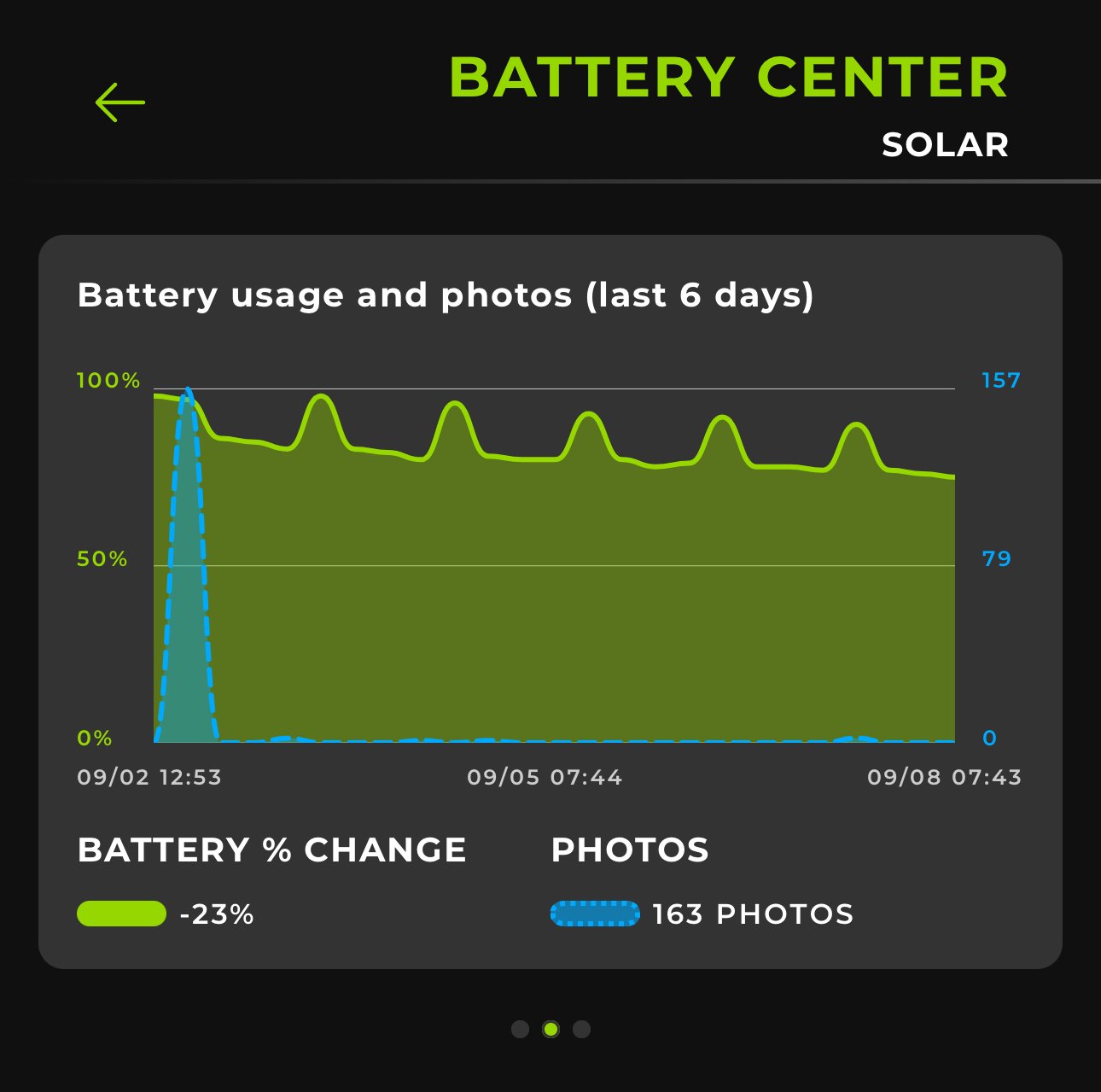
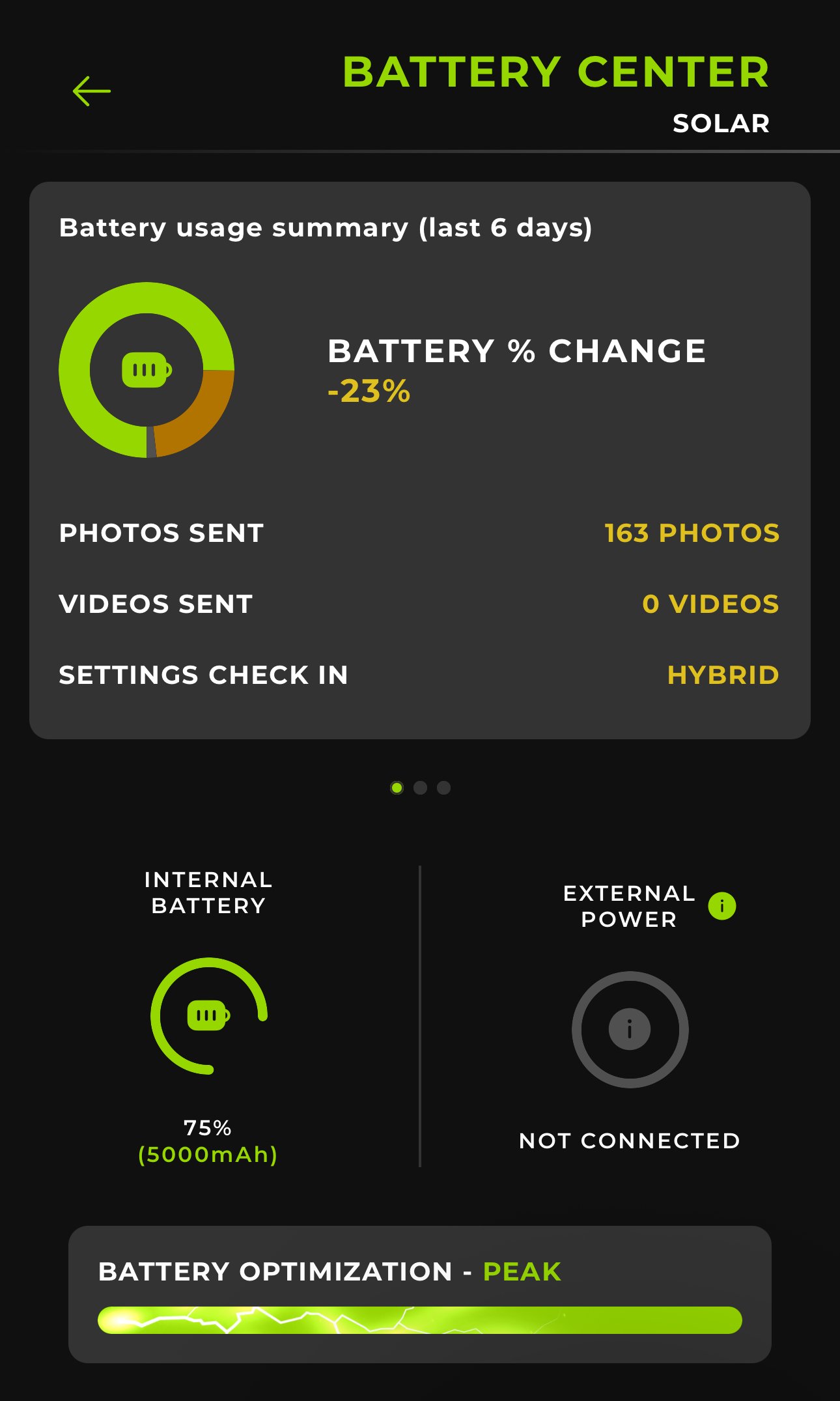
If you’re really into adjusting your camera settings to maximize battery life, there’s a Battery Center feature in the Reveal app. It shows a summary of battery usage, how well the solar panel or external battery pack is performing, and suggested settings for maximizing battery life. You can click the Battery Saver setting and hit Apply to get the most battery life possible — or just keep the settings on Instant if you’re like me.
Best Value: Stealth Cam Fusion Max 3
Get a Two Pack From Bass Pro
Get a Single Camera from Bass Pro
Pros
- Fast trigger speed
- Feature-rich app
- Excellent battery life
Key Features
-
Resolution:
42 MP photos and 1080p video -
Power:
16 AA batteries or rechargeable lithium cartridge -
On-demand photos -
Camera feed can be shared with friends -
Plans from $5 to $20 per month -
GPS App with species filter -
Price:
$150 for a two-pack or $80 for one
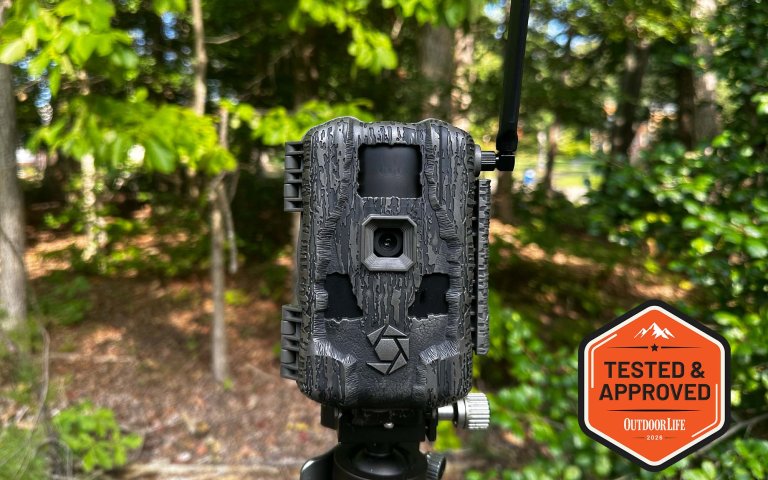
If you buy the Stealth Cam Fusion Max 3 in a two-pack, it costs $75 per camera. It’s packed with features, has a very fast trigger speed and has been reliable in the field with great battery life.
In the daylight walk-through test at 10 feet, it caught me twice while I walked from right to left. When I walked from left to right, I got two blank photos. At 60 feet, it took four photos of me walking right to left and two walking left to right. It didn’t trigger at 110 feet.
The night performance was similar, with multiple captures at 10 and 60 feet and no trigger at 110 feet.
In the field, I aimed the Fusion Max 3 at a cluster of oaks dropping acorns. I don’t have a lot of oaks where I hunt, so several in one spot are a major draw. In a month, the Fusion Max 3 racked up 1,600 photos of deer, squirrels, raccoons and turkeys. The battery is still full with the send setting on instant, though I’m using the optional lithium cartridge upgrade. The photo quality is good overall. The night photos are especially good, with a nice, even flash that doesn’t blow out any details — even when deer are very close to the camera.
The app lets you filter by species, and it even separates whitetail does from whitetail bucks. You can locate the camera by GPS right in the app. The app also has a huge amount of data on how many photos were taken during different moon phases, wind directions and temperatures.
The Fusion Max 3 has good performance, excellent battery life and a powerful app at a very reasonable price. That makes it my pick for the best-value trail camera of 2026.
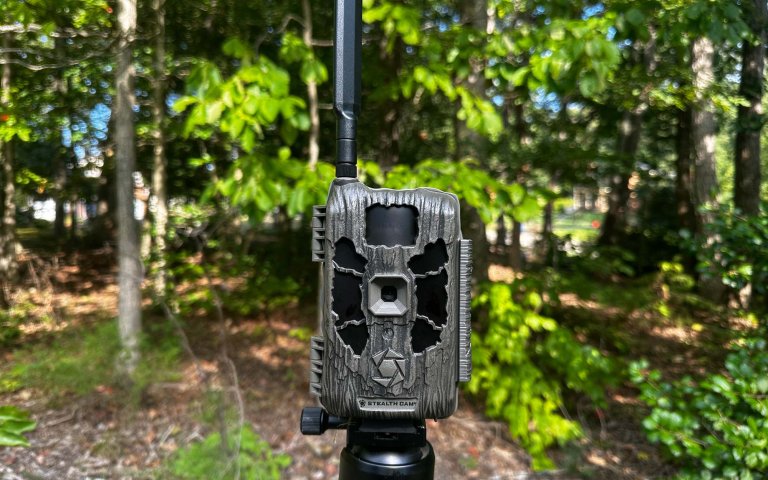
Best Trigger Speed:Stealth Cam Deceptor Max 3
See It
Pros
- Excellent trigger speed and sensitivity
- Great app
Cons
- Some motion blur at night
Key Features
-
Resolution:
50 MP photos and 1440p video -
No-glow flash -
Power:
16 AA batteries or lithium cartridge -
Live view -
Camera feed can be shared with friends -
Plans from $5 to $20 per month -
Price:
$120
In the walk-through test, the Deceptor Max 3 showed off its advertised 0.3-second trigger speed by capturing multiple photos per pass at every distance. At 10 feet, it took two photos of me walking right to left and three walking left to right. At 60 feet, it took only one photo from right to left but five from left to right. At 110 feet, it was one of the few cameras to trigger, taking one photo on the right-to-left pass and two from the other direction. The night performance was nearly identical, with multiple captures at all distances. That’s superb performance in this test, and it makes the Deceptor Max 3 a fantastic camera for travel corridors.
In the field, I set up the Deceptor Max 3 on a saddle that doesn’t get much traffic early in the season but is a deer highway during the rut. I paired it with a solar panel and a rechargeable lithium battery to keep it running through November. It has taken 361 photos in the month it has been in the field with the instant send setting and hasn’t lost any battery life. Based on the Fusion Max 3 taking 1,600 photos with no battery drain, the Deceptor Max 3 might stay in the field until turkey season.
The camera’s photo quality has been good. I was impressed by how well it handled the harsh shadows at its location: Pockets of sun and deep shade appear fairly evenly exposed in the photos. Camera nerds would call that good dynamic range.
Stealth Cam Revolver Pro 3.0
See It
Pros
- Ideal for fields and open hardwoods
- Versatile
Cons
- Best used with a trail camera stake
Key Features
-
3 modes: single-zone capture, 180-zone capture, and full 360-zone capture -
4MP, 8MP, 16MP or 50MP photos -
.4-second trigger speed -
Price:
$130
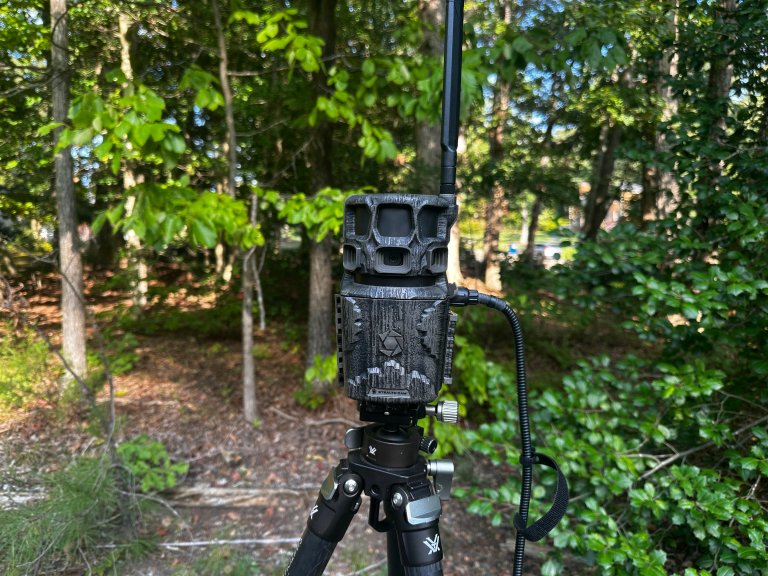
The Stealth Cam Revolver Pro 3.0 is a unique camera that solves the problem of deciding which way to aim a camera. That choice is especially hard in open hardwoods and fields, where nothing funnels deer movement. It takes photos in all directions, so you never have to wonder about the deer you missed because they walked behind your camera.
The Revolver Pro 3.0 triggered at 10 and 60 feet, both day and night, with no triggers at 110 feet. Several of its cameras caught me as I started the walk-through test and then walked past it.
Moultrie Edge 4 Solar
See It
Pros
- Fast trigger speed
- Improved HD image quality
- Includes solar panel and rechargeable battery pack
- Excellent app
Cons
- Battery pack did not stay in camera
- Pricey
Key Features
-
GPS enabled -
All photos sent in HD quality Internal memory (No SD card) -
Advertised detection range:
100 feet -
Trigger speed: .
.4 seconds -
Integrates with Moultrie feeders -
Syncs with OnX Hunt app -
Image/Video:
40mp photos; 1080 video -
Price:
$170 plus $9 per month plan
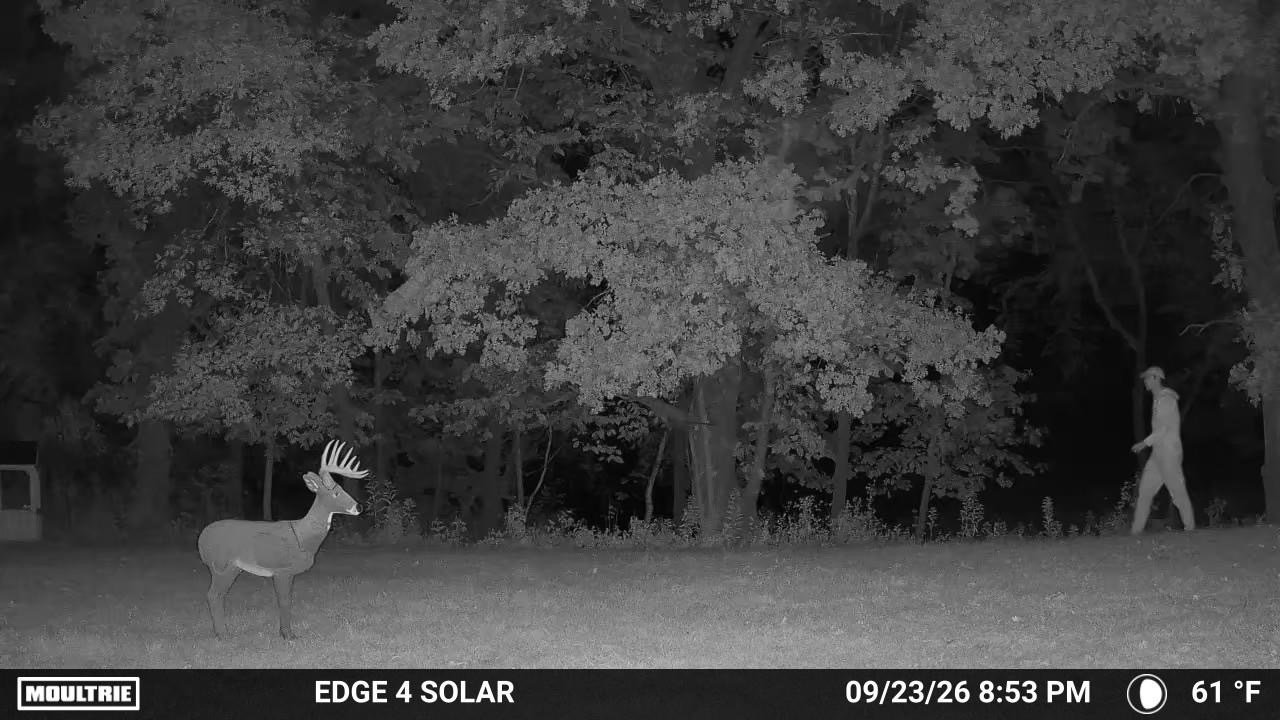
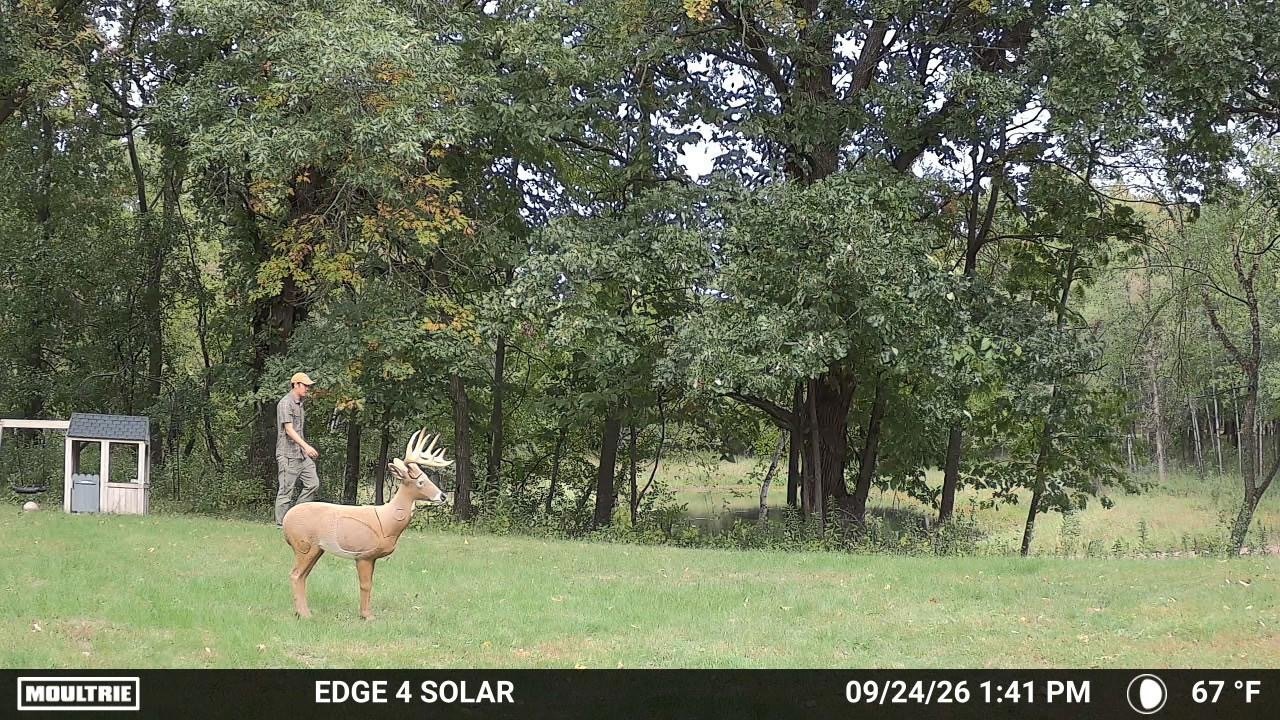
This tricked out Edge 4 from Moultrie has a bunch of upgrades that are worth discussing, but first the downside: when I set this cam up I was not able to get the battery pack to stay in the camera body. Something malfunctioned with the latching mechanism so I had to zip tie the rechargeable battery into place. I expect that this issue was unique to my camera, but it’s not what you like to see in a unit that costs $170.
Now on to the good stuff. It’s clear this camera has a very quick trigger speed as it was able to capture 8 photos of me crossing at 10 feet in the walkthrough test. It also seems to have a generously wide detection range, because it caught me at the edge of the frame at 60 feet. It did not detect me at 110 feet.
What I have always liked best about the Moultrie system is the app. It has a bunch of features (like camera mapping, weather prediction, an AI image recognition filter, and game activity prediction) but it’s also very easy to navigate. One important upgrade is that now all photos are sent in HD mode, so you no longer have to wait to download the high resolution image of a potential shooter buck. This makes scouting with the app even more streamlined.
Moultrie successfully improved nighttime image quality with this camera. Night images are much sharper and clearer with the Edge 4 compared to previous versions.
Lastly, the rechargeable battery pack and integrated solar panel should keep this camera running for months on end, if not the entire season. I’ll continue to test those features throughout the deer season, assuming my ziptie holds in place. — Alex Robinson
Most Affordable Plan: Spypoint Flex M-2
See It
Pros
- Affordable
- Easy setup
- Affordable plans
Cons
- Didn’t send photos immediately
- Questionable battery life
Key Features
-
GPS Enabled -
Advertised detection range:
90 feet -
Photo/Video resolution:
32 MP; 1080 video -
Trigger speed:
.4 seconds -
Connects to multiple networks -
“Buck Tracker” AI image filter -
Requires SD card -
2-Year warranty -
Price:
$80 per camera plus $4 per month plan
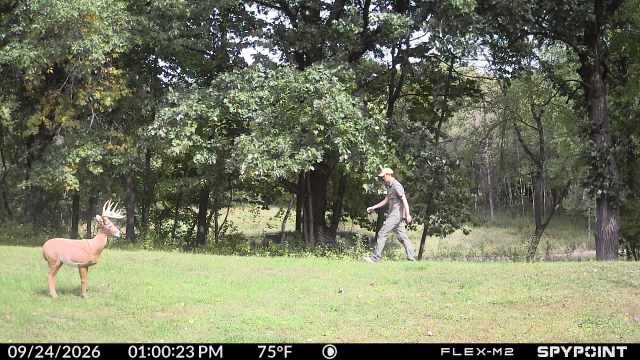
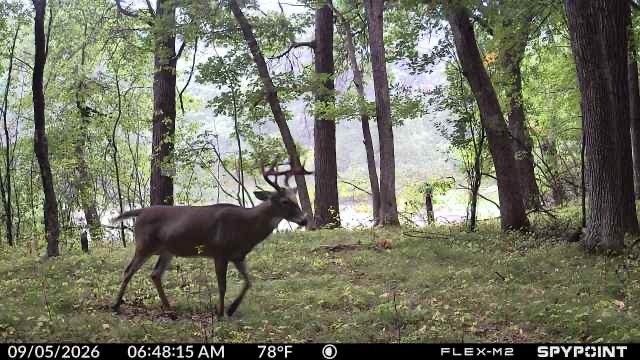
If you need affordable cell cameras to get you in the game, then look no further than the Spypoint Flex M-2. You can get a two-pack of these cameras for $100 or a three-pack for $130. Plus Spypoint offers very affordable plans starting at only $4 per month (for 250 photos). Unlimited photos costs only $10 per month. That’s as good of a deal as you’ll find in the trail cam game.
Plus, this camera is easy to use and intuitive to set up. Spypoint has improved the durability of this camera and it’s more weather-proof than previous models. It’s capable in the field too. The camera caught me easily at 10 feet and 60 feet (but did not detect me at 110 feet).
On the downside, I did have some trouble with photo transmissions. In a few cases the camera took a few hours to transmit a photo after it was triggered. While photo quality was solid, it’s not as sharp as some of the more expensive cameras in our test. Also, the camera ran out of batteries after about a month and a half. I was using Duracell AA batteries so I’ll probably swap to rechargeable lithium batteries for better performance.
Overall, these cameras are a screaming deal. They come with a 2-year warranty and are definitely worth adding to your arsenal. — Alex Robinson
Spartan GoLive 2
See It
Pros
- Triggered at all distances during the day and out to 60 feet at night
- Live function works with just a slight delay
- Easy to use and set up
Cons
- App could be improved with species filters
- Expensive
Key Features
-
Live streaming up to 30 FPS -
Multi Carrier Transmissions -
96 degree field of view -
Infrared flash -
Anti-theft GPS -
Uses micro SD cards -
Uses 12 AA batteries -
2 year warranty -
Price:
$330 -
Plans from $16 to $33 per month
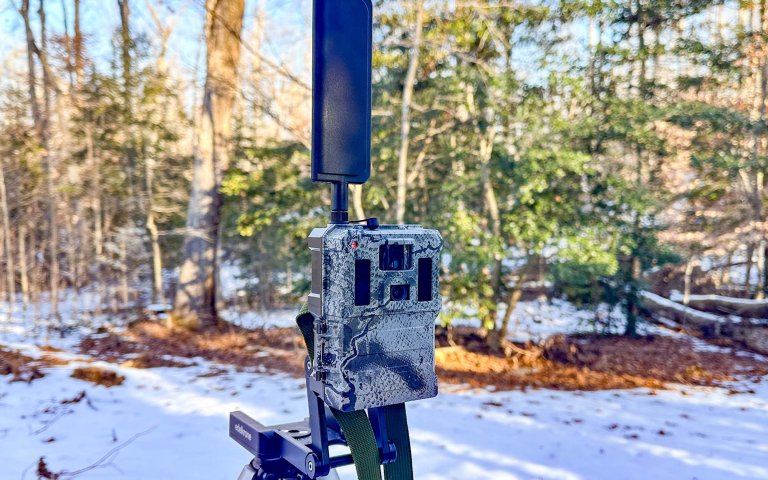
I’ve had the Spartan GoLive2 in the field for nine months and its been a great camera. The live works quickly every time and I get great quality videos. The issue I have is that the live video feed can vary in its image quality. Occasionally, it’ll come in pixelated, clear up, and then become pixelated again. I find the live is best used in wide open fields or for seeing animals that are inside 15 yards.

Spartan GoLive2 Video
The Spartan GoLive2 showed solid performance in the walkthrough test, capturing all distances during the day and out to 60 feet at night. In the field, it captured coyotes on the move and deer feeding at distances from 10 to 75 feet, with very few blank photos.
I primarily use the GoLive 2 in video mode. The videos populate in the app and are ready to view instantly. The video quality is great, but the flash range on videos is low compared to photos.
The technology within the Spartan GoLive2 is impressive. However, the camera itself needs improvement. The camera struggles to find the right exposure at night and during daylight. It most often over exposes images, which reduces detail.
Another issue is the shutter speed is too slow — probably because the camera is trying to use a lower shutter speed to gather more light — and I get a lot of blurry images. A quick software update would probably fix those issues and I hope Spartan releases one because aside from that, the camera has been excellent in the field. — Scott Einsmann
Cellular Trail Camera Plans Compared
| Brand | Plan | Month-to-month | Paid annually | Photos per month | HD / video | Notes |
| Tactacam Reveal | Starter | $5 | $55/yr | 250 | HD: $5 per 50 | Overage $5 per 250 photos |
| Tactacam Reveal | Intermediate | $8 | $85/yr | 500 | HD: $5 per 50 | |
| Tactacam Reveal | Pro | $13 | $120/yr | Unlimited | Unlimited HD photo & video requests | |
| Tactacam Reveal | Xtra add-on | $4 (1 cam) / $7 (2) / $9 (3+) | Unlimited HD photo & video, low-light color | Live View is $6/mo per camera extra | ||
| Moultrie (Edge) | Standard | $9.99 | $107.88/yr ($8.99/mo) | 1,000 | 10 videos | Add 500 images for $4.99 |
| Moultrie (Edge) | Unlimited | $16.99 | $155.88/yr ($12.99/mo) | Unlimited | 50 videos | |
| Moultrie (Edge) | Pro Series | $34.99 first cam, then $7.99 each | $275.88/yr first cam, then $95.88 each | Unlimited | 50 videos | Includes HuntPlan; aimed at 4+ cameras |
| SpyPoint | Free | $0 | $0 | 100 | Only free tier among the five | |
| SpyPoint | Basic | $5 | $48/yr ($4/mo) | 250 | HD packs: $5 per 50 photos or 20 videos | |
| SpyPoint | Standard | $10 | $84/yr ($7/mo) | 1,000 | HD packs: $5 per 50 photos or 20 videos | Insider Club price: $8/mo |
| SpyPoint | Premium | $15 | $120/yr ($10/mo) | Unlimited | HD packs: $5 per 50 photos or 20 videos | Insider Club price: $12/mo |
| Stealth Cam | Standard | $5 | $60/yr | 600 | 200 video previews; HD video $0.25 each | 4K photo downloads, Live View and maps included |
| Stealth Cam | Plus | $8 | $96/yr | 1,200 | 400 video previews | |
| Stealth Cam | Unlimited | $20 | $240/yr | Unlimited | Unlimited previews, 10 HD videos | Multi-camera discount: $20 / $15 / $11 (cameras 3–7) / $8 (8+) |
| Spartan (GoCam) | 1-month shared | $15.99 | Depends on data used (~1,500 thumbnails per 500MB) | Premium features included | Shared plan covers up to 3 cameras; extra cameras $5/mo | |
| Spartan (GoCam) | 3 / 6 / 12-month prepaid | $64.99 / $109.99 / $199.99 | Depends on data used | Premium features included | Up to 5–10 cameras |
How We Test the Best Cellular Trail Cams
We test cell cams both objectively and subjectively. Out of the box we fire them up and connect them to related apps. Then we run each camera through a straightforward walkthrough test. After that we hang the cameras in the field and utilize them just as any hunter would run cameras on a property. We’ve been testing trail cameras for several years now. So we have years of experience with certain cameras, and only a few months of data on other cams. But as we let each of these cameras soak (and as new models come out) we’ll continue to update this story with new info.
The Walkthrough Test
Each cellular trail camera is set to its fastest shooting mode and highest sensitivity. Markers are placed at 10 feet, 60 feet, and 110 feet. Then the tester walks past the camera (left to right and then right to left) at a medium pace at each given distance — about the speed of a rutting buck tromping through the woods.
The walkthrough test is then repeated at night. From there we analyze the results for blank photos, failures to trigger, blurry images, and overall photo quality. The test is meant to measure the camera’s detection range, trigger speed, shutter speed, and flash range.
Field Testing
We set each camera in the field to see how it performed in real world conditions. We set cameras in areas that had reasonable cell service. In the field, we evaluated the camera’s photo quality, reliability, and ease of setup. This included the ability to use each camera’s app to review and sort photos. Over time, we get a sense of the camera’s durability – but this can very greatly from camera to camera (even among the same brands and models).
The Test Team and Locations
- Scott Einsmann, gear editor, Virginia
- Alex Robinson, editor-in-chief, Minnesota and Wisconsin
Read the full article here
