
A cold wind hit us as we broke out of timber from our camp near the mouth of Ormond Creek. We kicked the horses out to the gravel bars of the Slana River, which drains out of the great Alaska Range of mountains. It was late September, 1964, and we were heading for a day of hunting for moose, caribou, and grizzly bear.
Just as we reached the river bar, my foreman and assistant guide, R. L. Ford, said, “Don, what’s that down near the edge of the willows?”
I pulled up old Monty, my saddle horse, and slid off to get a better look through binoculars. A grizzly ambled into my field of vision. He was roaming the bar. As I kept the glasses on him, he stopped to dig at a clump of pea vine.
“Grizzly,” I called. “The wind is right and he’s only about 400 yards away. Let’s get Jackie on him!”
While this short conversation was taking place, Jackie Hoyle and her husband Roy, and my 15-year-old daughter, Maude Ann, came up behind us.
“What do you see, dad?” she asked.
“A grizzly for Jackie,” I replied. “Come on, Jackie, I want you much closer. He’s too far for your .300 Savage.”
While the others held the horses, Jackie and I started the stalk, keeping in the low willows on the bank. The grizzly was still worrying the pea vines. We eased down the bank until we were within 175 yards of the bear.
“Close enough,” Jackie whispered. Knowing this gal from past trips with me, I knew she was right.
“Take a rest over that old blow-down spruce, Jackie,” I said. Just as she flopped down at the base of the dead tree, the bruin seemed to sense something was amiss and stopped digging. He looked up.
“Better slam him through the shoulders and break him down,” I whispered. “He hasn’t far to run if he heads for the bush.”
Jackie squeezed off her shot just as the grizzly started to move. At the blast of the Savage Model 99, he went down, but was instantly back on his feet, roaring and bawling. Jackie cranked in another shell as the bear set out on a dead run for the thick spruce. Just as he hit the treeline, Jackie’s rifle cracked again, and the grizzly was blasted off his feet. He started biting at everything within reach, but this time he stayed down.
The grizzly was still breathing when we reached him, but the 180-grain Remington Core-Lokt bullets had finished him. Jackie’s first bullet hit him when he was moving and had gone too far back. The exit holes of both bullets, however, left openings that I could stick my fist in. By this time the rest of the gang had joined us and congratulations flew fast.
To go back a bit and tell you how all this came about, I should start with Roy Hoyle, 36, and his wife, Jackie, 35. Roy drives a cross-country tractor-trailer outfit and Jackie keeps the fires burning at their home in Lincolnton, North Carolina. Jackie, incidentally, had never done any hunting until her marriage to Roy. But as soon as she realized she was destined to become a hunter’s widow, she decided to join him. Jackie has the best ability to spot game in the bush of any woman hunter I have ever guided, and the day is never too long for her. We had planned to hunt for six or seven days on this trip.
The Hoyles had hunted with me on two previous trips to Alaska, taking Dall sheep, caribou, and grizzly. They had also been on a trip with me in Texas for the exotic sheep, the mouflon, down in the hill country near Austin. So, like many ardent hunters, they were back for another trip. They both had taken good Dall rams and caribou in one of our other camps this season.
I’m a big-game guide and outfitter from Slana, Alaska. I operate out of Hart D Ranch in Slana, which is located in the heart of the Mentasta, Wrangell, and Alaska mountain ranges in eastern Alaska. I have been working in this business from Alaska to Mexico for about 30 years.
My daughter, Maude Ann, is a freshman in high school. Since the nearest high school is 70 miles away, the state of Alaska provides her with a course from the University of Nebraska by mail. She takes her books along into the hunting camps and combines her studies with her first love, big-game hunting. She has hunted from Texas to Alaska, taking mouflon sheep in Texas and mule deer in Colorado.
I decided to take the Hoyles and my daughter up to our old hunting country on the headwaters of the Slana River from which Roy and Jackie had made their first trip back in 1959. Both Roy and Jackie wanted a moose and they were, of course, always looking for grizzlies. We left the ranch on September 26 and trucked the horses to Mentasta Village, where the old trail takes off. Seven hours and 19 miles later, we rode into Ormond Creek camp with plenty of time to set up our gear before dark.
Other members of the party were Everett Hall, 62, from Mitchell, South Dakota, who had been putting in the summer working on the ranch, and R. L. Ford, 40, my right-hand man and assistant guide.
To get on with our day’s hunt, I decided to leave R. L. to skin out Jackie’s grizzly, which was a boar that would square about seven feet. The rest of the party would swing out of the valley of the Slana, into a side valley which we have named Death Valley because of the amount of game bagged there in past years. As we prepared to leave, the sky turned a dirty gray and the wind began to blow harder from out of the southwest.
“Sure feels like snow, Roy,” I said as we started the long ride up the mountainside. “Better try to find you a decent moose today if we can.”
The snow in the high valleys was already four inches deep. From past experiences, I knew the horses could be belly deep in snow by morning if a storm set in.
“Daddy, you promised to let me shoot a caribou and don’t you forget that,” Maude Ann reminded me.
We stopped for a minute to let the horses catch their wind. As I looked down the valley and across the Slana, I spotted two small bull moose sparring and putting on a big show for three cows standing nearby. The rut was in full swing and both moose and caribou were on the move, which is the best time of the year to hunt for these trophies. As we watched from a distance, a larger bull strode from the woods and rushed the young paddle heads. The young bulls discreetly decided to do their courting elsewhere and took off at a good clip. I glassed the new arrival carefully through my 7 x 35 Bushnell Custom binoculars.
“How big is he?” asked Roy.
“Maybe around 50-inch spread. We can do better than that.”
As we topped out at the mouth of the valley, I paused to look over the valley floor and the chain of small lakes strung along its length. The lakes were feeling the icy clutches of winter, and some of the smaller ones were already frozen. No animal life was in the open caribou flats, but on the steep slopes of a mountain near the other end of the valley we spotted four cow moose. They were traveling fast.
“Daddy, why are they moving so fast?” asked Maude Ann.
“Don’t know,” I replied. “Maybe a grizzly spooked them, or they may have pulled out and left a couple of old bulls fighting back there.”
In late summer and early September, bull moose can be as elusive as whitetail deer in a cedar thicket, but as fall progresses and the rutting season begins, things change rapidly. They start polishing the velvet from their antlers and are soon digging out rutting holes in which to urinate. They get down on their knees and roll and work around in this mess until they stink to high heaven.
Sure enough, as we watched, a fair-size bull came around the shoulder of the mountain and took up the trail of the cows. About 50 yards behind, two more bulls came into view. These were smaller and they were keeping some distance behind the larger bull. None looked trophy-size, so we swung through the scattered spruce and alder thickets on the west side of the valley. We were following moose trails that threaded along the base of Belcher Mountain. Moose sign was everywhere. We worked our way two miles back into the valley. The wind was raw and had now switched from southeast to east. We slid off the horses and led them over a small side ridge which ran down the mountain and into the bed of a small creek now frozen solid. As we topped the bank on the other side of the creek, Monty pulled back sharply and snorted. At this instant, the stench of a rutting moose hit me square in the face. I reached for my .44 Magnum Smith & Wesson revolver. A bull, less than 50 feet away, showed up on the trail and started coming toward us at a good clip. He suddenly stopped, looking hard at me and shaking his head as though he were planning to take on my horse. I had the .44 ready.
“That moose has ideas that Monty is either a girl friend or another bull,” I said to Roy.
The moose was still holding his ground, and rather than get into any possible mix-up with him I drove a shot three or four feet to the side of the trail alongside him. This shook him up a bit, and he slowly turned and moved off.
We mounted up and rode on to Granite Creek, where we stopped in a small grassy bend to eat lunch and to let the horses paw out some grass in the snow.
After lunch, we struck out up the west fork of Granite Creek. After a mile or so, we stopped and led the horses through a gut off a canyon on a narrow rocky trail which crisscrossed the stream several times. It was slippery on the sliderock and snow, and a man or horse could easily have slipped and snapped a leg. So we took it easy.
We were now on the south side of the entrance to Caribou Valley and were gradually making a circle toward our camp on Ormond Creek. The wind was behind us now and had dropped to a stiff breeze, which is bad for hunting as our scent would carry ahead of us, but nothing could be done about it.
We rode out into the widening valley and saw a bunch of moose that had no doubt picked up our scent. They were moving up and out of a side gulch on the mountain. As they came into the open, we saw five cows and, trailing close behind them, a bull. Putting my glasses on him, I saw he looked pretty good. They were about 800 yards away.
“How does he look?” asked Roy.
“Looks like a fair head to me,” I replied, “but we will have to get closer. Let’s move up to that rocky ridge.”
The ridge was about 100 yards long, thrusting about 150 feet above the valley floor. Meantime, the moose had stopped and were watching our horses. The old bull began hooking the brush with his antlers, not much concerned with our presence. The cows apparently thought that if the old man was not worried, they’d also hold still.
One old cow, however, never took her gaze from us. About this time, two of the cows bedded down on the grassy slope, and the bull and the others began to move into the thicket. The bull continued to horn the brush as though sparring with a real adversary.
While this was taking place, we had reached the shoulder of the rocky outcrop and ridden in behind it out of sight. I instructed Jackie and Maude Ann to lead the horses out in the open so the moose could see them. I have used this trick before to hold the attention of game while stalking. Roy was carrying his Remington Model 721 rifle, which he had converted to a .300 Weatherby Magnum. We took off behind the rocky spur toward the moose, keeping out of sight and traveling fast to get to the ridgetop for a closer look at the animals. By the time we had struggled through the wet and slippery snow to the top, Roy and I were steamed up and breathless. I eased up for a look over the top. The moose were still in sight, and the old cow still intently watching the horses.
The bull, thrashing the alders, had moved deeper into the thicket. I estimated the range at about 400 yards with no cover between us and the animals. If we decided to take him, I knew it would have to be from here. The girls were now leading the horses in a little circle as they had been instructed to do after we were in position for a shot. The eagle-eyed cow moved off a few feet. She was getting nervous. The bull started to move out, but stopped to watch the horses.
“Don’t shoot into that mess of alders, Roy,” I said. “It’s too thick and we want a better look at those antlers.”
As if the bull were following my thinking, he sauntered out to the edge of a small open spot in the alders. His head was clear in the opening and I took another good look.
“He has about a 60-inch spread,” I said to Roy. “Palms not too wide, but he’s a fair trophy. It’s up to you.”
“Looks plenty good to me,” Roy answered.
He slipped off his heavy wool jacket and made a cushion rest for his rifle. He had a nearly perfect prone position on the outcrop.
“How far did you say it is?” whispered Roy as he took a steady look through his 2½ to 8X Bausch & Lomb variable power scope.
“I figure 400 yards.”
Roy settled down and squeezed off a shot. At the roar of the .300, I heard the distant slap of the bullet hitting flesh, but the moose never flinched.
“You hit him!” I said. As I spoke, the beast took a few steps, then tried to run. But he went down with a crash, tumbling end over end through the brush and snow and coming to a stop some 60 feet from the mountainside at the edge of the thicket. I looked at my watch. It was 1:15 p.m.
“Don,” said Roy, “this old Slana River area is pretty fair hunting. A grizzly and a moose in a little over half a day of hunting is something.”
The girls had seen the show and were coming with the ponies. When they reached us, we all set out across the valley to where the slain moose lay. Leading my horse and taking as straight a course as possible, I paced off 394 yards. It was a long shot and a good one.
After taking some pictures, Roy and I pulled off the cape and cleaned the moose out. The tape showed an antler spread of 61-inches. The rack had good, heavy beams. It was a creditable trophy.
When I opened up the lung cavity, we saw the bullet had sliced across the top of the heart, through the opposite shoulder, and was lying against the hide. The 180-grain Hornady spire-point bullet, pushed along with 79 grains of No. 4831, had done an excellent job and had almost perfect expansion to about .45 caliber. As I finished the cleaning work, I noticed the fog and snow were settling in more.
“We better get going,” I said. “It’s going to get dark early today and we still have to ride several miles to camp.”
“I still haven’t seen a caribou,” Maude Ann grumbled. “You are a fine guide, I must say.”
“Yes,” I jokingly agreed, “this country sure is hungry. So far we’ve only taken two head of game today. It sure is bad!”
As we mounted our horses, the snow suddenly stopped falling and the fog seemed to lift. We hadn’t traveled over a quarter of a mile when I saw something moving out of the creek bottom about a mile away and heading up the side valley to the south, where a small creek drained into the west fork. I stopped and looked through the glasses. Sure enough, it was a lone caribou traveling directly away from us. It was a bull, but the antlers were not very tall and looked narrow.
“Let’s go after him, dad,” Maude Ann said.
I had already made up my mind that it was not worthwhile because he would beat us to the pass he was headed for and would drop over into the headquarters of Indian River.
“Nope,” I answered. “Let him go. We may see some farther on.”
My words were met by a stony stare from my child. My friendly group had suddenly become very cool and silent, no doubt thinking about what a mean guy I was.
As we rode over the low ridge that splits Ormond Creek and the west fork of Granite, a pair of caribou showed up — a cow and a calf. I rode out on the ridge and watched them. Roy rode up and, swinging in his saddle, looked off to the north toward the bulk of Belcher Mountain.
“Look over there!” he exclaimed excitedly.
I twisted sideways in my saddle. No wonder he was excited. Down across a swale in the muskeg on the other side of a small lake was a herd of caribou not over half a mile away. I put my binoculars on them and started to count. In a very short time I counted 54 head of cows, calves, and bulls. Some were feeding on moss and lichen, and a good number were bedded down.
There were six trophy bulls in the bunch. Three were lying down and two were meandering about. But the sixth was a great herd bull with tall and widespread antlers. Was he ever busy! Two young bulls were worrying him as they tried to get into his harem. He was running one out of the herd as I watched, while on the other side of the herd the second young bull was slipping in with the cows.
I’ve seen such action in caribou herds many times, and it is the same old story. The old bull’s tongue was hanging out as he rushed back and forth, doing his best to keep the upstarts away from his cows. Turning to Roy, I asked him and Jackie to take all the horses and ease onto the ridge. I would take Maude Ann and stalk down the swale. It was wide-open country, but if our luck held I could get her in range.
“Get your rifle and come with me, honey, and keep quiet,” I told her.
We struck off down the swale directly toward the herd, and soon we were on the shore of the small lake. The caribou were directly across it and about 300 yards away.
“Babe,” I whispered, “we can get a little closer by working along the edge of the lake, but you’re going to have to shoot from this side.”
“Okay, dad,” she whispered.
We crept along the bank, making ourselves as inconspicuous as we could. But several of the cows were watching us, and two of them made a little sashay toward us. The breeze was between us and the herd, so there was no worry there. We came to a big hummock and stopped for consultation.
“Get down here and take a good rest over this hump,” I said. “It’s still over 200 yards, but we can’t get any closer. Those old cows are getting curious.”
Maude Ann was carrying her .243 Winchester Model 70 rifle with a 2½X Bausch & Lomb scope. She was using 80-grain Remington Core-Lokt bullets, the same load she used to take two mouflon sheep in Texas.
“Now take your time and get your breath,” I told her. “Put your crosshairs right behind that big bull’s shoulder and squeeze that trigger. Don’t pull it — squeeze it.”
At this point, I was more shook up than she was.
“Yes, daddy, I know all that. Just be still,” she said.
The little .243 cracked and the bull staggered forward and dropped. At the same instant, we heard the telltale plop of slug hitting hair and solid meat.
“He’s down, babe,” I yelled. “And all four feet in the air.” At my yell, a great furor shook the herd. The animals were running in every direction, milling about as though a pack of wolves was charging them.
“Oh daddy, you’re the best guide in the whole world,” Maude Ann cried.
It was now 4 p.m. and dark was coming fast. I told Maude Ann we’d just clean the bull out and come back next day to skin out the cape and take pictures. I checked the distance as we walked over to the bull.
“I step it 225 yards,” I said. “You made a good shot, even though I was talking too much.”
Read Next: I Spent 40 Years Living with Wolves. They Still Manage to Surprise Me
He was a fine trophy bull with heavy beams 57 inches long and a good shovel. It was one of the best trophies taken all fall by any of our hunters, so I was not unduly proud of my daughter’s shooting ability.
I went to work and found that the .243 had entered the lungs, pulverizing them, then had gone through, leaving an exit hole two inches across.
After rolling the carcass into position to cool out, we rejoined Roy and Jackie where they had been holding the horses. Roy let out a shout and hugged Maude Ann, and Jackie kissed her. It was a mutual admiration society of three well-pleased hunters who had slammed down three species all in one day. It was a great event for me, too, being the first time that this had happened in over 30 years of guiding.
After all the palaver, we mounted again and headed for camp. It had become as dark as the inside of a black cat, but we jogged down the trail, everyone chattering happily. The wind had dropped to a gentle breeze as we rode toward camp. The lights shining through the tents and the smell of R. L.’s and Everett’s hot supper guided us. This was indeed a fine day.
After a supper of barbecued Dall sheep ribs and all the trimmings, I planned the next day’s operation. I told R. L. and Everett to take about five or six horses in the morning and we would go early in the morning to bring Roy’s moose and Maude Ann’s caribou.
At 4 o’clock next morning, we hastily ate breakfast, saddled up, and took off with complete crew. As we neared the caribou kill, we had to cross Ormond Creek and climb a short, steep hill.
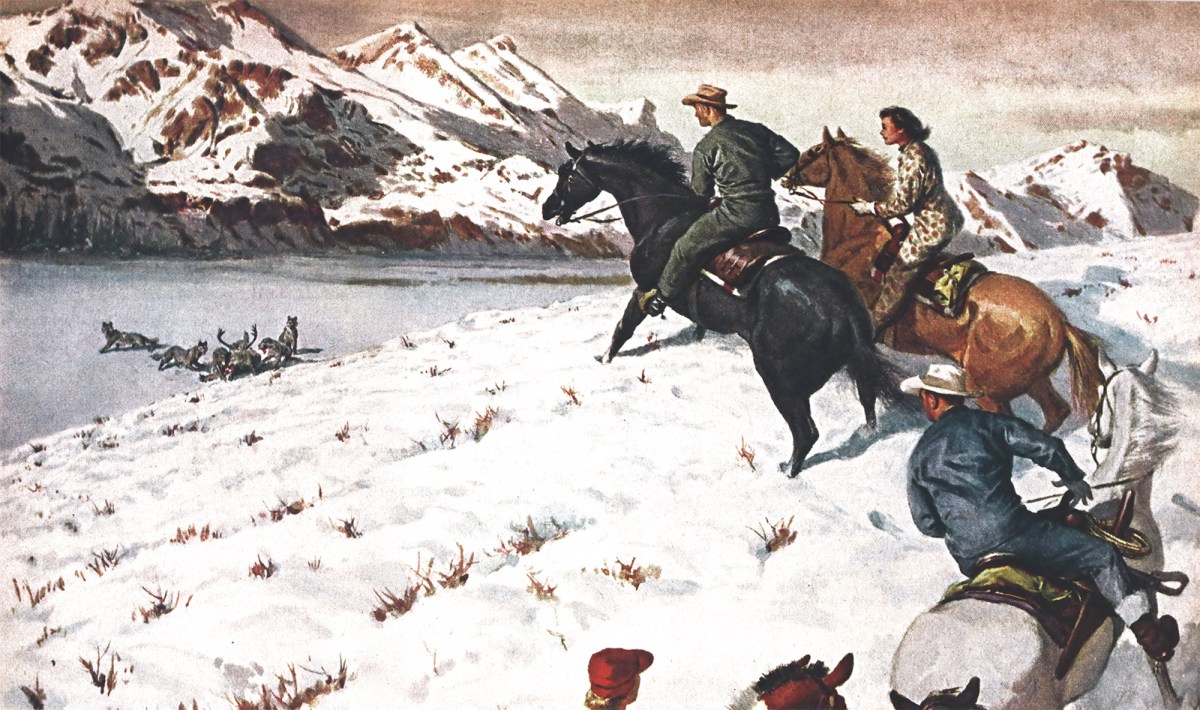
I noticed Monty tossing his head as we were riding up the hill and felt sure from his actions that he was giving us an indication that something was wrong. At first I figured he just smelled the dead caribou, but as we broke over the top we saw what looked like a dozen wolves tearing and pulling at the caribou about 300 yards away. In an instant, the old bitch spotted us and the entire pack of those devils lit out. I counted seven wolves, a big dark male and a beautiful gray bitch with five youngsters nearly as large as she and the male. R. L., coming up behind me, was reaching for his 6 mm. rifle.
“Hold it,” I said. “Remember, this is Unit 13 and wolves are closed to hunting here.”
The Alaska Department of Game has the state divided into 26 game-management units, and this one was closed on wolves. So we just sat on the horses and watched them climb Belcher Mountain as if it wasn’t there.
Riding up to the caribou, it was evident that this hungry gang hadn’t been at it long before we arrived. But they had cleaned up the hindquarters and eaten into the rib cage. Fortunately, they had only ripped the cape on the brisket in a couple of places. I assured Maude Ann that the taxidermist could fix it.
As I skinned out the cape, the rest of the gang left to pick up Roy’s moose. While we waited for their return, the wolves showed up again near the top of the mountain. One would occasionally let out a mournful howl as though complaining about interlopers on the grub supply. When the others returned with the moose, R. L. and Everett loaded the caribou meat, cape and antlers, and left for camp.
“Let’s ride around toward Sunrise Valley and just look for game before we return to camp,” I said. It was sunny at the time, but dark snow clouds were piling up.
Read Next: I Walked Away From a Record Book Bull to Kill the Woodland Caribou of My Dreams
About two hours later, after spotting two or three dozen caribou and a lone bull moose, we rode up to the top of the low hill and looked out over the valley. We saw well over 400 caribou traveling back into Sunrise Valley. It was a sight I’ll dream about when I am too old and stiff to make it into the hills. Then, with a rush of wind and blowing snow, the storm came in with a roar. Winter was here!
“I think we’ve had a good hunt,” I said. “Let’s hit the trail.”
This story, “A Day on the Slana,” appeared in the June 1965 issue of Outdoor Life.
Read the full article here