
In the salty village of Montauk, on the eastern tip of Long Island, New York, they still call Harry Alfandre the unluckiest fisherman who ever lived. Harry was a lean, angular man who had the nose of a beagle for fish, especially tuna. During his days at Montauk, he stirred up storms of excitement and comment by big-city rod and gun columnists.
It was Harry who discovered the famous “Rosie’s Ledge” giant-tuna grounds and instigated what amounted to a revolution among East Coast big-game fishermen. Yet Alfandre himself never managed to land one of the great, finned furies that became synonymous with his name. But he tried. Oh, how he tried.
Two weeks before Labor Day in the summer of 1949, Einar Randrup, owner of the commercial fishing dragger Marion H., came into Montauk with a very large bluefin tuna. He had harpooned it somewhere east of Fisher’s Island. Harry Alfandre saw the fish, talked with Randrup, and lost a night’s sleep mulling over what he’d learned.
The next day Harry took Capt. Clancy Pitts, a local charter skipper, and the crew of the Rosie, his own small fishing cruiser, and shoved off across Block Island Sound for Fisher’s Island. With Harry’s 15-year-old son Ronald and nephews Howard Alfandre and Sandy Hacker, they were five. After several hours of scouting, they’d found no tuna. A lobsterman they met told them where tuna had been sighted the day before.
When they reached the spot, a couple of miles south of Watch Hill, Rhode Island, huge tuna were breaking all over the place. Four draggers were dashing about, trying to harpoon the fish. One finally got an iron into a tuna. Harry watched and got an idea.
The next day they returned to the spot off Watch Hill, trolling squid and mackerel baits among the rioting tuna. They hooked two large ones, which they promptly lost to broken lines. That evening, back at the Montauk Yacht Club, Alfandre told some of the local guides what he’d seen. They said he was off his rocker because “Tuna don’t grow that big in these waters.”
The third day Harry lost another fish. When they got home, tired and disgusted, they found Capt. Don Gross of the charter boat Capt. Don preparing to sail the following morning for the big ones. Don Gross knew how to handle big bluefins, and his client was none other than the then Mrs. Dan Topping, wife of the co-owner of the New York Yankees and no mean fisherwoman.
History records that Mrs. Topping caught more dead weight of tuna in the next four days than the entire fleet of the U.S. Atlantic Tuna Tournament, which happened to be fishing at the same time at the Mud Hole of Hudson Canyon, off New York harbor. The fuss the press kicked up over Harry’s discovery of the fabulous new tuna grounds and Mrs. Topping’s eye-popping catches resounded from Maine to Florida. In a lyric column in the New York Journal-American, the late Jack Brawley dubbed the spot off Watch Hill “Rosie’s Ledge,” after Alfandre and his little white boat Rosie. The name stuck.
Local guides quickly quit scoffing and joined the rush to harvest the big fish. Frank Tuma Jr., skipper of the Gannet, brought in seven big ones. Don Gross racked up an even dozen, including the season’s largest, a 779-pounder caught by New York sportsman Robert Manger. Captains Ralph Pitts, Bob Tuma, Carl Darenburg, and George Verity, spark plugs of the Montauk charter fleet, helped account for the 25 giant tuna that were weighed in at the Montauk Yacht Club.
Among the tuna at Rosie’s Ledge was one monster folks started calling Geronimo. He showed himself occasionally in chum slicks, always far back from the baited hooks. When he joined other tuna in their spectacular surface-feeding, his mighty tail swept like the black scythe of Father Time among the sickle-blade tails of lesser fish. Men guessed his weight at between half and three quarters of a ton.
Harry Alfandre saw and coveted Geronimo. He lay awake nights thinking of ways to hook the elusive monster. But luck was not with him. When summer was over, the Rosie’s score was high on broken lines and fractured rods but still zero on big tuna in the boat. Nevertheless, Harry was already planning for the next season, nursing the germ of a radical and exciting idea.
As the summer of 1950 began, Russ MacGrotty inflamed tuna-season hopes by his early capture of a 409-pounder at Rosie’s Ledge. Tuna guides and anglers flocked to Montauk as the fishing picked up. Chissie Farrington broke her own women’s world record with a 674-pounder caught on 24-thread tackle.
Alfandre’s new plan was to try to catch giant tuna from the sharpie in the manner of the old-time whalers’ Nantucket sleigh-ride.
Then came the electrifying news that old Geronimo, grown even bigger and more wary, was back. This was all Harry Alfandre needed to hear. He had refurbished the Rosie, bought new tackle, and hired quiet, capable Oscar Rodge as skipper. An old-time Montauker, Oscar had an unshakable Scandinavian faith that anything the crew of the Rosie set out to do, it could accomplish. Oscar had built Harry a 14-foot rowing sharpie and placed in its bow a cut-down fishing chair. Alfandre’s new plan was to try to catch giant tuna from the sharpie in the manner of the old-time whalers’ Nantucket sleigh-ride, fighting the fish from the chair in the sharpie with rod and reel. People scoffed, but not to his face.
Folk had learned that Harry’s vinegary tongue could marinate those who tried to twit him. Even his wife Rose, for whom the Rosie was named, said nothing.
Then came the fateful day, Sunday, August 13. The weather was ideal for tuna fishing, and a long file of sport-fishing boats roared from Montauk toward Rosie’s Ledge, 12 miles across the Sound. The Rosie, towing her sharpie, wallowed in the wakes of more powerful and dashing cruisers. Most of the fleet was already anchored and chumming when the small, white boat arrived and planted her mud hook.
The art of chumming consists of doling overboard a thin soup of ground menhaden mixed with sea water and laced with chunks of cut whiting or menhaden. It’s a messy and often smelly process, but it does attract big tuna. Alfandre placed the heavy fiberglass rod with its 14/0 reel filled with 54-thread line in one of the cockpit rod holders. He hooked on a 15-foot cable leader, baited the 13/0 Sobey hook with a whole, fresh whiting, and drifted the bait deep behind the boat, tending the line by hand. The others, Ronnie, Howard, and Oscar, cut bait or dipped chum.
Suddenly a motor coughed to life down the long line of anchored boats and one of the chumming vessels slipped its buoyed anchor cable, speeding off in circles, fighting a freshly hooked giant tuna.
“Watch for fish in our chum slick,” Alfandre warned his crew, knowing that where one big tuna strikes, many more may be feeding.
Then he felt an incredibly heavy weight on his fishing line. He had put the bait down 60 feet under the surface, hoping for a large fish. He stripped a fathom of the fishing line from the rod and reel, dumping the slack into the water so the fish would have loose line to swallow the bait. When the line came tight again he yanked on it as hard as he could with both hands to set the big hook.
“I have one on!” he yelled as he grabbed up the big rod.
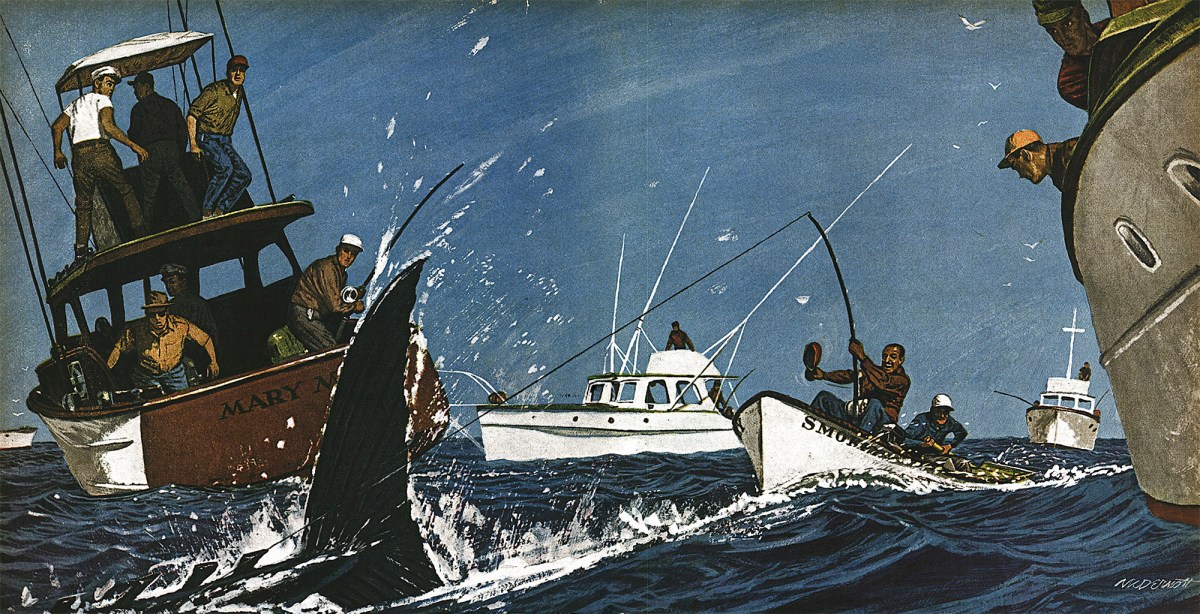
They managed to get him aboard the sharpie and into the chair without upsetting the smaller boat. Oscar tumbled in after him, releasing the line that held the sharpie to the Rosie’s side. Grabbing up a steering oar, Oscar dug water to swing the small boat’s bow after the fish as Harry jammed his calloused thumb down the star-drag wheel to increase the tension.
The rod bucked and cracked. Alfandre shouted. Line whistled out through the guides. Oscar paddled frantically, cursing around his cud of cut plug. The boat started to skim over the water, towed by the hooked fish. Some distance ahead the tuna boiled at the surface. Harry and Oscar caught a glimpse of a great, familiar, scythe tail.
“Suffering catfish, we’ve hooked Geronimo!” Alfandre shouted.
The sharpie raced through the anchored fleet, spray flying. Harry hung onto the rod with one hand, flailing his fishing cap from side to side in his excitement, like a jockey urging on a reluctant bangtail.
“Outa our way!” he bellowed at the startled occupants of Gene Goble’s resplendent Fishangri-La. The tuna took them whizzing under the larger boat’s bow.
The sharpie splattered through the gathered boats like an outboard racer that had bucked off its driver. Motors roared into life as skippers suddenly decided to abandon anchor lines rather than risk a ramming from the seemingly jet-propelled skiff and its two wild-eyed occupants.
“Can’t you steer this fish outa the fleet?” Alfandre shouted over his shoulder at the drenched, blaspheming Oscar.
Somehow, Oscar managed to shoehorn the sharpie through the mob of boats without scraping paint or chafing the fish line on an anchor warp. Finally, they were clear of the fleet and out in open water. Oscar heaved a sigh of reliet, but Harry saw fresh danger.
“Turn the fish back inshore!” he howled at Oscar. “He’s taking out to sea at better than ten knots!”
The fight between the tuna and the two men in the sharpie settled down to a gut-wrenching slugging match that circled, stopped, started, and zigzagged just outside the fleet.
By cramping the boat hard to one side of the tuna’s wake, Oscar found he could steer Geronimo back in the general direction of Rosie’s Ledge and the chumming fleet.
“Don’t let him drag us back into those boats!” Harry screamed.
“Wish you’d make up your mind,” Oscar grumbled, wiping tobacco juice and salt spray from his chin.
Meanwhile, the Rosie and another fishing cruiser, the Barracuda, skipped by young Bobby Darenburg of Montauk, were hovering, near, anxious to render aid, but afraid to come too close. The fight between the tuna and the two men in the sharpie settled down to a gut-wrenching slugging match that circled, stopped, started, and zigzagged just outside the fleet.
Once Geronimo sounded and lay doggo, gathering strength. “Gotta get him moving,” Harry muttered, yanking strongly at the fish with the heavy rod His problem was a special one. A well-handled power boat can chase and hound a hooked giant tuna into making run after run, burning up its supply of body oxygen faster than this vital element can be replaced by water flowing over the gills.
Eventually, the fish can be driven to the point of complete collapse. This is the secret of those startlingly swift victories over huge tuna that mystify so many landlubbers. But Harry and Oscar had no motor with which to chase Geronimo.
All Harry could do was to goad the fish into making oxygen-burning runs by banging at him with the rod under heavy line pressure, then quickly releasing the drag pressure to fool the fish into thinking it was free.
It was back-breaking work. Blisters broke on Harry’s hands. He and Oscar were soaked with sweat and salt water. They were dying for a drink. The sharpie needed bailing. At odd moments Oscar flung out a scoop or two of water, but most of the time he had to concentrate on steering and shifting his weight to prevent a capsize.
At last the fish showed signs of weakening. Alfandre increased drag pressure and began to muscle in the last 50 yards of line. He had literally to haul the boat up behind and finally on top of the tiring tuna as it cruised slowly along, a few feet under the surface. Oscar tried paddling, but it didn’t help much. The outermost 15 feet of the line was spliced double as gamefish rules allow. When Harry got two turns of this double line on the reel spool he clamped down on the drag pressure to the maximum. The Rosie and the Barracuda cautiously came closer.
Then they saw how big the fish was. “His tail’s under the stem of the sharpie,” Oscar called out.
“His head’s two feet beyond the bow,” Alfandre marveled. “He’s longer than the sharpie!”
Slowly the fish rose to the surface. Harry winched in the last of the double line until the stainless steel snap-swivel connecting the line to the cable leader touched the rod tip. Dropping the rod, he grabbed the leader and hauled the skiff toward the wallowing fish. Oscar shoved the flying gaff at him. Holding the leader with one hand, Harry made a powerful swipe and drove the hook of the flying gaff into Geronimo’s jaw.
He separated the stout ash gaff handle from the detachable hook and hauled tight the half-inch manila rope that was spliced to the gaff hook. The Barracuda had backed close to them and Oscar threw the free end of the gaff rope to Bobby Darenburg, ho haul in the slack and took two quick turns around one of the boat’s after bitts.
“He’s ours!” Harry croaked triumphantly, picking up the rod to get it from underfoot.
Then Geronimo came to life, showering the two boats and the people in them with sheets of spray from his great, slashing tail. Down he plunged, snapping the gaff rope like string. Bobby Darenburg stood in the stem of his boat, too stunned even to pick up the broken end of the gaff line that hung over the transom.
“He’ll dump us over!” screamed Alfandre, staggering under the weight of the fish on his rod.
Oscar scrambled just in time to prevent a capsize as Harry got the reel drag released so the fish could take out line. When they had themselves and the sharpie under control, they were back where they were before the gaffing, but minus the gaff and with the boat half full of water.
“What’ll we do now?” asked Oscar.
“Bail out the water, then tire him out and gaff him again,” said Alfandre. “What else is there to do?”
Wounded by the swallowed hook and the gaff in his jaw, Geronimo couldn’t last forever. Harry goaded him into a couple of runs, but the old steam was not there. Finally the fish was back cruising slowly under the surface, setting its fins against the pull of the line. Harry could gain no more line. They had reached a stalemate. The splice of the near end of the double line was still two feet under water.
Geronimo’s blood stained the water. Harry rested, panting, his arms aching. If he could just get in the last couple of fathoms of single line and put two turns of double line on the reel, he would be able to apply enough pressure to raise the huge fish to the surface. Both the Rosie and the Barracuda were standing by to pass them a fresh gaff. He tried once more to raise the fish a bit and failed. Black spots danced in the backs of his eyeballs with each pounding pulse. He had been fast to the tuna for more than three hours, and he didn’t know how much longer he could keep up the pressure.
The end came with a shocking suddenness. The hot sun, burning down on the drying linen line just beyond the rod’s tip, caused the fibers to lose some of their wet-test strength. Harry took a deep breath and tried to lift the fish, applying a few extra pounds of pressure. There was a sharp snap as the line paned. Harry lurched backward out of the fishing chair. Oscar lunged to catch him.
Black spots danced in the backs of his eyeballs with each pounding pulse. He had been fast to the tuna for more than three hours, and he didn’t know how much longer he could keep up the pressure.
When they regained their feet they could see the broken end of the white fishing line snaking slowly into the depths as Geronimo’s mighty, dying bulk sank away from them.
Numbly they let Ronnie and Howard help them back into the Rosie’s cockpit. No one spoke.
The Rosie continued to fish for big tuna at Rosie’s Ledge and Harry was sometimes in the sharpie, but there was always someone else behind the big rod. Alfandre’s zest for rod-handling was slow to return.
Stan Smith of the New York News hooked a 10-foot shark fishing from the sharpie with Harry at the steering oar. Asked if he had fun, Stan replied, “Fun? It was the second closest thing to suicide.”
Guessing at Geronimo’s size, good tuna men estimated his length at 14 to 16 feet. He certainly was longer than the 14-foot sharpie. For fish caught with rod and reel, the present world-record bluefin is a Nova Scotia 977-pounder. It measured not quite 10 feet long. A 1,200-pounder brought into Block Island in 1956 by a swordfisherman was short of 12 feet. Using these measurements as rough guides, it’s safe to say Geronimo probably weighed 1,600 to 2,000 pounds.
Read Next: The Legendary Shark Fishing Record That’s Never Been Broken
It is fitting to note, in closing, that 16-year old Ronnie vindicated his father’s faith in sharpie-fishing for big tuna just three weeks after Harry’s debacle. Ronnie took a 676-pound bluefin from the tiny boat in the fast time of 30 minutes flat. When the Rosie returned to Montauk that afternoon with Ronnie’s big fish, every boat in the harbor blew its whistle or fog horn. Rex, the dockmaster, fired salutes from the little brass cannon at the Yacht Club.
That night, at the Yacht Club Crew’s Bar, a beaming Harry was buying drinks for all hands, satisfied to see his son redeem family honor.
Read the full article here