
A TELEPHONE CALL last July started my wife and me on a trip into the Klondike that was at times as wild as any experienced by the prospectors who took part in the gold stampede in 1898. At least it was as rushed at the outset, and while we didn’t come back with any gold, we enjoyed a rich experience that lasted a month and covered 7,000 miles.
The call came on a Thursday morning to my home in Centerville, Utah, where I am a photographer and free-lance writer. My wife Kit runs “The Gallery Upstairs” in nearby Bountiful.
“Would you,” asked the man on the phone, “like to make a trip down the Yukon River in Canada with Ken Sleight?” Ken Sleight, 36, lives in Bountiful and has been guiding river trips and hikes for the past 10 years. He calls his enterprise Wonderland Expeditions.
It turned out that Ken had engaged to guide a party on a float trip down the Yukon and had to be in Whitehorse, Yukon Territory, Canada, on Monday morning, which allowed us three days’ traveling time. He was shorthanded and needed help in the driving. He could use two people and was leaving at midnight. Since Whitehorse is 2,300 miles from Centerville, the driving would be nonstop except for gas and a meal or two. But my wife Kit didn’t hesitate a moment, and we agreed to go. Our daughter Colleen was having a summer with grandparents, so Kit packed while I hired a dogsitter and someone to take care of the lawn for the month.
I also grabbed a fly reel with no line and a bait-casting rod with a worn-out reel. I was all thumbs but managed to find my fly box.
By dawn we were humming past the Idaho side of the beautifully colored Grand Tetons. Dozens of antelope fed in the sagebrush near the highway. We rolled northward through Montana during the day, passed Glacier National Park, where aerial tankers were bombing a nearby forest fire, crossed into Canada with a minimum of delay from the friendly customs people, and continued north.
The highways in Canada are lovely, including the dusty Alaska Highway. Meals, except in Calgary, a beautiful city, and possibly Edmonton, are generally more expensive than in Salt Lake City, but meat in supermarkets is a bargain, and other goods are near our prices.
That night sleet fell in Calgary, but Edmonton, farther north, offered shirtsleeve weather the next morning. After driving the flat but lovely miles of Alberta’s well-marked highways, we entered British Columbia and drove west. Eighty-three miles from Dawson Creek we bumped onto the winding, gravel Alaska Highway, formerly the Alcan Highway, built by troops in World War II. For the next 830 miles we ate dust until we reached Whitehorse and saw the broad, swift, clear Yukon River early Monday morning.
Whitehorse is the capital of Yukon Territory, an expanse of 207,076 square miles with only 15,000 residents. Of these, 6,000, or more than a third, live in Whitehorse, a city that is a strange mixture of the pioneer and the modern. Modern department stores, and motels, and banks, withal having a certain frontier-type architecture, rub shoulders with older structures and log cabins dating back to gold-rush days.
I gaped at the magnificent big-game trophies in the small MacBride Museum, itself to be replaced in the future by a modern, more spacious building. The Royal Canadian Mounted Police, now clad in brown uniforms instead of their red-and-blue dress uniforms and mounted inside souped-up automobiles rather than on horses, keep an eye on things from their frugal frame headquarters close to an up-to-date government building. The city has a fine airport and is the railhead for the White Pass & Yukon Railway, but our foremost concern was with the Yukon River, stretching 2,000 miles from Teslin Lake to the Bering Sea.
We planned to float the historic stretch from Whitehorse to Dawson, a distance of 437 miles. On the gravel road it’s a one-day drive. On the river, even with the dependable outboards, it takes eight days. For the most part, this section of the river is swift and smooth, and the foliage predominantly green—the varying greens of mosses, alders, aspen, and conifers—brightened by patches of yellow and orange lichens on the rocks.
Dawson, our destination on the Yukon, today has fewer than 800 residents, but at the height of the gold rush at the turn of the century, when it was known as the Paris of the North, its population numbered 28,000. The area still has mining, and prospectors comb the hills on foot and by helicopter.
We had no sooner reached Whitehorse than Ken got into high gear. He quickly rounded up his party, several of whom had made previous trips with him. It consisted of a working group of eight, counting himself. Bill Adams and Duane Price, from Santa Barbara, California, would shoot movie film that Adams and Ken would show to audiences in the winter; Maddie Fleming, also from Santa Barbara, would shoot slides and cut tapes for her husband, Rex Fleming, film producer who wasn’t able to make the trip; and Norwood and Betty Hazard, both formerly with the Buffalo, New York, Museum, would take color movies and transparencies for TV and lecture tours.
My wife Kit planned to sketch and take black-and-white photos as reference material for future paintings at her art gallery. I was general factotum for Ken, as well as the keeper of the trip’s official records.
Next, Ken set about buying groceries and preparing and loading the rafts, all of which he did in six hours. Two paddlewheelers, giants of the days when there were no roads from Carcross to Dawson City and now tourist attractions of Whitehorse, sat drydocked, overlooking preparations for our departure.
Our flotilla consisted of two 10-man neoprene rafts; a glass kayak designed by Ron Smith, a whitewater guide from Park City, Utah, who was prevented by last-minute illness from accompanying us; and a foldboat belonging to the Hazards. We had a fine pair of 18-horsepower outboard motors, camping gear, cooking utensils, some 16 cameras, two tape recorders, two spinning outfits, an assortment of lures, and my own mickey-mouse fishing equipment.
With everything in readiness we put in less than four blocks from the center of Whitehorse. In days gone, countless gold seekers lost their belongings, and many their lives, in the waters of the Yukon trying to reach the Klondike in crude barges and boats. Today, with our modern equipment, we found the only testing water on the Whitehorse-Dawson stretch of the river to be Five Fingers Rapids. This water, near Carmacks, named after one of the first men to stake a claim on Bonanza Creek, was a terror of the early days.
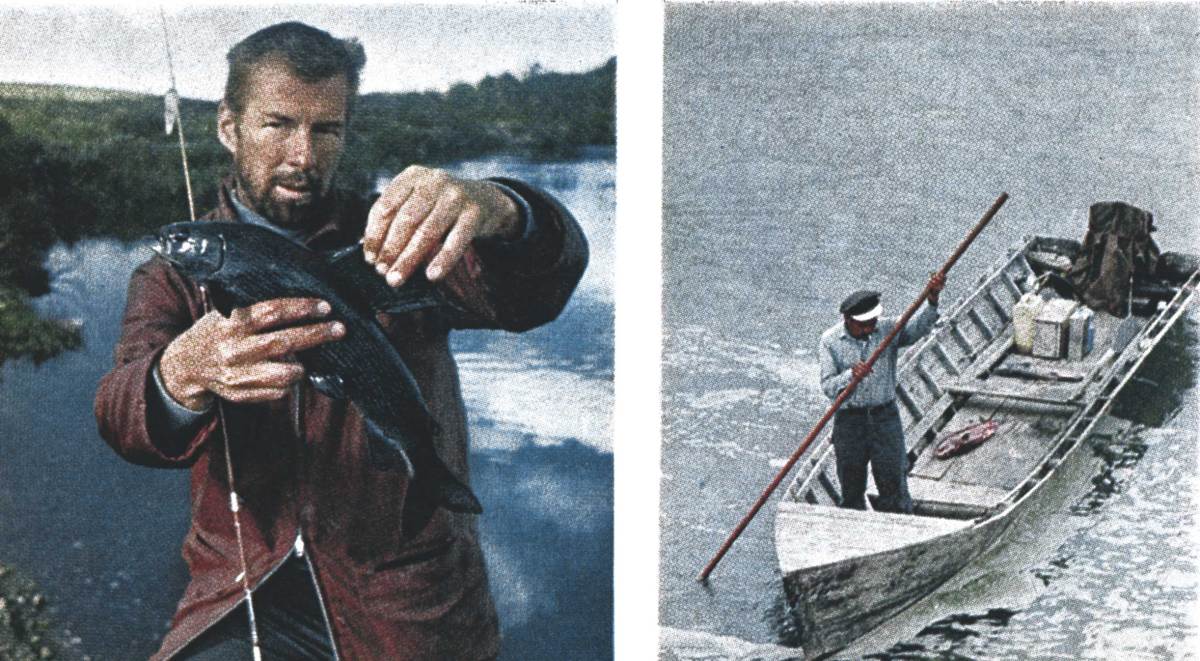
We stopped above the rocky Fingers to look at the cables, secured to house-size rocks, that were used to winch the upstream paddlewheelers through the narrows and rough water. Ken shot the left-hand side and took a bit of water over the bows of the two big rafts lashed together. Then I paddled the fiberglass kayak through the right-hand side, and Betty and Norwood followed in the foldboat—no trouble.
The remoteness and reminders of dreams of other days make the Yukon trip dramatic. We stopped at countless cabins and clusters of cabins along the banks. The tale was a familiar one. Sod roofs had caved in. Heaps of clothes, scraps of blankets, and old moccasins or shoes cluttered the floors. Here were a saw, an ax, an old whisky bottle, and there a frying pan, an empty wallet, a calendar.
Outside were broken steel traps and stretching boards. In the grown-up clearings we found garbage dumps, wild roses, raspberries, and an occasional headstone. One read: “Here Lies My Son, Age 16. . . .” Some groups of cabins, like those on 40-mile-long Lake Laberge, are just as their owners left them, owners who lost the battle with blackflies, mosquitoes, and no-see-ums in summer, and 79-below temperature in winter. Nature can be mighty harsh in these parts.
Speaking of Lake Laberge, it was there that Norwood Hazard took time to read Robert W. Service’s poem “The Cremation of Sam McGee.” According to the poet, the cremation took place on the bank of Lake Laberge in a wrecked sternwheeler in winter. When the narrator had the fire in the firebox going briskly, he opened the door and there sat Sam, who requested that the door be closed. It was the first time he’d been warm, he said, since leaving Tennessee. The poem is a perennial favorite around campfires.
It was just below Lake Laberge at a lovely but rainy campsite that we first met the arctic grayling. Trolling had produced nothing on the river; Betty didn’t get a nibble in 100 miles (some kind of record). But we caught grayling up to 17 inches in eddies next to camp, and it was Betty who caught the big one. We used spinners, spoons, and a lure shaped like a peanut shell. I had brought along flies, but, alas, left them in the cab of the truck located at the R.C.M.P. parking lot at Whitehorse.
The license, which costs $2, allowed us to catch 20 grayling a day. I did a lot of trolling from the kayak, and in a small stream I hooked and whipped the biggest northern pike I’ve ever seen. Then, not satisfied, I held the rod with one hand and tried to take a picture of the fish with the other—and, in my enthusiasm, lost it!
That was our last strike on the Yukon River leg of the trip, although we did have a wonderful salmon dinner courtesy of Dan and Abbie Roberts, the Native couple who watch over the historic remains of old Fort Selkirk and are the sole residents of the former Hudson’s Bay Company post. That 20-pounder, right from Dan’s net, filleted by Abbie and cooked on a skillet over an open campfire, was the outstanding meal of the river trip. Incidentally, the salmon don’t go for lures, certainly not our lures, on this part of their river migration. Those landed are taken in nets or with fish wheels by the Indian tribes.
Wildlife was scarce along the river, probably because of the heavy rains. A cow moose, bald eagles, and a few mergansers were just about the only things we saw.
Eight days of rain, wind, and cold made the trip rough. Plastic sheets used for tents withstood wind and water but were noisy. Black was better tent material than clear, since night doesn’t arrive in summer until 11 p.m. or so, and daylight comes a couple hours or so later.
At Stewart River, 70 miles upstream from Dawson, we met the Rudy Burians, a happy, isolated bush family. They, along with their barking sled dogs, welcomed us, and they showed us their place: a quiet home with guns on the back porch ready for marauding wildlife, and the local post office in the kitchen; a new cabin going up; buildings with wolf, bear, wolverine, and other furs stored for a marketing trip to Whitehorse; and many stacks of firewood. We listened to the bush radio with Mrs. Burian. One of her sons had been injured fighting fire.
“Old Spike is recovering nicely,” the radio reported.
The Yukon, milky from entering glacial water from the White River, which rises in the 16,000-foot peaks of the Wrangell Mountains of Alaska, carried us quickly to Dawson, old with the look of the frontier, and not too noticeably a tourist town. The haze of a nearby forest fire—one of three big ones in progress—hung above it. Helicopters moved in and out, and weary-eyed, unshaven fire fighters—along with a horde of American trailerites on a mass expedition—crowded the few high-priced restaurants until there was barely any breathing space left.
At this point, Bill and Duane flew home and Maddie stayed to cut tapes with some oldtimers. With the Hazards we visited poet Robert W. Service’s cabin, watched a gold dredge at work, saw a melodrama version of Service’s “The Shooting of Dan McGrew” at the reconditioned Palace Grand Theater built in 1889, and stopped at an excellent campsite across the river, accessible by free public ferry. There Kit and Betty learned the mysteries of gold panning from Betty Jane Harbour of Aspen, Colorado. They didn’t get rich, but they enjoyed themselves.
Ken had a party of kayakers from China Lake, California, waiting at Whitehorse when we returned by bus and truck. We hauled their boats and gear to the head of the Teslin River at Johnson Crossing on the Alaska Highway, and then Kit and I waved them a goodbye and headed north for sightseeing.
Five days later, we reprovisioned Ken and the kayakers downstream at Carmacks and drove on to the Chapman Lakes vicinity, northeast of Dawson. Entering the area on the gravel road, we encountered hunter Clarence Combs, formerly of Iowa and Oklahoma, now a Yukoner and retired. He’d met a grizzly on the road, faced off with the bear, and downed it on the fourth shot, just 75 yards from where Kit and I stopped. Another grizzly was in the area but ran the moment we approached the carcass of the first.
You can hunt bear, moose, caribou, and Dall sheep here. Nonresidents must have a guide, and a registered guide list is available from the Game Department, Yukon Territorial Government, Box 2703, Whitehorse, Yukon Territory, Canada.
Read Next: Hunting Sheep In the Yukon Has Been a Dream Adventure for Generations. But That Opportunity May Be Fading
The Blackstone River and its tributaries are clear and outwardly without vegetation. You can spot the lovely graylings in the deep pools, and they consistently take Black Gnats drifted down over the holes. They will take hardware, too, though I had more success with the flies retrieved from the truck in Whitehorse. The graylings battle beautifully on top and down deep, and they are a culinary delight. The high, long dorsal fin is used in the battle and gives the fish its distinctive look.
Time ran out, and we chased back to Dawson to meet the kayakers. Ken was in a hurry again, so we loaded up. He had another trip scheduled, this time in southern Utah. We’d have lots of time going back, he said. Four days this time. We’d probably even spend a night in a motel on the way back. It would, without a doubt, be a breeze.
Well, it wasn’t, but the Yukon is definitely worth a vacation rush, any summer.
This story was originally published in the July 1967 issue of Outdoor Life.
Read the full article here