

We Floated into a Hellacious Swamp and Found the Best Squirrel Hunting of All Time

SOMEWHERE IN THE flat, gray mist that hung like a shroud over the dripping tangle of cabbage palms and moss-bearded water oaks, a lone duck shattered the stillness with a sharp, plaintive cry. A chill whistled down my spine. Duck or no duck, it sounded like the wildcats we’d heard screaming from the depths of Tate’s Hell the night before.
“Watch for him,” whispered Gene Padgett who was sculling the skiff. “He may come in.”
I blinked the mist out of my eyes and squinted up the twisting, narrow creek that was almost vaulted by towering walls of vegetation.
“If that bird can find his way in through this stuff he deserves a Distinguished Flying Cross, not a load of 6’s,” I murmured.
We’d been sculling Florida’s Caesar Creek for two hours, scanning the overhanging branches for squirrels, watching for the slightest flicker of movement and seeing nothing. Stranger than that, there wasn’t a sound from the swamp, not even the snapping of a twig or the swish of a palm.
The only thing I could hear was the soft, rhythmic squeak of the paddle in the sculling lock. The more I thought about it the louder it got.
“Suppose it’d do any good wrapping a handkerchief around that paddle?” I asked Gene.
“Probably. I’ll try something different when we get up here.” He nodded toward an abrupt narrowing of the creek that marked the upper end of the Caesar. We sat quietly for 20 minutes, but nothing showed.
“O.K., let’s go back down,” said Gene. “I’ll paddle from the bow this time.”
We switched seats and headed back downstream. He worked the paddle with one hand, quietly sculling the water toward him. The skiff moved without so much as a gurgle, and we slipped silently around the first bend. Then everything happened at once.
Something smashed into the top of a stubby palm. Simultaneously, bark rattled from an oak, and high up in the gaunt branches of another tree a squirrel let out a startled burst of chatter as he tried to get out of sight.
Gene’s Browning automatic roared and sent the gray cartwheeling into the top of a palm. I shot the one in the oak and swung quickly to another silhouetted against the sky on a tangle of vines. Both fell. I was fumbling for more shells when Gene knocked another out of the top of the oak. We nosed the skiff ashore, collected our four, and pushed off quickly. There wasn’t time for congratulations, but we both knew why our luck had changed. We’d been spooking them with a squeaking sculling lock.
In the next two hours, before the mists completely blotted out the treetops, we enjoyed squirrel hunting the likes of nothing I’ve ever experienced before. But then, that’s the way Gene had said it would be when he invited me on a three-day drift-hunt down a creek named Caesar beside a swamp called Tate’s Hell south of the town of Sumatra in the Florida panhandle.
Gene Padgett is a jeweler in my adopted home town of Chattahoochee near the Georgia-Florida line. We’re the same age, 37, but while I grew up chasing Michigan ringnecks and snowshoe rabbits, Gene was stalking panhandle gators and getting the drop on gray squirrels. We met over a wristwatch of mine that needed cleaning, and we started hunting and fishing together.
Last November, shortly after squirrel season opened, I happen to mention to him that there was a disappointing lack of squirrels around the swamps. That started him off. Two years ago, he said, he and a couple of friends from Tallahassee had stumbled onto some of the most fantastic squirrel-hunting country they’d ever seen. It was in the swamps of the lower Apalachicola River. His companions were Clyde Owen and Bill Scott, both natives of northwest Florida. Clyde is a Baptist minister our age, and Bill is a 27-year-old policeman.
My business is writing about the outdoors, so a few days before Thanksgiving when Gene invited me to join the three of them on their annual drift-hunt to Caesar Creek, I promptly accepted. What particularly intrigued me was the area they intended to hunt—the edge of a legend-ridden and largely unexplored chunk of Florida real estate aptly called Tate’s Hell.
Located mainly in Liberty and Franklin counties, this nightmare of endless bogs, hammocks, sloughs, and snake-infested swamp is recognized as one of the few impregnable wastelands left in America. Today it is part of 630,000 square miles of wilderness that makes up the Apalachicola National Forest. The last U.S. Soil Survey map made in 1915 described the huge interior area as “muck,” while the narrow fringe bordering the Apalachicola River was identified as “swamp.” But all maps bear the name it was given 100 years ago when, according to legend, two woodcutters saw a gaunt, wild-eyed figure stagger out of the swamps near Carrabelle on the Gulf Coast. His clothes were in shreds, his face and body were covered with scratches, and his hair was matted with mud and slime.
“Good Lord!” one of the men cried. “Where did you come from?”
“From . . . hell,” the man gasped, and fell dead at their feet.
He was Seab Tate, a robust, 37-year-old farmer and trapper from along the Apalachicola River. No one really knows what happened to him from the time he followed the tracks of his missing cows into the dismal swamp until he came out seven days later. But it’s said that the ordeal turned his hair white.
In 1952 the Florida Game and Fresh Water Fish Commission selected one of its officers, Ross Summers, to lead a small expedition into Tate’s Hell. Using three jeeps, one equipped with a power winch, the group entered the swamp from the west. After traveling all day and part of the night they covered only six miles. Tired of hauling first one vehicle then another out of the oozing mud, they finally established a base camp and continued on foot. It took them six days to cover 22 miles. During that time they killed 55 moccasins, five rattlers, and one coral snake.
A century of progress has done little to shrink the borders of Tate’s Hell. Today it is bounded on the east by the New River system that flows into the Gulf of Mexico at Carrabelle, on the north by Sumatra and the Apalachicola Northern Railroad, and on the west by Route 65.
Bill Scott had been brought up on the edge of the swamp. As a boy, he and his father trapped and hunted everything from otters to alligators. Bill not only knew this country but had picked up a lot of swamp lore along the way, a particularly important point, I thought, because except for a few basic supplies like bacon, eggs, coffee, flour, and cooking oil, the four of us would be living off the swamp.
So, carrying nothing more than my hunting and camping gear, I met them in the middle of the night on a crossroad north of Sumatra. Gene had circled by Tallahassee for Clyde and Bill, loaded his pickup with camping gear and skiff, and trailered a second boat behind. I followed them in my car south toward the Gulf of Mexico, and by 1 a.m. we crawled into our sleeping bags in a clearing at the edge of Tate’s Hell on a slough running into East River, a tributary of the Apalachicola.
In the gray half-light before dawn, Bill’s father, William Scott, drove in with his boat and joined us. In no time, bacon and eggs were hissing and sputtering in the homemade cook stove Bill had brought. He had taken the burner from an old gas heater and welded it inside a sheet-metal box open at the bottom and topped with a permanent grill. A rubber hose connected the burner to a five-gallon bottle of butane gas.
“If you’re headed for the old campsite on Caesar Creek,” said Bill’s father, “you got a long boat ride ahead of you. It’ll kill the morning for hunting.”
“Probably be plenty of boats. I’d go ashore if I were you.”
So we launched the boats at the slough and motored to the Apalachicola River. There was mist rising off the water and the air was cold. In the boat ahead of ours, Brother Owen, an ex-Air Force man, had tucked the tips of his ears under his A.F. jockey cap.
“What about working the other side of the river and setting up camp around noon?” asked Bill.
The west bank of the river presented a wall of vegetation so thick it was hard to find a place to land. Cabbage palms and moss-draped cypresses crowded the bank. Bill and Gene had left their scoped .22’s behind—a Winchester pump 61 and a Remington automatic—in favor of shotguns. Bill was carrying a double-barreled Winchester Model 24, Clyde and Gene both had Browning automatics, and Mr. Scott was using his double-barreled Stevens. All the guns were 12 gauges. Since I hoped to get in some long-range shooting, I had chosen my .22 Marlin automatic Model 99 scoped with a 3-6X variable power Weaver lens. Slipped over the ocular was a tubular rubber eye-flange called a Scope-Aid made by a Sierra Vista, Arizona, firm. It gives me several seconds sighting advantage by putting my eye instantly at the correct distance.
Bill’s dad finally found a place to let me out—an opening at the base of a palm tree. I squeezed through sideways.
“The rest of us will drop off at 200-yard intervals below you,” he said. “We’ll pick you up here in three hours.” He backed off the boat. “Watch where you step,” he called cheerfully.
I started slowly into the bush with my eyes on the ground. Mr. Scott’s last remark wasn’t meant to be as casual as it sounded. What he meant was to watch out for snakes. Georgia, Alabama, and Florida host the country’s largest and most dangerous species of rattlesnake—the Eastern diamondback—which attains a length of seven feet. Others to watch out for are cottonmouth moccasins, coral snakes, and copperheads. We took the same precautions any outdoorsman in the tristate area takes—snakeproof boots, pocket snakebite kits, and the habit of looking before stepping.
A few yards from the riverbank everything turned soupy. I waded through the mud and brush until I found a small rise, then squatted against the bole of a gum. A minute later the swamp came alive with sounds. Squirrels barked, leafy branches made swooshing sounds, bark shucked off and rattled palmettos, and things splashed repeatedly into sloughs. But it all was happening behind a screen of swamp. Then I saw a gray scamper up a sapling and do a tight-wire act from one tree to another. I screwed my scope down to 3X, followed him with the crosshairs, and when he paused for an instant, I fired. He dropped into a narrow slough, and I stayed put. But from that moment on, nothing else moved.
After trying various ridges and muddy hammocks for three hours, I headed back to the pickup point on the river.
Together we had enough squirrels for the pot, but all the action had come during the first hour. Then it was as if somebody had waved a wand over the swamp and everything vanished.
With lunch over, we decided to save ourselves some river miles by driving closer to the spot where we would push off for the Caesar. This was Gardner Landing, 10 miles south of our previous night’s camp at Smith Creek Landing. There we unloaded the boats again and piled them high with gear. Including our three tents, there were cots, sleeping bags, cook stove, two five-gallon jugs of water, cooking supplies, machetes, rain and cold-weather clothes, pots and pans, outboard fuel tanks and their reserves, gas lanterns, and flashlights, plus a load of firewood, ice chests, a sackful of my cameras, fishing tackle, and a set of bed springs. On top of this we packed our shotguns, rifles, and ammunition, then climbed aboard and motored up East River into Caesar Creek. The narrow waterway looked ideal for our kind of hunting.
By midafternoon we had set up our three tents in a small clearing facing the creek and backed by palm trees. Then, in the boats, we eased up the Caesar looking for squirrels. Bill told me that drift hunting in these parts was almost a necessity because of swamp.
“For the same reason, they hunt deer down here with shotguns and dogs,” he said. “But you don’t take a stand on an open road. You use a boat and follow the creeks.”
When we reached the upper end of the creek and hadn’t seen any squirrels, we tried hunting the banks on foot. That was a mistake.
The undergrowth was thicker than it had been on the river. Cabbage palms, many with four-foot wide fronds, were more numerous than I’d ever seen. At least it meant we wouldn’t starve. With a sharp ax or machete you can lop off the fronds, then hack through the foot-thick trunk about three feet from the top. The frond stems interlace down the section and can be peeled off like layers of an onion, leaving a three-inch-thick tender center. This part can be eaten raw or chopped into a pot of boiling water, seasoned, and cooked until tender the same way you would ordinary cabbage. The flavor vaguely resembles cabbage.
It was impossible to move without a rattling accompaniment of waxy fronds. The ground was covered with a deceiving carpet of leaves, and underneath was mud. With each step, I sank up to my ankle or my knee. At times, visibility was only as far as I could reach. Wherever I could find an opening, I sat and waited, watching the treetops. Nothing moved. I waded deeper into the swamp thinking I might find higher and firmer ground. If anything, it got worse. There was squirrel feed everywhere—nuts, acorns and datelike tupelo balls—but no squirrels.
After a couple of hours it started to grow dark, so I followed my compass back to the creek and waited half an hour for the boats to zero in on my yahoos and whistles. The Caesar had just enough twists and turns to make my companions think I was signaling them from somewhere deep in the swamp. When I didn’t come to their answering shots, they followed the waterway downstream, sweeping the banks with their flashlights. They caught the wave of my handkerchief about an hour after dark.
Shortly after midnight it flooded, and though we didn’t know it then, this was one thing that changed our luck. After breakfast the next morning, Bill and I were motoring slowly upstream when we came to a log that had drifted across the stream. We shut off the motor to drag it aside. In the silence, a squirrel barked just around the next bend. Bill winked, laid his shotgun across his lap, paddled ahead cautiously, then sculled the stern of the skiff up under a small cabbage palm hanging over the water.
“Keep your eyes open,” he whispered. Then he grasped the palm fronds and shook them violently, at the same time making a series of loud, smacking, kissing sounds with his lips.
Instantly a squirrel popped out from behind a tree opposite us and ran scolding along the limb. Bill snatched up his shotgun, fired, and the gray nosedived into a clump of palmettos. Bill waited a few minutes then whacked the frond again and smacked his lips. Another gray scurried around a tree trunk. I brought my Ithaca up, uncorked one of the twin-barrel full chokes, and watched the animal drop.
Before we could beach the boat it started to rain again, a heavy downpour that lasted two hours. We stood under giant palm fronds and stayed as dry as if we had a roof over our heads.
Just before it was over, squirrels started barking behind us in the swamp, and we went in after them. This is where the rain had helped us. The dead leaves and bushes that had made so much racket when we’d pushed through them before, were now soggy. We could approach squirrels without spooking them. Bill and I both collected two more before the rain set in again and drove us back to camp.
It was still misty when I pushed off with Gene shortly after lunch for another stab at drift-hunting the Caesar. We had covered about 1½ miles before we realized the sculling squeak had been alerting every squirrel in our vicinity. Now with less than half the afternoon ahead of us, we were determined to make our downstream trip pay off.
Rounding a bend, I glimpsed a squirrel streaking for the top of a tall, skinny sapling. He stopped in the crotch and sat still as we drew opposite.
The current had already taken us past the small opening in the brush where I’d seen him, so I asked Gene to back up the boat. He sculled me into position again. I could barely see the squirrel now. It was too long a shot for the 12 gauge. I picked up my .22 and put the 3X sight on him. It was about 75 yards, and a limb was concealing most of the squirrel’s body. I screwed the ocular lens down to 6X and pressed the rubber flange of the Scope Aid eyepiece tight to my cheek to isolate the image. The squirrel’s head and tail were all that showed. I took a deep breath and squeezed. The gray pitched forward out of the tree.
“I better stay out here and zero you in on that one,” said Gene. “Those trees will look alike when you get there.” From the middle of the creek he guided me to the tree. The squirrel was lying where it fell. I climbed back into the boat and we moved on. A minute later Gene spotted one that I never saw until he picked him out for me with a load of 6’s. The racket flushed another that Gene leveled three seconds later. Then it was my turn to guide him.
The next hour was all a squirrel hunter could ask for. We alternated with the .22’s and the shotguns. If the squirrels stopped long enough to get the crosshairs on them, we used the rifles. Many of the squirrels we jumped from creek-bank trees had the habit of tearing off into the swamp, then climbing a tree to look back at us. That’s when the .22’s came in handy. But most of the action was too fast for rifles. And when the overcast tightened up on us and the swamp began to grow dark, we stuck with the shotguns entirely. Sometimes we had to call the grays out with Bill’s palm-rattling method, but usually we were able to slip up on them until they spotted the boat and gave themselves away.
On our way back to camp, I had a feeling we could never have as fine an afternoon of shooting again. Drift-hunting had beat bog-hopping on foot all to pieces. We had hunted a tremendously wide area quieter and more efficiently than we could have any other way, and we did it from the comfort and convenience of a boat.
Read Next: The Best Squirrel Hunting Rifles
Gene and I reached camp after dark. Bill and Clyde had already built a roaring fire and were fixing supper—fried squirrel and cooked cabbage palm flavored with fresh oysters they’d collected downriver.
“I sure hope you guys had some luck,” Gene called. “We sure didn’t.” “You didn’t?” said Brother Owen as he bounced off a camp stool. “You should have come with us.” Then he grinned as Gene started tossing our squirrels onto the bank.
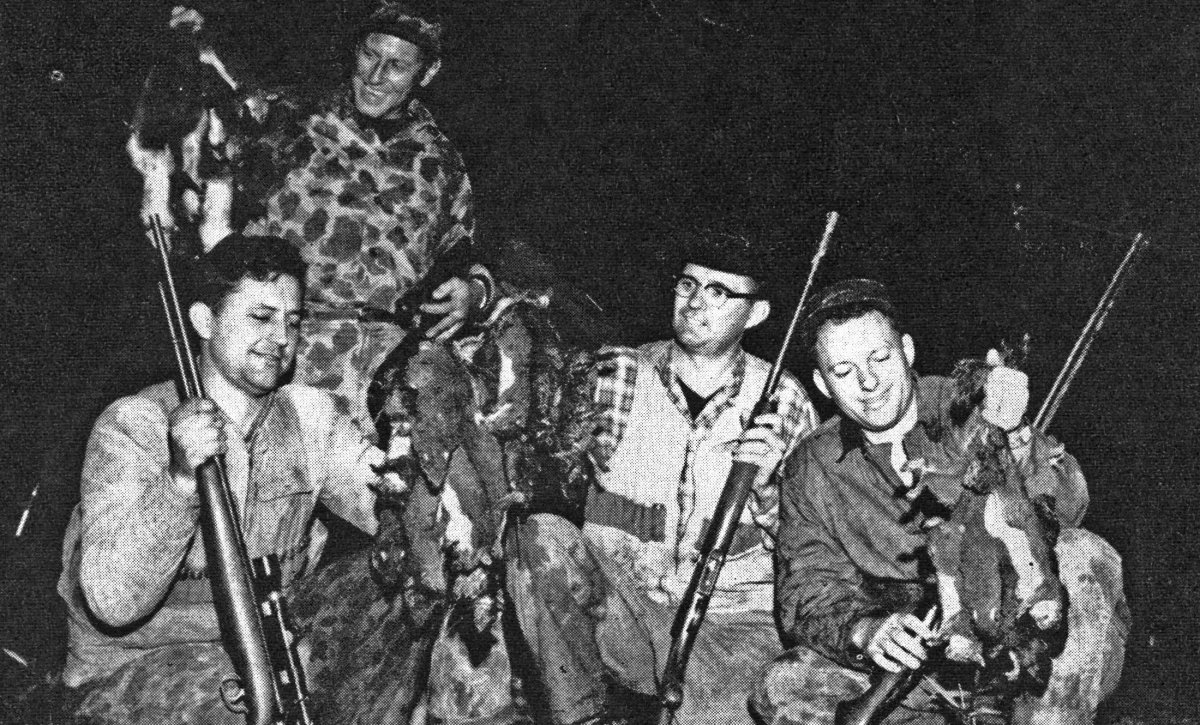
We had 18. When added to those Bill and Clyde had shot, the total for the afternoon came to 38 squirrels—two shy of our combined daily limits.
We broke camp the next afternoon and motored down the Caesar for the last time. Near the mouth of the creek was a sight that struck me as being typical of what the edge of Tate’s Hell has to offer the sportsman. Near shore was a boat tied to a low-slung palm tree. A man was sitting in the stern puffing contentedly on his pipe. Across his lap lay a shotgun, and a cane pole was propped under his knee. He may have been in hell, but it sure looked like paradise.
Read the full article here
