

Wade Fishing the Great Lakes? Try This Traditional Tactic for the Best Smallmouth Bass Bite of Summer

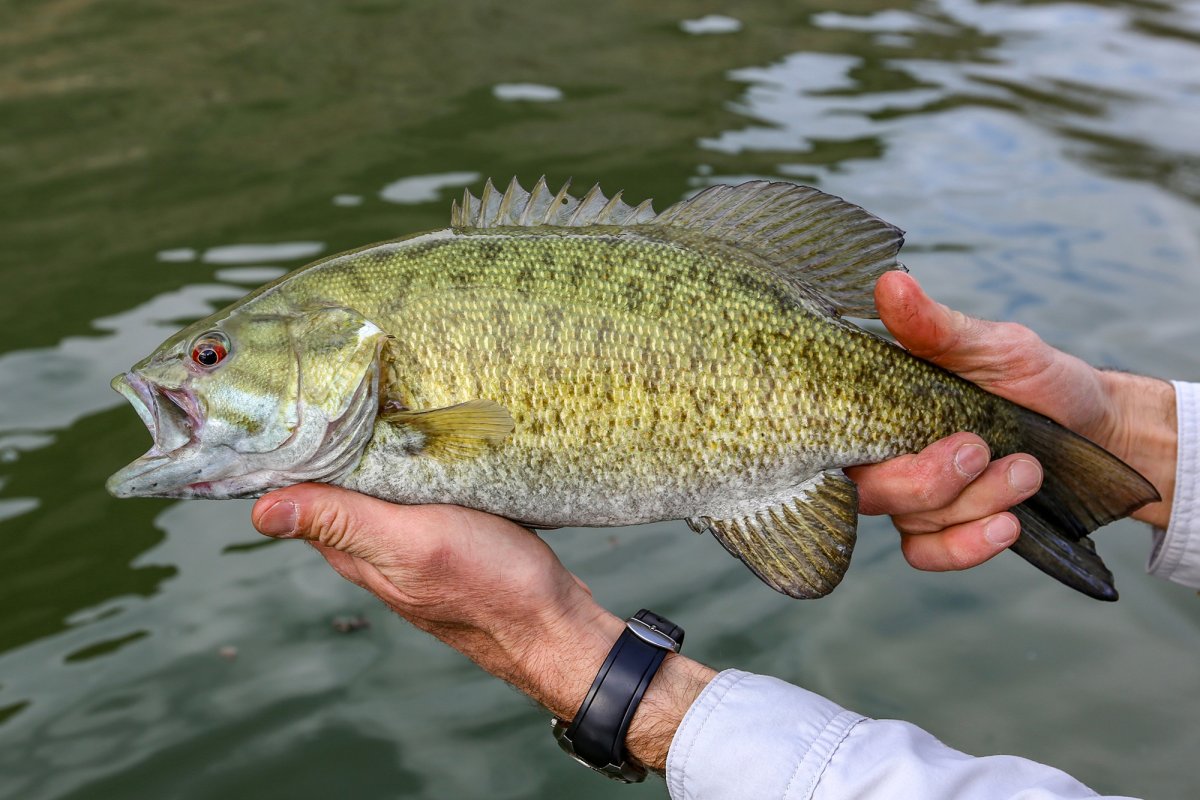

The day was bright and hot but wind pushing across the immense expanse of Lake Michigan cooled everything except my anticipation. Waders on, I stood at the edge of a pothole that the surf had carved in the rock-and-gravel beach.
While coming down the beach, I had sent dozens of tiny frogs scattering in fright. Since small frogs and smallmouth black bass go together like bacon and eggs, I chose a diminutive froglike plug—a sinker—as a lure. As I lifted the rod and let the plug sail out, I noticed a line of low-wallowing freighters, trailing plumes of black smoke, against the far-off horizon.
The plug hit at the far edge of the long, narrow pothole, up against a scattering of reeds. I let it sink, then started it homeward with a slow, erratic retrieve, keeping it close to the bottom. It had only got started when it stopped with a jolt. The limber tip of the long glass casting rod dipped down strongly. The extra-fine strand of braided nylon made a tight circle to the left, parting the water swiftly and throwing a wisp of fine spray before it.
Then the bundle of explosive at the far end of the line started to come up. The surface water lifted, and out burst a sparkling bass, gills flared. With shimmering dexterity the clay-and-yellowish two-pounder marched across six feet of wind-rippled surface, to disappear amid tossing droplets.
Presently, leading him to net and lifting him, I saw the line of freighters again. It was then that I thought how queer the scene was: my unhooking a squirming smallmouth while before me lay a lake 75 miles wide and 300 miles long. Fishing for smallmouths in the Great Lakes hits you that way. To those who haven’t heard of it before it may even sound preposterous.
The smallmouth is generally thought of as a creature of the rocky northern lakes or of swift, cool streams. Yet it’s a fact that the Great Lakes—the world’s largest and most important bodies of fresh water—offer some of the greatest bass fishing to be found anywhere.
That day I was at the end of Waugoshance Point, a long, rocky jut of land a few miles west of Mackinaw City, at the tip of Michigan’s lower peninsula. In about 50 casts I’d hooked several fish that I lost when they leaped. I also landed and released five fish of from two to three pounds. That certainly indicates a tremendous concentration of bass, and it’s typical.
Yet the Great Lakes are but lightly touched by sports fishermen in an age when smaller lakes are gone over with a fine-tooth comb. For example, 10 years ago only a few native anglers in the sparsely settled Waugoshance section knew of the smallmouths there. But in time summer tourists got wind of them, and they quickly spread the word. Anglers were soon coming from other parts of Michigan, and from Ohio, Indiana, and Illinois. Few went away without a limit, and there were tales of men taking and releasing a hundred smallmouths a day—fish of from one to six pounds.
Waugoshance is only one small area in a vast region. The Great Lakes cover tens of thousands of square miles. Michigan’s shoreline alone is almost as long as the distance from New York to Hollywood. In numerous places the smallmouth fishing is excellent; the natives have enjoyed it for years. But otherwise only a few anglers think of the Great Lakes in terms of gamy bass. Many have no idea that black bass are native to these big waters.
That is understandable. Ever since pioneer days, the big lakes have been tremendously important commercial fisheries. Emphasis has always been placed on yellow perch, lake trout, ciscoes, whitefish, wall-eyes, and, in later years, smelt. The yellow perch, fabulously abundant and easy to catch near shore, has been the sport and meat fisherman’s top target.
Resident fishing licenses have never been required for fishing in the Great Lakes, and license money could not be spent to improve it. In the minds of many, therefore, the Great Lakes continued to be commercial grounds in which sports anglers merely dabbled, while the so-called “inland” lakes were their true fishing grounds.
Meanwhile, what has happened? Yellow perch and smelt have got a tremendous workout from shore, and there has been a moderate amount of trolling for lake trout and pike. Residents need no license for any species of fish in the big lakes, including bass. (Brook, brown, and rainbow trout fall under special laws.) Nonresidents aren’t so lucky; they may freely take perch and certain other species in these waters, but for bass they must be licensed. The logic in all this escapes many an angler.
Great Lakes bass may not be netted by the commercial fishermen, so they have thrived mightily. Maybe this will give you an idea:
One spring I was up at Grind Stone City, on Lake Huron at the tip of Michigan’s “thumb,” when some of the local boys found the submerged hulk of a boat just offshore. By wading out waist-deep one could cast right over it. Bass, a regular convention of them, were feeding on minnows and crawfish around the old wreck.
A bug fisherman began casting and I counted his throws. He made 65 consecutive casts that brought strikes. Some of the fish weren’t hooked, of course, and some hooked ones fought free. It made no difference to him; he was merely out for sport and he released his catch.
That’s a lot of strikes for one spot. Multiply it by suitable locations all along the all-but-endless shoreline, and it makes your head swim. Naturally, the bass aren’t always there; in fact, they are in these feeding areas for only a few months a year. When they do come, they swarm in. And if the angler keeps posted as to the best fishing period, he can be there too.
The shallows are empty one week, and the next week the bass are in. Word goes out and fishermen rush to a favored spot, knowing that the bonanza may not last long. The fish move mysteriously, and no one yet knows why. They come inshore in early summer to spawn in the rocky bays and shallows. After spawning, they may stay in the shallows for several weeks, or leave only to return suddenly. Possibly food supply has a lot to do with their migration.
Much seems to depend on weather, wind (which may rough up the shoals and send the fish to deeper water), water temperature, and the like. All in all, it is very easy to miss the smallmouths by getting to the grounds too early or too late. If any date could be chosen as marking the beginning of the run, it would be around July 10. But the bass are unpredictable.
Last year I went up to Waugoshance Point in late June, on the opening day of the bass season. I’d heard reports that the fish were in. They weren’t. Not many, anyway. For 146 anglers checked by a game officer at the point, the average catch was less than one fish. I went back on July 4—and caught one bass. Anglers attributed poor business to high winds, which, they said, were forcing the fish offshore. Toward the end of July I was back, and that was the trip with which I started this account.
There are many minor mysteries about this inshore migration. I know of one spot that was fantastically productive for several seasons. Suddenly it deteriorated. Anglers declared the crop had been fished out. I doubt it. More likely, changes in shoreline or food supply simply caused the bass to seek better ranges.
Another place, an offshore island with a rocky coast, has fish in evidence from long before the season opens until long after it closes. Shrewd anglers find these things out, and it adds to the joy of fishing.
Read Next: The Best Smallmouth Bass Lures: The Only Baits You Need to Catch Giant Smallies
The most unusual bit of lore was related to me by an old-timer. He’s been fishing a pet ground of his for more years than I’ve lived. He always works this spot—it’s on the Lake Huron shore, some distance north of Alpena—during late June and through July, taking bass that run a couple of pounds apiece or less. With the coming of August he quit, because August is generally considered a poor month. The midsummer heat is said to drive the smallmouths out of the shallows.
One summer, for no good reason at all, the old-timer went out to that favorite spot on August 10. He didn’t do much except hook and land a real old settler of almost seven pounds. That got his spirit up, midsummer or no. He was back on August 12. Lo and behold, the place was swarming—but not with the usual one or two-pounders. The fish that struck now ran four pounds and up.
Why? Nobody knows. But the oldtimer goes back every August at the same time and gets much the same results.
The feat of the man who got 65 strikes with 65 casts may lead you to believe that the Great Lakes shores are a fly fisherman’s paradise. But they haven’t proved so. Few anglers, to my knowledge, have done any serious fly fishing for these bass. Those good fly men who tried it have not had much success. Nor have I. But I’m not convinced that the fly has been given a thorough test.
At Beavertail Bay, a rocky spot on the Lake Huron shore of Michigan’s upper peninsula, a friend of mine has been taking enormous smallmouths each spring and summer on minnows fished with a bobber. I’ve bet him that I can match his results by using flies and bugs. I’m still not certain I can do it, because the fish that swarm inshore don’t do much surface feeding. They lie deep, around the rocks. But one of these days experiments with flies will pay off, and then watch out.
Up to now probably 95 percent of the smallmouths taken have been caught on night crawlers. An acquaintance told me of fishing a stretch of Lake Michigan shoreline that had huge sunken boulders on the rock-and-gravel bottom. Each boulder harbored at least one bass, sometimes more.
“You could fish your head off in that area without doing any business at all,’’ he said, “until you learned to lay your crawler on a big rock. When you put it there and left it, you’d immediately be hung to a fish.”
Other men wade armpit deep, looking for boulders in the gin-clear water. Then they cast the crawler—hooked through the head and strung out to wiggle enticingly—so that it swirls around the pockets formed by the boulder. That swirling does the trick.
During my late-July fishing last season I had good luck with fairly small plugs and wobbling spoons. I fished them deep and very slowly. However, I had better results with night crawlers, with which I experimented until I came up with what looks like a surefire method.
I use a very fast reel and 12-pound test line of extremely fine braided nylon. At its end I attach a swivel and to the swivel a fair-size bell sinker. About 18 inches up the line I tie on an eight-inch dropper of stiff, heavy monofilament, to which I attach my hook and night crawler. This stiff nylon stands out nicely at an angle from the soft line and doesn’t give tangling trouble.
I make a long cast, let the bell sinker take the rig quickly to bottom, then start reeling so slowly the handle is barely turning. That keeps my baited dropper flowing horizontally out from the slanted, weighted line.
In one afternoon I landed and released 27 good bass with that technique, so I know the method works— at least in that location.
Great Lakes bass fishing seems ideally suited to spinning tackle, although I have not yet seen it so used. When you get down to it, though, I don’t suppose the method of fishing is anywhere near as important as finding the fish to use it on. So far as I can judge, nobody’s come home skunked from the hot spots, when the fish were in, no matter what he went out with. Hunting for and finding a good spot may be a tough problem for the stranger. On the other hand, it’s part of the fun.
Good new locations turn up every season as more anglers learn about Great Lakes smallmouths. But there is plenty of shoreline left. And you can get to most of it without hindrance. In settled areas or resort sections you’ll run into posted beaches, but vast stretches remain where you may roam at will.
In Michigan, for instance, lake-shore highways bring you close to the surf, and you may stop and fish almost anywhere. There are state parks with camping and trailer facilities right on the shores of some of the best territory. The man who fishes from a boat can go pretty well where he pleases.
In starting out it’s probably wise to try a proven area, at least to the point of using it as a base of operations. In Michigan I’d suggest:
In the lower peninsula, a great half circle of shoreline running clockwise from Traverse City on the west to Grind Stone City on the east, specifically Beaver Island in Lake Michigan— reached by ferry from Charlevoix—and other islands in its vicinity.
Bois Blanc Island in Lake Huron reached from Cheboygan or Mackinaw City. Alpena on Lake Huron and near-by Grand Lake territory. The “point of thumb” area on Lake Huron, with a village like Grind Stone City or Point aux Barques as your headquarters.
In the upper peninsula, the Cheneaux Islands district eastward from St. Ignace all the way to Detour on Lake Huron; the Drummond Island shores, reached by ferry from Detour; westward from St. Ignace through Manistique to Escanaba, and that means almost any of the coastal cites and villages on the north shore of Lake Michigan.
These areas will almost always produce, and you can get local advice, information, and guides. The shorelines are so vast and easily accessible you are almost sure to hit upon a “private” pocket that will produce heavily.
You might start your quest by examining an ordinary road map of one of the Great Lakes states. A Michigan map, for instance, shows innumerable bays, points, coves, etc., and such waters usually are good for bass in season. After you pick a likely-looking area you can write to the proper county seat for detailed maps, ask for dope from a Chamber of Commerce, or contact the state conservation department.
The county maps put out by the Michigan Department of Conservation, Lansing 13, Mich., show state lands and beaches, trails, parks, campsites, etc. Even the smallest bays are identified.
Rocky shores should be your choice, of course, since the smallmouths frequent them. If there are both rocks and weeds, so much the better, for the bass is a cover fish. Wherever you go you won’t be crowded; those Great Lakes shorelines can absorb a lot of anglers.
Read Next: The Best Way to Catch Smallmouth Bass in Rivers: Hit Them With Topwater Lures While Wading
Using waders or a small boat, according to depth, you can work the rocky shorelines in waters from three to 15 feet deep. You’ll find the fishing very much like salt-water surf casting. The fish add to the illusion. They’re handsome fellows, pale in color, presumably taking their hues from the light color of the rocky bottom and the immense, clear waters in which they roam.
The beginner on the big lakes had better work along the shore in waders rather than use a boat. Storms rack up swiftly thereabouts, and the water can be extremely hazardous for light craft. As you get familiar with the moods of the big water you can use a boat, as I do on occasion.
One day a couple of summers ago a friend dropped by my place and said, “I’ve found a new bay the bass are using, and they’ve just come in.’’
That evening I slid my little boat into a tiny, obscure bay and proceeded to skirt the edge of its reed growth, where water fell away over the deeper, rockstrewn floor. Maybe it sounds cocky to say so, but I didn’t hurry a bit; I knew I was going to catch fish. The concentration of bass was so great there would be spirited competition for food. So 1 sat there in the boat, idly gazing into the distance, noting the ever-present, smoke-plumed freighters wallowing along. There was an enormous red sun about to fall with a splash.
I finally snapped on a plug and made my cast. As usual I thought, “This can’t be bass fishing. The atmosphere simply isn’t right.’’
But I knew it was the atmosphere that made such fishing appealing. That, and what happened when I absently started to reel in the sunken plug. A big, tough, water-tossing smallmouth was air-borne, and the setting sun glinted redly on his shining sides. That’s something a fisherman remembers for a long, long time.
This article was originally published in the July 1953 Issue of Outdoor Life.
Read the full article here
