This Giant Nontypical Northwoods Buck Was Found Hanging in a Wisconsin Cabin. It’s Backstory Remains a Mystery

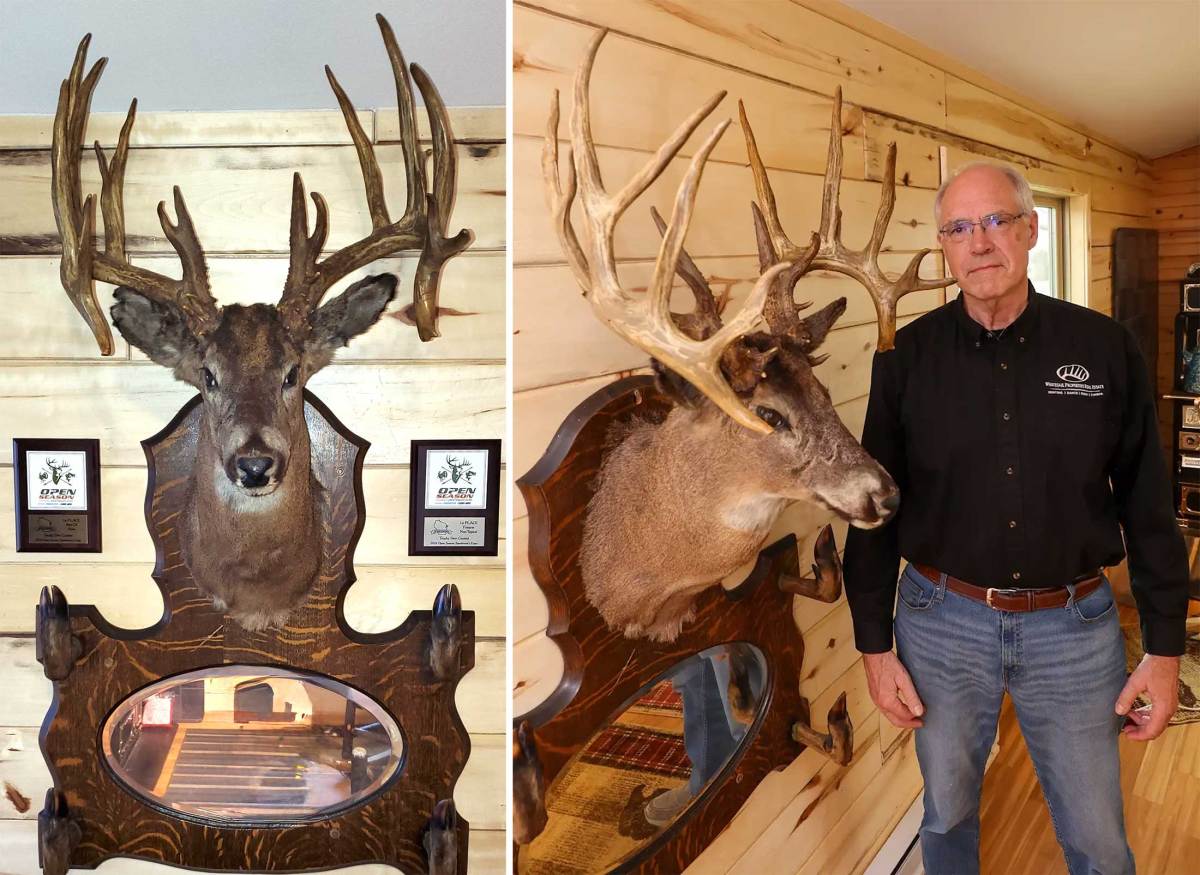

Brian Ruesch, a realtor from Central Wisconsin who specializes in buying and selling hunting land, stumbled upon an absolutely giant buck mount a few years ago. Since Ruesch’s part of the state is core whitetail country, he knows a thing or two about big deer. And he knew right away that the old rack hanging on the cabin wall was something special.
Ruesch was appraising a property at the time and the property owner offered to to sell him the mount. He didn’t hesitate.
“She said her father-in-law purchased it back in 1960 when he saw the horns at a garage sale, but she had no idea where that was,” Ruesch says. “He obviously knew he was looking at a unique deer at the time. This means that mount had been hanging on that cabin wall for nearly 65 years before I came along.”
After Ruesch bought the giant nontypical mount, he went about trying to uncover its history. One of his ideas was to bring the mount to the Open Season Sportsman Expo which was held in Wisconsin Dells in March. The nontypical buck scored 215 inches and won the “Best of Show” at the expo.
The state record nontypical in Wisconsin is an unbelievable 253-inch deer taken in 1973. While Ruesch’s buck doesn’t currently crack the top 10 biggest whitetails taken in the state, it’s conceivable that at some point decades ago it could have —— if it had ever been officially scored. Most of the states top nontypical bucks have been taken in the last 50 years or so, and this buck is believed to be much older than that.
Ruesch knew that he had purchased a massive rack, but he didn’t realize the full extent he had until a friend and certified scorer convinced him to bring the head to the expo and they eventually learned its score.
“This is the biggest deer show in the Midwest, and I knew this was a special deer,” say Marlin Laidlaw, who started scoring bucks in 1977 and became certified for the Wisconsin Buck and Bear Club in 1980.
“I had to talk Brian into bringing it to the show, I know he’s glad he did now. The taxidermist who mounted this buck knew what he was doing,” says Laidlaw, who estimates he’s scored more than 4,000 deer through the years. “You just don’t see many bucks over 200 inches. There weren’t a lot of taxidermists in those years, but Wisconsin’s always had good ones, because we’re a deer state.”
Ruesch found a clue about who originally mounted the buck when he removed the head from the wood backing.
“It was in really good shape for being so old, but I thought I’d put the horns on a new cape,” he says. “I’d gotten started on removing the head from the wood backing when I saw the taxidermist’s name and address stamped on it. I saw it was mounted by a ‘Karl Kahmann,’ who owned Aardvark Taxidermy Studio in Hayward, Wisconsin. So I did a little research hoping to find out more about the buck.”
Ruesch eventually found out the taxidermist’s 82-year-old grandson still lived in Hayward. Better yet, the man had worked in his grandfather’s shop during his high school years.
Howard Morgan, the taxidermists’ grandson, was born in 1944. Unfortunately, he was too young to recall anything about the mystery nontypical buck. But he was able to share some great stories from the old days working with his grandfather.
“I was really close to both my grandparents,” Morgan says. “They moved up to Hayward from Chicago in 1925, where he’d been curator at the Chicago History Museum. I worked with him growing up, I’ve got a lot of good memories of those years. He took me squirrel hunting once when I was 12 years old somewhere a few hours south of here. He got tired on the drive back home and said I should drive so he could take a nap. I wasn’t so sure that was a good idea, but I drove and he napped. Those were the days.”
Interestingly, Howard is possibly the only person still alive who saw Cal Johnson’s world-record muskie when it was caught in July of 1949 in Lac Courte Oreilles.
“I think I was about five when Cal caught this fish. Gramps knew I’d want to see it, so he called for me to come to the shop where Cal had the fish. It was simply massive, just huge,” says Morgan. “I also remember grandma being mad as heck because of all the people who drove over her flower beds in the yard to see the fish after word got out about it.”
Now Ruesch is hoping someone will be able to fill in blanks on the history of this impressive deer, which was likely shot 100 years ago in far northern Wisconsin.
Read Next: This 49-Point Buck Was Promoted as a New State Record. Critics Say It Was Pen Raised
“People who’ve examined and measured many bucks think that although the mount had been in a central Wisconsin cabin since 1960, it likely came from northern Wisconsin. It was probably taken in the late 1920’s or early 1930’s,” Ruesch says. “One reason we think it came from that era is the unique base the buck’s mounted on, including the mirror, which was typical of deer mounts from those days. The other reason is that’s where most of the deer in Wisconsin were during that time. The buck may have come from the Hayward area where it was mounted, but it’s more likely that it came from the counties along the coast of Lake Superior.”
The dark, almost chocolate-colored horns are more typical of deer that rub their velvet on alder and maple. The tannins found in their bark stain north-country deer’s antlers. Alder and maple forests are predominant in that area around the Lake Superior coast.
If any Outdoor Life reader recognizes this buck, please contact the author at [email protected].
Read the full article here