
The Mathews Solocam is back! Well, sort of. The single-cam system that made Mathews a household name in the 1990s is being resurrected under Mathews’ budget-friendly/youth brand — Mission Archery.
The Mission Stryde features the modernized Mission Solocam, offering the same buttery-smooth draw we’ve always loved about Solocam bows, with an adjustable module that makes simple draw length changes easy. That’s a huge difference right there, if you recall the draw-length specific cams of the old Mathews Solocam bows.
There are two different lengths available – 28 and 30.5 inches – and two different limb configurations, making the Stryde a bow that can be built for kids or for adult bowhunters who simply want a quality bow at an affordable price. The Stryde enters the market at a time when many bowhunters are getting spooked by flagship bow prices and are looking for other options.
See It
- ATA: 28 or 30.5 inches
- Weight: 3.8 pounds (28”) or 4 pounds (30.5”)
- Draw Lengths: 21 to 29 inches (28”) or 22 to 30 inches (30.5”)
- The brace height for the 28-inch bow is 6 inches, while it’s 6.5 inches for the 30.5-inch bow.
- Stryde 28 Speed Rating: 320 fps
- Stryde 30.5 Speed Rating: 323 fps
Adjustable Draw Length
The Mission Stryde is offered in axel-to-axle lengths of 28 inches and 30.5 inches. The Stryde 28 weighs 3.8 pounds, while the 30.5 weighs 4 pounds. Draw length ranges are 21-29 inches on the 28-inch bow, and 22-30 inches on the 30.5-inch bow. Those lengths are adjustable on each bow, thanks to the rotating module.
And that module is affixed to that single cam, or “solo cam,” if you will. Single-cam bows have long been heralded because that single cam at the bottom – paired with a simple, round idler wheel at the top – is shaped to evenly distribute the draw weight over the course of the draw cycle, effectively eliminating the big hump that can be associated with two-cam bows. Talk to guys who owned Mathews Solocam bows back in the day. They loved them.
Draw Weight Adjustment
The draw weight range on Strydes with the standard limbs is 50 to 70 pounds. Or, bows can be fitted with lightweight limbs that offer a draw weight range of 30 to 50 pounds. The let-off is fixed at 80 percent, which I’ll talk about when we get to the shooting experience.
Construction and Features
The bows feature aluminum risers with composite limb pockets, where flagship bows would be all aluminum. But the Stryde’s use of composite pockets is common among bows in this price category, and they’ve proven to be able to take some abuse.
There’s a dovetail machined into the back of each riser so that any IMS – integrated mounting system – rest can be attached. There’s also a Berger hole for mounting standard rests, but the IMS rests are fast becoming the preferred option, since the connection is so much stronger.
You don’t get the Mathews Limb Shift tuning system on the Mission Stryde, which isn’t surprising. But there is a split yoke at the top of the bow, which is one of the simplest tuning systems ever made. It does require a bow press, but it’s so easy to work with if you have a press.
Testing the Mission Stryde
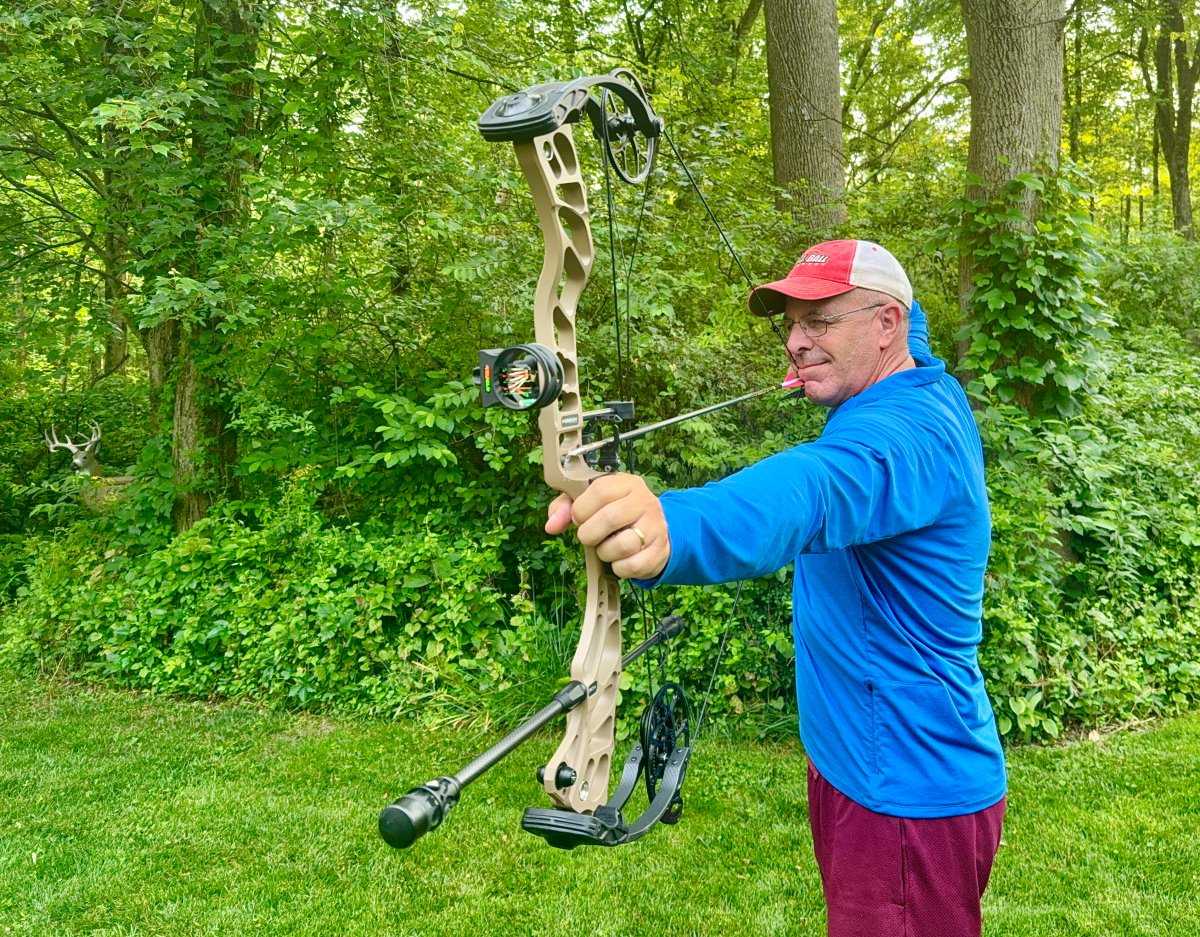
My draw length is 30 inches, so I chose the Stryde 30.5 to test. I initially set the bow to 70 pounds to get a speed reading, but then dropped it to 62 for repeated shooting. I’ll explain why in a minute.
For accessories, I installed a Mission-branded QAD IMS Ultrarest, a five-pin Truglo sight, and a 10-inch Conquest 3K stabilizer. And with this setup, I prepared to shoot 300-spine Victory Rip XV arrows.
Tuning
To start my testing, I set the arrow rest and nocking point and then checked the cam timing. It was off just a bit out of the box, and one twist in the bottom cable got the cams synced. Nothing unusual there.
Next, I shot the Stryde through paper. There was a slight nock-left tear, which I easily fixed by putting one twist into the left yoke attached to the upper limb, and taking one twist out of the right yoke. Again, from my experience, bows with split yokes like the Stryde has are so simple to tune. You do need that bow press, because you have to disconnect the yokes from the limbs to twist them, but if you have a press, the split yokes are very simple.
Speed Testing
With the bow now timed, tuned, and set to a 30-inch draw and 70-pound weight, and shooting a 350-grain arrow, I got a speed reading of 316.9 fps. Basically, 317 fps against the listed speed rating of 323. Pretty close.
Shooting Experience
The bow drew just like I would expect a single-cam bow to draw. The string came back easily with a steady, consistent motion until the cam rolled over. When I say the string came back with a steady, consistent motion, I mean there were no perceived peaks or valleys before the cam rolled over. Sometimes a bow will start off light at the draw and then stiffen or vice versa. The Stryde draw was steady to the rollover.
Now, here’s where the 80-percent letoff and the fact that I dropped the draw weight to 62 pounds for repeated shooting come into play. The valley on this bow feels shallow to me at my draw length. It might feel better at a different length, but I can’t speak to that. And by shallow, I mean if you’re not paying attention at full draw, the string wants to jump forward. It caught me off guard a couple of times at 70 pounds, which is why I took two turns out of the limb bolts to drop the weight to 62 pounds. At that draw weight, I could hold the string at full draw comfortably.
Once I got the draw weight figured out, this bow shot as well as I could have expected. There’s no vibration, but just a little bit of hand shock. It produces an audible “blip” at the shot. I wouldn’t call it loud, but it’s not quiet either. A set of cat whiskers tied to the string would take care of that if the noise bothers you.
But none of that matters to me if the arrows hit behind the pins. That happened for me out to 40 yards. That was my max distance, only because that was all the room I had.
The rubber grip is the right shape for me to maintain a consistent hand position. I didn’t feel like my hand was moving around either at the shot or from shot to shot. There’s nothing more frustrating than a grip that feels different from shot to shot.
I liked the 80-percent letoff at 62 pounds because it gave me the right amount of resistance to hold steady on target. The pin sat still, and the shots broke clean. The arrow flight was impeccable, and I didn’t have to work hard to hit what I wanted to hit.
At 20 yards, I spent some time shooting at a Vegas target face. I hit Xs and 10s as well as I would expect with a bow set up mainly for hunting. Occasionally, I hit a 9, but nothing lower than that.
Outside at 40 yards, it was easy to keep my arrows grouped together. Again, I didn’t feel like I had to pay strict attention to my shot to maintain consistency. It just came naturally.
Final Thoughts
Prices for the two Strydes currently are listed at $599 for the 28 and $650 for the 30.5. You get a lot of performance for those prices. For kids, novice bowhunters or experienced bowhunters who want a high-performing bow for under $700, the Mission Stryde is a home run with a legendary cam.
Read the full article here