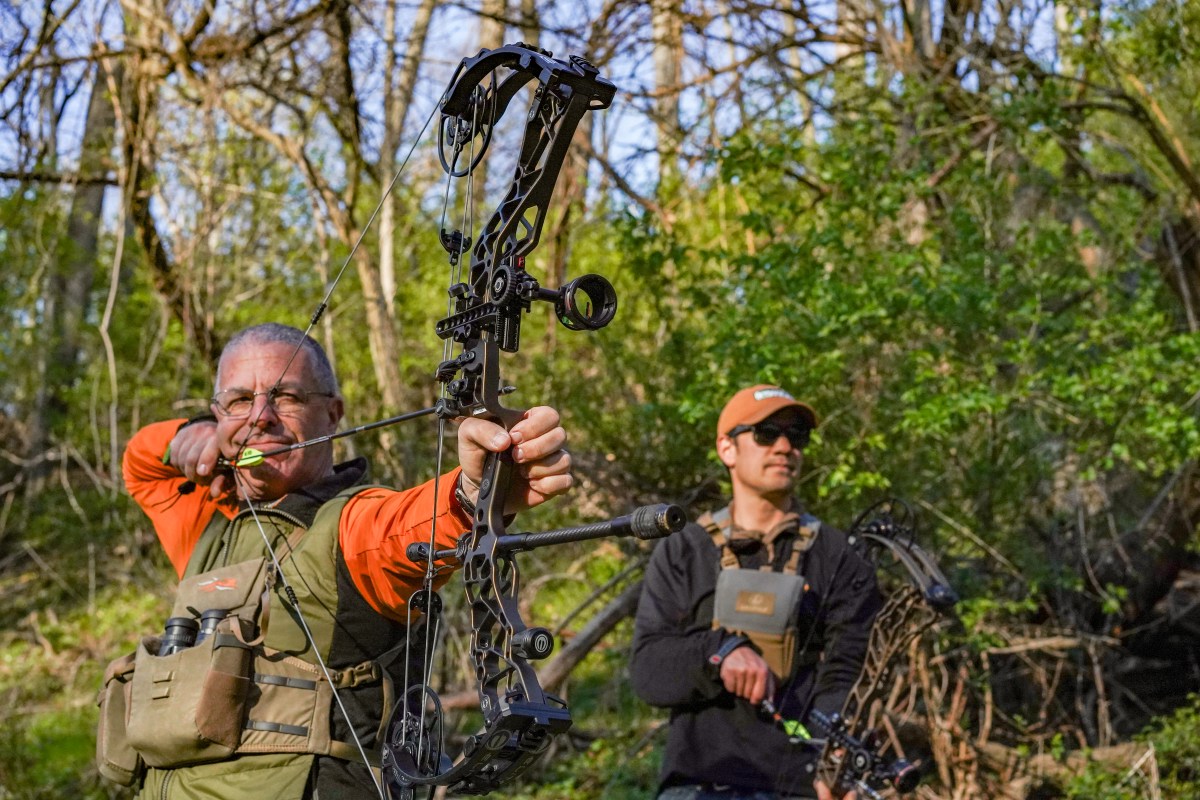

This year’s bow test was by far the most competitive we’ve seen. After shooting seven flagship compound bows for three days, which included shooting 405 arrows for accuracy testing, we chose a definitive winner and concluded that we are indeed in the golden era of compound bows.
We’ve consistently said that all the flagship bows are good, but this year, all of them are excellent. Bow buying is no longer a question sorting the best bows from the lemons. It’s now a matter of taste and priorities.
If you’re going to spend $1,300 to $2,000 on a new flagship compound, here are our quick recommendations from the test.
If you want a light bow that’s easy to pack into the backcountry, the Xpedition NexLite is a great option. If you want a super smooth draw and good performance, the Mathews ARC 34 with Z-Mods is our pick. If you want an exceptionally fast bow, shoot the PSE Sicario. If you’re looking for a well-rounded bow with helpful features, the Hoyt Alpha AX-3 33 and Elite Varos are the top two bows to consider.
If you’re ready to dive into the gritty details of every bow we tested including real-world speeds, draw force curves, accuracy results, and our subjective opinions, read on.
You’ll Never Guess the Winner of This Year’s Bow Test
Jump Ahead
How to Use this Buying Guide
This annual article is a review, but it’s also a buying guide. I want to give you as much information as possible so you can narrow your search to a handful of bows to try out yourself. Here’s a quick guide on the data provided.
Click here for a full breakdown of the testing protocol.
Bow Accessories
All bows were set up with QAD arrow rests, Axcel Antler Ridge stabilizers, and Axcel Driver sights. We shot factory fletched Easton 5.0 arrows.
Accuracy
We shot five arrow groups at 50 yards and each tester measured three groups for each bow. A total of nine groups for each bow get averaged. You’ll find the average group in the test results section for all the bow reviews. The top three bows (Elite Varos, Hoyt Alpha AX33, and Mathews ARC 34) received an additional six groups for accuracy testing.
Scores
We score bows from 1 to 5 on features, back wall, draw cycle, grip, and post shot. A 5 means a bow was the best of a particular category, a 3 is average, and a 2 or 1 means it was a poor performer relative to the field.
Fore Draw Curves
Think of a draw cycle like a rocking chair. The rocker can be shaped in a way so that the rock starts easy, has its peak in the middle, and then finishes easy. Or it can be shaped so that the beginning requires a little more force and then the end of the rock is much easier. The location of the peak and the shape of the curve changes the experience. A force draw curve is a visual depiction of the rocking chair’s rocker. It’s done by recording draw weight every half inch of draw from brace height to the back wall. Then it’s plotted on a line graph. We record every draw force curve twice to rule out any false readings.
Speed
All bows were chronographed using a Garmin Xero C1 and a 389 grain Easton 5.0. Bows were set at 60 pounds (+/- 1 pound) and a 29.5-inch draw length.
See It
Specs
-
Price:
$1,300 -
ATA:
32 inches -
Draw Length:
25.5 to 31 inches -
Weight:
4.75 pounds -
Brace Height:
6 5/8 inches -
Speed (389 grain arrow/29.5-inch draw length):
285.8 fps -
Tested Draw Weight: 60 pounds
Features
-
Micro Splitters:
Adjust cam timing without a bow press -
R.A.C.:
Picatinny mounts for optional accessories -
S.E.T.:
Fine-tuning cam lean without a bow press -
Adjustable let-off -
1/4 inch draw length adjustments -
Picatinny sight mount and Integrate rest mount
This year’s bow test was such a close race that after the initial round of scoring, less than one point separated the top three bows. Then, after accuracy testing, where three testers measured nine groups totaling 45 shots per bow, the average group size of the top three bows were within an inch of each other. At that point, the Varos was in the lead, but it was a narrow margin. Even the three testers were split on which of the top three bows they’d buy.
We did a final shootoff of 30 more shots per bow and the testers focused solely on comparing the Varos, ARC 34, and AX-3 33. When the dust settled, the Elite Varos was the clear winner in accuracy, scores, and the test team’s pick.
The Varos has a full suite of user-friendly tuning features, the best post-shot experience in this year’s test, and it’s not weak in any area of its design. Most importantly, it was the most accurate bow we tested.
Shooting a compound bow is difficult, especially under pressure, and the best bows make the hardest part of archery a little easier. The Varos did just that. Its standout performance was in the accuracy category where our three shooters averaged a 2.79-inch group at 50 yards. In the final 30-arrow shootoff the Varos’ groups were an average of 0.6-inch smaller than the other two bows. The testers all mentioned that it was the easiest bow to be accurate with, and it didn’t punish marginal shots as severely as other bows did.
The Varos won the features category outright because it comes fully loaded, and each of its features is exceptionally well-executed. Elite’s new Micro Splitters allows you to micro-adjust cam timing without a bow press. The Varos arrived with the top cam hitting slightly faster than the bottom. With a typical bow, a half twist in the cable would be too large an adjustment to fix the timing issue. You’d either be stuck accepting the slightly out-of-sync cams or spending an afternoon trying to find the right combination of twists. With the Micro Splitter, it was incredibly easy to even out the 1/16-inch timing difference by turning a single screw. This feature is excellent for getting cams even, but it can also be a benefit if you want to experiment with a slightly faster top cam to improve your aim.
The Varos also has ¼-inch draw length adjustment, S.E.T. (cam lean), a Picatinny sight mount, Picatinny mounts for optional bow hoist, bow stand, and sling, and an Integrate rest mount. All the tuning adjustments can be made without a bow press and are among the easiest to use.
In a field of vibration-free and quiet bows, the Varos was noticeably better. ‘That bow is quiet’ was a frequent comment throughout the three days of shooting. “It’s like the Artus and Exalt from last year had a baby,” test team member Connor Kaufhold says. “It has the speed and draw cycle of the Artus and the back wall and wonderful post shot of the Exalt.”
The Varos scored in the bottom three for the draw cycle category, not because it’s a difficult draw, but because of the severe dump into the valley. As you get the bow close to full draw, the pull weight suddenly drops until you hit the back wall. It’s an abrupt transition that causes sight movement, and it also makes the bow more difficult to let down. The good news is that it’s fixable. For the final shootoff, the testers were able to fully customize the bows to their preferences, and they adjusted the let-off from 90 to 80 percent, which dramatically smoothed out the transition into the valley.
The back wall is solid, and it’s easy to keep the bow at full draw — especially when set to 90 percent let-off. We shot the Varos at 60 pounds of draw weight, and its holding weight was only 7.8 pounds. If you ever have to draw and hold for an extended time, this is the bow you want in your hands.
The machined grip is comfortable and repeatable. It obviously lends itself to accurate shooting, but the testers found it slippery and suggested adding grip tape.
At 4.75 pounds, the Varos is among the heaviest bows we tested. The weight could be an issue if you’re trying to cut ounces for a backcountry hunt. But it’s a benefit for absorbing vibration and stabilizing the shot. “I think it (the Elite’s mass weight) really helps with having a good holding pattern on target and being a generally forgiving bow,” says Kaufhold.
The winner of the bow test is purely performance-based, but it is worth noting that the Elite Varos is the least expensive bow in this year’s lineup. Especially when you consider the depth of features and overall bow quality, it’s a great value.
Hoyt Alpha AX-3 33
See It
Specs
-
Price:
$1,499 -
ATA:
33.56 inches -
Draw Length:
26 to 31 inches -
Weight:
4.75 pounds -
Brace Height:
6 3/8 inch -
Speed (389 grain arrow/29.5-inch draw length):
285.6 fps -
Tested Draw Weight: 59.6 pounds
Features
-
XTS Tuning System:
Adjusts cam lean without a bow press -
Adjustable let-off (75, 80, or 85%) -
1/4-inch draw length adjustments -
Picatinny sight mount -
Integrate arrow rest
The Hoyt Alpha AX-3 33 is a well-rounded bow that excels at every metric we tested. It has a nice draw, a great grip, good speed, a solid back wall, and a superb post-shot. Aside from being a fantastic all-around performer, the AX-3 is beautifully machined and nicely finished. Ultimately, it was just a half step behind the Elite in the finals.
The AX-3 ended up in a three-way tie for the second-best draw cycle. The draw peaks quickly, then levels out, and has a steady transition into let-off. The back end of the draw cycle is superb and it makes the Hoyt a very smooth bow to let down. This bow also had the best back wall in this year’s test, it’s solid, with very little give and a generous valley that lets you comfortably settle into your shot.
Last year, Hoyt introduced their new HBX Gen 4 cam, which does a great job balancing a nice draw and good performance. The AX-3 was just as fast as the Elite Varos, and it scored higher for the draw cycle category. One of the ways the HBX Gen 4 is able to generate speed without a harsh draw is through its draw-length-specific modules. If you design a bow that can be adjusted 5 inches on a rotating module, there are typically some performance trade-offs. Hoyt limits the adjustment range on their modules, which maximizes efficiency while still allowing you to fine-tune your draw length in ¼-inch increments. It’s a smart design.
This year, Hoyt added the XTS Tuning System, which is an elegant method for adjusting cam lean. We’d put it neck-and-neck with S.E.T. for ease of use and effectiveness. While getting the AX-3 prepped for testing, it had a slight right tear. Instead of moving the rest, we used the XTS tuning system to get a bullet hole using only a set of Allen wrenches.
The AX-3’s grip was the test team’s favorite this year. When three different people all like the same grip, you know it’s a good one. “Most comfortable grip and back wall in the test,” says Kaufhold. “The grip is perfectly shaped to fit most hands and allow for accurate shooting.”
See It
Specs
-
Price:
$1,469 -
ATA:
34 inches -
Draw Length:
26.5 to 32 inches -
Weight:
4.3 pounds -
Brace Height:
6 1/2 inches -
Speed (389 grain arrow/29.5-inch draw length):
284.1 fps (SWX-Z) 289.3 (SWX) -
Tested Draw Weight: 60 pounds
Features
-
Limb Shift:
Adjust cam timing without a bow press -
Bond Grip:
Allows the user to change grip styles -
Bridge-Lock sight and stabilizer mounts -
Machined-in pull rop attachement point -
Draw length and let-off adjustable via mods
The Mathews ARC 34 with Z-Mods was the unanimous choice for best draw cycle. It’s an even, effortless pull with no extreme high or low points. The testers commented that the 60-pound ARC 34 felt like it was only 50 or 55 pounds. You can also shoot the ARC 34 with the standard SWX mods, which have a very similar even feeling, but the draw isn’t as effortless.
In the ARC’s draw force curve, you can clearly see how it slowly builds to peak weight and gradually steps down into the valley. While recording the values for the ARC’s draw force curve, it was very consistent throughout its peak weight section; we recorded less than a .5 pound difference in the 12 measurements in that zone, which is an indication of the SWX-2 cam’s efficiency.
That efficiency is likely why the speed difference between the standard SWX and SWX-Z mod isn’t as much as you’d think. The standard mod shot 289 fps, and the Z mod shot 284 fps. All the testers agreed that the comfort you get from the Z mod is definitely worth the 5 fps speed cost.
The ARC has a solid back wall, but it does have a relatively short valley. You have to maintain constant pressure on the stops, to avoid a collapse. If you’re used to shooting a bow like an Elite at 90 percent let-off, and you go to the ARC, it will take time to get used to keeping the stops pinned. On the flip side, unlike the Elite, the transition into the valley is fluid.
The ARC 34 also aimed exceptionally well. “When I put that dot where I want it, it just doesn’t move. It aims awesome,” says Reilly. The steady aiming contributed to the ARC 34’s excellent accuracy and overall positive shooting experience.
The ARC comes with the Engage grip, which has been standard for years. It’s no secret that the OL test team doesn’t prefer the Engage grip — it’s comfortable but does not aid in repeatability. You do have plenty of options from Mathews and the BeeReal grip from Ultraview if you want to swap it out. Or you can remove the grip and shoot off the bare riser.
The smooth draw and rock-steady aiming are the ARC’s headlines, but it’s also a very light bow for its length at 4.3 pounds. The weight savings is made possible by detailed machining and lightening cuts made throughout the riser. An underrated performance metric is how much fun a bow is to shoot. The ARC scored high in giggle factor because of its smooth draw, nice post shot, and easy aiming experience.
Bowtech Alliance
See It
Specs
-
Price:
$1,399 -
ATA:
30.5 inches -
Draw Length:
26-31 inches -
Weight:
4.09 -
Brace Height:
6 7/16 inches -
Speed (389 grain arrow/29.5-inch draw length):
280.5 fps -
Tested Draw Weight: 60.8 pounds
Features
-
DeadLock:
Adjusts cam lean without a bow press -
Centermass Sight:
Inline sight mounting -
Integrate arrow rest mount -
Griplok:
Adjustable grip angle -
Flipdisc:
User can go from performance to comfort setting my flipping the module
In a year of great bows, the Alliance was the one that was just good. This was a year unlike any other, in which bows were separated by small margins. We had several bows that had near-zero vibration, so the slightest felt vibration was the difference between the highest and the lowest scoring bows. The same goes for the other categories. A 4.2-inch group average at 50 yards is solid, especially for a 30-inch axle-to-axle. But, this year’s top contenders were shooting around a 3.5-inch group average.
The area where the Alliance 30 performed the best was its draw cycle. It tied for second in this category. With the DeadLock Cam on the comfort setting the draw gradually builds to peak weight and gently drops down in weight as it reaches full draw. The draw force curve isn’t too far off from the Mathews ARC 34’s and is a good illustration of how easily this bow is to pull back.
The two main points of contention were the Alliance 30’s grip and back wall. The testers felt the wall was too soft for their liking. The Alliance 30 uses rubbery cable stops, which likely contributed to that soft feeling. They also agreed the grip was too thin and too deep for their preferences. And while you can adjust the grip’s angle, you can’t adjust the width or depth.
Don’t get us wrong, the Alliance 30 is a good bow. It was easy to tune, it has helpful features, and it will shoot lights out if you do your part. Just because it wasn’t the best bow for this group, doesn’t mean it won’t be the right bow for you.
Darton Tritech 33
See It
Specs
-
Price:
1,350 -
ATA:
33.18 inches -
Draw Length:
25.5-31 inches -
Weight:
4.6 pounds -
Brace Height:
6 3/8 inches -
Speed (389 grain arrow/29.5-inch draw length):
278.2 fps -
Tested Draw Weight: 60.2 pounds
Features
-
Perfect Tune:
Adjusts cam lean without a bow press -
Perfect Timing:
Adjusts cam timing without a bow press -
Adjustable cable guard -
1/4-inch draw length adjustment -
Optional speed mod included -
Adjustable let off -
Picatinny sight mount -
Integrate arrow rest mount -
Adjustable grip angle with swapable inserts
Darton has been making some of the most interesting bows over the last three years. The Tritech 33 is another stellar option in their lineup. It had one of the smoothest draw cycles, it was among the most accurate bows, it has a ton of tuning features, and it has one of the most comfortable grips.
Imagine it’s a week before hunting season and you notice your cam timing is just a little bit off. If you don’t have a bow press, you’d have to find time to go to the archery shop, check your bow’s tune, and then adjust your sight again. But, if you have a Tritech 33 you can do all that at home. Darton introduced their Perfect Timing feature, which is a pressless solution for adjusting cam timing that only requires Allen wrenches. We utilized every tuning while getting the Darton prepped for testing. It had a stubborn right tear that required a combination of the Perfect Tune and cable guard adjustment to get out.
The Tritech 33 is just as feature-rich as the Elite Varos. It also has ¼-inch draw length adjustment, cam lean adjustment, and all the low-profile accessory mounting options. But the Elite scored higher in the features category because we felt its tuning features are easier to use. We also found the Tritech’s draw length adjustment cumbersome due to multiple screws that use different-sized Torx bits. Also at certain draw lengths, one of the screws can only be accessed by pressing the bow.
As you draw the Tritech 33 it quickly hits peak weight, and then it has a smooth finish as you get to full draw. It’s not as smooth as the ARC 34, but it’s not far off. The Tritech 33 also received praise from the testers for its nice post shot and comfortable grip. This is yet another full-featured and solid performing bow available to bowhunters.
See It
Specs
-
Price:
$1,999 -
ATA:
33 inches -
Draw Legnth:
24.5 to 30 inches -
Weight:
3.9 pounds -
Brace Height:
5 1/4 inches -
Speed:
305.2 fps -
Tested Draw Weight: 60.4 pounds
Features
-
EZ.220 System:
Spacers that adjust cam lean. Requires a bow press and tool. -
Full Draw Stability:
Increases dynamic brace height -
Picatinny sight mount -
Integrate sight mount
The Sicario clocked in at 305 fps at 60 pounds and 29.5-inch draw, shooting a 389 grain arrow. This is about 20 fps faster than the next closest bow in this year’s test. It’s a stupidly fast bow, but that’s only half the story. Unlike most speed bows, this one is comfortable to draw and shoot.
The draw is stiff and requires effort throughout the pull, but it’s smooth. At full draw, you can keep the stops pinned without breaking a sweat. Speed bows have always been notoriously horrendous to shoot. While the Sicario isn’t as nice to shoot as the Mach 33, it is exceptionally nice for the performance you get. Gone are the days where you have to put your rotator cuff in danger or shoot a 350-grain arrow to shoot over 300 fps.
Speed isn’t everything, but it does have its advantages. If you want to dominate the IBO hunter class, shoot a heavy arrow with a flat trajectory, or shoot targets well past 100 yards, the Sicario’s performance will give you the edge you need.
The Siciario struggled with accuracy, most likely due to its 5.25-inch brace height, which is more than an inch shorter than the next shortest brace height we tested. Even with PSE’s Full Draw Stability, which increases dynamic brace height, it’s a very short brace and will be more critical.
The Sicario’s speed is hard to ignore, but it has everything we liked about the PSE Mach 33 in 2025. Things like low vibration, a USA-made carbon riser, the EZ.220 system, an excellent grip, and superb craftsmanship.
See It
Specs
-
Price:
1600 -
ATA:
33 inches -
Draw Length:
24.5 to 31 inches -
Weight:
3.75 pounds -
Brace Height:
6.375 inches -
Speed (389 grain arrow/29.5-inch draw length):
280.3 fps -
Tested Draw Weight: 60.1 pounds
Features
-
Magnite:
A magnesium alloy riser material -
Xlok tuning system:
Adjusts cam lean with spacers without a bow press -
M-Lok Accessory attachment -
Integrate arrow rest mount -
Picatinny sight mount -
1/4-inch draw length adjustment -
Adjustable let off
The NexLite was the lightest bow in this year’s test at only 3.75 pounds. It’s even lighter than the carbon PSE Sicario, which is the same length. It’s made from Magnite, a magnesium alloy that uses ceramic nanoparticles combined with other rare earth elements. Xpedition says the material is 30 percent lighter than 6061 aluminum and stronger than carbon.
Despite the NexLite’s low weight, the testers praised its lack of vibration. “The post shot for this bow was very unique,” says test team member Alex Robinson. “There was hardly any vibration, but because it was so light it did jump a bit in my hand. Overall, I really did appreciate Xpedition’s execution of an ultra-light bow that is still nice to shoot.”
If you shoot the NexLite without any accessories, it will jump forward at the release, but as soon as you add a little weight in the form of a sight and stabilizer, it settles down. One of the benefits of a lightweight bow is that you can put more weight into your stabilizers to customize the bow’s aiming pattern and post-shot reaction.
We really appreciated the overall build quality of the NextLite and the little details, like a machined Picatinny sight mount rather than a bolt-on rail section. It features a smart and easy-to-use shim system for tuning. To shim the cams, all you need is an Allen wrench. You’ll remove the shims from the limb tips and swap or replace them. No bow press is needed, and the whole process takes minutes.
Like most bows these days, you can get an optional bow stand for the NextLite. But, what makes the Xpedition stand so cool is that it’s very lightweight and it attaches via M-LOK, a light and secure attachment method.
How We Tested
Set Up
All bows were set to 60 pounds (+/- 1 pound). We set bows at 29.5 inches of draw length and measured exact draw weight to provide context for the bow’s speed.
We timed the cams, set the centershot to the standard 13/16 inch, and set the nocking point height level. Then we paper tuned to a bullet hole to make sure we were doing the speed and accuracy testing with a tuned bow.
Scoring
After the test team finished shooting all the bows, they scored them on five criteria. Each was scored on a 1 to 5 point scale and the scores are based on a bow’s performance relative to the other bows in this year’s test. A score of 5 meant the bow was the best, or tied for the best, in a particular category. A 3 means a bow is average . A 2 is a poor performer. A 1 is an exceptionally poor performance.
- Features: Tuning adjustments, rest/sight mounting, draw length adjustment, and customizable grips are all things we look for
- Back Wall: How does the back wall and valley feel?
- Draw Cycle: Is the draw smooth or harsh?
- Grip: Is it comfortable and does it promote consistent hand placement?
- Post Shot: Does the bow have vibration and noise? This test is done with no additional stabilizers on the bow.
Accuracy
Three testers shot a total of 405 arrows over two days to gather accuracy data. The testers were allowed to adjust stabilizers on the bows to suit their personal preferences. Other than that, the bows were set up identically.
The accuracy test is telling because a bow must shoot well for three different archers to earn a small group average.
Speed
We shot Easton 5.0 arrows in a 350 spine cut to 29 inches with a 100-grain field point. The arrows weighed 389 grains overall. Each bow’s exact draw weight is listed along with its speed in the test results section.
We used a Garmin Xero C1 chronograph to measure three shots from each bow. We then averaged those three recorded speeds for the final spec. Because everything from a bow’s tune to the weight of the peep can affect a bow’s speed, the speeds listed are meant to provide reference points, not the final word on a bow’s speed. It’s also important to note that all of today’s flagship bows are pretty fast, but what’s impressive to us is when bows are easy to draw and still shoot fast.
Draw Force Curves
We put bows in an LCA Draw Board and used an LCA Bow Scale 3.0 to measure draw weight at every 0.5 inch of draw length from brace to the back wall. We recorded these measurements twice for the sake of accuracy.The weights were plotted on a line graph to depict each bow’s draw cycle. Bows that ease into their peak weight and ease into let off ultimately feel smooth. A bow that quickly gets to the peak weight and sharply drops off is an aggressive draw cycle.
Gear We Used for Testing
Chronograph: Garmin Xero C1
The Garmin Xero C1 uses doppler radar to track a projectile and measure its speed. We chose it because it’s the best chronograph available and it provides consistent readings no matter the lighting conditions.
Bow Sight: Axcel Driver
For our test we need a sight with a bright, easy to aim fiber and easy, toolless adjustments. In our opinion, the Axcel Driver is the best sight for the job.
Arrows: Easton 5.0
The Easton 5.0 is the hot arrow this year and our pick for the best hunting arrow. Its good weight, solid components, and tight specifications made it the perfect arrow for accuracy testing this year’s top bows.
Arrow Rest: QAD Ultrarest
The QAD Ultrarest won best overall in our best arrow rest review. So it was an easy pick to be our arrow rest of choice for the bow test. It offered easy setup, reliability, and accuracy.
Stabilizer: Axcel Antler Ridge
The Antler Ridge stabilizers and mounts allowed the test team to quickly customize their stabilizer set ups based on their preferences.
Other Tools Used
The Test Team
P.J. Reilly: A longtime bow reviewer and video host for Lancaster Archery Supply. Reilly also reviews bows for LAS and has bowhunted everything from whitetails to musk ox.
Alex Robinson: Outdoor Life‘s Editor-in-Chief, bow test veteran, and workaday bowhunter.
Connor Kaufhold: The youngest member of the test team, but also the most experienced competitive archer. Kaufhold is a collegiate all-american in recurve, compound, and bowhunter divisions. He works at his family business, Lancaster Archery Supply, and enjoys bowhunting whitetails.
Scott Einsmann: Outdoor Life Executive Gear Editor, test organizer, former archery coach, and lifelong archery nerd.
Test Results
| Bow | Features | Back Wall | Draw Cycle | Grip | Post Shot | Total |
| Elite | 5 | 4 | 3 | 3.6 | 5 | 20.6 |
| Hoyt | 3 | 4.6 | 3.6 | 5 | 4 | 20.2 |
| Mathews | 3 | 4.3 | 5 | 3 | 4 | 19.3 |
| Darton | 4 | 2.6 | 3.6 | 3.3 | 3 | 16.5 |
| PSE | 2 | 3.3 | 2.6 | 4.3 | 3 | 15.2 |
| Xpedition | 2 | 3.6 | 2.6 | 2.3 | 3.3 | 13.8 |
| Bowtech | 3 | 2.6 | 3.6 | 2 | 2.6 | 13.8 |
Accuracy Results
| AVG | |
| Bowtech | 4.22 |
| Darton | 3.723333333 |
| Elite | 2.72 |
| Hoyt | 3.636666667 |
| Mathews | 3.56 |
| PSE | 4.04 |
| Xpedition | 4.24 |
Final Shoot-Off
| Bow | AVG |
| Elite | 2.875 |
| Hoyt | 3.458333333 |
| Mathews | 3.666666667 |
Bow Specs
| Bow | Price | Speed | ATA | Draw Min | Draw Max | Weight | Brace Height | Draw Weight | Holding Weight |
| Bowtech Alliance 30 | 1,399 | 280.5 | 30.5 | 26 | 31 | 4.09 | 6 7/16 | 60.8 | 11.3 |
| Darton Tritech 33 | 1,350 | 278.2 | 35.125 | 25.5 | 31 | 4.6 | 6 3/8 | 60.2 | 12.9 |
| Elite Varos | 1,300 | 285.8 | 32 | 25.5 | 31 | 4.75 | 6 5/8 | 60 | 7.8 |
| Hoyt AX 33 | 1,499 | 285.6 | 33 9/16 | 26 | 31 | 4.75 | 6 3/8 | 59.6 | 8.6 |
| Mathews ARC 34 | 1,469 | 284.1 | 34 | 26.5 | 32 | 4.3 | 6.5 | 60 | 12.5 |
| PSE Sicario | 1,999 | 305.2 | 33 | 24.5 | 30 | 3.9 | 5.25 | 60.4 | 10.8 |
| Xpedition NexLite 33 | 1600 | 280.3 | 33 | 24.5 | 31 | 3.75 | 6.375 | 60.1 | 9 |
Final Thoughts
Bow trends come and go. One year the industry is excited about speed bows and the next year it’s all about long axle-to-axle bows. Those trends existed because historically, you had to choose one extreme or another. You could get the bow with the short brace height and horrible feeling draw, but it had good speed. Or you could get the easier-to-shoot bow that was on the slow side.
But, the latest trend is bows with fewer compromises and every feature imaginable. The 2026 crop of flagships all draw smooth, are stable, and shoot arrows at good speeds. Nearly all of them have tuning features that don’t require a bow press.
So what’s next for compound bows? I think we’re at the point where we don’t need a new bow release every year. If I bought any one of the above bows, I’m very confident I wouldn’t need to upgrade for at least three years.
Maybe if manufacturers started an every-other-year cycle, we’d see even greater leaps in bow capability but I imagine that would make choosing a compound bow an even greater challenge.
Read the full article here