
This story, “Mighty Trout of the Mighty Mo,” appeared in the April 1963 issue of Outdoor Life.
“It’s going to be tough dragging a 10-pounder back through this fence,” said Bill Browning, unhooking himself from a shaft of barbed wire.
“What a joker you are,” grunted Gene Anderegg as he raised up too soon and ripped a jagged tear in the back of his shirt.
Gene and Bill had been crawling under a fence on the banks of the Missouri River, some few miles below the Hauser Lake Dam near Helena, Montana. Gene, who is sales manager for a camera-distributing firm in New York City, had come to Montana looking for some trout fishing. Bill, director of travel promotion for the Montana Chamber of Commerce, had promised him something special.
“You’d better do pushups every morning to get in condition for these Missouri whoppers,” he had written Gene.
“Were those pushups for getting under fences?” Gene asked him now.
They reached the river, and Gene waded right out. He tossed a No. 2 Gray Marabou Muddler fly across the current and started it back. After two strips of the line, a big wave appeared in back of the fly; then Gene felt the hard, tugging yank of a heavy fish. He struck and saw his rod tip dip down almost to the surface. The fish hung there, then made a short run toward shore.
“That’s a small one,” said Bill. “Hurry him in and try for a big one.”
At that moment the fish jumped clear of the water, and Bill changed his tune. The trout was a real monster.
“Did you see his size?” Bill yelled. “Take it easy, Gene. Let’s not lose this one.”
The fish bolted out into the river for 150 feet, swirled, did an oblique to the right, and headed for the surface. Out he came again, a buster of a brownie fighting up a storm. Back in the water, he swung his massive body from side to side, shook his head, clamped his jaws together, made the rod dip, jump, and quiver. Gene began flexing his cramped and sore fingers, first one hand, then the other.
“I needed more than pushups,” he yelled to Bill. “What a fish!”
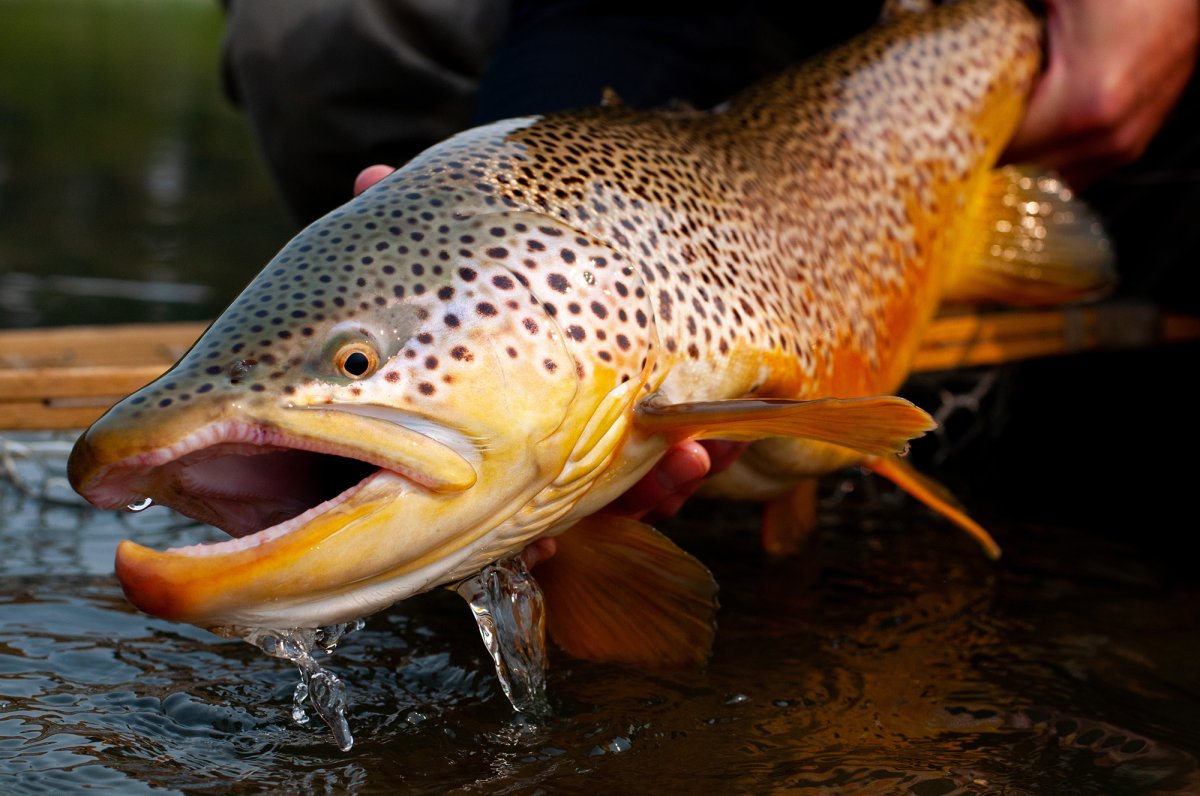
He finally worked the trout in about 15 feet from shore, held his rod high, walked back from the river, and skidded the fish up on a gravel bar. He eased the pressure, reached down, and got some of his aching fingers into the gills. Then he carried the brownie well back from the river. It weighed an even 10 pounds.
“You win, Bill,” said Gene. “It’s going to be tough to get back through that fence carrying this thing. Look how deep he is. That’s the biggest trout I’ve ever seen.”
After 15 minutes, Gene was into another nice one. It weighed four pounds nine ounces. Half an hour later, Bill had one that went five pounds nine ounces. Then it was dark and they had to quit.
At the time, I was on a fishing trip in Montana and happened to be in Dan Bailey’s Fly Shop at Livingston when Bill and Gene came by with those big fish. I took one look and just about jumped out of my boots.
“Where?” I asked.
“The Missouri,” they told me.
I had fished the Missouri for two years running and caught some beauties up to 4½ pounds, but this looked like the year of the great harvest and I wanted in. I pushed Bill into a corner and arranged to meet him at the Hauser Dam the next day.
We went downstream a bit. The Missouri is big and wide where we started to fish, and as I waded out to knee depth several trout were rising within easy casting distance. I saw a big swirl just 35 feet away, threw the 1/0 Muddler out, dropped it five feet upstream from where the fish had shown, let it float dead for four of those feet, then raised the rod tip and pulled back hard. The fly darted my way. There was a boil of water in back of it, then a tremendous hit, and water flew as I set the hook.
The fish ran downstream for 100 feet, came halfway out, ran for shore, turned and ran out again, then went deep and acted as if he were rubbing his hook-shaped jaws on the bottom. I finally got him out of that, though, and he plunged away on the surface, throwing water all about. This time I got a good look. He was at least seven pounds.
He ran downstream and dogged in the current. I went after him, wading ashore and walking along, reeling as I went, until I got below him. Then I pulled him backward. He ran for shore again as if he was going to beach himself, turned, and shot up through the shallows, his back out of water, putting up spray with vicious lunges of his big, broad tail. That tired him, and at last I could turn him toward the bank and reel in until the leader came to the rod tip. Then, like Gene, I walked back slowly, keeping the pressure on, and soon he was kicking and flapping on the shore.
He wasn’t quite as big as I had guessed — just five pounds 15 ounces. But that was only the beginning. In rapid succession I landed a two-pound four-ounce brownie, a three-pound rainbow, two browns that must have been twins at four pounds 12 ounces each, and then another that went five pounds 15 ounces. By that time shadows were stealing over the river, trees on the far side were growing black, and the sun was just about to slip under the covers of night. I could see Bill coming back down the river from where he had been fishing. He had a 4½-pounder in his vest.
“You’d better keep that one,” he said as I unhooked the biggest I’d taken thus far. “It’s time to go.”
I slid the fish back in the river, the same as the others.
“I’ll keep the next one,” I said. “Just give me five more casts.”
One cast, two, three, four, five — and nothing.
“One more, just to reel in,” I muttered, and threw the fly out.
It had hardly hit the water before there was a strike that jolted me all over. The reel went into a screech that sounded like the old ’49 coming round the mountain. I couldn’t do anything but hold onto the rod. That trout hooked himself, and I still don’t know why he didn’t break the 4X tippet, he hit that hard.
I landed him 10 minutes later. He weighed six pounds 14 ounces, a fat and fit brownie to cap a couple of hours of the best trout fishing I’ve ever had — and this in a river that most people think of as a place to go for catfish!
It’s true that downstream from the town of Ulm, in north-central Montana near Great Falls, the waters of the Missouri are too warm, slow, and silty to sustain trout. Down there, paddlefish, sturgeon, and catfish take over, but there’s great trout fishing from Ulm all the way upstream through a series of river stretches between the Montana Power Company’s dams and reservoirs to Trident, where the Missouri is formed by the confluence of the Madison, Jefferson, and Gallatin rivers. A stream classification committee for Montana, classifying the rivers on the basis of availability, esthetics, use, and productivity, marks the Missouri as a Class A stream from Lombard to Townsend, and again from Wolf Creek to Ulm. Actually, it could have pinned the blue ribbon on the whole length of river from Trident to Ulm. Throughout this 125-mile stretch, the angler can be up to his ears in some of the best trout fishing for the biggest trout he can find in any river in the United States.
Last year in the Holter Reservoir, a 10-pound brown was taken, two were caught that went 15 pounds, and one angler, in just over a week, took 24 trout — rainbows and browns — that dressed out at 64½ pounds. Another fisherman stood on the dock at Gates of the Mountains, cast out a spoon, and got a brown that weighed 12 pounds 12 ounces. In the Big Spring area below Toston Dam, Mattford Swain took a 15-pound 13-ounce rainbow.
Two years ago, in December, a rainbow and a brown weighing 15 pounds apiece were taken on bait below Canyon Ferry. At the Toston Derby last Labor Day, a nine-pound brown took the top prize, and a dozen rainbows and browns touched the six-pound mark. There seems to be no end to the big fish in the Mighty Mo, and the number taken that weigh from two to four pounds is unlimited.
What makes these Missouri River trout so big and so plentiful?
The Missouri is very warm compared with other trout rivers, almost at the danger point of being too warm to hold trout. A bit more temperature, and they couldn’t take it. But the volume of water, augmented by the aeration from rapids and at the dams, the cooler water along the bottom of the reservoirs, plus the usually cold nights which are common in Montana at this 3,500 to 4,000-foot altitude, all conspire to keep the water just cool enough so trout can live. Meantime, the very fact that the water is warm encourages the development and flourishing of those things on which trout feed. And food builds bulk.
Aquatic insects in all their phases abound, as do vast schools of minnows, hellgrammites, frogs, and snakes. Perhaps the one item that puts more weight on a trout than any other is the sculpin minnow, sometimes called bullhead, darter, or muddler. This minnow is found all over the bottom of the Missouri throughout the trout stretch, and trout, especially browns, seem to consider it far better than May fly on toast or field-mouse mousse.
Thus trout in the Missouri have few meatless days due to cold temperatures, whereas in the average trout stream the fish are semidormant for long periods. To add to all this, the Missouri is a very big river, and while it is open to angling year round, and lots and lots of trout are taken from it throughout the year, there are still plenty of places fishermen seldom reach. There is plenty of room for trout to roam, plenty of depth so they can dive and sit out a cold spell, and there are plenty of rapids where they can always find oxygen.
In the reservoirs, and right at the foot of the dams, many of the big fish are taken on bait and spoons. One day, right where the pool below the Hauser Dam funnels out to form a fast-running stretch of water, I met a spin fisherman who was coming up the bank.
“I just lost the granddaddy of all trout down there,” he said. “He hit a big spoon, ran a couple of hundred yards downstream, then wrapped the line around a rock and cut me off. I couldn’t stop him at all, and I had a good drag on my reel. He must have gone 20 pounds.”
There was a time when I might have doubted that, but not any more — not in the Missouri. There are sure to be 20-pounders and better in there. My friend the spinner didn’t tie into any more of them that day, but while I fished near him I saw him hook one good fish after another, all better than two pounds, which is a good trout anywhere, and his top one looked to be about five pounds.
He was using a hammered brass spoon, but many types are popular as spinning lures. They should be in ¼ and ½-ounce weights according to whether you’re fishing deep and heavy water or are working the shallows where you want the lure to be light enough to avoid snagging on the rocks.
In the reservoirs, quite a bit of trolling is done with spoons, and some of the top fish have been taken this way. In the upper reaches of Canyon Ferry Reservoir and in some of the other lakes and impoundments of the Missouri chain you may also get into largemouth bass and walleyes. Montana license fees, by the way, are reasonable — nonresident fishing tab is $10, and a resident pays $3.
One of the hottest stretches for fly men is from Toston Dam to Townsend. The river is shallow there, and nice pools and flats make great holding places for trout. The angler has a chance to wade out and reach distant lies. Wading in the Missouri is good, but the fisherman should wear chest-high waders with felt soles to enable him to reach the best water safely. He must also watch the water level, as sometimes extra volume is released from the dams. This flooding could catch an adventurous wader in uncomfortable depths. Usually the water is released from the dams between 8 and 9 a.m., after which a constant flow is maintained throughout the day. The rise of water does not start swiftly, but it pays to keep a lookout, and it’s a good idea to phone the dam office and find out just when the water will be released.
Old-time fly men on the Missouri say the best time is from April through June, that July and August are slow because the fish are deep then to avoid the heat, and that fly fishing picks up again in September and stays good through November. After my own experience there last summer, I’d pick September. Even in midwinter, however, fish are taken occasionally on small snow flies tied on No. 16 hooks with the sparse dressing that ordinarily would go on a No. 20 hook.
For big brown trout anywhere, I use big Muddlers. I have caught lots of good fish on No. 4 and No. 2, but if I want to tangle with the big ones, I tie on the 1/0 and start casting. The Missouri is no exception. The Muddler is the top fly, and the Marabou Muddler runs a close second. Rainbows seem to prefer the white over the natural brown Muddler Minnow fly, and they like a smaller fly than does the brownie. A No. 10, 4, or 2 White Muddler will catch you some nice rainbows.
Related: Brown Trout Are British Imports. These Are the 4 Native Trout You Should Chase to Celebrate America’s 250th
The Spruce Fly, the Black and White, the Red and Yellow, the marabou streamers in all black or all yellow, the Edson Tiger and the White Ghost are all good too, in hook sizes from 10 up to and including 1/0. Best regulation wet flies are the Royal Coachman, Coachman, Cowdung, Gray Hackle with yellow body, Gray Hackle with red body, all in hook sizes from 12 to and including No. 4. Dry flies that murder Missouri fish are the Gray Wulff, Royal Wulff, Red Variant, Black Spider, Blue Dun, Black Gnat, Light Hendrickson, Olive Quill, Quill Gordon, Iron Blue Dun, all in hook sizes 10 to 16 except the Wulff patterns, which should be 10 and 12.
This summer, for the first time, I skated a big two-inch spider across Missouri pools and had a ball. I tried them first one dull morning and didn’t get a hit, so I put them away. Then the sun came out. I put the spider back on. I threw it out 50 feet, raised the rod tip, then pulled back. The spider stood up on its toes, danced a foot my way, then, when I yanked back good and hard, the big fly skated a yard and a half across the water. A brown trout came out, taking the fly on the way up, and went back in smacking his lips over the juicy mouthful. When I finally landed him, I figured him for a nice three pounds. A couple of dozen casts later and I had another hit, right in the middle of a strip, and I struck hard enough to have yanked that trout right over my head. Of course, the 3X tippet couldn’t stand that treatment, especially with a five-pound trout chewing on the spider. But through the rest of the bright part of the day I had great sport with fish from two to three pounds.
Bait fishermen favor the sculpin minnow, but sucker meat and night crawlers do a great job too. The sucker meat is cut in wedge-shaped chunks, so the front end is bigger than the back, and the old hand at Missouri bait fishing will tell you to leave the skin on but be sure to scale it. During the grasshopper season, hoppers are preferred above any other live bait, and they are also used dead and take plenty of trout.
Many anglers float the Mighty Mo starting below the dams, making trips of from two to five miles a day, fishing as they go, often beaching their rubber boats or skiffs and wading the pools. This allows them to reach distant waters that are seldom worked, and they come up with some good catches. Once you get away from the immediate vicinity of the dams, you seldom see anyone except another adventurous fisherman who has walked along the stream for three or four miles, or another floater going by, the anglers casting up a fit. In the distance you may spot a herd of cattle grazing and a couple of ranchers gathering in the wild hay. In the canyons, the hills loom high, and you see cottonwoods, gnarled and ghostlike, and pine trees spiraling up, and near the tops of the hills are patches of aspen, bright green in summer, a yellow flame in the fall.
Great rocky cliffs sometimes reach down to the river, and in the river itself you can see huge chunks of rock that came thundering down the mountain long years ago. Along the banks the grasses grow thick, and small bushes make shade for cattle and game. At dusk you see mule deer, mink, grouse, and wildcats. Coyotes, traveling from one hunting ground to another, serenade their nighttime gods in a wild symphony as thrilling as any sound in the out-of-doors. It’s wild and beautiful along the Missouri, with all the color and grandeur of a Charles Russell painting.
The fish you may find in spots that are away from the beaten path are well worth a walk of a couple of miles, as one Florida couple found out last summer when they followed Gene’s and my own sortie to the Missouri.
Dr. A. M. McCarthy, a surgeon from Daytona Beach, has been fishing in Montana for the past three summers. Last year he took his wife, Sue, along to introduce her to the world of trout fishing. On her first venture on the Missouri she landed a five-pound six-ounce brown trout, quite a catch for a lady who had been trout fishing for a scant two months. Half an hour later, Mac brought in one that went seven pounds, 12 ounces. A few minutes later he had a four-pounder, then a three-pounder.
Read Next: The Best Trout Rods, Tested and Reviewed
“One thing you’ve got to remember about the Missouri,” says Mac, “is not to keep your first fish. The Montana limit is 10 pounds and one fish, and you can hardly stay under that on the Missouri and fish for more than a couple of hours.”
That may be a slight exaggeration if you look at it day by day, but it happened to Gene Anderegg, it happened to me, and it happened to Mac. It’s almost bound to happen to anyone who fishes for the mighty trout of the Mighty Mo.
Read the full article here