
This story, “Midnight Mules,” appeared in the August 1972 issue of Outdoor Life.
The outboard motor stopped, and our boat glided silently to a halt in the velvet-black shadows. The glass-smooth lake smelled like most central-Florida lakes at night — pungent with the odors of fish and decaying vegetation. The air vibrated
with the bellowing and chirping of frogs.
“Jack caught a twelve-pounder right there on his first cast one night last year,” my father said, indicating a slightly darker patch among the shadows. I knew that the darker area was a small patch of lily pads, or “bonnets,” about the size of a city apartment’s kitchen floor.
I sent my plug sailing about 10 feet past the pads, let the lure rest a moment in the widening circles, and then began that slow, crawling stop-and-go retrieve that drives big bass out of their scales. The plug was almost past the pads when I automatically sped up my retrieve to get ready for the next cast. Thwoom! A fish attacked my plug with malice aforethought, as my lawyer friends would say. I leaned into the rod with all of my 220 pounds in an effort to sink the hooks solidly. All that I accomplished, however, was to snatch the plug about 30 feet toward the boat and away from the fish.
Related: Flipjacking: We Uncover the Lost Art of Cane-Pole Fishing for Bass
“He missed it,” Pop said, “and that was Old Muley himself.”
To us, any big bass is a “he,” though most of them are actually females. Old Muley is our pet name for any bass over 10 pounds.
“Yep,” I said with a groan. “From the sound of the splash he made, he’d have gone at least ten pounds.”
Ralph Hobbs, our other fishing partner on this trip, lit his pipe and then laughed.
“I bet” he said, “that fish is sitting down there wondering where the heck that funny doodad got to in such a hurry. You really snatched it out of there.” “That’s the trouble,” I said. “If I had left the plug there, he’d probably have hit it again. Old Muley took unfair advantage of me by hitting on the first cast like that. He almost scared me to death.”
We were fishing in early June on Orange Lake, 22,000 acres of beautiful, primitive bass water that lies approximately halfway between Gainesville and Ocala in central Florida. Orange is a trophy-bass fisherman’s paradise. It has miles of floating shoreline, grass beds, bonnet beds, and marshy potholes. Some of the biggest largemouths taken in central Florida come from Orange Lake (see “Trail of the 10-Pound Bass,” OUTDOOR LIFE, April 1966). I’ve seen bass weighing 17 ¾, 16½, and 15 pounds apiece brought in by fishermen on Orange.
Another great attraction of the lake is that you don’t see speedboats and water skiers. Orange is a natural lake and is so shallow in most places that you’d need a posthole digger if you wanted to fish deeper than six feet. The shoreline is so marshy that except for the boat landings and a couple of other places that you’d never find anyway, there’s no place where you can step from your boat onto dry land. Orange is one of the few lakes left in the U.S. that are almost the same as they were before the white man came. Few signs of civilization are visible from this bass hotspot.
My father and his brother Jack have been fishing Orange Lake since 1948. I started fishing with them in 1951 when I was six years old. During our combined 68 years of experience, we’ve come to know this big lake that we travel so far to fish as well as we know our own homes.
Related: The Best Bass Lures: The Ultimate Guide to Every Type of Bass Bait
My father and I live in Columbiana, Alabama, where we’re in the floor-covering business. Jack is from Birmingham, Alabama, where he’s a taxidermist who specializes in bass mounts. Jack also maintains a taxidermy business and a second home in the community of Orange Lake. We are all self-employed and have understanding wives, so we make the 450-mile trip to Orange often enough to average 20 to 30 days of fishing there from March through September. Ralph Hobbs and I have been hunting and fishing buddies since our college days of the University of Alabama. Ralph is an attorney in Selma, Alabama. After I missed Old Muley on my first cast, Pop, Ralph, and I continued our course around the slough while we diligently combed the water with our topwater wobblers. During the next half-hour, we boated and released a couple of four-pound bass and a yearling largemouth that was barely bigger than the plug.
Unless we want a mess of bass to eat, we release most of the fish that weigh under five pounds. Jack mounts largemouths weighing over five pounds for displays at restaurants, sporting-goods stores, and boat landings.
For ourselves, we mount only our biggest trophies. Dad’s present record is 13¼ pounds, Jack’s is 13¾, and my biggest bass is only 11 pounds. I seem to be jinxed. I’ve caught nine bass that weighed exactly 11 pounds each. When Jack or my father kids me about catching a heavier fish, I just smile and say that I’m holding out for a 15-pounder. After we had caught and released the pair of four-pounders and the yearling, another lunker bass struck at Pop’s plug without touching the lure. Bass often use these hit-and-miss tactics at Orange Lake. Other nights, however, you couldn’t take the lure away from them with a shotgun. I’ve never figured out why the bass are so unpredictable.
With two promising strikes to our credit, we each expected that the next cast would bring in Old Muley. We were all quieter than usual. The silence was broken only by the frogs and mosquitoes and the repeated plops of our plugs. Then we heard a ponderous roll and a heavy swirl behind Ralph’s plug.
“Tease him, Ralph. Tease him,” I advised. This was only Ralph’s second trip to Orange, and I was anxious for him to top his previous record of a 7 ½-pound fish. Ralph let his plug remain motionless, and then he moved it a bit. He missed a second strike.
“Easy, Ralph,” Pop said. “Try him again.”
Ralph continued his slow retrieve and missed a third strike.
“If that fish isn’t going to get on there,” Ralph said, “I wish he’d quit doing that before I’m a nervous wreck.” Ralph’s plug had almost reached the rod tip when the water churned and his reel drag screamed.
This time he’d hooked the bass. Dad turned our handheld spotlight on so we could enjoy the show. The fish rushed away from us and danced the Charleston on top of the water.
“Thinks he’s a sailfish,” said Ralph. “Just one of those sluggish Florida bass you read about,” Pop said. “He’s not but about nine pounds, but he’ll do for a start. Careful, now.” He followed the action with the spotlight.
The lunker settled down to a deep, head-shaking fight as Ralph eased him toward the boat. Pop reached down with the net, scooped the bass inside, and then started to lift Ralph’s catch
aboard. The rim of the net had barely cleared the water when the fish did a back-flip and deposited Ralph’s plug in the boat. The bass was gone. What followed must have sounded like a mule skinner’s cussing contest.
Related: The Best Bass Fishing Rods, Tested and Reviewed
Our comments didn’t help Ralph’s feelings any. We told him that he was the cause of our bad luck, because anybody who could lose a fish that was already in the net was the jinx of all time. We laid down our rods and took a coffee break. As we sat musing, I had an idea.
“If you two amateur bass fishermen will quit moping and drive me back to where Old Muley knocked all the paint off my plug awhile ago, I want to try something,” I said.
While the electric motor pushed us back around to where we had fished earlier, I laid my stiff topwater rod down and picked up the outfit that I use with artificial worms in daylight. I had once caught a 10-pound bass at night on an artificial worm, though it’s difficult to fish a worm at night when you can’t see the line. Tonight I had a hunch, and I figured that we couldn’t do any worse than we had been doing.
When we reached the spot that I wanted to cast from I told Pop to cut the motor. As we glided to a stop I cast toward the pads. But I hadn’t allowed for the slight breeze, and the worm landed 10 feet wide of my patch of bonnets.
“That’s the fancy fish-catching ability he was talking about,” my father told Ralph.
I didn’t answer as I reeled in for another cast. On my next try the fake worm landed exactly where I wanted it, about two feet past where the fish had struck before. I paused to let the worm sink, and I felt a slight tap-tap on the line.
“There he is,” I said, putting my reel on free-spool and pointing the rod at the fish. “He’s not moving any. That might be him.”
A lunker bass seldom moves off more than a foot or two at the most when he’s mouthing a worm.
I waited for a moment and then I turned the reel handle to lock it into gear. Extending my arms toward the fish as far as I could reach, I took up slack until I could feel a slight vibration on the tightened line. Then I heaved back with all of my weight. I felt the shock clear to my shoulders, as though I had sunk my hook into a stump that was solidly rooted to the bottom.
“Get the net!” I shouted. “That’s Old Muley.”
The water exploded. The fish came completely clear, walked on his tail, and then sulked deep, shaking his head, neither giving nor taking an inch of line. Pop switched the spot on, spooking the bass.
The fish whirled and made a long run at an angle toward the front of the boat and then executed a beautiful gill-rattling jump. When the largemouth jumped I got him off balance and headed him our way. With the spotlight, we could see Old Muley in the clear water as he passed the boat. He looked like a submarine.
“Man, what a fish!” Ralph whooped. “Get the net, Pop,” I said. “He’ll be ready the next time I get him close.”
I brought the tiring but still-strong fish slowly to the boat, and Pop scooped him up.
“That, gentlemen, is the way it’s done,” I said happily as the fish pounded on the floor of the boat with his tail.
“Shut up and let’s weigh him,” Pop said. “I say he’ll go about eleven pounds.”
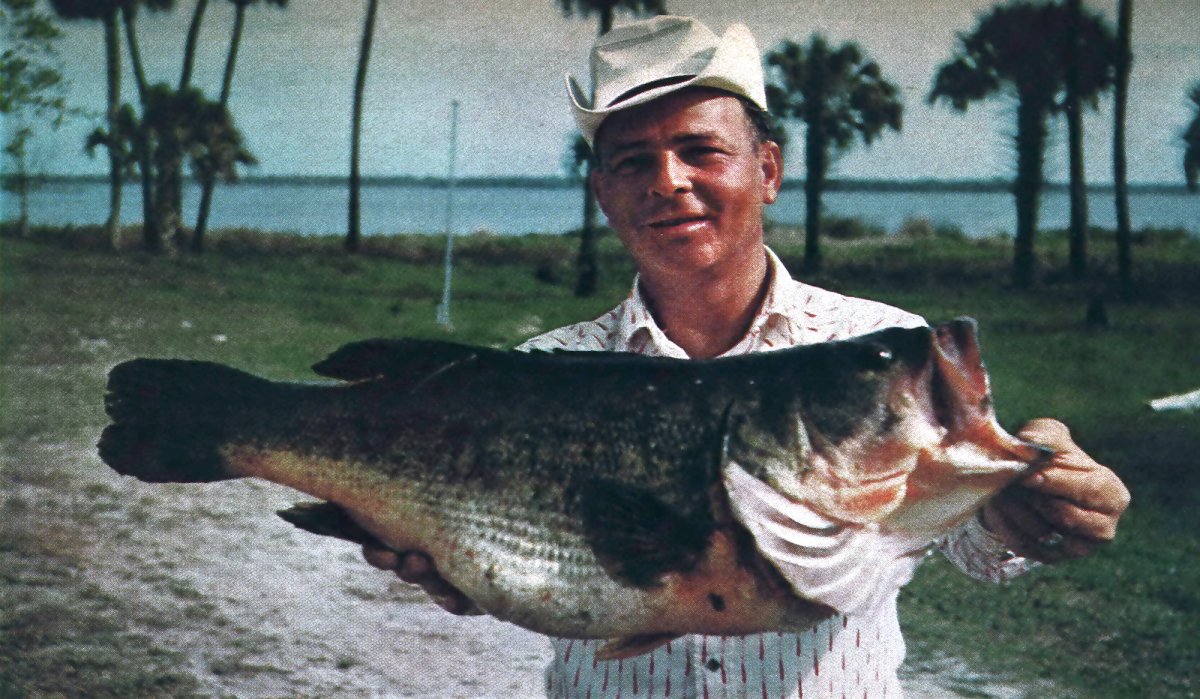
You guessed it — my prize weighed exactly 11 pounds. My previous record still hadn’t been broken, and I now had 10 11-pounders to my credit. We fished another hour or so without any luck before we finally called it a night.
The next day we had good success with worms, taking small fish off the bottom. But we didn’t get anything larger than six pounds before we took time out for supper and some well-deserved rest.
We ate, took a nap, and were back out on the lake by 10 p.m. We fish only during the hours that have proved to be the best fishing; we’ve caught 95 percent of our Orange Lake lunkers between 10 p.m. and 2 a.m., and between 10 a.m. and 4: 30 p.m. If we have no luck one day, we change our schedule the next.
But our second night was windy and we were only able to try a limited number of areas. Wind is the bugaboo of night fishermen; we prefer glassy calm if we can get it.
We fished for a couple of hours and had only two small fish to. show for it and no other strikes. We moved to a new area, where I had a light strike. I expected another small fish, but I was in for a surprise when I set the hook. After a good fight, I boated a nine-pounder. The bass had slipped up behind the plug and then had just sucked it in completely, impaling himself on all three treble hooks. We performed a major operation with knife and pliers to free the lure. I made a crack about how we good bass fishermen always hook our fish well so they don’t go jumping from nets and things like that. Ralph said I wasn’t funny.
We packed our gear and headed home the next morning. We hadn’t set any records, but we had enjoyed plenty of action. We could always hope, though, that we’d really bring in a bunch of big ones on the next trip. My father and I, by the way, once took eight bass in one day that weighed a total of 86 pounds, counting only the fish we kept. We threw back everything under 10 pounds. Call me a liar if you wish, but I have witnesses.
Orange Lake lies just off U.S. 441 between Gainesville and Ocala.
Boat landings are plentiful, and the accommodations are ample, if not luxurious; camping areas are also available. Clean, comfortable, and reasonably priced cabins can be rented locally. Boat-landing proprietors will give you honest and often helpful reports on the fishing. The landing operators can also supply you with a guide, an absolute necessity on your first few trips. Orange is big, and you can easily get lost if you’re new to the area. A guide is also valuable as a paddler and fishfinder.
Orange is no place for a cartop boat. Your boat must be seaworthy and designed for fishing. Small boats are dangerous on a shallow lake the size of Orange. If the wind is blowing, three-foot waves are common. You can get out of the wind to fish, but you usually must cross open water to reach such sheltered areas. A boat that’s too big might be seaworthy, but it draws too much water and is too hard to handle and fish from. The ideal boat for Orange is a 14-foot or 16-foot fiberglass or aluminum open fishing boat with high sides. Motor size is not too important, but if you like to move around and explore a lot, you will need a motor with 25 horsepower or more. That 22,000 acres is a lot of water.
The boat landings on Orange have good boats to rent and reliable motors, but the motors are generally only 9½-h.p. models or smaller. Most rental boats are wooden, but they’re seaworthy and good for fishing. You must display running lights while you’re operating a boat at night. The lights may be extinguished while you’re fishing.
Orange Lake has plenty of vegetation. You will almost always be near some of the abundant lily pads and grass beds when you hang a big fish, and you need tackle that can manhandle a 10-or-12-pound bass before he can wrap your line and break off.
I once advised a Tennessee man that he needed heavy tackle to fish Orange. “Son,” he said, “this little spinning rod and eight-pound-test line have whipped smallmouths and largemouths all over Tennessee. It’ll whip ’em here.” I watched that same gentleman lose five fish in the 8-to-10-pound class later that day. Each fish wrapped the line and broke it.
All serious trophy-bass fishermen around Orange use the modern free-spool casting reel on a rod that has plenty of backbone. Line strength is a minimum of 20 pounds, and I like 25 even better because it will generally hold a hung-up fish until I can get to him and pull up fish, grass, and all. A line heavier than 25-pound-test, though, is difficult to cast with, the hooks will rip out of a fish’s mouth before the drag will slip.
You need only five types of lures in order to handle any situation on Orange Lake:
• Large topwater plugs, especially wobblers, any color (night fishing only).
• Balsa or plastic minnows in the seven-inch saltwater size. I prefer silver with black or blue back.
• Artificial worms and eels with a 5/0-to-7/0 weedless hook.
• Weedless spoons with pork rind — deadly in grass beds.
• Large topwater spinner bait in frog color, for fishing around grass and bon-net beds or along the shoreline.
If you fish these lures and don’t catch fish, then either the bass aren’t hitting or you haven’t found them. You’ll notice that I’ve recommended large lures. A 10-pound bass has a gargantuan appetite and the digestion of a billy goat. The lunker’s mouth is big enough to cram your two fists into, side by side. He’s also lazy and is much more likely to hit something resembling a bellyful than to waste energy on hors d’oeuvres.
Read Next: Gollywompers: A Secret Old Bait for Giant Bass
If Old Muley isn’t hunting because he has just dined on the next-door neighbor or some innocent passerby, your only hope is to aggravate him into taking a swipe at your lure out of meanness. Come to Orange Lake and try it. If you hit it when the fishing is right you’ll never be the same. And while you’re fishing, if you see some guys in a 16-foot brown fiberglass boat with a white motor, that’ll be Pop and I. Hail us down, and maybe I’ll show you that 15-pounder.
Read the full article here