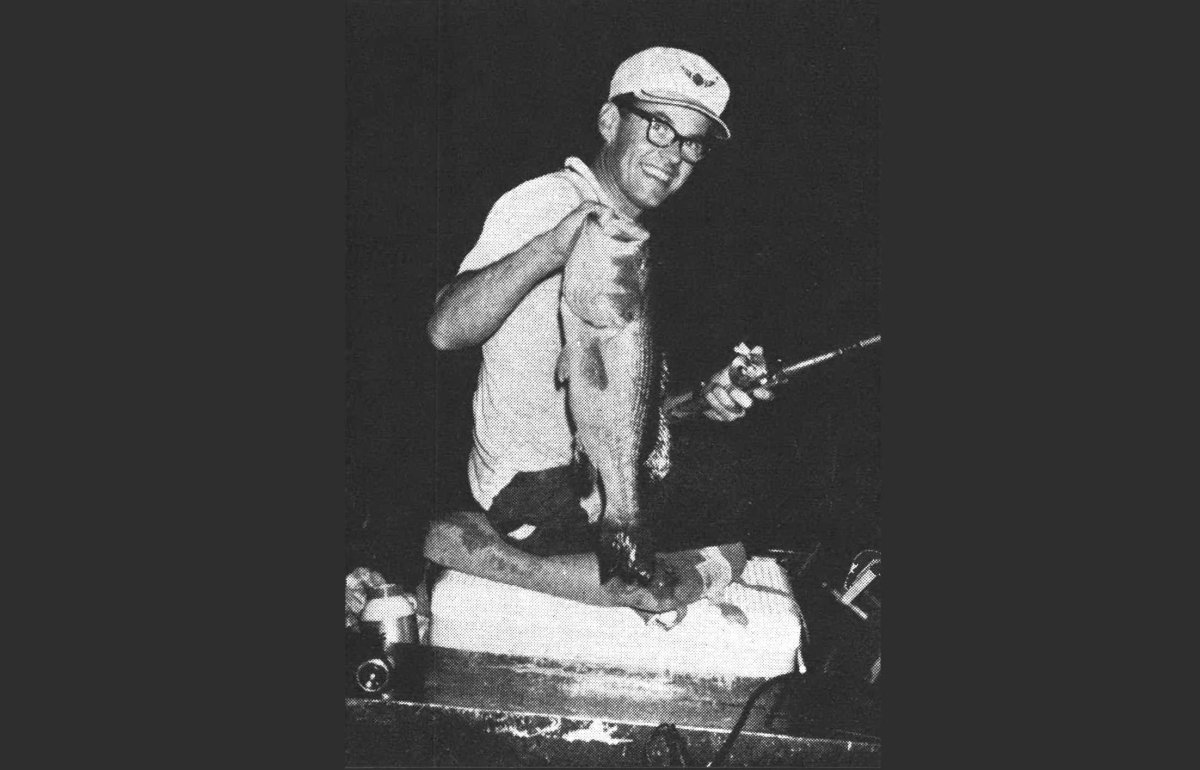

IT WAS 1 A.M., and Lake St. John was truly a thing of beauty. The Louisiana moon had climbed above the maze of cypress trees and was flooding the water’s surface with lambent patterns of light. A warm June breeze swayed the beards of gray Spanish moss as I worked our boat into position.
My night-fishing companion, Don Patterson, leaned forward in the bow and whipped his plug under some low-hanging branches. As often happens at night, his cast was a trifle long, and the lure landed in the moss-draped limbs of a tree. He gave his line a couple of stout tugs, but the lure refused to come loose.
We cautiously approached the tree to retrieve the plug. Suddenly a gust of wind caught the boat and pushed Don’s end into the branches. He quickly flashed his light around, and there, inches from his head, was a cottonmouth!
My friend’s retreat to my end of the boat was a feat to behold. I’d never imagined him to be so nimble. The snake slipped off the limb and plopped onto the cushion that just moments earlier had held my pal’s posterior. Then it eased over the side and went its way.
Had that moccasin bitten Don about the face, we would have had a grave situation on our hands.
This incident occurred during the summer of last year a few miles from Ferriday, Louisiana. Lake St. John, formerly a bend in the Mississippi River, is noted for its bass fishing. It is my favorite lake for night fishing.
I’m a night-fishing enthusiast. From April through September I try to make at least a couple after-dark fishing trips a month. After September I generally devote all of my spare time to hunting.
I’m 33 years old and make my living as a lawyer. I am married to a girl named Peggy, who is perhaps the most patient, understanding woman in America. We have three active (to put it mildly) children, and we make our home in Brookhaven, Mississippi.
In addition to practicing law, I also serve as outdoor editor for the local newspaper and write a monthly outdoor column for a magazine published in Jackson, Mississippi.
I am fortunate to live amid some of the best fishing that this country has to offer. I enjoy all types of fishing, but going after bass at night especially intrigues me. An examination of my catches last year will explain this preference.
On the night of April 22 I caught 23 bass. The night of May 20 yielded 14 more. June 16 wasn’t bad either, putting 17 in the freezer. June 17 produced my best catch of the summer—24 largemouths. I strung 16 more on the night of July 19. August 17 and 19 produced a total of 38. Finally, on the night of September 16, I wound it up for the summer with an even 20 bass.
These catches made a grand total of 152 bass caught in eight nights of fishing, for an average of 19 bass per night. Not bad in anybody’s league.
Some readers may think that I exceed the legal daily limit on bass, which is 15 in Louisiana—and in Mississippi, where I do a lot of fishing. However, in those states the night angler who starts fishing before midnight and fishes on into another calendar day is entitled to take two days’ limit, or 30 bass, during the night. He cannot, of course, exceed the possession limit, which is 30 bass.
This midnight rule can vary from state to state, so check its interpretation with the fish-and-game authorities in your state.
Since I began to fish at night several years ago, I have caught hundreds of bass during the so-called dog days of summer. All of these fish were taken on moonlit nights. I didn’t keep a tally before last year, but I honestly believe that my score the year before was even better.
During my night sojourns I’ve learned that fishing is apt to be at its best when certain conditions prevail. For example, it has often been written that the darker the night, the better the fishing.
I disagree.
In my experience, bass activity increases with the size of the moon, with the peak of action occurring a night or two before the moon is full. When the moon begins to wane, the action starts to slack off.
Now, it might be that dark nights do produce good fishing. I can’t honestly say, because I don’t fish on dark nights. I can say, however, that getting the lure close to cover is what puts fish on the stringer at night, just as it does during the day.
It’s hard enough for me to cast accurately in pale moonlight; I’m sure that trying to put a plug close to heavy cover in total darkness would drive me as batty as a bedbug in 20 minutes.
I have also discovered that, when conditions are right, certain techniques will consistently produce fish. For instance, the great majority of night fishermen swear by noisy surface plugs. Well, not I. Of the 152 bass I caught last year, not one was taken on a surface plug. But more about techniques later.
As for equipment, I find that the best rods are those with plenty of backbone. I prefer a rod that’s heavy in the butt section and has fast tip action. The two I use are 5½ and 6 feet long.
In reels, I give the nod to the standard baitcasting variety. I have more control with this rig than I do with either spinning or spincasting outfits.
It is difficult to estimate the distance to a target in moonlight, and a cast must often be altered while the lure is in flight. This is more easily accomplished with the old thumbing method required of users of baitcasting reels. I do, however, carry a spinning outfit as a spare.
I use heavy line for night fishing—at least 20-pound test. I seem to get hung up more at night, and the stout line withstands my yanks and tugs.
I’m not at all interested in floating lines (lines of braided material, for example), which are preferred for use with surface lures. I use no surface lures whatsoever, feeling that underwater lures will outproduce them three to one at night.
Speaking of lures, I’ve found that plugs with black spinners are the most productive by far. And the bigger a plug’s spinner, the better I like it. A large spinner not only reflects moonlight but also makes possible a great deviation in retrieves. A fast retrieve will lift such a lure near the surface. Yet the same spinner will also carry a lure deep if you fish slowly.
Read Next: The Scientific Reason Why Black Lures Catch the Most Fish
Black lures are the most easily seen by bass at night. They cast a better silhouette against the moonlit sky than do lures of lighter shades.
I think it’s a good idea to attach a chunk of pork rind with a trailer hook to lures that can accommodate them. I don’t know whether bass are attracted to this addition or whether they simply strike short more often at night. In any event, a great many of the bass that I’ve filleted were caught on a trailer hook.
There are several lessons to learn when it comes to locating bass at night. In my bailiwick I have found that in April and May bass prefer deeper waters at night. Many times they are well out from any visible cover. In June they begin to move into shallower water and can be found around offshore cover.
During these times, when the bass are in water five to 12 feet deep, the slow retrieve is your best bet. Get your plug down to the roots, rocks, and other bottom cover. Bump it along over these bass hideouts, being sure to vary your retrieve so that your lure looks alive.
The warmer the weather gets, the closer to shore the fish will move. Where I fish, by midsummer bass are feeding in very shallow water at night. Under such circumstances I cast to the water’s edge and begin the retrieve by reeling very fast, keeping the spinner fluttering at the surface. I slow the retrieve as the lure gets into deeper water. That is the way small food fish behave when they are being chased by bass in shallow water, and that’s the action I try to create.
As a rule, it is important to work your lure as slowly as the water depth will allow. I try to let my lure touch bottom before I begin the retrieve. Many times a bass will assault it with felonious intent just as it touches bottom. In any event, try to keep your lure just above underwater cover.
Bass are highly conscious of moonlight. I know this because 90 percent of all bass that I’ve caught on moonlit nights have come from the shadowed side of objects.
Read Next: The Best Bass Lures: The Ultimate Guide to Every Type of Bass Bait
There is a tremendous temptation to fish areas that are flooded with moonlight. The light makes for easy fishing. But succumbing to that temptation is the most common mistake made by night fishermen.
One night last summer Bob Stamps and I were working the cypress thickets on Lake St. John. These thickets extend 50 yards out into the lake in some places. The trees are large and scarcely a boat’s width apart. The limbs are draped with moss.
It is a dark and eerie setting. And the fishing is tough because of the darkness and the difficulty in casting under low-hanging branches. But the bass are generally there.
That night, while we were working out a 100-yard stretch of these trees, Bob and I managed to boat 11 bass, one of which weighed just under seven pounds and cost me the price of our breakfast.
When we worked back into open water, we encountered two other fishermen, who were busily casting to any open stretch of shoreline.
“Any luck?” Bob inquired.
“Naw, not much,” said one of the men. “Only three bass. This lake’s as dead as a doornail!”
Bob and I cranked up the motor and skipped on down the lake to the next cypress break. As I recall, we caught a total of about 50 bass that night.
Bass prefer to lie in the shade at night, just as they do during the day. I always cast to the shadowed side of trees, logs, and other cover. If a bass is around, that’s usually where he’ll be.
Weather conditions can also have a decided effect upon the way bass feed at night. I recollect one night when the bass were really cooperating. A friend and I began fishing at about 9 p.m., and by 9:30 we’d strung seven bass between us. Shortly thereafter, however, the sky clouded over and the bass quit feeding as if someone had blown the 5 o’clock whistle. We didn’t catch another fish until the sky cleared again just at daylight.
During the retrieve interrupt the lure’s progress with sharp jerks of the rod tip and momentary pauses. This tactic keeps the lure deep. Maintain this pattern until the lure is directly beneath the boat. Then jig it up and down a time or two. Sometimes this will provoke a trailing bass into a strike.
Regardless of whether you fish deep water or the shoreline, you’ll always find bass close to heavy cover at night. Such is their nature. True, they’ll venture away from cover to attack a plug, but the closer to their lairs you can put your plug, the better your chances will be of inducing a strike.
Some fishermen contend that the cooler temperatures at night, rather than moonlight, make bass more eager to strike. My personal opinion is that the moon has a very definite impact on the feeding patterns of bass. I have night-fished during all phases of the moon, and, as I mentioned previously, I consistently catch more bass prior to a full moon. And yet at other times I have been shut out until a little riffle put the fish into a striking mood.
Rain will sometimes work wonders on hot summer days, but I have never been successful on rainy nights. The best night for fishing is one that is perfectly clear, with just a slight riffle on the water. Under these conditions, bass will feed heavily sometime during the night.
Most of my fishing is done on the old “river lakes” of Mississippi and Louisiana. The majority of these lakes are easily accessible and are little more than an hour’s drive from my home.
This fact points up one of the nicer aspects of night fishing. Wilderness lakes, guides, and expensive equipment are not required in order for you to fill your stringer. On the contrary—lakes normally crowded with folks during daylight hours can produce fantastic fishing by moonlight.
Such popular lakes usually have an abundance of piers, boathouses, and similar structures. These spots, though alive with activity during the day, are nearly deserted and still by night, and shad and other small food fish congregate around them. Consequently ol’ brother bass hangs around, back in the shadows, ready to pick off a few backsliders.
I fish piers and similar structures by casting to the shoreline and working the plug out to the boat. My first toss will be to the object’s shadow. Boats at anchor are likely spots, as are boathouses. I have caught many a bass from the inside of an open boathouse.
It is important to remember that such structures furnish little protective cover. Therefore, you must approach them as quietly as possible. Bass might not see so well at night as they do during the day, but they are quite sensitive to sound, especially if the water is calm. Be careful with your oars or paddle, and try not to knock over the coffee jug.
Bass fishing at night, like most good things, has its “spoilers.” On Southern waters these spoilers are snakes and wasps. Both of these villains are partial to the moss-covered limbs of cypress trees. When I fish in the cypress breaks at night, I am very careful about where I put my hands.
Moccasins or Ol’ No Shoulders, as a friend of mine calls them, often stretch out on cypress limbs during the heat of a summer’s day. Though I have seen very few in the trees at night, there is no guarantee that one won’t be there, waiting, as I mentioned at the outset of this story.
Wasps also like the Spanish moss that clings to cypress trees in the South. It furnishes excellent nesting places for them.
Wasps can be nasty little devils, and my associations with them have never been very pleasant. However, a little care can go a long way toward preventing your having to take a midnight swim.
I don’t worry about snakes and wasps, but neither do I get so wrapped up in the fishing and the beauty of the night that I forget them. I try to treat these hazards with due respect. Like most wild creatures, they wish only to be let alone.
Moonshining is no lead-pipe cinch. Being successful at it takes hard work. But I have noted with much pleasure that during the hot-weather months a good cast is more likely to be rewarded at night than during the day.
Besides, moonshining offers a welcome change. You don’t have to endure the blast of the summer sun or the wakes of the water skiers. Most evenings, you literally have the lake to yourself. And deserted lakes are hard to come by these days.
This story was originally published in the September 1968 issue of Outdoor Life.
Read the full article here