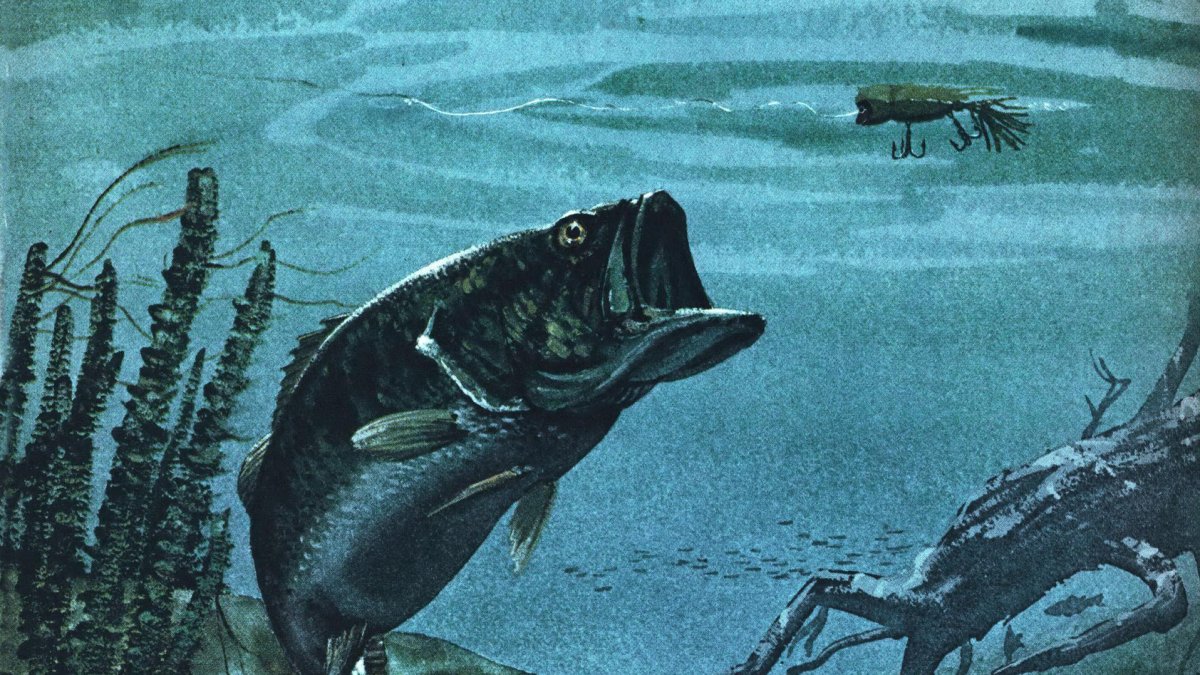

This story, “Bull Bass Are My Hobby,” appeared in the July 1963 issue of Outdoor Life.
Sometimes you can’t win. Conditions that July night were just about perfect. It was warm and still, with barely enough breeze to ruffle the surface of the water. A big moon, almost full, made casting as easy as by daylight.
I was on Bull Shoals Lake, the huge, sprawling impoundment that straddles the Arkansas-Missouri border in the north-central Ozarks. Since 9 p.m. I’d been scratching bottom in 30 to 40 feet of water, using a black-and-orange jig and a nine-inch black eel. At that time of year, with the surface water at summer temperature, that’s as deadly a method as I know for taking lunker bass, but tonight it wasn’t working. It now lacked 15 minutes of midnight and I hadn’t had a single strike.
It was a nice night to be out, but it takes a fish or two to round out a safari of that kind. I looked at my watch again. Exactly midnight. I rate the period from then until dawn the best of all. I’d allow myself a couple more hours.
The breeze was drifting me slowly across the hump of a submerged ridge, with maybe 15 feet of water under the boat. On either side, the banks sloped off into three or four times that depth. I eased the anchor down. I’d sit here a spell and give those sloping banks a good going over.
I knew this point was a tough place to fish. It had drowned stumps, brush, and ledges to hang up on. But big bass are seldom found on smooth bottoms. The rougher the terrain, the thicker the stumps and sprouts, the better your chances. I reached out with a long cast, let the jig sink to bottom, and began a very slow retrieve, turning the reel handle just fast enough to move the bait. I’d make it crawl all the way up the hill to the boat.
My hook guard encountered a sprout 30 feet down. I worked it loose carefully and felt it spring free. That’s frequently a critical instant in bass fishing. There’s something about the action of a jig pulled off a snag that’s likely to stir things up, so I wasn’t surprised when something grabbed my eel and walked off with it.
He’d need time to get the jig in his mouth. I let him go while I counted off eight seconds. Then I rammed the hook into him with everything I had.
He wasn’t a real biggie. I’d say about five pounds, from the feel of him, but he knew the right tricks. He made one hard try for bottom, heading back to the stump from which he’d pounced in the first place. I horsed him out of that notion, knowing I had no choice, and he started for the top, fighting like a wildcat every inch. He came out of the water twice, kicking up a storm both times, but I tipped him over before he could shake his head. I had him halfway to the boat when he jumped again and did something bass of that size aren’t supposed to do. He corkscrewed up, jackknifed, and threw the jig almost into my lap.
Ten minutes after that, in 40 feet of water a little farther out, I hung a genuine lunker and had better luck. We fought a hard scrap, but at the end I got the net under him and hauled him aboard. He weighed an even eight pounds. I eased him over the side of the boat and let him go, a bass too beautiful to kill. Maybe I or another fisherman would tangle with him again. It’s on that theory that I put back 99 percent of all the bass I boat. I weigh them quickly, if they’re worth it, and turn ’em loose.
The action stayed lively. I went on fishing in lunker habitat, avoiding the shallows that hold more small fish. About the time the first hint of gray showed in the east, the bass quit striking as abruptly as they’d begun. By then I had landed seven big ones, with a total weight of 36 pounds. I’d lost two in the same class when I had ’em almost in the net. That’s as close as I ever came to realizing a long-standing ambition — to take a limit catch of 10 lunkers, four pounds or better, on a single fishing trip.
I’ve been fishing for bass 40 years, much of that time in the Ozarks. I lived in Kansas City until the late ’30’s, and was on bass water somewhere in southern Missouri or northern Arkansas every chance I got. I moved to Chicago then, and for a decade I fished in Illinois and southern Wisconsin. In 1948 I moved to Arkansas, partly because I was tired of city living and partly to be nearer to good Ozark bass water. Since then I have fished two top impoundments, Lake Norfork and Bull Shoals, as often as time and my health permitted, day and night, 12 months of the year. I think fishing is the most enjoyable pastime on earth, and there’s hardly any such thing as getting enough of it.
I have kept no record of my lifetime catches, but they’d run well into the thousands. In the past seven years I have taken 360 of the size I class as lunkers — four pounds and up. The two best weighed an ounce over 10 pounds apiece.
I wound up a fishing reporter, living in the town of Bull Shoals and keeping score and reporting catches for a group of resort owners, float-trip operators, and fishing docks on Bull Shoals Lake and the White River below it. In the past six years I have recorded 25,275 bass weighing from four pounds to 13 pounds 14 ounces. Marvin Bushong caught that last one in 1961. It’s the top bass from Bull Shoals. The 1962 score alone was 4,000. In a seven-day period in April of this year I recorded 788 bass bigger than four pounds, the top fish going 10 pounds 12 ounces. With this kind of fishing at my doorstep, I have unusual opportunities to study bass and bass fishermen.
Bull Shoals was impounded in 1952, and since that time I have turned into a specialist. My hobby is lunkers. In those 11 years, I have shared boats with some of the greatest lunker experts in the country, nationally known fishermen from far and near, as well as with a number of top Ozark guides. In addition to the things I’ve learned on my own in 40 years of bass dealings, I’ve had an excellent opportunity to glean wisdom from the men I’ve fished with.
Lunker bass rarely come easy, but that only adds to the challenge. They are to the fisherman what trophy game is to the hunter. For me, bass fishing of any kind is superb sport, but fishing for lunker bass stands at the top. The bigger the bass, the harder you fall!
It’s one thing to hook a lunker, another to land him. He’ll knock the reel handle out of your hand, tow your boat, wrap your line around a stump before you know what you’re fast to. Knuckles are skinned, lines break, hooks straighten. But when you finally get a big one in the net, nothing else matters. I don’t know a big-bass addict who’d trade places with a king, unless he could go right on with his bass fishing.
Every angler is entitled to his own preferences, but so far as I’m concerned somebody else can have the muskie, the channel cat, the pike, and the walleye. Give me a lunker bass. The rest are all good, but he’s better.
It’s often been said that 10 percent of the fishermen catch 90 percent of the fish. Where big bass are concerned, there are quite a few things you can do to put yourself in that lucky minority.
In my early years I was guilty of a common error of beginners. Too often I fished where, at the moment, there was nothing big to catch. My idea was to cast within inches of the shoreline and retrieve as fast as a fish could swim. Most of the time I took nothing but slim sprinters willing to run my lure down. Little bass came easy, but I rarely caught a hackle raiser, even in water where I knew they abounded. Others landed them, I didn’t. It wasn’t until I learned the basic rule, that you can’t catch ’em unless you put your bait where they are, that I began making a showing on big ones.
Given their choice, bass prefer water temperatures in the upper 60’s or 70’s. As lakes warm up in spring, bass patronize the shallows, remaining in the upper layers until their spawning activities are concluded. But once summer arrives, they seek the depths, especially the big ones. Most of the year you’ll take few lunkers fishing shallow and fast. They’re likely to be farther out and in deeper water than the average angler surmises. To catch them it’s necessary to work your lure on bottom at the proper depth, and in extreme cases that may be as deep as 50 to 60 feet.
Most fishermen start their careers by going after small bass in relatively shallow water. My advice to beginners, instead, is to learn to take lunkers first. Even the small fry spend a good deal of time in deep water. So study the kind of bottom the big ones like, the water temperatures they prefer, the depths they seek at various times of the day and year. Find out how to put your lure within reach of the heftiest bass in the lake. The more you learn about catching the heavies, the easier it will be to take bass of all sizes.
If you want to get a fishing education in a hurry, start with jigs. Maybe I should say jigs-and-eels, since the jig fishing I’m talking about is not to be confused with the jigging done on many Southern lakes in late winter and very early spring. The water is dingy then, and jigging is done with a stiff pole, short line, and treble hook with a gob of night crawlers, this bait fished around trees and snags along shore. Fishing with a jig-and-eel combination is altogether different.
Jigs, often called leadheads, are one-hook lures — essentially a big bucktail fly with enough lead molded on the head to make it cast easily and sink fast. Some have feathers or a rubber skirt instead of the bucktail body, and occasionally they are bare. The standard attachment is a pork eel, although pork strips or plastic worms are sometimes used instead. Now and then a fisherman holds out for the jig by itself, without a trailer, but an eel or worm gives far more action.
These jigs are the greatest teachers of all when it comes to revealing the whereabouts of bass, especially big bass. They sink quickly to the floor of the lake. They drop from ledge to ledge, crawl over or around weeds and snags, invade every kind of hideout. They convey to you the feel of things as they creep on bottom, letting you explore as you fish. They have imparted more knowledge to more anglers than all other lures put together, and as killers of big bass they have no equal.
Other lures do well, but can’t match the jig-and-eel month in and month out. Spinners and spoons retrieved slowly near bottom take a lot of bass, and I have known brief periods in the fall when spoons outranked everything else. Deep-running plugs can be hard to beat under the right conditions, and there are times when surface lures are as good a bet as any. But the figures show that over the years it’s jigs that take top place, at least on Bull Shoals. Of more than 20,000 lunkers I have recorded there since 1958, 24 out of every 100 were taken on jigs, 21 percent on spinners, 17 percent on underwater plugs, 12 percent on plastic worms, 11 percent on surface lures, and 3 percent on spoons, leaving 12 percent to be accounted for by live baits or lures of a kind not reported. There are countless other lakes where jigs will do as well.
Jigs are made in various weights, from a quarter ounce up, for use with either casting or spinning tackle. The most effective length of eel is largely a matter of personal opinion. For years, on the impoundments I was fishing, a nine-inch eel was generally regarded as the top bass killer, but recently shorter eels have come into vogue, largely because the longer the eel the greater the chance of missing strikes. I dropped from nine inches to six for that reason, and many times I even fall back on eels only four or five inches long. But during those rare periods when I find lunkers in a feeding frenzy, I’m inclined to go back to the nine-incher, in hope of tempting the biggest of the lot.
| Lure used | Percentage of total |
| Jigs | 24% |
| Spinners | 21% |
| Underwater plugs | 17% |
| Plastic worms | 12% |
| Surface lures | 11% |
| Spoons | 3% |
| Live baits and unknown | 12% |
When it comes to color, some of the best bass experts claim a dark bait is most productive, especially after dark. But two of the top lunker specialists I know put white over any other color, night or day, and make their choice pay off. My personal preference in eels is for red, black, white, and yellow, in about that order. All fishermen are prone to rely on the colors, in any bait, that have done the best for them. Some score with orange and with combinations of black and orange, black and white, or black and yellow. When bass are on the prod, color seems to make little difference. But I like to change lures every now and then and offer a variety, just to make sure I miss no bets.
In weedy or brushy lakes, jigs need to be equipped with guards. I’ve seen anglers throw up their hands in horror at the idea of fishing such water with bottom-scratching lures, but fears of that kind are largely groundless. It’s surprising how easily a weedless jig travels among or over weeds or slides off slippery sprouts and stumps if retrieved slowly and gently. I have fished as long as two weeks without losing a lure.
What locations are best? As a starter I suggest points, bars, and ridges, after which the jig fisherman can gradually take on bluffs, rocky ledges, drowned islands, weedbeds, and other tough spots. Fishing a point or bar calls for a careful approach. I like to motor in slowly and quietly toward the shallowest water and then move the boat out along the ridge with no noise or commotion. I let the boat drift if the breeze is right, stopping every 50 to 60 feet and dropping anchor if necessary, casting to deep water ahead and on each side.
Allow all the time necessary to do the job right. It takes determination and patience to spend three hours exploring a single point, but I have done it many times and made it pay. Depths from 15 to 60 feet should be probed, letting the lure sink all the way to bottom and retrieving very, very slowly, so the jig-and-eel crawls upslope all the way to the boat. This technique has several advantages. For one thing, it enables the fisherman to keep his bait on bottom the whole length of the retrieve, something that’s difficult if not impossible when casting from deep water into shallow. For another, an eel crawling up a ridge or bank toward shore seems to have far more appeal for bass than one moving out into deep water, probably because fish pick up much of their natural prey under the former circumstances.
Few fishermen like to fish as deep as 50 to 60 feet, but sometimes it’s necessary. The depth at which lunkers are found is governed largely by water temperatures. In Bull Shoals a few years ago, the 35 to 60-foot levels were very much worth probing, but since Table Rock Lake was impounded, on the White just above, its flow of cold water has changed the habits of the big fish in Bull Shoals. Now they take their ease at the 15 to 20-foot levels most of the time, and even in the hottest weather of summer it’s rarely necessary to go deeper than 30 feet.
I often use a simple method to find the depth of the water where I’m casting, by pre-measuring and counting the number of turns of the reel needed to bring the lure to the surface at boatside. On my favorite reel, for example, 16 turns indicates 20 feet. A depth finder is still better, if you can afford it. It’s particularly useful in locating drowned islands, ridges, and drop-offs. I have a good one, and I’m indebted to it for a lot of big bass.
No factor in jig fishing is more important than the rate of retrieve. The bait should move no faster than a crawl. Many experts raise and lower the rod tip, but that isn’t essential. Winding in the line very slowly is equally effective. The trick is to keep the lure on bottom every foot of the way and coax it over obstacles at a snail’s pace. On the average, it takes two to three minutes to complete a retrieve, longer in very deep water.
Are short or long casts more productive? My vote goes to the long, for one reason. The more ground you cover and the longer a bait is in the water, the greater the chance a bass will pounce on it. But when they’re in a striking mood, the length of the cast makes little difference, provided you reach them with the lure. I’ve caught some of my biggest when they were lying close to the boat. I’ve even taken them when the cast was so short I was afraid my arm movement would spook them. They were feeding, and nothing else mattered.
One of the most difficult things to learn in jig fishing, especially if you’re using a long eel, is to give the fish a chance to finish his shopping. Even the specialists are likely to miss two strikes out of three as a result of bad timing. I know some who operate on the theory that a heavy fish will set the hook himself. They give him time to mouth the bait, then lift the rod slowly and keep a tight line. But that’s not for me. The risk of a lightly hooked fish getting away is too great. I wait for six or eight seconds (it’s not easy) and then I strike hard.
Even after you have a big one hooked, there’s likely to be a slip between set and net. Few bass grow to lunker size without learning how to get off a hook, and the majority of fishermen lose more than they land. I estimate that on the average, five get away for every one boated.
Bass fight with terrific power and know what to do. Many are lost because the fisherman gives them line and lets them run. That’s a fatal mistake in the vicinity of brush or weeds. To prevent it, I like a reel with a star drag that can be tightened to suit the strength of my line. Another favorite lunker trick is to race for the top, especially at night. You have to keep a tight line all the time your fish is coming up and be ready to pull him off balance the instant he breaks water. Otherwise, the odds are good you’ve seen the last of him.
Inadequate lines, leaders, and hooks that can’t stand strain are also a major cause of disaster. I can remember when bass fishermen thought it wasn’t sporting to use a line heavier than 10-pound-test on a bait-casting rig. Many preferred something lighter. We don’t think that any more, not where I do my fishing. We went first to 12 pounds, then to 15, and even 20 is considered respectable now. Better a heavy line, we reason, than a fish that gets away with a hook in its mouth or gullet. The stronger line is also a big help in freeing snagged lures. For surface lures I like a braided line, but for deep fishing I prefer monofilament, black for night, light for daytime.
Don’t get the idea from what I’ve said so far that I think jig fishing is the only way to take big bass. Don’t give up your favorite method; just add the jig-and-eel routine to it. There are times, when bass are in the shallows along shore or chasing schools of young shad to the surface in midlake, when other baits and methods are as good or even better than the jig-and-eel. One out of every nine bass above four pounds that I’ve recorded from Bull Shoals in the past six years was caught on a surface lure. And devoted as I am to the bottom crawlers, I have to concede that for heart-stopping action it’s hard to equal the spectacle of an eight-pound largemouth smashing into a lure at the top.
Best times for top-water lures are late spring and early summer, and again after the water cools in the fall. Most casters rate early morning and late afternoon the prime hours, but I know surface-plug fans who do very well after dark, too.
Whenever bass are tearing up the water in pursuit of surfacing shad, a plug that looks like a shad is almost certain to get action if fished close to the top. Spoons fished deep under the school also are a good bet at such times. Heavyweight bass often cruise underneath when a shad raid is going on, waiting to pick off any cripples that sink down to them. I remember a fall afternoon a few years back when I landed more than 20 bass in two hours, seven of them lunkers, using spoons that way.
There is one thing about fishing for bass — lunkers in particular — that many novices don’t understand. Even on the most productive water, you can’t expect to make a killing every time you go out. Fish don’t feed 24 hours a day. They have their times and moods, and when they decide to sulk, you can cast until you’re black in the face without hooking a fish.
Fishermen do a lot of arguing about why fish pounce on anything that’s offered them one minute and turn down the most tempting lure the next. I doubt anyone will ever come up with a hard-and-fast, sure-fire answer. Some say it’s because an impounded lake is new or old. Others contend it’s the time of day, the dark of the moon, the weather, the air and water temperatures, the rhythm of tides, or the direction of the wind. I know anglers who believe that on days when bass lay off, it’s because they have grown wise to lures. If they happen to strike the next day, they’ve forgotten what they learned last week.
I have given this business of bass whims a lot of study, and I’ve come to the conclusion that no one explanation will hold up. Strikes may be prompted by curiosity or anger as well as appetite. In fact, it seems to me the killer instinct often has more to do with bass response than hunger. That’s why a hangup on brush is likely to be a blessing in disguise. A lurking bass can’t resist grabbing the bait as it pulls free.
Big bass do not feed often, and nobody can forecast just when it’s going to happen. When they do feed, they feed with a vengeance and strike with abandon. But in water where food is abundant, it doesn’t take them long to get their fill and quit. The only sure way to get the best of them is to fish as often as you can and stay with it until they start hitting. That’s the key to successful bass fishing, but it calls for luck as well as know-how.
I recall an early August evening when I worked points and flats for four hours. I had only two strikes and boated no fish. At midnight a rising wind and the threat of a shower persuaded me to quit, but on the way to the dock I decided to make a last cast or two in deep water over a point. With three casts, I missed one strike, then boated a 4-pound bass and a 6½-pounder. Finally the wind lifted the anchor and set the boat adrift, so I gave up, knowing I was missing an hour or two of very fast action.
A couple of nights after that, I went out at midnight to take advantage of a waning moon. Up to 4 o’clock in the morning, I chalked up four very gingerly strikes but boated nothing. Then the fun began. A bass that couldn’t have weighed less than eight pounds picked up my eel on a sprouty bottom, gave me a terrific battle, and snapped my 15-pound-test line like cotton thread when I touched him with the net. In the next 70 minutes, I landed six lunkers that totaled 32 pounds, and lost six more. Then the action was over, as suddenly as it had started.
Most anglers rate March, April, and May the best bass months, at least on Ozark lakes. That’s a profitable theory, but it doesn’t always hold true. Of 5,540 fish from four pounds to 12 that I recorded in 1958 from Bull Shoals, 777 were taken in April. There were 1,194 in May, and 695 in June. Those are months of very heavy fishing. Catches of lunkers from July through October ranged from 400 to 600 that year, and the score for the winter months was under 300 each.
I kept track of my own catches by month that same year. They totaled 137 lunkers. July was best, with 25, August next with 21. I caught 20 in April, 17 in June, 11 in September, and from three to seven the remaining months.
I can recall many times in summer and fall when fishing was better than in spring. For example, there was the June evening I took seven hefties, the biggest eight pounds, in five hours. One August morning I went two hours without a nibble and then landed six lunkers on six casts. On an October day I got 22 strikes and landed 12 bass, two to three pounds, in 1½ hours, all on spoons. One calm, sunny November afternoon the bass were rustling shad, and I caught seven lunkers in an hour and lost as many more. Bass feed every month of the year, and if a man could fish 24 hours every day, there’d be very few times when he’d get skunked.
As for the best time of day, there’s no doubt that big bass feed most by night, or at least from an hour before dusk until an hour after dawn. Of 225 lunkers I caught in a three-year period, 83 were taken in the daytime, the rest between twilight and daylight. Night casting during the summer months accounted for the lion’s share. The midnight-to-dawn shift is the one I like best of all. Lakes are calm and undisturbed then, few fishermen are out, and the most bait-shy bass are less wary. Good lunker opportunities often occur when the moon first shows and again when it sets.
Although most casters who fish by night like moonlight, I’m convinced that in general the moon has more effect on fishermen than on fish. Bass seem to strike just as readily on dark nights, but moonlight makes the fishing easier, especially if you want to work the shore, the weed beds, or drowned-timber bluffs.
While night casting sometimes calls for a flashlight, it should be used as sparingly as possible. It’s all right for unsnarling backlashes or changing lures, but not for keeping track of the shoreline or placing casts.
There are two ways to cast on dark, moonless nights and still stay out of trouble. One is to forsake the shore altogether, anchor the boat in open water on a point or bar, and fish the slopes. The other is to keep the boat close to shore and angle-cast ahead and out. This works best and is safest for an angler by himself, but two men in a boat can do it with little risk if they are careful. It means retrieving from deep water into shallow, which is all to the good, and is likely to produce even in daytime, if the bass are feeding.
Another major factor is weather. The lull when a front is approaching or just after the wind changes direction is a good time to be out. For daytime fishing, a cloudy or even threatening day is better than sunshine, but at night I like a clear sky. A breeze just strong enough for drift fishing can be an asset, and in daylight you are likely to do better on wind-ruffled water than when it’s glassy slick. For jig fishing, however, I’ll take a dead-calm night that lets me work the lure as slowly as I please.
Read Next: Flipjacking: We Uncover the Lost Art of Cane-Pole Fishing for Bass
One thing I have never done is rely on fishing charts, tide tables, or calendars. Consequently I have no first-hand evidence about their reliability. The few times I have used them they failed as often as they succeeded, but maybe that was my fault. I may have fished too deep, too shallow, or in the wrong places.
In any case, when I get a chance to go fishing, I’m going, regardless of forecasts. I don’t want to discourage myself in advance. The times when bass won’t deal with you are the times to try all the harder, to apply every bit of knowledge you have, not to sit back and take refuge in a pre-arranged alibi. Nor do I want to limit my trips to the days or nights when I have special reason beforehand to expect a catch. In bass fishing, the uncertainty is half the fun.
Read the full article here