
This story, “Death Ran with the River,” appeared in the May 1971 issue of Outdoor Life.
My wife’s excited cry reached me above the growling roar of the river. It was a cry of pleasure, but unknown to her it also carried a warning.
“Look,” Rita called. “Look at those beautiful mossy-green velvet cliffs!”
I looked, and the cliffs were beautiful all right. But the knowledge of what they meant went through me with a sharp shock. Velvet Falls must lie just ahead, and I had been warned that the rapids there were some of the worst on the river.
Then I saw the white water, leaping, plunging, raging between its rock walls, and I knew the rapids were going to live up to their reputation.
I could see the river running to the left, and I strained at the oars to pull our big pontoon boat to the inside of the curve. There’d be no stopping, since we were being sucked downstream at millrace speed.
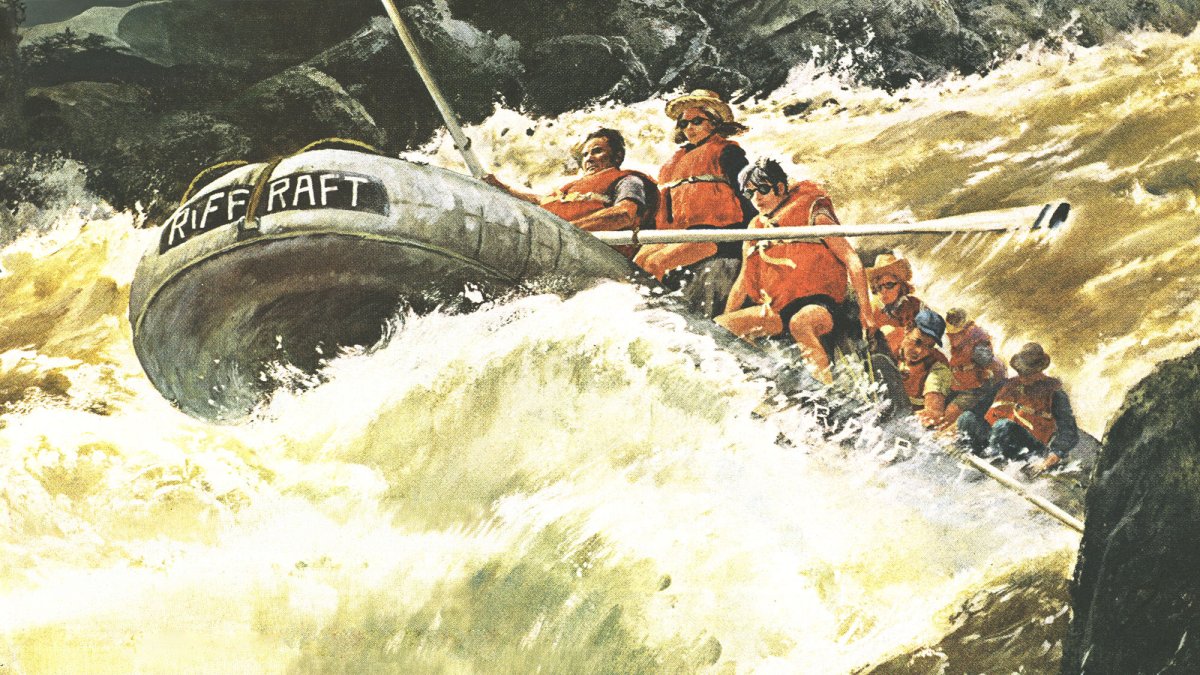
The rapids seemed to rush to meet us, but before they claimed the boat I could see exactly what we confronted. The river poured into them like a chute of water sluicing over a spillway crest, piled high in the middle with its own volume. At the foot of the chute was a wave over 20 feet high.
Veteran boatmen who were on the Middle Fork that week said afterward that they had seen current-born waves that stood 30 feet in the air. I can easily believe that estimate — just as anyone who has not seen such water could hardly imagine its terrible power. I had never looked at rapids so murderous.
Our boat was just to the left of the river’s center, and my only option was to point its nose straight ahead and hit that giant wave head-on. Hitting it sideways would mean certain upset.
We were moving in excess of 20 miles an hour when the white water engulfed us. The front end of the boat, where I was sitting, knifed up out of the raging water, and I found myself holding two useless oars, attached to nothing. The left oarlock had snapped, and the mount on the right was broken.
The raft was rigged for two oarsmen, with a front and a back position. I scrambled the length of our raft and leaped to the rear oars, and then we were through the rapids and sliding swiftly downstream on deep, smooth water. Velvet Falls was behind us, and we were still right side up. Next Tom Logan and his party, in the second boat, came slicing safely out of the foaming turmoil. Everyone breathed easier.
Shortly after noon on Sunday, June 21, 1970, our party of 13 had put in at Dagger Falls northwest of Stanley, the starting point for most boat trips down the wild and turbulent Middle Fork of Idaho’s famed Salmon River. Our plan was to run the river to its junction with the main stream of the Salmon, 113 miles downstream, through wilderness country all the way. We were challenging what many call the wildest river in Idaho, even more difficult than The River of No Return that is the Salmon itself.
Of our 13, five were women and three were teenagers. Eleven of us were from Denver, Colorado, or its suburbs.
Everyone in the party had done some whitewater boating before. I was the leader, Tom Logan the second boatman. We considered ourselves experienced enough to lead the group down the Middle Fork and were confident that everyone would do his share to make the trip an exciting and rewarding adventure.
I’m 33 and an engineer in the Denver office of the U.S. Bureau of Reclamation. I live in Lakewood with my wife Rita and our three youngsters — Mark, 9; Ann, 6; and David, 3. Tom, 41, works in the same office that I work in.
The rest of our party comprised a variety of river enthusiasts. Paul and Silva Cunningham had their two sons, Craig, 15, and Bruce, 13, along. Paul is a consulting engineer in Denver. Ken Wright from Boulder, a camera enthusiast who would take the pictures of the trip, had brought his 13-year-old daughter Rosemary. Ken operates his own consulting-engineer firm. Uldis Palde, a researcher with the Bureau of Reclamation who came to this country from Latvia after World War II, and his wife Rebecca completed the Denver group. The others were Brian Lea, a bachelor stockbroker from New York; and Penny Colbran, a pretty blonde magazine writer from San Francisco. They flew in and rendezvoused with the rest of us at Twin Falls. The Colorado delegation had driven to Idaho in two vehicles, each towing a trailer.
Tom Logan and I shared a deep attachment for wild rivers. I grew up in Massachusetts and have spent much of my time in the outdoors all my life. One of the reasons I moved to Denver in 1964 was to be near the mountains. I made my first whitewater boat trip in 1966, along with Uldis Palde, down the Yampa and Green rivers through Dinosaur National Monument in Colorado. In 1968 Tom and I teamed up and ran those same two rivers together. It was his first experience, and he liked it as much as I do. In April 1970 we went down the Colorado River through the Grand Canyon. It was the fiercest river we had tackled up to that time, but it proved far less dangerous than the Middle Fork.
Our equipment for this trip had been chosen carefully, based on what we had learned on other floats. Our boats were two sturdy 22-foot neoprene pontoon rafts that had been tested thoroughly on several rivers, including the Green, Yampa, and Colorado.
We had removed the original rubber bottoms and replaced them with plywood floors suspended in the center of each raft. The floors kept our gear fairly dry. More important, they allowed shipped water to drain out and thus prevented the boats from filling up with water in bad rapids, a condition that turns them sluggish and uncontrollable.
Our outfit had been thoroughly inspected by the National Park Service earlier that year, before we started our trip down the Colorado. Maybe the most important items we carried were the life preservers that everybody would wear at all times. We had learned that lesson well in Grand Canyon, where eight of our 12-member party ended up in the Colorado River before the trip was finished.
We reached Dagger Falls that Sunday morning. We learned from a forest ranger that another party was on the way down the river ahead of us. Everett Spaulding, a veteran outfitter and boatman from Lewiston, had put in with 10 others a few hours earlier. They were using two wooden McKenzie River boats and a 10-man rubber raft.
Also at Dagger Falls we met a group of 19, ready to start the trip in four 10-man rubber rafts. They were from Southern California, and all of them were experienced on rivers of this kind, including the Cataract and the Grand Canyon leg of the Colorado. Led by Don Wilson, a 35-year-old professor at Stanford University, they were without a professional river guide, but like ourselves they seemed to have no misgivings about making the trip safely.
In all, 43 persons would be floating the Middle Fork that day. And while nobody suspected it then, death was going along. Of the three parties starting the trip, ours was the only one that would reach its destination at the main stream of the Salmon. In the next five days the river, which had never claimed a life in a boating accident, would kill three men, and the main Salmon would drown three more.
We exchanged work and banter with the Wilson party while the boats were inflated and the gear was stowed. We were ready for launching before they were, and they gave us a send-off with much good-natured kidding. We pushed our pontoon boats away from shore.
A series of small rapids took us tumbling downstream, and I fought the current to keep away from cliffs that could rip a rubber boat like a skinning knife. We wanted to find a campsite, for we had planned to run only a few miles that first day, just far enough to get away from all vestiges of civilization. But we had little time to look away from the river, and the shores were either cliffs or steep banks that offered no spots for a camp. We passed a few places where our U.S. Forest Service map showed beach campgrounds, but they were covered with high water.
A faint stench hanging in the air as we rounded a bend told us we had reached Sulphur Creek, a roaring tributary. I realized with some astonishment that although we had been on the river only 15 minutes we had come four miles. And I knew then that we had tackled the Middle Fork at a bad time. It was at flood stage, and we learned later that its average rate of flow that week was close to 15 miles an hour.
Bad weather has brought hardship, danger, and even death to many outdoorsmen. In our case, it was good weather that caused all the trouble. There had been heavy late snows in the Bighorn Crags and Yellowjacket Mountains that drain into the Middle Fork. Now the warm June days were speeding the runoff, sending the river far above normal levels.
We came to quieter water, and I relaxed enough to enjoy the scenery. Then Rita’s cry about the velvet-green cliffs brought me back to the oars again, and we plunged into the rapids at Velvet Falls as I described at the outset.
Not far below we spied a possible campsite next to some slower current. We moved in, signaling Tom to do likewise. He landed first. Someone in his party leaped ashore with a rope and pulled the raft in. As we neared shore we threw our rope to them, but before they could help us the current sent us hurtling downstream again and wedged us hard against a huge rock.
I yelled to Tom to haul us in with the front rope, and I jumped into the river to give him a hand with the back one. The rest of the party had scrambled to shore, leaving only Rita and Silva Cunningham aboard the raft. The fast water was too much for Tom and me. It swung the boat away from the rock and back into the main current, and Tom was forced to let go.
I heard Rita scream with fright, “Al, don’t let us go down the river alone!”
Then, still hanging to my rope, I was swept off my feet and into another rapids. I went along the rope hand over hand, reached the boat, and floated and tumbled behind it until it veered away from the cliffs that confined the rapids. Then the girls helped me aboard.
The Middle Fork slammed us downstream another three miles before the current slowed enough for us to land. A gravelbar ahead offered a campsite, and we moved toward it. At that point we got unexpected help. Four men who had packed into the canyon on horseback were camped there. Rita called to them for help, and they caught our rope. At last we were safe.
We tied the boat and waited for Tom. His raft was overloaded with 10 people, but I was not greatly worried, since Tom is an excellent boatman. Sure enough, in a few minutes he came tumbling into sight. He swung toward the gravelbar, and we caught his rope.
That was a pleasant campsite. Hot springs bubbled into the river there, and the pack party told us that we were at Sheepeater Hot Springs, 13 miles below Dagger Falls. We had made it in just over an hour and were stunned at our speed.
Paul and the girls got the campfire going, and soon corn on the cob was cooking and the aroma of broiling steaks filled the campsite. Brian had brought a couple of cases of wine along, and we opened one to drink with the meal. Afterward we took turns at the hot springs and settled down for an evening of fellowship around the fire.
We loafed the next morning, allowing ourselves the luxury of a late breakfast. Then we repaired the battered oarlocks and studied the river for some sign that it had crested and the water was dropping. No such luck.
We left the camp after lunch. A mile downstream we hit a wicked cliff-scraper rapids that brought us close to disaster. Brian, handling the back oars in Tom’s boat, broke one oar and left the other wedged in a crevice in the cliff. We still had two spares, but we knew that another such mishap could mean serious trouble.
The next few rapids had appropriate names — Artillery, Cannon, and Pistol. Cannon was a real shocker. As we neared it I saw the all-too-familiar chute of racing water with a giant rooster-tail wave at the lower end. I tried to keep left of center so that the boat could slide off the top of the wave and not be in danger of dropping back into the hole. But the force of the huge wave tore away our two oars on the right side, and I lost all control. The rapids slammed us toward a submerged island where a big log stood at an angle above the water, wedged between two trees.
My first concern was that the log might rip the pontoon. Then, as we were driven against it, that fear was replaced by one far worse. Because we were wedged that way, the force of the water began to submerge the upstream tube, and I saw that the raft was going to roll over. I grabbed the log and hung on. When the boat had rolled I would jump back onto it and be ready to help anyone who was in trouble.
At that point, however, Paul and Rosemary went into the river after one of our runaway oars. The lightened boat slid along the log and righted itself, half submerged. I leaped back aboard, shouting to everyone to crouch and avoid the projecting branches. Then we slipped free and were afloat once more.
Tom’s boat was sweeping past, and we yelled at him to try to retrieve our two oars. He recovered only one.
Indian Creek Guard Station was only a few miles farther down, and the intervening rapids were exciting but not dangerous. We found quiet backwater there and tied up without difficulty.
We had come now to the first evidence of civilization — trash receptacles, a picnic table, a Forest Service patrol house with short-wave radio, a landing strip for small planes, and restrooms. Later in the season, when the water is low, river parties fly in to Indian Creek and start their trips from there.
Our oar problem was now critical. We were down to five good oars and one broken oar. Tom and Brian repaired that one with wood splints and baling wire, and though it was heavy and clumsy it was solid enough for emergency use. But we couldn’t afford to lose any more oars, so we decided to tie each one of them to the frame of the boat with a five-foot length of cord.
Our destination for Tuesday was Hospital Hot Springs, 28 miles downriver, and our maps showed only one major rapids on the way. Despite our mishaps, we left that morning in high spirits.
That day proved to be our best. We were at a lower elevation, out of the heavily timbered country and in a canyonlike area. The river had widened and slowed, and I relaxed at the oars and for the first time began to enjoy the serenity and beauty of the wilderness.
The rapids, when we reached them, were a chilling sight — a two-step waterfall thundering into a huge hole that boiled like a giant kettle. But we avoided the hole and churned through the fast water without trouble.
Farther downstream we overtook and passed the two McKenzie River boats and the big pontoon raft of the Spaulding party.
At Hospital Hot Springs we fashioned a swimming pool with a sheet of polyethylene, and just before dusk Rita and I slipped away from the others to relax in the hot water. The cold black river running by, the high cliffs to the west, the darkening night skies to the east, and the total isolation of that forested wilderness filled us with a rare and matchless sense of joy and tranquility.
While we were loading the boats on Wednesday morning the Spaulding party passed by. Though we did not know it, only two of the three groups that had started on Sunday were still on the river. Don Wilson, leader of the California party, had drowned when he tried to wade across the river below the mouth of Sulphur Creek with the aid of a rope held by other members of his party on shore. The force of the current against the taut rope had pulled him off his feet, and he was dead before those on shore could pull him to safety. Some members of the party elected to continue the trip, but after they lost one of their boats they gave up and flew out from Indian Creek.
The rapids we ran that Wednesday were not too dangerous, though I misjudged a bit of bad water at Jack Creek and hit it at an angle, cracking the frame of our boat.
A few miles farther downstream we spotted the Spaulding party fishing a back eddy. Little did anybody suspect the tragedy that lay ahead of them.
We meant to camp at Wilson Creek that night, but the river was so fast that we pulled in there around 3 p.m. We found a narrow strip of sandy beach, sprawled out in the sun, and relaxed. Later the cooks fed us a delicious dinner of Mexican foods.
As we were preparing to shove off the next morning, the Spaulding party floated by. We commented on their confidence, for only about half of them were wearing life jackets. Our group had a firm rule that jackets be worn while we were on the river and secured to the raft when we went ashore, to prevent their being kicked overboard or carried off by the wind.
The rapids we faced that day were big and fast, but the river had widened, affording us a choice of how to run them. In the afternoon we came to Redside, reputedly one of the most dangerous spots. Spaulding’s party had pulled out on the left bank above the rapids to look them over.
Before the trip began I had been advised to run Redside on the left, but a member of the Spaulding group signaled from shore for us to move to the right. I liked nothing I could see about the place. At the head of the rapids lay an enormous hole that spelled almost certain disaster if we pulled into it. The river was curving to the right, so the force of the current drove our boat to the left. I put all my strength into the oars to avoid that treacherous hole, but I didn’t quite succeed. We went down into it about 10 feet from the center, rose to the top, and hung there for a moment that seemed endless, suspended at the very crest of the wave with the river frothing around us. I had experienced that same sensation once before, at Lava Falls in Grand Canyon; a split second later we had overturned on that earlier trip.
But we were luckier this time. The pause was short-lived, and then we shot downstream again.
In the other boat, Tom wisely chose the left side of the rapids and came through without difficulty.
Just below Redside lies Webber Rapids. It is unnamed on the Forest Service maps and known only to well-seasoned river-runners. We rated it hardly more than a stretch of rough water, but in the next hour it would prove to be far more dangerous.
I looked upstream and saw a second life jacket floating down, half submerged, and tragedy hit me. “That’s a body!” I screamed.
A few miles downstream we came to Parrot Placer Camp and battled our way to shore against a racing current. Tom was farther out in the river, and despite his best efforts he smacked into our boat and we both lost control. That was the last good campsite we were to find, but we’d lost all chances of landing.
We ran Cliffside Rapids, came to Cradle Creek campground, and pulled both boats into the backwater. But the campsite was under water, so we started to rope our boats down to another backwater 50 yards below.
We had let the first boat down and were coming back for the second when we spotted a life jacket swirling in the current. At first I thought that somebody had failed to secure his jacket, and I was angry at such negligence. Then we saw a sleeping bag and other gear bobbing in the backwater, and the realization hit us that there had been an upset upriver.
“They may need help,” Tom said. “We better get ready.”
“Let’s get our boats together first,” I countered.
I looked upstream and saw a second life jacket floating down, half submerged, and tragedy hit me.
“That’s a body!” I screamed.
“No,” Ken said, “it’s just a jacket.”
But almost instantly the horrified shrieks of the girls, who were closer, confirmed my fears.
There was nothing we could do. We were directly above Ouzel Rapids, and if anyone tried to swim for the body he would be courting almost certain death. We stood and watched the river carry its grim burden out of sight.
Within minutes a lone McKenzie River boat came into sight upstream, with Spaulding at the oars. We waved him in and told him what we had seen.
He said that he had brought his boat through Webber Rapids with one or two passengers and had landed just below to wait for the second McKenzie River boat and the raft. Both craft had upset in vicious water, and two men, Gene Teague and Ellis Harmon, were missing.
The rest of the party had set up a makeshift camp a short distance below the rapids while Spaulding continued on down alone. On the way he had found the raft overturned and had tied it to the bank. He didn’t find Harmon or Teague, but we knew now that one of them was dead, and it seemed almost certain that the other also had drowned.
Spaulding asked us for help, and Tom assured him we’d do all we could. Then I asked Spaulding about Hancock Rapids a few miles below.
“They’ll be drowned out,” he said. “No problem. But when you get to Rubber Rapids, be careful.”
Spaulding asked one of us to go with him in the McKenzie boat as far as Stoddard Bar. Paul volunteered. The rest of us got our boats together and put in once again. The elation of the morning was gone. We wanted only to get off this killer river before it claimed us as its next victims. But the only way out lay in floating the last seven miles of savage water down to the Salmon itself.
At Stoddard Bar, Spaulding elected to beach his boat and come along with us. We welcomed him, for ahead lay five miles of almost continuous rapids and he knew the river well. My boat went through Rubber Rapids with no difficulty, but Tom broke an oar there, leaving us only four. If we lost another we’d be forced to lash the boats together.
We went down through a series of rapids, and at last Spaulding said, “Just one more and we’ll have smooth going.”
Then we floated around a bend and could see the main Salmon ahead of us.
It’s hard to describe the feeling of relief that swept over every member of the party. What had begun as a wonderful wilderness adventure had turned into a grim contest with death. Never in my life had I seen anything more shocking than that lifeless body floating past in its life jacket, reminding us how close we were to the same fate.
Ken and Brian immediately started hiking for the town of Shoup to phone for assistance.
Spaulding was badly shaken by the loss of two men from his party. Teague was a 58-year-old friend of his from Oregon who had been in charge of one of the boats. Harmon was a 29-year-old attorney and member of the Sierra Club from California. Each of them left a wife and children.
Twenty minutes later we saw a Forest Service pickup coming on the gravel road along the river. The men in the truck had just retrieved Harmon’s body below the mouth of the Middle Fork and were taking it to Shoup. Spaulding left with them.
For supper that night we ate some delicious cutthroat and Dolly Varden trout that Uldis had caught and drank the last of the wine. But we were a subdued and saddened group, happy that we had navigated the Middle Fork, relieved to be at the end of the trip, hardly able to realize the dangers to which we had been exposed.
We were eating breakfast the next morning when helicopters landed with the disheartened survivors of the Spaulding party. They had spent the night huddled around a cheerless campfire, without boats or gear.
So far as old-time rivermen know, the drownings of Teague and Harmon, and of Don Wilson from the California party, were the first ever to result from boating accidents on the Middle Fork. We learned later that the main Salmon also had claimed three lives during those disastrous five days.
Read Next: My Brother and I Are Expert Paddlers. We Nearly Drowned Anyway
On Sunday, about the same time we were starting out, David Gluer, a 19-year-old from Detroit, Michigan, had drowned while on a trip with his father when their two-man boat overturned. And on Thursday morning, a few hours before Teague and Harmon died, four young seasonal employees of the Forest Service, one of them a girl, toppled into the river in a pickup truck when the driver got too close to the edge of the road in trying to avoid an oncoming vehicle on a curve. The girl and one young man escaped from the truck while it was being rolled along on the river bottom, and they made it to shore. The other two drowned. The truck was later found 500 yards downstream in a stretch that had holes as deep as 30 feet. The two bodies were also discovered, but the second one not until 30 days after the drownings.
And on that same tragic Thursday, some 75 miles upstream, another party bowed to the Middle Fork and gave up their trip. The 18-man group included Sir Edmund Hillary, the conqueror of Mt. Everest, a man far more accustomed to danger than any of us. They had left Dagger Falls in two pontoon boats on Monday, a day behind us. They ran 40 miles to Thomas Creek, then quit the river and were flown out.
The day we left the river we learned that we were the sixth party to put into the Middle Fork in 1970 — and the first to complete the trip without mishap. It had never been our objective to prove anything. We had simply been blessed with luck.
Read Next: A Freak Storm Flipped Our Canoe, and My Buddy Didn’t Make It. Here’s Where We Went Wrong
The Forest Service acted promptly to issue warnings, through newspapers and TV and radio stations, that the river was in an extremely dangerous condition, and they urged boat parties not to try running it until the high water dropped. Today, Lou Slagowski — administrative assistant for the Salmon National Forest — believes strongly that permits should be required for such trips as we made, for the sake of better control and to enable the Forest Service to prohibit river floats completely in times of abnormal risk. Such a closing would have saved the lives of three people that fateful week last June.
Read the full article here