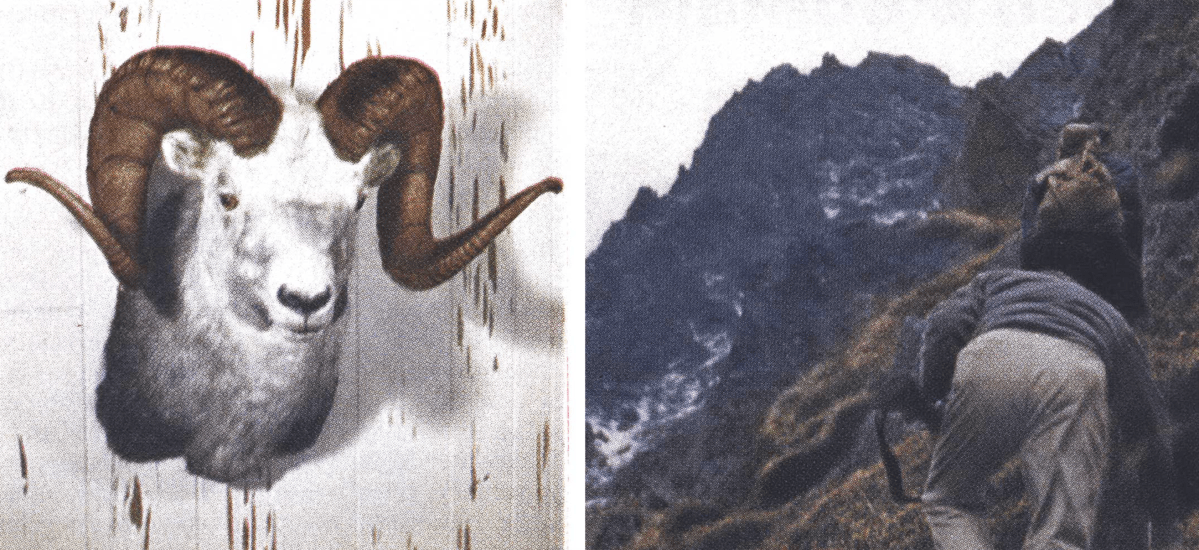

THE HUGE RAM’S HORNS shone in the sunlight as he slowly turned his head to look across the slopes. The horns were massive and even, and they seemed to be longer than a curl and a half.
I was lying on my stomach at the edge of a cliff about 100 yards above him. I chambered a round into my .264 Winchester Magnum and slowly pushed the muzzle out over the edge. The angle was so steep that I had to hold the rifle tightly to avoid dropping it.
Bruce Creyke Dennis, my guide, held my belt so that I wouldn’t slip and start rocks rolling over the cliff.
“He’s a record-book ram,” Bruce whispered. “For God’s sake, don’t shoot off his horns!”
The ram stood quartering toward me, and those huge horns covered all of his chest cavity. I had to wait until he turned his head. I thought now of Bruce’s story about a fabulous double-curl Stone ram seen several times the previous summer by a helicopter pilot for a geological-survey team. Was that just another legend, or could this magnificent ram below me actually be the double-curl ram of Ice Mountain?
Slowly the ram turned his head to look down toward the valley. I was breathing easier now, and I centered the crosshairs of my variable-power scope on his shoulder. I held my breath and squeezed the trigger.
Two years earlier Dr. Reid England and I were quail hunting near our homes in Canton, Illinois, when Reid asked if I had planned my next big-game hunting trip. That’s all it took to start the ball rolling.
I’m the publisher of a daily newspaper in Canton, a central-Illinois town of 15,000 near some of the best duck hunting in the Midwest. And trophy deer are becoming commonplace along our wild Illinois River bluffs. I make an occasional duck hunt and bowhunt for deer, but, like many other guys, I hanker to get some really wild country under my feet once in a while. Trouble is, my hankerings and my budget don’t always coincide. I’m 30 years old, and I have a loving (and understanding) wife and three young children, plus a mortgage to pay off, so my hunting trips are spaced too far apart. Reid England is a successful veterinarian who works in Peoria, some 40 miles northeast, and has a summer cottage on a nine-acre lake near Canton. An ardent fisherman and hunter, he’s the type who catches a stringerful of bass before I even think about going fishing. Doc had done a lot of small-game hunting but had always wanted to try for big game.
Reid was interested in sheep hunting, and I was eager for another chance at a grizzly. I’d missed a big silvertip while hunting with Roy Hargraves during a 1956 British Columbia trip. A few years later I had an opportunity to join Bill Niemi of Seattle on a hunt for Alaska brown bear. We both shot large bears. Bill’s went into the record book.
I spent the next two years after the quail hunt planning the big-game trip, working out the right handloads for my .264 Magnum, and shooting. Unfortunately, I also loaded up my .264 with fancy gadgets, including a custom trigger, which could be made into a hair trigger simply by pushing the trigger shoe forward, and a scope that required adjustable mounts because it lacked internal adjustments.
My final handload selection was the 140-grain Nosler bullet powered by 57 grains of du Pont No. 4350 powder. This combination gave me consistent groupings at 200 yards, and I had been extremely impressed with the performance of the Nosler bullets on mule deer and antelope that I’d shot on hunting trips to Wyoming. Reid and I spent months picking out the right hunting area and outfitter. After examining the latest Boone and Crockett Club record book and talking to outfitters and hunters, we narrowed our choice of area to either the northwest tip of British Columbia or the newly opened Mackenzie Mountains in the Northwest Territories.
Our final decision came after a conversation with Dr. Vernon Smith of Minneapolis, who had taken many trips with John Creyke Dennis, Telegraph Creek, B. C., outfitter, and has several trophies listed in Records of North American Big Game, the Boone and Crockett record book.
The clincher came when Vernon said, “The Dennis boys told me about a huge double-curl ram that’s been spotted several times on the east side of Edziza Peak—it’s known locally as Ice Mountain. That country is tough to hunt, but if that ram does exist, it should be a world record or awful close to it.”
Just the thought of hunting for such a ram started my blood racing.
The hardest part of the preparations was getting in shape. Trimming 25 pounds from my six-foot frame was a real challenge. A diet and running two miles each day helped, but even at 210 pounds I didn’t feel 18 years old again. At last we were ready to go.
In mid-September 1966 Doc and I flew from Chicago to Wrangell, Alaska, where we cleared through Canadian customs, bought our hunting licenses, and boarded a float-equipped bush plane for the 165-mile flight up the Stikine and Iskut river basins to Mowdade Lake. A few minutes after turning into the Iskut River basin, we crossed the Alaska-British Columbia border, which is marked by a long slash cut through the trees on the mountains.
Several hours later our pilot made a pass over the sparkling blue waters of Mowdade Lake, nestled among the mountains. I glanced back at Doc, who was looking intently at the lake with a bet-I-catch-the-first-trout smile on his lips.
We were greeted by head guide Bruce Creyke Dennis, 30-year-old son of our outfitter. Bruce is soft-spoken, about five feet six inches tall, and lean and tough as they come.
Bruce’s uncle, Tommy Dennis, was to be Doc’s guide. Tommy proved to be a good-natured guy with a big smile. He had lost two front teeth earlier in the hunting season, so his smiles took a little getting used to.
Joe, an Indian, was our cook and jack-of-all-trades. Short, plump, and happy, Joe turned out to be a top trail cook. His specialties were fresh-baked bread and fruit pies.
The camp nestled in a stand of pines about 20 yards from the lake, the surface of which was being dimpled by feeding rainbow trout. Doc and I set up our fly and spinning rods, but we soon found that the trout were staying out in deep water.
Doc rushed back to the tent and donned a pair of ultralight waders that he’d tossed into his duffelbag at the last minute. As the sun sank below the mountains, Doc started connecting on a small spinner and soon had a mess of rainbows ranging from 11 to 16 inches.
After a dinner of pink-fleshed trout, hot fresh bread, fried potatoes, and coffee, we sat around the wood-burning stove, and I asked Bruce about the double-curl ram up on Ice Mountain.
“Well,” he said, “I talked to the helicopter pilot who saw the ram several times last spring and summer. The pilot said his horns are wide, very heavy, and double-curl.”
“Have you seen that ram?” Doc asked.
“No,” Bruce replied, “but we’ve seen several big ones up there. But it’s a big area, and this is the first season I’ve hunted Ice Mountain.”
We were awakened before daybreak the next morning by a strange clanking sound. I peeked out of my down-filled sleeping bag and saw the beginning of what was to be an utterly delightful daily ritual. Bruce was kneeling in front of our small stove and starting a fire to drive the predawn chill from the tent. Soon we were so warm that we had to jump out of our bags in self-defense.
Joe’s timing with hot pancakes, eggs, crisp bacon, and coffee was perfect.
After breakfast Doc and I walked back to a long rock bar to check our rifles. We each took several shots, and both rifles were dead on.
Soon we were riding at the head of our 14-horse packtrain, pushing up across soggy tundra to get to the dry, high ground above timberline. After several hours of traveling we hit firm ground and started a long climb through a forest of spruce and fir. As we climbed, the trees became stunted and thinner. A light drizzle started as we climbed over a high mountain pass.
As I swung out of the saddle in an alpine meadow above timberline, both Diamond, my horse, and I groaned. Diamond wasn’t used to packing 210 pounds, and I wasn’t used to sitting for four hours on a round-backed nag.
We found a large rock and sat down to eat lunch. I had just unwrapped my sandwich when I glanced back at the horses. I was horrified to see Diamond drop to his knees and start to roll over, trying to get rid of the saddle and my rifle.
Bruce yelled at the top of his lungs, jumped up, and caught Diamond before the horse rolled completely onto his side.
“I don’t think he hurt your scope,” Bruce said, and Tommy agreed.
The scope looked O.K., but I thought I’d better take a couple of shots to check it. Someone suggested that shots might spook both the packtrain and any sheep around and that I should bore-sight the rifle. I removed the bolt, tossed my jacket over a boulder, and firmed up for a look. Everything seemed to check out.
Shortly after lunch Bruce sighted fresh sheep tracks in the shale. We left the packtrain and followed the tracks as far as possible with the saddle horses. Then we started climbing on foot.
After we’d climbed several hundred yards, the altitude hit us. Seven-thousand feet is a lot higher than our native 700-foot level. I began to wonder whether my daily two-mile running sessions at the Y.M.C.A. had been enough.
Bruce maintained a slow but steady pace up the ridge, stopping only long enough to glass new areas.
My lungs seemed about to burst. Each step required a great effort. The only thing that kept me going was that Doc seemed to be doing very well, and he’s 10 years older than I.
As Doc and I plodded on, stopping every few steps to catch our breath, fog closed in, sometimes cutting visibility to little more than 10 yards. Fear of losing sight of Bruce prodded me into taking a couple of extra steps before each rest pause.
Then the fog lifted and we saw three rams lying in shale at the base of a cliff some 400 yards above us. We climbed higher to get a better look, sat down with our Leitz Trinovid 8 x 32 binoculars, and examined the sheep. They hadn’t seen us.
“See the ram on the right?” Bruce said. “He’s young. Horns won’t go over twenty-five inches. The one in the middle will go thirty-two or thirty-three inches, and the ram lying out to the left should go about thirty-eight.”
This was our first look at wild Stone sheep. Frankly, after that climb anything would have looked good, but we passed up these sheep, still thinking about the double-curl ram.
That night in camp, Bruce and Tommy told us that they had got a glimpse of two massive rams several weeks before while guiding Jerry Mason and Dave George, both from Brigham City, Utah. They were sighted after Jerry shot a ram that was scored at 179⅝, which would put it well up in the Boone and Crockett Club’s record book, and Dave took a ram that just missed the record book because of a badly broomed horn.
“We just had a short look at the rams as they moved over a ridge,” Bruce said, “but they were huge—bigger than any I ever saw before.”
“One was gray, and the other was almost coal black,” Tommy added. “The black ram’s horns were quite a bit longer than the gray one’s.”
“Was it the double-curl ram?” I asked.
“I don’t know, John,” Bruce replied.
We set up our sheep camp two days later below timberline at the head of a valley. A stream rushed past several yards from our tents. As dusk fell we watched through my 30X Bausch & Lomb spotting scope as 20 mountain goats fed on the opposite mountainside.
Doc and I decided to spend the day hunting together since the two outstanding rams had been seen together in this area. During the climb to the mountaintop behind camp, we spotted a full-curl ram but passed it up because the bases of its horns were small.
We sat atop this spiny-backed ridge for a good hour before spotting something on a ledge near the top of the next ridge over. We set up the spotting scope, and Bruce studied the object for a long time.
Finally he said, “A Stone ram, and a heck of a big one! It looks like the gray one we saw a few weeks ago.”
Doc, Tommy, and I climbed all over one another for a look.
The ram was huge, but was he the double-curl ram? As I watched this old gray monarch, his head lowered several times. It seemed that just keeping his head up required great effort. His horns were massive and well over a full curl.
Doc and I had flipped a coin to see who’d get first crack at a grizzly if we saw one while together. But we hadn’t decided on the first shot at a ram. Now was a tough time to make this decision.
Our plight was eased somewhat when Tommy said that he thought the black ram, the gray one’s partner, probably was behind the next ridge.
Both Doc and I were trying to be good sports. I suggested that we flip. Bruce was getting impatient. Doc was the best sport.
“John,” he said, “I know you’re anxious to get a record-book trophy. Go ahead and take a crack at this one.”
Loose stones clattered down the mountain as we led our horses down a slide area. Suddenly Bruce stopped, pointed to something directly below us, and hissed, “Three rams!”
“Where?” I asked. I could see only boulders and shale.
“About two-hundred yards down and to our left. We spooked them.”
Doc and I looked through our binoculars and spotted the three rams, one of which had a massive full curl. They trotted slowly across the boulder-strewn mountainside, stopping occasionally to look at us.
After a long discussion Doc decided to pass up the biggest of these three rams and hope instead for a chance at the black ram.
We had just started up a draw when Bruce saw my gray ram on the distant skyline. The ram must have seen us coming down the mountain and moved out.
Later, we stood atop a 9,000-foot ridge, breathless and disappointed after a fruitless four-hour search for the gray ram. For the first time since the stalk had begun, I felt the wind knifing off the blue-green glacier that covered Ice Mountain.
Our eyes watering, we clambered down several hundred yards to the top of a line of rock bluffs, which dropped vertically 300 feet into the side of the mountain to form a narrow ledge. Bruce picked his way onto an outcropping for a better view. I started to follow but chickened out when I watched him jump across a three-foot-wide crevasse. My legs still felt like rubberbands, thanks to the climb.
Bruce glassed the area below us and then started climbing along the drop-off. But suddenly he crouched, sat down, took off his black cowboy hat, and cautiously peered over the side at something below him. He waved for me to crawl down.
I was warm again, and my heart began to pound so loud that I swore I could hear its echoes from the other side of the valley.
“The ram’s standing about a hundred yards below us,” Bruce said. “He hasn’t seen us, so take your time. He’s one hell of a ram!”
Then, as I mentioned at the start of this story, my guide warned me about hitting the horns.
The blast of the .264 Magnum reverberated off the canyons. I looked up, astounded, as the ram turned and slowly stepped behind the bluff. I couldn’t believe it! It had been a layup, an unmissable shot.
Before my shock wore off, Bruce was on his feet and running to another edge of the bluff, hoping to spot the ram again. I stumbled after him. Could all those hours of target practice have been in vain?
We finally saw the ram again. He was walking up the ledge about 100 yards directly below us.
I shot again.
“That one hit behind,” Bruce said. Behind? I’d aimed at the shoulder! “Try holding a couple feet in front,” Bruce yelled.
Then I remembered Diamond’s rolling onto my rifle. The scope must have been knocked out of line.
The big ram was confused. Apparently he hadn’t seen us above him, and now he stopped, looking around to find the danger. With my scope’s crosshairs squarely on his nose, I fired again, and the bullet hit his shoulder. He fell and started rolling down the rocky slope. Each time his horns slammed on the rocks, a report would echo off the far mountainside.
It took us several hours to get back to the horses and lead them near my downed ram.
Bruce put his tape around the horns and announced, “He’ll go way up in the record book! His horns measure forty-six inches long and nearly fifteen inches around the bases.” These were green measurements, of course.
I was flooded with emotions as I stood over my ram—pride and yet sadness, and excitement because he was much better than any I had ever dreamed of.
Tommy was confident that my kill wasn’t the double-curl ram. He and Doc stayed on top to glass the mountain basins for the black ram.
Bruce and I stumbled into camp about an hour after dark. Doc greeted us and said that on his way back to camp he had seen the full-curl ram that we’d spotted earlier. He decided to try for the ram, even though it was late in the afternoon.
Doc stalked up a narrow ridge and got 250 yards above the ram. Then he dropped his quarry with a single 150-grain factory bullet from his Browning .270.
That night we anxiously got out our Boone and Crockett scoring sheet and started field measurements. My ram measured out, green, at 186. Later Bert Klineberger, of Jonas Brothers in Seattle, scored it at 185.
However, my ram was finally given a score of 180 by the B. & C. Club judges in Pittsburgh and was awarded third place in the club’s 1966-67 competition, results of which were announced earlier this year. That score ties it for 19th place in the all-time records.
My ram’s right horn measured 45 inches long and 14 inches around the base, while the left horn was 44 inches long and 14 inches around the base.
Doc’s ram was scored at 170, which places it within the top 100 Stone sheep in the record book.
We spent the next two days hunting mountain goats among the peaks and ridges around camp. Doc spotted a good billy from camp, made a difficult climb with Tommy to within 250 yards, and downed the goat with one shot. The old billy’s horns measured 9¾ inches long, and though the trophy missed making the record book, Doc was well pleased with it.
The next day, it was my turn. My billy’s horns also went 9 inches.
The following day, we decided to move our camp to an area in which we could hunt caribou and grizzlies. It was a six-hour ride over wind-swept passes and through lava and black-sand fields along Ice Mountain’s glaciers. We set up camp near three waterfalls at the head of a narrow valley at timberline.
While hunting out of this camp one afternoon, we ran into a herd of caribou on the tundra flats. The animals spooked upon seeing us but soon stopped running when we didn’t follow. The herd bull threw back his head to test the wind but apparently couldn’t catch our scent, so he started trotting toward us. As the rest of the herd followed nervously, Doc and Bruce held a hurried conference about the size of the herd bull.
Doc made his decision and dropped the bull.
One day after Doc’s caribou kill, we decided to return to the tundra flats to look for grizzlies. Bruce and I rode north along the edge of the flats. Around noon we rode out to a point overlooking a swampy valley and set up the spotting scope.
“There’s a grizzly feeding on a kill!” my guide said excitedly.
I practically pushed Bruce off the mountain in getting to the scope.
A large blond-tip grizzly was standing in chest-high willows. As I watched, he lifted and swung his massive head in a manner typical of large bears. A mountain breeze ruffled the tips of his hair. He was magnificent.
The bear was a good 1½ miles away, so we mounted up and rode part of the way, tying the horses about a half-mile downwind of him.
I could tell by the way Bruce looked over his .308 that he was a little nervous about my ability to put the bear down. My custom trigger had misfired several times when I’d shot at a silvertip fox the day before.
I hadn’t brought along the tools needed to dismantle the trigger, but I thought I’d worked out the problem the night before with a good cleaning and light oil. The rifle had dry-fired well.
We took off our hunting jackets so that we’d be quieter while stalking through the willows.
Bruce led the way past a lake and up a moose trail toward the hill on which the grizzly was feeding. The willows closed in on the trail and made visibility very poor.
My guide told me that we’d be about 20 yards downwind when we spotted the bear, so I switched my variable scope to 2X. I couldn’t help but think that the bear would instinctively defend his kill. I remembered how deceptively fast a grizzly can move. My temples throbbed.
We moved slowly up the moose trail, stopping every time the wind would die so that the bear couldn’t hear the willows slapping against our clothing.
We stopped about 30 yards from the bear’s kill. We thought we’d be able to see the grizzly’s back over the willows, but he wasn’t to be seen. Was he lying on top of the kill, or had he seen us and crouched in nearby evergreens to ambush us?
We retreated quickly to the lake to talk over our situation.
We tried an approach from a different direction, but again we could not see the bear, and again we retreated, this time to a high knoll about 300 yards from where we had last seen the grizzly. Bruce climbed a tree but saw nothing.
We tried to wait the bear out, but after about an hour we decided to move in from the last possible direction.
We were slipping through brush not 25 yards from the kill when there was a Woof!, and the grizzly’s head and shoulders reared above the brush. I don’t know who was more excited, the bear or I.
I snapped off a shot that went over the bear’s head. He started bounding off, angling past us.
I regained control of myself, leveled down, and squeezed the trigger. Nothing happened. Misfire!
I slammed another shell into the chamber and squeezed off again. Nothing! As I chambered my last shell, the grizzly raced past me.
The rifle went off, and the slug hit the bear in the left foreleg. He rolled over several times, sat up, and fought the air. Fighting mad, he growled and ripped up the brush.
By the time I reloaded, the grizzly was running. My next shot was a square hit, and he went down for good.
As Bruce and I stood there watching for any movement, my knees began to shake uncontrollably. Bruce grinned and wisecracked something about my potential as a frug champion.
By the time we started toward camp it was snowing and so dark that I couldn’t see Diamond’s head. During the next half-hour’s ride I decided that this sure-footed mountain horse wasn’t a nag after all.
As Doc and I relaxed in the jet on the way home, we reminisced about the trip. I could tell that Doc had caught bear fever even though he hadn’t got a shot at any of the three grizzlies he’d seen during our hunt.
When the conversation turned to our record-book rams, Doc asked a question that still haunts me: “John, do you think that black ram would be a new world record?”
Read Next: Hunting Sheep In the Yukon Has Been a Dream Adventure for Generations. But That Opportunity May Be Fading
The Stone ram that has held the No. 1 spot in the record book since 1936 was shot by L. S. Chadwick in the Muskwa River area of British Columbia. It scored 196. Most experts agree that none larger will ever be taken.
But of course I wonder about that black ram Tommy and Bruce saw running with the one I shot. At any rate, it’s interesting to note that the Stone sheep that beat mine out for second place in the 1966-67 big-game competition was also shot in Telegraph Creek. It measured 182 and was killed by Mrs. John Crowe of Millville, California. Her guide on that hunt was John Creyke Dennis.
This story was originally published in the September 1968 issue of Outdoor Life.
Read the full article here