
I first ran into this idea while reading Blood Meridian by Cormac McCarthy. There’s a scene where the characters are deep in hostile territory, cut off from supply, and they end up improvising black powder using what they have on hand. One of the details that sticks is the use of…. urine.
It sounds strange at first. You read it and wonder if that’s just McCarthy leaning into the brutal, desperate tone of the book, or if there’s something real behind it.
I ended up digging into it, and the short answer is this: there is a real historical basis, but it’s a lot slower, dirtier, and less practical than the novel makes it feel. Let’s get into it.
Where the Urine Idea Actually Comes From
 Black powder, in its traditional form, is made from three components: saltpeter (potassium nitrate), charcoal, and sulfur. Out of those three, saltpeter is the most important one.
You can make charcoal almost anywhere, and sulfur has been mined and traded for a long time. Saltpeter is the bottleneck.
Before modern industry, people didn’t have factories producing nitrates on demand.
They had to pull nitrogen compounds out of organic waste, and that’s where urine came in as being very useful. If you wonder why, that’s because urine contains urea, the component that breaks down into ammonia. Over time, bacteria convert that ammonia into nitrates.
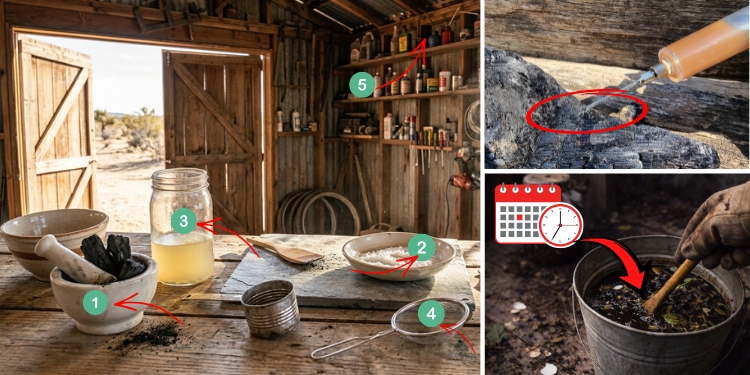
Those nitrates can accumulate in soil or organic matter under the right conditions. In the past, people collected manure, straw, wood ash, and yes, urine, and let it sit and decompose in controlled piles. These were often called “nitre beds.”
After months or even years, those beds could be processed to extract saltpeter.
So, when you see urine mentioned in connection with black powder, it’s not the urine itself that matters. It’s what it becomes after a long biological process.
What the Book Gets Right (and What It Doesn’t)
McCarthy’s scene captures the desperation and improvisation well. People have tried to produce nitrates from whatever they had available for centuries, especially in wartime when supply lines broke down.
Where the story compresses reality is… time. You don’t get usable saltpeter from fresh urine in a matter of hours or even days. The transformation relies on bacteria, moisture, oxygen, and decomposition. Even under decent conditions, you’re looking at months. So, when people in the past used it, they planned large-scale nitre operations years in advance.
The Only Gun You Need in a Crisis (and Why Other Types Would Be Useless)
There are accounts from Europe where governments ordered farmers to collect waste materials and build nitre beds specifically to support black powder production. That should give you an idea of the scale and patience involved.
While the concept is grounded in reality, the speed implied in fiction doesn’t match how chemistry and biology actually work.
How Long Does It Really Take
 If you’re starting from scratch, time is the biggest constraint, and it’s not even close. What’s happening in the background is a slow biological chain. Urine starts as urea, bacteria break that down into ammonia.
Then different bacteria convert ammonia into nitrites, and finally into nitrates. Each step depends on the previous one being complete, and none of them move quickly.
People in the past figured out ways to speed this up a bit by combining materials that already supported those bacteria.
Here’s what that looked like in practice:
- Urine + plain soil or dirt. If you’re just adding urine to soil, you’re relying on whatever bacteria are already present. This works, but it’s slow and inconsistent. Timeline: usually 6–12 months before you see meaningful nitrate buildup, sometimes longer depending on temperature and moisture.
- Urine + manure (animal or human). Manure already contains active bacteria and partially broken-down nitrogen compounds, so it jumpstarts the process. This was one of the most common historical approaches. Timeline: roughly 4–8 months for noticeable nitrate formation under decent conditions.
- Urine + manure + wood ash. Wood ash introduces potassium, which is useful later in forming potassium nitrate, and it also changes the pH in a way that can support certain stages of the process. Historically, ash was almost always part of the mix. Timeline: still measured in months, typically 4–6 months for early results, with better yields over 8–12 months.
- Established nitre beds (maintained over time). Once a system had been running for a year or more, it became much more productive because the right bacteria were already thriving. At that point, adding fresh material could produce usable nitrate-rich soil more quickly. Timeline: as little as 2–4 months for additional buildup, but only after long-term setup.
Even though this offers an interesting perspective on DIY ammo, there’s one recipe I’ve personally tried that worked beautifully. It uses only a handful of simple ingredients and stays within legal limits in most places, though it’s always smart to double-check your state’s regulations. You can find the DIY black powder recipe here.
Is This Practical in a Crisis?
This approach does have real value, and it’s the kind of knowledge every prepper should have in their back pocket.
It isn’t something you rely on for immediate results during a short-term emergency, since it takes time to work. Where it really becomes useful is in longer situations, especially when you’re thinking in terms of resilience over months or years. When it’s part of a broader system, planned ahead of time and maintained properly, it can quietly add to your overall preparedness.
Speaking practically, there are other ways to make your survival setup work harder for you. Fish waste, nutrient-rich water, leafy greens, herbs – these are all byproducts of a working aquaponics loop. The combination only comes together if you have a reliable food-growing system that feeds itself and keeps producing without constant outside inputs.
That’s why I started my own Aquaponics setup. It gave me the foundation – a productive, self-sustaining food system where the fish feed the plants and the plants clean the water, so that everything else, from protein supply to year-round harvesting, becomes possible.
Without that base, none of the rest matters. Start with Aquaponics now and build from here. 👉I want to find out more!
You may also like:
 How to Make Shotgun Shells at Home? (With Pictures)
What Your Gun Salesmen Will Never Tell You (VIDEO)
Best & Worst States for Gun Owners
What No One Told You About Your Guns
How Our Forefathers Made Glue Out of Pine Resin
Read the full article here