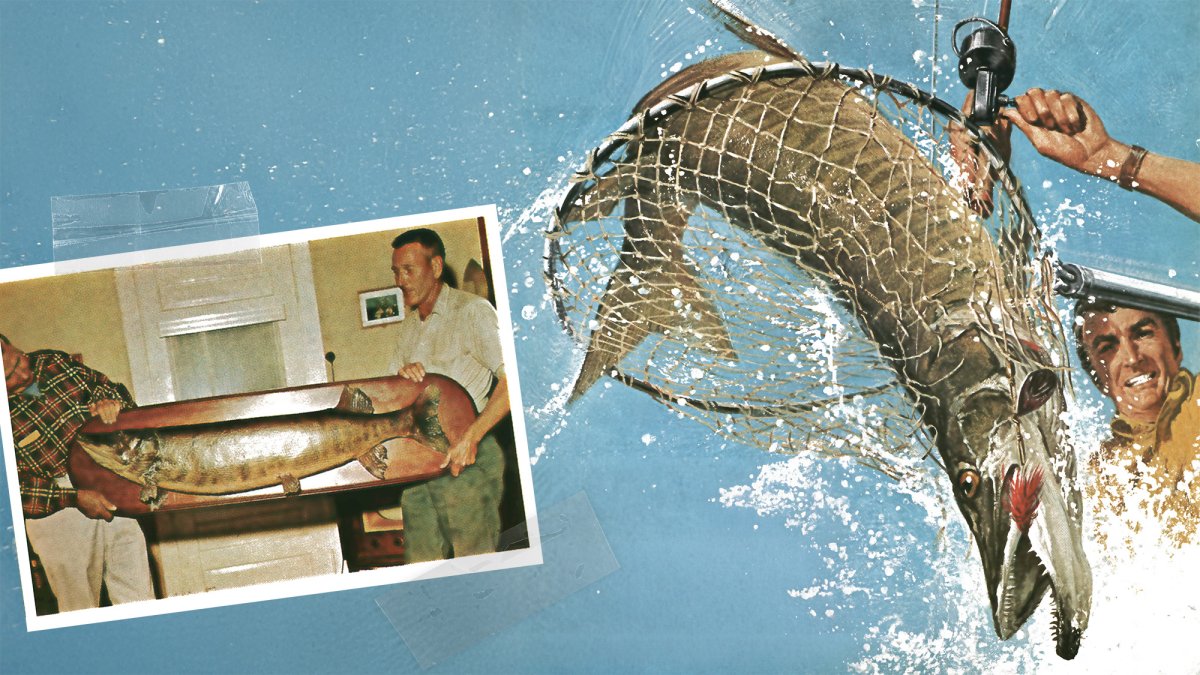

This story, “Comeback of a Heavyweight,” appeared in the July 1971 issue of Outdoor Life.
Imagine putting back a 31-inch fish; imagine a 31-inch fish being short of legal size! It happened to me on a fisheries-biologist’s holiday in the 1940’s when I was working on a muskellunge-restoration project at Chautauqua Lake in southwestern New York State.
A few minutes earlier, the light trolling rod had bent sharply and the reel had begun to whir.
“You’ve got one!” exclaimed my guide, Dick Arnold. “Start reeling in.”
Easy enough to say. But not so easy to do when on the other end of the line you have a battler with the temperament of an old-time bare-knuckle pugilist. After giving and getting back line several times, I brought the big fish close enough to the boat for Dick to slip the net under it.
“A dandy!” Dick said. But the yardstick did not validate the statement.
“Well, it serves you right,” Dick quipped as he slid the glistening greenish-gold muskie back into the water. “You were so all-fired-up about setting a thirty-two-inch size limit.”
But his blue eyes had a twinkle as he sank the barb. We were longtime friends and sometime fellow workers in the state fish-hatchery crew. Dick was referring to my work as a New York State fisheries biologist when the heavyweight Chautauqua muskie seemed to be down for the count. In 1941 only 871 were caught.
As manager of the dethroned champ, I had a part in starting the big fellow on the comeback trail. Our research studies demonstrated the need for drastic changes. As a first step in the rehabilitation program, I helped set up new Marquis of Queensberry angling rules — the principal one being that 32-inch minimum-size limit. Now, just a short time after I’d pushed through the new limit, it had backlashed.
But if it helped the king of freshwater fish regain his crown, it was O.K. with me. And over the years it did help. The annual take has increased to more than 6,000 muskies.
This kind of fishing, according to a 1968 Cornell University survey, lures more than 15,000 hopefuls from 23 states and Canada to Chautauqua Lake each season, bringing in a purse of $2 million to sweeten up the economy of the champ’s home territory. Chautauqua, incidentally, is some 70 miles from Buffalo, 45 from Erie, Pennsylvania, and 130 from Cleveland, Ohio.
This kind of fishing also lured me back in 1968 to the “Muskie Capital of the World.” Wisconsin may ask for equal time to debate that title, but where else can a fisherman find one 13,000-acre lake in which the muskie catch runs 30 to 40 tons each season?
Actually, the Chautauqua “muskalonge” (New York’s official spelling) with its vertical, barred markings is a native of the Ohio River Valley. Hence its scientific moniker (Esox masquinongy ohiensis) to distinguish it from its spotted cousin (Esox masquinongy masquinongy) of the St. Lawrence River, Wisconsin, and Minnesota; and from another cousin, the unspotted, unbarred northern muskie (Esox masquinongy immaculatus), also of Wisconsin and Minnesota.
In some parts of its range the barred variety is called a tiger muskie, but in the Chautauqua region the big fish is always a “lunge.”
On my return match in 1968, Joe Wilbur, veteran Chautauqua Lake fisherman, took me in charge. Dick Arnold had retired. Joe met me at the Bemus Point dock, where our group boarded his cabin cruiser, the Doris V. The party included my wife Dottie; Jim Lindsey, regional supervisor of fish and game; and Bill Shepherd, who inherited my former job as regional fisheries manager — both of the New York State Department of Environmental Conservation.
As the Doris V pulled away from the dock, the October sun began to break through, though a mist still masked the cottage-rimmed shore. The wooded hills, dipping gently to the water’s edge, looked as they might have when they belonged to the Eries, Nation of the Cat. No wonder the Iroquois, to the east, coveted the beautiful Chautauqua country and its great “noscononge” — which, loosely translated, means “the fish with the ugly mug.”
In 1655 the fierce Iroquois annihilated the peaceful Eries. As a traditional victory-night celebration, a fire of 1,000 trees blazed brightly — with an Erie tied to each tree!
Joe Wilbur, a slim, wiry man with close-cropped gray hair, set a northerly course and then began rigging up the hardware. Trolling for lunge, Wilbur style, is the poor man’s version of saltwater big-game fishing. From a pair of eight-foot glass rods set in gunwale sockets, Joe let out two stern lines. From two big surf rods, like port and starboard outriggers, trailed two more lines.
Joe believes in thorough coverage, and that’s good advice for the newcomer to Chautauqua Lake. With 30 years of experience in back of him, he explained:
“Lunge hang out in the weedbeds mostly, streaking out like lightning when they spot a meal. Or maybe a lunge makes a pass at a plug because he thinks a rival is muscling in on his territory. And then there are the cruisers showing up when you don’t expect ’em. I’ve caught ’em everywhere, so I fish for ’em everywhere.”
Reaching into a tacklebox, he selected sinkers, plugs, and leaders.
“Today,” he told us, “I’m putting six ounces of lead on the port stern line. This one will be out ninety feet. The other port line will be out a hundred and twenty feet with a two-ounce sinker. We’ll put two ounces on one starboard line and let it out a hundred-twenty feet, and the other starboard line will be out the same distance with an ounce and a half on it.”
A nylon leader with a braided-steel core was attached to the end of each line — insurance against a lunge’s needlelike teeth. From a dozen or so jumbo double-jointed minnowlike plugs, Joe selected four, each a different color.
“I don’t think color means much to a lunge,” he said. “The main thing is the action of the plug. I like ’er to go straight, and I like ’er to go fast.”
“The best bait of all for lunge,” added Bill Shepherd, “is patience.”
Joe handed me an outfit whose reel was loaded with 60-pound-test line.
“Let out four colors,” he instructed. “Each color is thirty feet of line. Then set the star drag pretty tight.”
“Perhaps you’ll catch one of the six-thousand muskalonge you tagged back in the forties,” my optimistic wife suggested. Unsung and unpaid, she had worked up the daily records when, as a fisheries biologist, I went out with the hatchery crew collecting data on lunge taken in pound nets during the spawning season.
But I had no illusions about my chances now. Lunge fishing is a sometime thing. When I started working on the Chautauqua muskalonge problem in 1941, fishermen averaged 168 hours of fishing for each legal lunge caught. Under Bill Shepherd’s stewardship, the time between strikes has shortened: in 1969 it was 27 hours, still an eternity to a fisherman.
Jim Lindsey confirmed my thoughts when he said, “Lunge fishing is a lesson in humility.”
But Joe Wilbur, whose lifetime catch is close to 1,000 lunge, expressed the true fisherman’s philosophy: “We’ve done all we can. Now it’s up to the fish. Let’s just relax.”
Relaxation was easy in the October shirtsleeve weather. Quite different from those bone-chilling spring days I worked with the hatchery crew.
Dottie recalled, “He would come back to our cottage shivering like a puppy — and smelling like a brewery.”
It was in those days that I learned the therapeutic value of boilermakers at Rappoles Hotel — famous Bemus Point hostelry of that era, affectionately known as the Rat Hole — where our crew headed after leaving the lake.
But hardships in the field were nothing compared with the beating I took while trying to sell the heavyweight’s rehabilitation program. I was facing a real dropout problem. The take in the pound nets had slipped from a 20-year average of about 2,000 lunge a season to 582 — hardly enough to justify operating the hatchery.
The situation was desperate, the remedy drastic. In one cast we revamped the rules: season shortened, allowable take reduced, the use of metal line and a gaff prohibited, and a special muskalonge license required in order to give more-accurate statistics.
But the rule change that caused the most gripes was raising the minimum-size limit from 24 to 32 inches.
“Tape-measure fishing,” snorted one angler. “I’d rather rassle an alligator than take a hook out of a lunge’s mouth.”
“You can’t do this to us,” groaned another. “We want fish, not reports by ‘bugologists’.”
“You’ll put us out of business,” moaned the tackle dealers.
“The tourist trade will be ruined,” screamed the Chamber of Commerce.
The new size limit was tough to sell because it was hard to translate into fisherman’s language. The change was based on “sexual dimorphism.” Equating such a complex biological factor with improved fishing was an acid test for a budding biologist. Yet it was the key to the problem.
Briefly, sexual dimorphism means that male and female muskalonge have different growth rates and reach sexual maturity at different ages. Males spawn for the first time in their third or fourth year, when they are about 24 inches long; females spawn a year or so later, in their fourth or fifth year, when they are about 30 inches long.
A 24-inch size limit was satisfactory for male lunge, but it simply was not adequately protecting the females.
It took only a few seasons to demonstrate that the 32-inch size limit was doing the job. It was succeeding so well, in fact, that in 1947 it was possible to lower the limit to 30 inches.
Back on the Doris V, we were still looking for some of those 30-inch fighters. Joe Wilbur’s system of complete trolling coverage continued. With lures working from top to bottom, we dog-legged around points and zigzagged in the bays. Joe, knowing the shoals, weedbeds, and kettleholes like the back of his hand, sometimes made S-turns to cover the champ’s neutral corners.
As we rounded Long Point, Joe’s sharp eye spotted the action — or, rather, lack of action — on my line.
“When the rod tip stops throbbing,” he said, “you’ve got weeds on the plug. Reel in, and clear the hooks.”
At Dewittville the Doris V turned across the lake toward Mayville and headed south, hugging the edge of the weeds. We passed two fishermen anchored in a rowboat. Both anglers were casting big plugs just like Joe’s, using conventional casting rods and reels.
“That’s what I call doing fisherman’s penance,” Jim said. “It’s muskie madness in its most virulent form. But anglers who have caught a lunge while casting say no thrill equals it.”
“Don Malmrose, our area’s conservation officer, and some of his friends,” added Bill Shepherd, “have developed a new wrinkle: casting a black eel jig with a light spinning rod. Beats plugcasting and is a lot more fun, Don says.”
Next we passed Prendergast Point, home of a million-dollar addition to the New York State Chautauqua muskalonge hatchery setup. Earlier in the day Superintendent Ray Norton, another longtime associate, had shown me around Prendergast and also the new Bemus Point hatchery layouts.
“We’ve made a lot of changes at Bemus since your day,” said the tall and lean Ray, a fish culturist with 46 years of muskalonge-rearing expertise behind him. “The biggest improvement is our controlled water temperature.
“Those yo-yo temperature changes sure raised heck with egg incubation. Now we can keep the water at a steady fifty-four to fifty-six degrees. When the eggs hatch and the fry begin to swim, we gradually raise the water temperature to from seventy to seventy-four, the best for fast growth.”
A lunge, from the start, wants his food alive and wiggling. After he hatches, his chief diet item is daphnia, a flealike crustacean that is cultured from yeast. As a lunge grows, his appetite grows. Carp and sucker fry come next, produced in hatching jars just as the muskalonge are. Then minnows become the main item at the training table. A one-acre pond of fingerling lunge will eat about 50 pounds of minnows a day.
After the guided tour at Bemus, Ray took me over to the Prendergast plant.
“Here’s where this hatchery comes into the picture,” he explained. “Our fifty-two ponds produce about three-hundred-fifty-thousand fathead minnows a season. Even so, we have to do a lot of stream and pond netting to get enough food.”
As I was leaving Prendergast, Tommy Thompson, who had been a big help in my early days of research, drove in with his netting crew. Big and smiling, as ever, he beat me to the draw on what has become a Chautauqua legend.
“Do you remember,” Tommy asked, “that lunge you knocked out cold with a pencil?”
I sure did. Tommy had been holding a just-netted lunge so that I could measure it and attach a tag. It began to wriggle like a Turkish belly dancer.
“Hold still, you rascal,” I said, giving the lunge a couple of taps on the head with an ordinary lead pencil. No one-two punch ever floored a heavyweight faster. The big fish quivered a couple of times and went down for the count. Tommy worked over it for a long time, but the fish wouldn’t come to.
As the Doris V passed Prendergast, Jim and Bill told Joe about my knockout. Joe, becoming more and more impatient with the lack of action, said, “I hope you’re not putting the whammy on this trip. I guess we’ll have to go right into the weedbeds instead of fishing the edges. We’ll be busy this afternoon keeping our lines clear.”
As we neared Toms Point, the line on one of the big outrigger rods began to run out at high speed. Joe pounced on it, adjusted the drag, and started getting back line. One color was spooled, then another, but the lunge elected to slug it out in classic stand-off style.
“This is a real buster,” Joe muttered as the contest became a draw, torture-testing the tackle to its limit. Another turn of the reel, and the line parted with the heartbreaking snap that gives anglers the galloping weeps.
“That was a helluva fish — might have been bigger than Bernie’s,” Joe said sadly. (Bernard Anderson, local Jamestown fisherman, established the current record in 1955 with a fish weighing 42½ pounds.)
Subdued in spirit, we did not speak the rest of the way in. What can a fisherman say at a time like that?
As we landed at the Bemus Point dock, Don Malmrose, conservation officer, came up. We told him of our tough luck.
“Tomorrow’s my day off,” he said. “You’ll have to try some live-bait fishing with me.”
The wind shifted during the night. A stiff northwester was kicking up when I met Don at the state’s public boat-launching site at the Bemus Point Hatchery.
“We’ll stick to the Narrows,” said Don as we stepped into his pointed double-ended rowboat, formerly a Chautauqua Lake trademark and now a collector’s item.
The Indians called the Narrows “judahgwah” (now “Chautauqua”), meaning “bag tied in the middle,” which is exactly how the lake looks on a map. Chautauqua Lake is actually two lakes whose narrow strait was spanned in 1811 by a paddlewheel ferry with cable guides.
The deeper upper lake, averaging 30 feet in depth and having a couple of 70-foot kettleholes, gets most of the fishing pressure. The shallower lower lake has an average depth of 15 feet.
“The Narrows is a favorite spot of mine,” Don told me. “Even if it wasn’t blowing I’d probably bring you here. You’re in good fishing water as soon as you leave the ramp.”
Lean and tanned from years in the outdoors, Don began setting up shop, skillfully handling the oars at the same time. At the end of the line on each eight-foot glass rod, he attached a six-foot nylon leader, finishing off with a short length of braided wire.
Don fastened five split-shot to each line, to keep the bait down. From the bait bucket came a lively six-inch horned dace, which was hooked through both upper and lower lips.
Related: The Most Insane 12 Days of Muskie Fishing in Wisconsin History
“Some fellows use twelve-inch suckers,” Don added, “but I do better with the smaller baits.” He handed me the rigged rod and added, “A lot of fishermen use a bobber, but I like the direct feel when you get a strike.
“When you do get a touch,” Don advised, “strip out some line quickly. Sometimes it takes a half-hour for a lunge to turn the bait around in its mouth and swallow it.”
Threatening black clouds brought whipsawing gusts and a spitting rain. We drifted near the ferry crossing.
“A good spot,” said Don. “My theory is that the paddlewheels keep the small fish stirred up, and this activity brings the lunge in to feed.”
Suddenly my rod dipped; but there were no telltale pulsations.
“I seem to have snagged a piece of Chautauqua County real estate,” I said to Don.
“Yeah, hand me your rod. I guess I’ll have to break the line.”
The ferry was starting to cross the strait, and we were smack in its path. Don noticed that my line was moving.
“Hey . . . I’ll bet you’ve hooked the ferry cable!” He reached for his knife.
“No, it’s a fish!” he exclaimed a moment later, handing the rod back to me.
The ferryboat operator, a fisherman and sympathetic soul, stopped the ferry. I payed out line as the fish kept shadowboxing.
“That’s a lunge, all right,” said Don. “Thought it might be a bass. Darn it, we can’t keep holding up the ferry. You’ll have to chance horsing him.”
I started cranking. For a moment the rod bent double. Then came a sickening slack and that aching feeling of loss that is familiar to every fisherman. I finished reeling in. A tooth-scarred horned dace told the story.
There was a long silence. Finally Don spoke:
“Don’t feel too badly. I know some fishermen — darned good ones too — who’ve never won a bout with old Battlin’ Esox.”
I know one, too. Me.
It was a defeat for me as a fisherman. But it was a victory for me as a biologist to know that I’d played a part in helping the champ make a successful comeback.
Editor’s Note — This bio accompanied the original story. Cecil E. Heacox is a career conservationist. He joined the New York State Conservation Department (now the Department of Environmental Conservation) as a fish-hatchery helper and eventually became deputy commissioner, a position from which he retired at the end of 1966. Heacox directed a restoration program that is credited with saving the Chautauqua muskalonge from extinction. He also helped to develop electro-fishing for research purposes, and he supervised studies on Catherine Creek and extensive tagging experiments in western New York. He is now a natural-resources consultant in Wassaic, New York.
Read the full article here