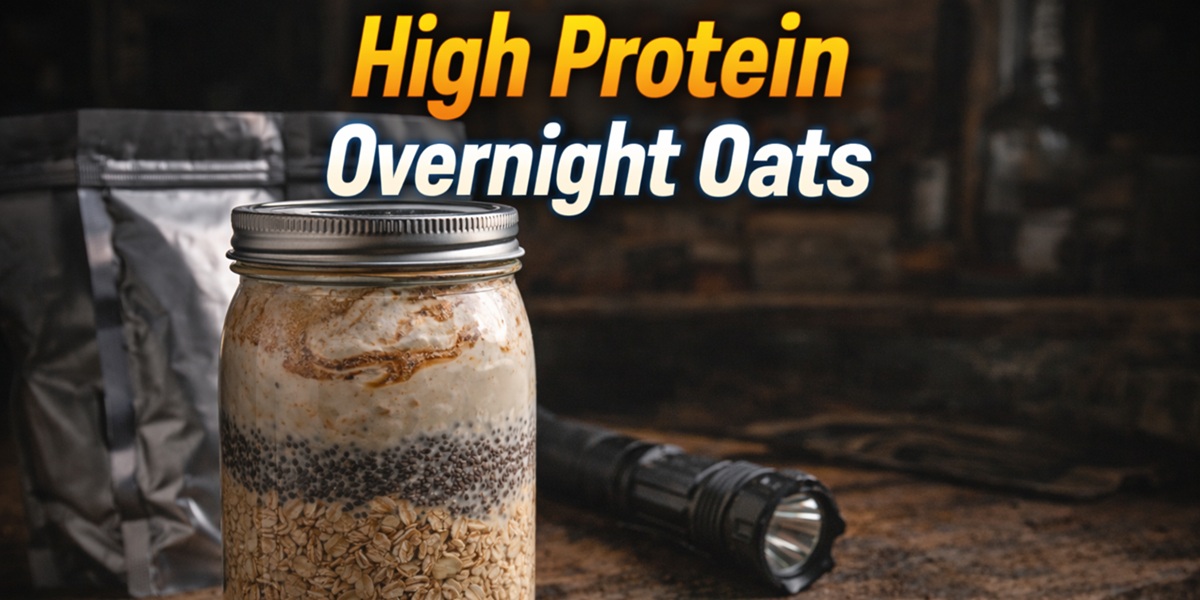

Most people think of overnight oats as a meal prep trend for gym-goers with perfectly organized refrigerators. That is missing the bigger picture. Strip away the Instagram aesthetics and what you have is one of the most practical, high-nutrition, no-cook foods you can build into a survival food system, one that requires nothing more than a container, cold or room-temperature water or liquid, and a few shelf-stable ingredients to deliver a meal that will actually sustain you through a demanding day.
In a grid-down situation, a bug-out scenario, or any extended emergency where fuel is rationed and hot meals are not guaranteed, protein intake is one of the first casualties. People default to carbohydrate-heavy shelf foods because they are easy and familiar. But carbohydrates without adequate protein leave you mentally foggy, physically weak, and burning through muscle mass at exactly the moment when you need your body to perform.
High protein overnight oats solve that problem cleanly. They are shelf-stable when the right ingredients are chosen, they require no heat to prepare, they are calorie-dense enough to matter, and they can be customized for protein content far beyond what most people think is possible from oats alone. This article covers everything: the survival case for this food, how to build the highest-protein version possible from shelf-stable ingredients, long-term storage methods, and eight complete recipes you can rotate through.
Why Protein Is the First Thing You Lose in a Survival Food Plan
The average adult needs between 0.8 and 1.2 grams of protein per kilogram of body weight per day under normal conditions, according to guidance from the National Institutes of Health. During physical stress, illness, injury, or sustained manual labor, that requirement rises significantly. A 180-pound man doing hard physical work in a survival scenario may need upward of 120 grams of protein per day to maintain muscle mass and immune function.
Most standard emergency food stockpiles fall far short of that. White rice, pasta, crackers, dried beans that require extended cooking, and canned goods heavy on vegetables and broth are the typical staples. They provide calories, but they do not provide adequate protein on their own. And protein deficiency in an extended emergency does not just make you feel weak. It impairs wound healing, compromises immune response, reduces cognitive function, and causes the body to break down muscle tissue for energy, which is precisely the reserve you cannot afford to lose when physical demands are highest.
Related: What Supplements Should You Stockpile?
The USDA FoodData Central database confirms that plain rolled oats contain approximately 5 grams of protein per half-cup dry serving. That is a reasonable foundation. The goal is to build on that foundation strategically using shelf-stable protein sources that require no cooking and blend easily into a cold or room-temperature base.
Why Overnight Oats Are a Serious Survival Food
No Heat Required
Rolled oats hydrate fully in cold water or milk over 6 to 8 hours. No stove. No fuel. No fire. In a situation where heat sources are scarce or tactically inadvisable, that matters. You mix your jar before you sleep and eat in the morning with zero preparation time and zero resource expenditure.
Scalable Protein Content
Unlike most simple shelf foods, overnight oats can be engineered to hit very high protein targets. A well-constructed jar can reach 40 to 50 grams of protein using entirely shelf-stable ingredients. That is a meaningful contribution to daily protein needs from a single meal.
Calorie Density
Rolled oats deliver approximately 150 calories per half-cup dry serving, and the protein additions stack calories quickly. A fully loaded protein overnight oat jar can reach 500 to 700 calories with the right ingredient ratios, which is a substantial meal for any caloric environment.
Minimal Water Requirement
Overnight oats require far less water than cooking oatmeal on a stove. You are hydrating the oats slowly over several hours, not boiling them. In a water-scarce scenario, the efficiency of hydration matters.
Long Shelf Life with the Right Ingredients
Rolled oats sealed in mylar bags with oxygen absorbers store reliably for 20 to 30 years, according to long-term food storage data from Utah State University Extension. Most of the protein additions covered below, including powdered milk, whey protein powder, and freeze-dried egg whites, have shelf lives of 2 to 25 years depending on packaging and storage conditions. This is a food system built for long-term readiness, not just this week’s meal prep.
The Survival Protein Stack: Best Shelf-Stable Protein Sources for Overnight Oats
Not every protein source works cold and without cooking. These are the ones that do, along with their protein content and shelf-life considerations.
Whey Protein Powder
The most efficient protein addition available. A single 30-gram scoop of a standard whey concentrate provides 20 to 24 grams of protein. It dissolves easily in liquid, blends into oats without changing the texture negatively, and adds very little volume. Properly stored in a sealed container kept cool and dry, commercial whey protein powder lasts 1 to 2 years past the printed date without significant degradation. Vacuum-sealed powder in mylar extends this further.
For preppers, buying whey protein in bulk 5-pound containers, repackaging into smaller mylar pouches with oxygen absorbers, and rotating stock every 18 to 24 months is an efficient and cost-effective approach.
Powdered Whole Milk
Full-fat powdered milk adds approximately 8 grams of protein per quarter cup of powder, plus fat-soluble vitamins and healthy fats that improve caloric density. It rehydrates easily at room temperature and adds a natural creaminess to the oats that improves palatability in conditions where morale matters. Shelf life in sealed containers ranges from 2 to 5 years; in mylar with oxygen absorbers, it can reach 20 to 25 years.
Freeze-Dried Egg White Powder
Egg white powder is one of the most underused prepper proteins. A two-tablespoon serving provides approximately 12 to 14 grams of protein with minimal fat and very low carbohydrate content. It rehydrates in liquid without needing to be cooked and blends into overnight oats without any eggy flavor when combined with other ingredients. High-quality freeze-dried egg white powder has a shelf life of 5 to 10 years sealed, longer in optimal storage conditions.
Chia Seeds
Chia seeds provide approximately 5 grams of protein per two-tablespoon serving, along with omega-3 fatty acids, fiber, and the valuable property of absorbing liquid and thickening the oat mixture naturally. They require no preparation, store for 4 to 5 years at room temperature in sealed packaging, and improve the texture of cold oats significantly. They also expand in the stomach, which extends satiety in conditions where rationing is necessary.
Hemp Seeds
Hemp seeds deliver approximately 10 grams of complete protein per three-tablespoon serving, along with a favorable omega-3 to omega-6 fatty acid ratio. They have a mild, slightly nutty flavor that disappears into oats. Shelf life is 1 to 2 years in sealed packaging. Hemp seeds are one of the few plant-based complete protein sources, meaning they contain all nine essential amino acids, which makes them particularly valuable in a survival food context where animal protein may be limited.
Peanut Butter Powder
Standard peanut butter does not store as well or travel as cleanly as the powdered version. Peanut butter powder delivers approximately 8 grams of protein per two-tablespoon serving, stores for 4 to 5 years sealed, and adds a concentrated peanut flavor that significantly improves palatability. It blends into the oat liquid and becomes part of the base rather than sitting on top the way jarred peanut butter does.
Related: How to Make Peanut Butter: The Prepper’s Complete Guide to Homemade, Long-Lasting Peanut Butter
Collagen Peptide Powder
Collagen peptides are not a complete protein source on their own because they lack tryptophan, but they dissolve completely in cold liquid and add 10 to 12 grams of protein per serving with zero flavor impact. They are particularly useful stacked on top of a more complete protein like whey or egg white. Shelf life is 2 to 5 years sealed.
How to Build a High Protein Overnight Oat Jar
The basic construction is simple. The ratios below produce a jar with approximately 40 grams of protein and 550 to 600 calories.
The Base Formula
- Rolled oats: Use old-fashioned rolled oats, not quick oats and not steel-cut. Quick oats go mushy. Steel-cut oats do not fully soften in cold liquid overnight. Old-fashioned rolled oats hit the right texture.
- Liquid: Water works, but powdered milk reconstituted in water improves protein content and texture considerably. Use approximately 3/4 to 1 cup of liquid per 1/2 cup of dry oats.
- Protein additions: Add your chosen protein sources directly to the liquid before combining with the oats. This helps them dissolve and distribute evenly.
- Fat source: A tablespoon of nut butter or nut butter powder adds calories, healthy fats, and staying power. Skip this only if you are tightly rationing calories.
- Flavor: A pinch of salt significantly improves flavor. Cinnamon, vanilla powder, and cocoa powder are all shelf-stable flavoring options that make the difference between a meal you eat and a meal you endure.
- Mix and seal: Stir everything together thoroughly. Seal the container. Leave at ambient temperature for 6 to 8 hours, or refrigerate if cold storage is available.
Rule of thumb: every 100 grams of finished overnight oats should deliver at least 8 to 10 grams of protein to qualify as a genuine high-protein meal rather than just a carbohydrate base with a token protein addition.
Eight High-Protein Overnight Oat Recipes Built for Survival Conditions
All recipes below use shelf-stable ingredients, require no heat, and are designed to be made in a wide-mouth mason jar, a lightweight camping container, or any sealable vessel. Protein estimates are approximate and will vary by brand.
1. The Base Camp (Vanilla Whey)
Protein: ~38g | Calories: ~530
- 1/2 cup rolled oats
- 1 scoop vanilla whey protein powder (approx. 24g protein)
- 1/4 cup powdered whole milk mixed into 3/4 cup water
- 2 tbsp chia seeds
- 1/4 tsp cinnamon
- Pinch of salt
Mix protein powder and powdered milk into the water first until dissolved. Add oats, chia seeds, cinnamon, and salt. Stir thoroughly. Seal and rest 6 to 8 hours.
2. The Peanut Butter Bunker
Protein: ~42g | Calories: ~610
- 1/2 cup rolled oats
- 1 scoop unflavored whey protein powder
- 3 tbsp peanut butter powder
- 1/4 cup powdered milk mixed into 3/4 cup water
- 2 tbsp chia seeds
- 1 tsp cocoa powder
- Pinch of salt
Dissolve powders into water first. Combine all ingredients, stir well, seal, and rest overnight.
3. The Egg White Protocol
Protein: ~44g | Calories: ~490
- 1/2 cup rolled oats
- 2 tbsp freeze-dried egg white powder
- 1 scoop unflavored whey protein powder
- 3/4 cup water
- 3 tbsp hemp seeds
- 1/4 tsp vanilla powder
- 1/4 tsp cinnamon
- Pinch of salt
Whisk egg white powder and whey into water first to prevent clumping. Combine with remaining ingredients, seal, and rest 6 to 8 hours.
4. The Collagen Stack
Protein: ~36g | Calories: ~520
- 1/2 cup rolled oats
- 2 tbsp collagen peptide powder
- 1 scoop vanilla whey protein powder
- 1/4 cup powdered milk mixed into 3/4 cup water
- 2 tbsp chia seeds
- 1 tbsp peanut butter powder
- Pinch of salt
Dissolve all powders into milk-water before adding oats and chia. Stir until fully combined, seal, and rest overnight.
5. The Hemp Fortress (Dairy-Free)
Protein: ~35g | Calories: ~560
- 1/2 cup rolled oats
- 4 tbsp hemp seeds
- 2 tbsp chia seeds
- 1 scoop unflavored plant-based protein powder
- 3/4 cup water
- 2 tbsp peanut butter powder
- 1 tsp cocoa powder
- 1/4 tsp cinnamon, pinch of salt
Useful when dairy-free is required or when powdered milk stocks are being conserved. Dissolve protein and peanut butter powder in water, combine all, seal, and rest.
6. The Chocolate Blackout
Protein: ~40g | Calories: ~580
- 1/2 cup rolled oats
- 1 scoop chocolate whey protein powder
- 2 tbsp collagen peptides
- 1/4 cup powdered milk mixed into 3/4 cup water
- 2 tbsp chia seeds
- 5 tbsp cocoa powder
- 1/4 tsp instant coffee powder (extends shelf life of opened jar and improves flavor)
- Pinch of salt
High morale value in extended survival conditions. The coffee powder deepens the chocolate flavor and adds a caffeine contribution. Dissolve all powders, combine with oats and chia, seal, and rest.
7. The Spice Route
Protein: ~38g | Calories: ~540
- 1/2 cup rolled oats
- 1 scoop vanilla whey protein powder
- 2 tbsp freeze-dried egg white powder
- 1/4 cup powdered milk mixed into 3/4 cup water
- 2 tbsp chia seeds
- 1/2 tsp cinnamon
- 1/4 tsp ginger powder
- Pinch of cardamom
- Pinch of salt
Flavor variety is underrated in extended preparedness situations. Rotate this one into your cycle to prevent palate fatigue. Dissolve powders, combine all, seal, rest.
8. The Long Haul (Maximum Shelf-Life Ingredients Only)
Protein: ~34g | Calories: ~570
- 1/2 cup rolled oats (mylar-stored)
- 1/4 cup powdered whole milk (mylar-stored) mixed into 3/4 cup water
- 3 tbsp freeze-dried egg white powder
- 3 tbsp hemp seeds
- 2 tbsp chia seeds
- 1 tbsp peanut butter powder
- 1/4 tsp cinnamon, pinch of salt
This recipe is built entirely from ingredients with multi-year to multi-decade shelf lives when properly stored. No whey protein, which has a shorter effective life. Purpose-built for long-term storage rotation.
How to Store Overnight Oat Ingredients for Long-Term Preparedness
Individual storage of each ingredient gives you the most flexibility. Pre-mixed dry blends are convenient but harder to rotate and adjust. Here is how to handle each component.
Rolled Oats
Transfer from paper or cardboard packaging into mylar bags immediately after purchase. Add one 300cc oxygen absorber per gallon-sized bag. Heat-seal the bag. Label with contents and date. Store in a cool, dark location. Expect a reliable shelf life of 20 to 30 years under these conditions. Temperature is the primary variable: storage at 55 to 65 degrees Fahrenheit significantly outperforms storage at 75 to 80 degrees.
Protein Powders
Whey and plant-based protein powders degrade faster than most shelf-stable foods. Repackage bulk powder into smaller mylar pouches with oxygen absorbers. Label with date. Rotate every 18 to 24 months. Keep stored containers away from heat, light, and moisture. Freeze-dried egg white powder lasts significantly longer than whey, 5 to 10 years when sealed, making it the better choice for deep storage.
Powdered Milk
Full-fat powdered milk in mylar with oxygen absorbers stores reliably for 20 to 25 years. Non-fat powdered milk lasts even longer but has a lower caloric density. For survival purposes, full-fat is the better choice. Once a bag is opened, use within a few weeks and reseal tightly between uses.
Seeds (Chia and Hemp)
Store in airtight glass jars or vacuum-sealed bags in a cool, dark location. Both seeds have natural oils that can go rancid over time with heat and light exposure. Properly stored chia seeds last 4 to 5 years. Hemp seeds, higher in fat content, last 1 to 2 years at room temperature, longer refrigerated or frozen. Rotate hemp seeds more frequently than other components.
Pre-Made Dry Mix Bags
For rapid deployment, pre-mix single-serving dry bags in advance. Combine one serving of oats, chia seeds, protein powder, and any dry flavorings into a small sealed bag. When needed, dump into a container, add water, stir, and wait. Label each bag with the recipe name and protein content. Store in a larger sealed bin. This method works particularly well for bug-out bags and vehicle kits where preparation time may be severely limited.
Field Use: Making Overnight Oats Without Refrigeration
A common question is whether overnight oats made without refrigeration are safe to eat. The answer is yes, with some conditions.
Overnight oats kept at ambient temperatures below 70 degrees Fahrenheit are generally safe to consume after 6 to 8 hours. At higher ambient temperatures, the preparation time should be shortened to 4 to 6 hours and the oats consumed immediately when ready. At temperatures above 90 degrees Fahrenheit, such as summer conditions in a vehicle or shelter without climate control, reduce prep time to 3 to 4 hours or prepare with the minimum liquid needed and eat within 2 to 3 hours of reaching a soft texture.
The USDA Food Safety and Inspection Service identifies the bacterial growth danger zone as 40 to 140 degrees Fahrenheit. In a survival context where refrigeration is unavailable, awareness of ambient temperature and shortened prep windows at higher temperatures is the practical management strategy. Oats made with water and shelf-stable dry protein additions carry lower risk than those made with rehydrated dairy, since dairy supports bacterial growth more readily than plain water.
In cold weather, overnight oats prepared at ambient temperature or in a pack are perfectly safe and actually improve in texture when the soak time extends past 8 hours.
Caloric Planning: How Overnight Oats Fit Into a Survival Food Budget
The standard emergency caloric planning target is 2,000 calories per day for sedentary adults and up to 3,500 calories per day for adults engaged in sustained physical labor. Overnight oats, at 500 to 650 calories per full serving, cover roughly a quarter to a third of daily caloric needs from a single meal. That makes them a strong anchor for one meal of the day without consuming the majority of your caloric budget.
From a macro standpoint, 40 grams of protein per meal means a single overnight oat serving covers approximately a third of a 120-gram daily protein target for an active adult. Pair it with a protein-heavy lunch and dinner, dried or canned fish, legumes, nuts, or additional protein powder preparations, and hitting daily targets becomes achievable even in a constrained food environment.
Cost efficiency is also worth noting. Bulk rolled oats are among the most affordable calories available in any market. At current prices, a 50-pound sack of rolled oats provides thousands of servings at a cost per serving of cents, not dollars. Bulk whey protein, while more expensive, still delivers protein at a cost far below most emergency meal kit equivalents when purchased in 5 or 10-pound bags and properly stored.
The Morale Factor: Why Food Quality Matters More in a Crisis
Preparedness planning that focuses only on calories and macros misses something that experienced survivalists and military logistics planners both understand well: food morale is a real operational variable. People who are eating flavorless, monotonous, or unpleasant food in a stressful situation show measurable declines in decision-making quality, cooperation, and motivation over time.
The flavor variety built into the eight recipes above is not an afterthought. It is a deliberate part of the design. Rotating between chocolate, peanut butter, spiced, and vanilla profiles across the week prevents the palate fatigue that leads people to eat less than they should because they cannot stomach another identical meal. That matters when nutritional adequacy is already under pressure from other stressors.
The fact that overnight oats require no cooking also has a psychological dimension. You prepare something before sleep, and it is ready when you wake. That small ritual of preparation and anticipation, something resembling a normal morning routine, carries more value in an extended emergency than it might seem in theory.
The Foods That Kept Generations Alive Still Work Today
High-protein overnight oats show something important: the most reliable survival foods are usually simple, shelf-stable, and built from ingredients that have been trusted for generations. Long before modern emergency meal kits existed, people relied on calorie-dense staples like oats, dried milk, seeds, and preserved proteins to stay strong through winters, crop failures, and supply shortages.
The Lost Super Foods is built on that same principle. It documents traditional survival foods that supported families through wars, economic collapse, and extreme scarcity — foods specifically chosen because they store well, provide real nutrition, and require minimal resources to prepare.
Inside The Lost Super Foods, you will discover dozens of forgotten staples that can dramatically strengthen a long-term food strategy: foods that last for years, sometimes decades, without refrigeration; foods that deliver meaningful calories and protein when supply chains fail; foods that helped previous generations endure situations far more difficult than most people prepare for today.
Many of the principles behind high-protein overnight oats — shelf stability, caloric density, minimal fuel use, and strategic ingredient stacking — appear again and again throughout traditional survival food systems. The difference is that most of this knowledge is no longer commonly taught, even though it remains just as effective.
If your goal is building a food supply that can handle real disruptions rather than short inconveniences, learning these traditional foods can dramatically improve your preparedness without dramatically increasing your budget.
Explore the full collection of long-lasting survival foods here!
Final Thoughts
High protein overnight oats are not a niche food trend. They are a genuinely practical survival food that solves several real problems at once: high protein from shelf-stable sources, no-cook preparation, significant caloric density, long storage life for the right ingredients, and enough flavor variety to stay edible across weeks of use.
Build a stock of rolled oats, whey protein, freeze-dried egg whites, powdered milk, chia seeds, and peanut butter powder. Pack single-serving dry mix bags for your bug-out kit. Store your bulk ingredients properly in mylar with oxygen absorbers. Run through the recipes above until you know which ones your household will actually eat under stress, because that is the only test that matters.
The food that gets you through an emergency is not the most elaborate food or the most expensive. It is the food that is ready when you need it, requires the fewest resources to prepare, keeps you physically functional, and that you can actually bring yourself to eat when things are hard. Overnight oats check every one of those boxes.
You may also like:
 Instant Eggs: The Survival Protein They Don’t Want You to Have
Strategies used by President Trump to Safeguard His Wealth (VIDEO)
High Protein Meal Prep on a Budget
8 Cheap Protein Sources to Add to Your Stockpile Right Now
How To Choose, Use & Store Protein Powder for Preppers
Read the full article here