

Do Bass Actually Eat Frogs, or Do They Just Strike Them? These Anglers Attempted to Find Out

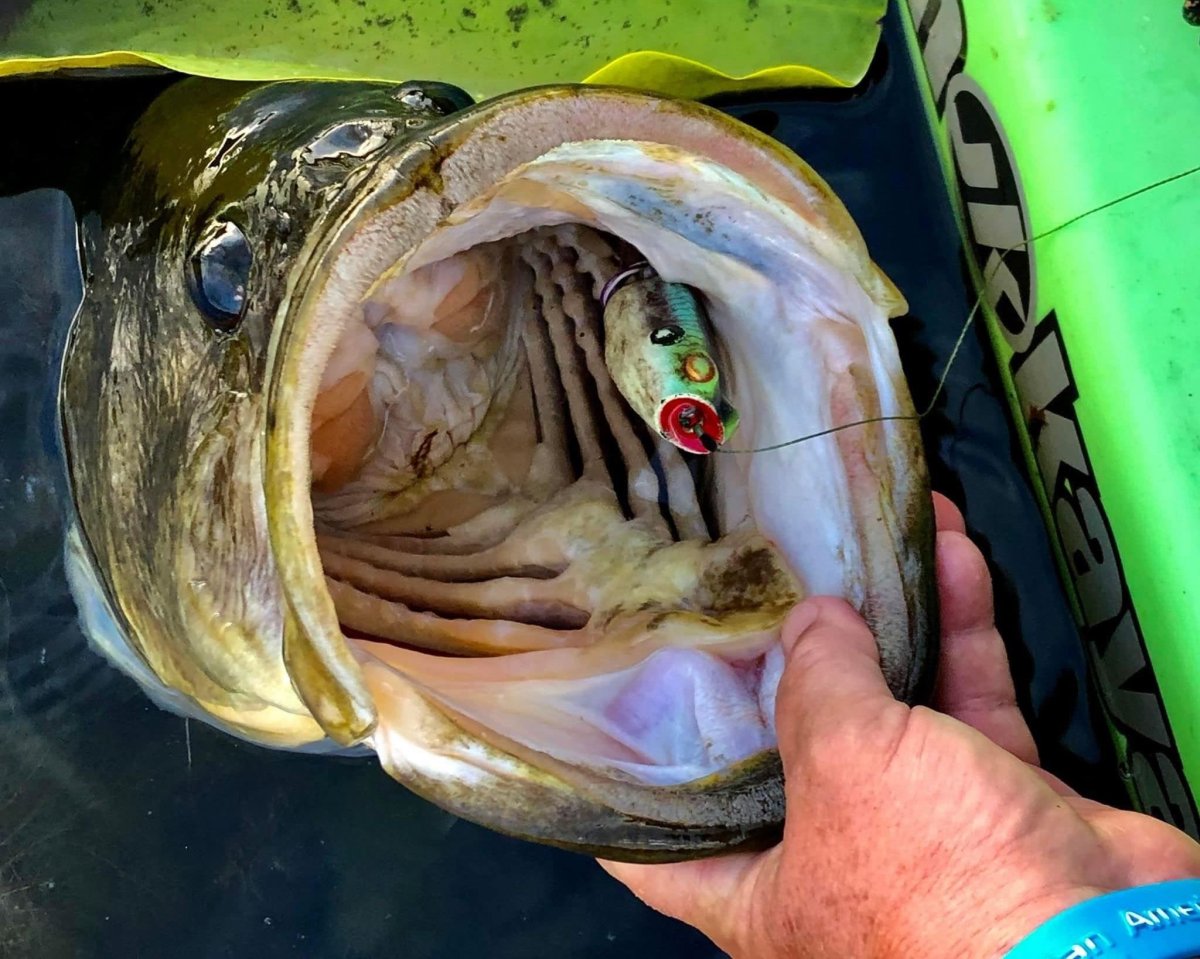

Doc and I started our wacky experiment by chasing the cows out of our fishing hole. It was a mean trick since the day was a midsummer scorcher, and one aging bossy that had cooling mud halfway up her sides turned at the water’s edge and moaned her protests. But she had to go. We couldn’t have her standing astraddle one of our best bass holes.
We had business with the bass. I call them pasture bass because that’s where they feed along the edges of pastures in water from six to 36 inches deep. But it wasn’t like you might think. We were there to catch bass, sure, but we had another, more important, mission which I’ll tell you about in a minute.
We’d spent most of that morning catching frogs: big, little, brown, and green frogs. Doc, whose full name and title is George H. Wegmann, M.D., had growled once in a while and threatened to go trout fishing. But he stuck with me, just as I’ve stuck with him sometimes when I’ve been tempted to go somewhere else. Now he was growling about my wading system. Saw grass, he complained, was cutting his bare legs, and the black mud oozing between his toes gave him a squeamish feeling. But I’d ruled out waders. In that heat you’d fill a boot with sweat in 100 yards.
“Why do we have to do this today?” he asked.
“Because by tomorrow there won’t be enough water in this pasture to wet down a frog’s belly,” I told him. “And besides I’ve got to find out about frogs and bass.”
The water along the edge of the Wisconsin marsh was hot, but it got cooler as it deepened. That helped. Cooled the blood, I said to Doc. He said I was nuts, that blood doesn’t get hot unless a man is sick, and then told me to shut up. He stood still, listening. “Think I hear a bass working over by where that fence comes into the water.” We both listened. I saw the rushes move. “He’s right over there,” I said, pointing. Doc nodded.
I dug into the pile of frogs I was carrying in one of my wife’s old silk stockings, shook them off as they climbed over my wrist and arm, and closed my fingers over a nice fat one. I waited for the bass to show his position again, and then I threw the frog two feet in front of the moving stems. The sound the bass made when he took the frog was like a cork popping out of a jug.
I dug out another frog and threw it to the bass. It was a big, strong, green frog and it must have started swimming right when it hit the water. We couldn’t tell—the grasses were too tall but they telegraphed the fish’s movements. It started moving just as the frog hit the water, swam a dozen feet, and stopped for maybe five seconds. Then there was that pop again.
“How many frogs you going to feed him?” Doc asked.
One more,” I said, reaching down into the stocking. The next was a brown one, and he must have landed right on top of that bass. Scared, the fish darted 15 feet as fast as a snake’s tongue. He came back slowly. It took maybe five minutes, then once more we heard a splash and the “glug.”
“It’s your turn,” I told Doc.
He took the weedless hook off the big bottom guide on his spinning rod and let it swing over to me. I caught it and hooked a little green frog lightly through the lips.
“When he hits,” I instructed, “give him a couple seconds before you set the hook.” Doc looked at me like a kid does when you tell him something he knows.
“And don’t cast right on top of him,” I cautioned.
“Tend your frogs,” he snapped, flipping the tiny green one out over my head.
It landed about three feet from where we’d seen the last movement, but the line stretched across the rushes and we heard sounds like the frog was just dangling its hind feet in the water.
That didn’t hinder the bass any. He took it quickly. Doc waited, then he tightened sharply. The bass tied a bundle of foliage into a bouquet.
I ran over to help and startled the bass into a couple of cartwheels. The frog went flying, but the hook held and so did the line. I soon had the fish by the gills. It was about a two-pounder, but we didn’t care about size. That wasn’t why we were there. I rapped the bass over the head with Doc’s knife. It stiffened, its tail quivered, and then it was quiet. I slit it open and took out its stomach.
“It’s empty,” I said, holding it up.
“I don’t believe it,” Doc said. I handed the stomach to him, and he expertly turned it inside out. There was nothing in it.
“Maybe a second fish came in and took the frog I cast,” he suggested.
We walked over to where Doc had hooked the bass and shuffled around in the rushes. I found a mangled frog and handed it to Doc.
“Every bone in its body is broken,” Doc said. Almost all the skin was off it too.
“What do you think?” I asked.
“Maybe it’s the frog I hooked the bass with,” Doc said. He handed it back to me, and I noticed that what little skin was left on it looked brown. Doc had cast a green frog.
“I don’t think so,” I said. “Let’s try again.”
Doc put the bass in a trout basket he was carrying. We waded out 100 feet.
“I still think bass eat frogs,” Doc said.
“I do, too, but why don’t we ever catch a bass with a frog in its stomach?”
“Might be because they have digestive systems capable of disintegrating a frog very quickly,” Doc offered.
“That one you just caught didn’t have time,” I said.
“Might have been two bass in there,” Doc said.
I shrugged. I just wasn’t sure anymore. All my life I’d been positive that bass eat frogs. Like many other fishermen, I’ve caught hundreds of black bass on frogs or lures resembling frogs.
Then Jim Schell of Neenah, Wisconsin told me one day that he doesn’t believe black bass eat frogs.
“You ever find a frog in a black bass?” he asked.
“Why, sure. Everybody has.”
But I wasn’t sure, and I kept thinking it over. Had I ever found a frog in a bass’s stomach? Yes, last summer. But that frog was the one I’d been using for bait.
I stuck by my guns for a week. Bass had to eat frogs. Why, frogs were the world’s best bait for largemouths. They’d take a frog when they wouldn’t take anything else. What were bass doing in pasture pools and along the shores if they weren’t hunting frogs? Didn’t they always come inshore late in fall just to fatten on frogs?
Did they? The more I thought about it the less sure I was. In fact I couldn’t remember ever having really good largemouth fishing in late fall.
I wrote to Jim about it, and he wrote back: “Years ago I met an old Mississippi commercial fisherman who agreed frogs were the No. 1 bait, but said that in all his experience he’d never found a frog in the stomach of a black bass. I’ve found a lot of things in bass, from mud-hen (coot) chicks and feathers to sticks, stones, crabs, bullheads, dogfish, and perch, but no frogs or parts of frogs.”
Even after that I wasn’t admitting anything—not publicly, anyway. But I began a little discreet investigating. First I called Dr. Edward Schneberger, head of fish management for the Wisconsin Conservation Department.
“Bass eat frogs, don’t they, Doc?” “Well, now. . . .” There was a long pause. Doc is a cautious man. “Well now . . .” he repeated. “Bass eat almost anything and everything.”
“I know, but about frogs—do bass eat frogs?”
“What do you think?” he asked.
“I think they do.”
That helped. “Sure, bass eat frogs,” Doc said, “at least I think so. Didn’t you ever catch bass on frogs?”
We fenced around like this a little longer. I’d obviously lighted some fires of doubt even in his expert mind. So I went to the big book.
“The largemouth,” it read, “will strike almost anything . . . but its favorite foods are minnows, insects, worms, frogs, and crawfish.”
There it was in black and white. But along about that time I got half a dozen letters from anglers who agreed with Jim Schell—bass do not eat frogs. I was astonished.
So I went bass fishing. My wife, Doc, and I caught and opened 13 bass. All their stomachs were empty except one. And there was a perch in that one.
Next day I put the question to William Dickenson, curator of lower zoology at the Milwaukee Public Museum, but he wouldn’t commit himself. He went to the Illinois Survey of Natural History and from its book on fishes quoted: “…of the stomachs of 16 black bass examined none had frogs in them.”
That still didn’t settle the question. I went fishing again and caught seven bass. One had two crawfish in its stomach, another had a mouse, one had a chub, and the stomachs of the four others were empty.
I was mulling over these findings as I splashed toward the pasture fence where Doc and I had spotted movement among the rushes. I threw a frog, but nothing happened. I threw two more. The same. We waded over to the area. Our “bass” turned out to be a muskrat which swam right between my legs.
Even while Doc was laughing, I heard a fish splashing at the edge of the reeds where lily pads carpet the water. I fed it five frogs before Doc got in there with his hook.
It was a big fish, and it gave Doc trouble. It jumped twice, sounded, and wrapped the line around the stem of a pad. The line held. I got wet clear to the neck collaring that bass, but the water felt wonderful.
By the time I got the fish to a finger of high land that slivers into the marsh, it was dead. I slit it open and examined its stomach. No frogs.
“If they aren’t eating frogs, then what are they doing?” I asked Doc.
“Maybe bass just hate frogs like a mongoose hates snakes,” Doc said.
“What about northern pike then? Or trout or muskies or catfish? They’ll all hit frogs.”
We were both stewing by then. The sun was sucking water from the marsh so fast you could almost see the level drop. We left the water to get my spinning rod, which I had leaned against a tree, and hurried back to the lake shore. I walked into the water up to my neck. Cooled off, I followed Doc to the marsh. “Let’s try one more,” I said.
We listened, watched, and steamed until we located another bass. We fed it four frogs and threw a hook along with the fifth. Doc nailed the fish right away, but it tangled in the weeds and broke his line. When we walked toward the bass it heard us coming and tried to jump, disgorging two frogs that went sailing through the air.
I dived on the bass, finished it off, and opened it up. Its stomach was empty. By the time I’d done that Doc was back with the two frogs it had spit out. They were skinned and mashed. It was hard to believe they could have been so mutilated in such a short time.
“Perhaps that’s your answer,” Doc said.
“What?”
“When you set a hook into a bass it disgorges whatever food it had in its stomach.”
“What about the other things you find in bass?”
Doc shrugged. “Let’s just stop feeding the fish, and try to catch some instead.”
So we did. We collected five nice bass so that we’d have some to hang on the fence for a picture. Then we quit because the cows were standing by the edge of the marsh looking with longing eyes at the cool water.
Read Next: Best Frog Baits for Bass
When we were stretched in hammocks next to the shack, I told Doc I thought I’d write to maybe 20 or 30 hotshot bass fishermen to see what they had to say about whether bass do or don’t eat frogs.
“Why stop at 20 or 30?” Doc asked.
“What do you mean?”
“I mean write a story about it for OUTDOOR LIFE. Then you’ll get your problem out to more than a million readers, most of whom probably know a lot more about bass fishing than you do.”
I passed up the slur on my knowledge because, for once, Doc had something. I wrote the story. Now that you’ve read it, what do you think? Do black bass eat frogs?
This story was originally published in the July 1953 issue of Outdoor Life.
Read the full article here
