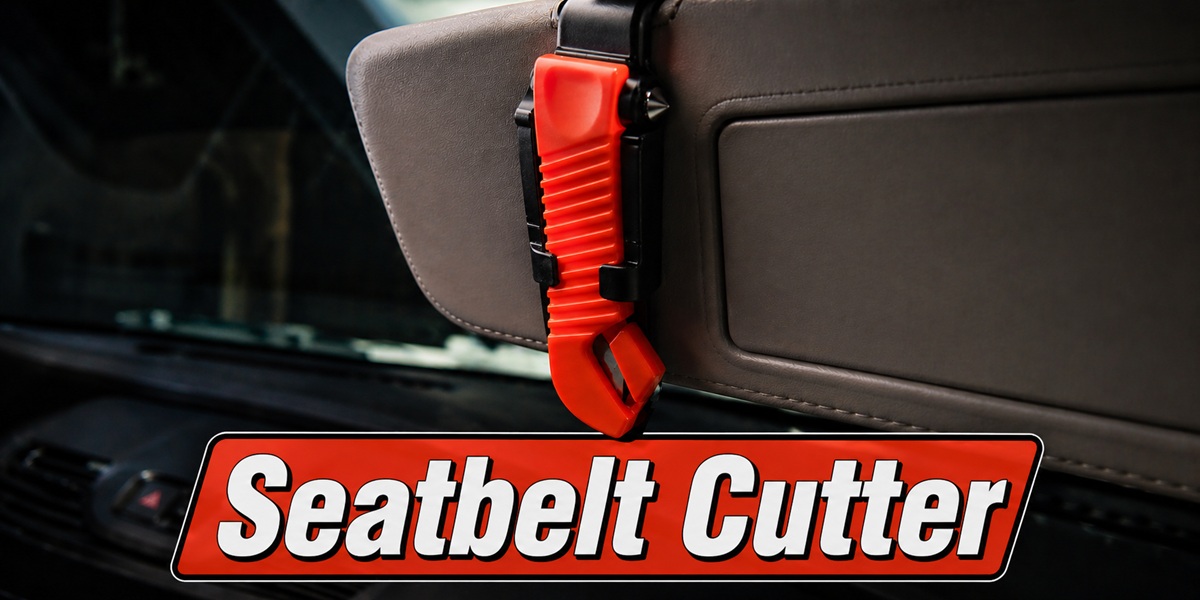

You are buckled in, the car just went off the road, and the door will not open. The seatbelt is jammed. The car might be filling with water. That is not a hypothetical situation. It happens. And in those moments, the only thing standing between you and a way out could be a
A seatbelt cutter is a simple, inexpensive tool. Most of them cost less than fifteen dollars. But choosing the wrong one, or storing it in the wrong place, can make it useless precisely when you need it most. This guide walks you through everything: how they work, what to look for, where to keep one, and which options deserve a spot in your vehicle right now.
Why a Seatbelt Cutter Belongs in Every Prepper’s Vehicle
Most people think car crashes only look one way: the big dramatic impact. But many vehicle emergencies develop slowly. You slide into a ditch and the car rolls. You hit a flooded road and the vehicle stalls and begins to sink. You are rear-ended and the latch jams from the force of impact.
In each of these scenarios, your seatbelt may become a restraint rather than a lifesaver. According to the National Highway Traffic Safety Administration (NHTSA), vehicle submersion crashes, though relatively rare, carry a significantly elevated fatality rate because escape windows are extremely narrow. Getting out in under 30 seconds can be the difference between survival and drowning.
A seatbelt cutter gives you that exit. It does not replace good driving habits, and it does not replace a window breaker. It is one layer of your vehicle emergency kit, and it is the layer that addresses the single most common physical obstacle people face when trying to escape a damaged car: a locked or jammed belt.
How a Seatbelt Cutter Works
Most seatbelt cutters use a recessed hook blade. You slide the blade housing along the belt webbing, and the belt feeds into a protected cutting channel. A sharp pull draws the blade through the webbing in one clean motion. Because the blade is recessed, there is minimal risk of cutting yourself or a passenger when using it under stress.
The design matters for a specific reason. In high-stress emergencies, fine motor control degrades. Adrenaline, disorientation, and fear make it harder to perform careful actions. A seatbelt cutter is designed to work even with shaking hands, even in the dark, and even if you are partially dazed. The best versions are operable single-handed.
Some models combine the cutter with a spring-loaded window breaker on the opposite end. This combo tool has become the standard for vehicle survival kits because it addresses both major escape barriers in a single compact package.
What to Look for in a Seatbelt Cutter
Blade Quality
The blade should be stainless steel, recessed in a protective housing, and factory-sharp. Avoid novelty versions with plastic or coated blades. Seatbelt webbing is thick, tightly woven synthetic material designed to withstand enormous tensile force. A cheap blade will bind, skip, or fail to cut cleanly, especially if the belt is under tension from bodyweight.
Single-Hand Operation
You may need to cut your own belt, your passenger’s belt, or the belt of a child in the backseat while bracing yourself against a door or dashboard. The tool must work with one hand. Look for a grip that can be activated with thumb pressure or a simple pull rather than requiring a two-handed squeeze or press.
Mounting and Accessibility
A seatbelt cutter stored in your glove box is largely useless. In an emergency, the glove box may be blocked by a deployed airbag, pinned shut by a crumpled dash, or simply out of reach if you are suspended upside down. Your cutter needs to be within arm’s reach of your seated and belted position. The most effective mounting locations are:
- Clipped to the sun visor
- Attached to the driver’s door pocket with a carabiner
- Mounted magnetically or with adhesive to the side console
- On a keychain or lanyard clipped to a belt loop, for drivers who want it on their person
Whatever mount you choose, practice reaching for the tool while belted in and looking straight ahead. You should be able to locate it without looking.
Combo Tools vs. Standalone Cutters
The combination seatbelt cutter and window breaker is the most practical option for most people. Having both functions on one tool reduces clutter, simplifies storage, and means you only need to reach for one thing in an emergency. The window breaker component is typically a hardened steel or tungsten carbide tip that concentrates force on a small point of glass, shattering tempered side windows with a single strike.
Laminated glass (found on windshields and some newer vehicles) will not shatter with a standard breaker. Side windows and rear windows are typically tempered, which is what these tools are designed for. If you are unsure about your specific vehicle, check the edge of the glass: tempered glass usually has a small stamp or label indicating the type.
Top Seatbelt Cutters Worth Considering
The following are among the most widely used and trusted options in the vehicle emergency tool category. This is not a comprehensive review of every product on the market, but a starting point based on what preppers, first responders, and automotive safety educators consistently recommend.
ResQMe Keychain Rescue Tool
ResQMe is one of the most widely sold vehicle escape tools in the world. It is small enough to clip directly to your keychain, placing it on your person rather than in your car. The spring-loaded window breaker activates with a push against the glass. The seatbelt cutter uses a recessed blade that cuts belt webbing in one pull. The compact design is its main advantage. Its main limitation is that it requires you to carry your keys on you, which is not always the case.
Lifehammer Brand Emergency Hammer
Lifehammer has been manufacturing vehicle escape tools since the 1970s and is widely used across European emergency services. Their standard model mounts to a dashboard bracket, keeps the tool visible and accessible, and includes both a hammerhead window breaker and a seatbelt cutter. The bracket mount is a significant advantage for drivers who prefer a dedicated in-vehicle tool rather than a keychain attachment.
AAA Road Safety Hammer
Available through AAA and major automotive retailers, this is a solid entry-level option for drivers who want a reliable combo tool without a high price point. It includes a recessed belt cutter and a pointed window breaker tip. The grip is designed for broad hands and works reasonably well under simulated emergency conditions.
Thrunite or Generic Branded Paracord Bracelet Cutters
Some preppers carry a compact seatbelt cutter on a paracord bracelet or survival band. These are worn on the wrist and ensure the tool is on your body regardless of where your car keys are. Blade quality varies significantly across brands in this category. If you go this route, buy from a reputable outdoor gear retailer and test the blade on a strip of nylon webbing before relying on it.
How to Use a Seatbelt Cutter: Step-by-Step
Knowing how to use the tool before you need it is not optional. Studies from the American College of Emergency Physicians consistently show that performance under emergency stress degrades for untrained individuals but holds for those who have practiced even basic procedures. Run through this at least once in your driveway, with the car parked:
- Step 1: Stay calm enough to locate the tool. Reach for the mount point without looking if possible.
- Step 2: Pull the belt away from your body slightly to create slack and expose the webbing.
- Step 3: Slide the cutter blade housing along the belt until the webbing is seated in the cutting channel.
- Step 4: Pull the tool firmly through the belt in one motion. The blade will cut through the webbing.
- Step 5: If the door will not open, use the window breaker on the side window. Strike the corner of the glass, not the center. The edges are weakest.
- Step 6: Clear glass from the frame with your elbow or a cloth, then exit the vehicle.
If you have children in the car, practice reaching into the backseat while belted. Know which direction you will need to orient the cutter for a rear-facing belt configuration.
Where to Store Your Seatbelt Cutter
Storage location is arguably more important than which specific tool you buy. A premium cutter stored in a center console is less useful than a budget cutter mounted to the sun visor. Here is how to think about placement:
- Driver sun visor: The most universally recommended location. Accessible while belted, within natural reach, easy to train your muscle memory on.
- Keychain: On your person at all times. Requires discipline to always carry keys, but ensures the tool is available even if you are not in your own vehicle.
- Seatback pocket: Lower priority but useful as a backup, particularly in the rear seat for passengers.
- Door pocket: Accessible but can be blocked if the door is damaged or the car is tilted.
Do not store more than one or two in the vehicle. Redundancy is good, but complexity is not. In a crisis, you want to reach for one thing.
Teaching Your Household to Use It
A seatbelt cutter does you no good if your teenage driver or your spouse does not know where it is or how to use it. This is a five-minute conversation and a one-minute demonstration. Show every person who drives your vehicle where the tool is stored and how to operate it. For households with teenage drivers, this is a basic safety orientation that should happen before they ever leave your driveway alone.
The Centers for Disease Control and Prevention (CDC) identifies motor vehicle crashes as one of the leading causes of injury-related death in the United States, with young drivers overrepresented in those statistics. A seatbelt cutter will not prevent a crash, but it may allow someone to exit one.
Building a Complete Vehicle Emergency Kit
A seatbelt cutter is one tool. It belongs in a broader vehicle emergency kit that covers the most likely emergency scenarios you will face on the road. At minimum, a prepared driver’s kit should include:
- Seatbelt cutter and window breaker (combo tool preferred)
- First aid kit with trauma-rated gauze and tourniquet
- Emergency mylar blanket or two
- Jumper cables or battery jump starter
- Flashlight with fresh batteries or a hand-crank alternative
- Road flares or LED emergency triangles
- Water (minimum one liter per person)
- Multi-tool or fixed-blade knife
- Waterproof fire starter
- Duct tape and paracord
Keep these items in a grab bag in your trunk or under a seat, not scattered across the vehicle. Speed and access matter in emergencies, and a disorganized kit is almost as bad as no kit.
Extra Reading: Building Your Get Home Bag
Maintaining Your Seatbelt Cutter
These tools require almost no maintenance, but they do require periodic inspection. Every three to six months, check the following:
- Is the blade still recessed and protected, or has it been damaged?
- Is the blade still sharp? Test by dragging it lightly along a scrap of nylon webbing.
- Is the mounting point still secure? Check clips, magnets, and adhesive.
- If it is keychain-mounted, is the ring or clip in good condition?
Blades on quality tools will hold an edge for years under normal conditions. If the blade shows corrosion, deformation, or dullness, replace the tool. The cost of replacement is negligible compared to what you are protecting.
Remember
Most people prep for what’s outside the house… but emergencies don’t wait for you to get home.
A crash, a flood, a jammed seatbelt — it all happens in seconds. And the difference between panic and control comes down to what you have within arm’s reach.
That’s exactly why elite operators don’t just think in tools… they think in systems. Layers. Redundancy. Immediate action under stress.
👉 The Navy Seal’s Bug-In Guide breaks down how to turn your home, your vehicle, and your daily life into a self-contained survival setup—so you’re not scrambling when things go wrong.
Inside, you’ll learn how to:
• Build layered protection instead of relying on a single tool
• Stay operational when systems fail (power, cash, transport)
• Set up your home and gear for real-world emergencies—not theory
• Think and act under pressure like those trained for worst-case scenarios
A seatbelt cutter is one smart layer.
But real preparedness is what happens when everything else fails at the same time.
Get the full system here!
Final Thoughts
Preppers think in layers. You have a fire extinguisher because fires happen. You have a first aid kit because injuries happen. A seatbelt cutter belongs in the same mental category: a straightforward, inexpensive tool that addresses a specific, documented survival risk.
Buy one. Mount it where you can reach it without looking. Tell every person in your household where it is. Then forget about it, because it will be there when you need it.
Vehicle emergencies move fast. The people who survive them are rarely the most athletic or the most experienced drivers. They are the people who thought ahead.
You may also like:
 Car Fire Extinguisher: What You Need and Why It Belongs in Every Vehicle
How to Siphon Gas From a Modern Car: Emergency Preparedness Guide
Don’t Throw Away Your DEAD Car Batteries! Do This Instead!
Read the full article here