

A Heart Attack Changed How He Fished. Then He Caught a Record-Shattering Brown Trout

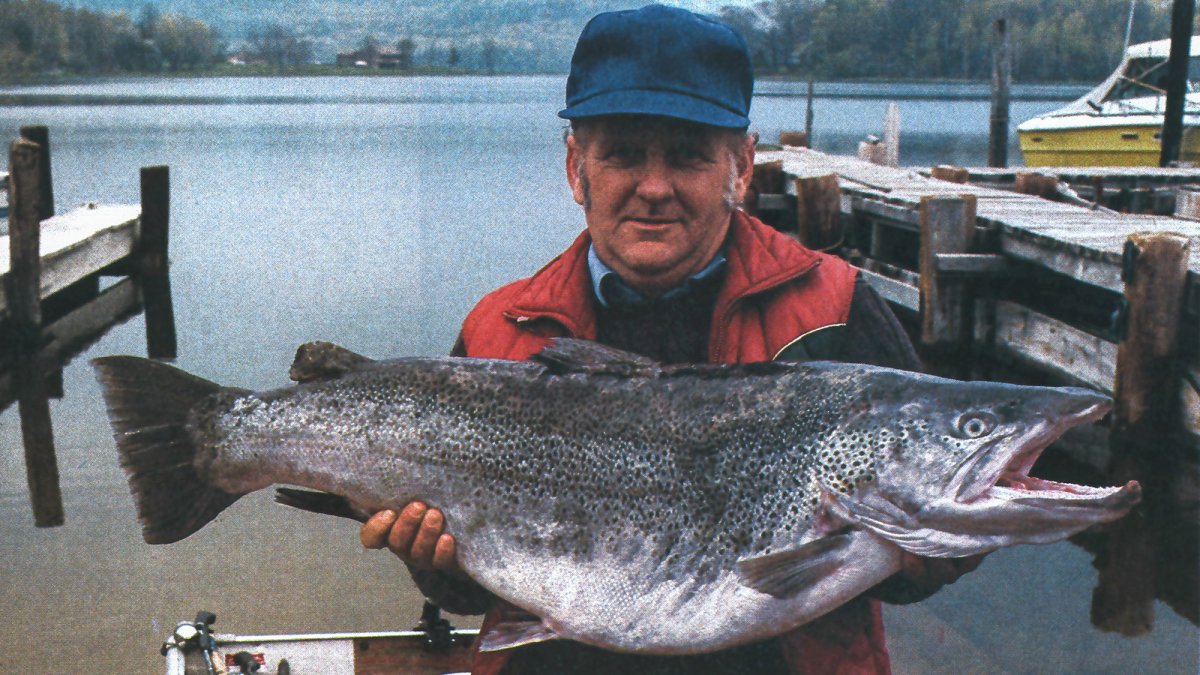

This article, “The Story of a Record Brown,” appeared in the September 1984 issue of Outdoor Life. The current world-record brown trout is a 44 pound 5 ounce fish caught in New Zealand in 2020. The current world-record 12-pound test record was another fish caught from the same spot, Oahu Canal, in New Zealand in 2013; that one weighed 42 pounds 1 ounce. The biggest brown trout ever certified in Michigan is a 41-pound 7-ounce fish caught in 2009 from the Manistee River.
If he had just grabbed the other fishing rod, Bob Henderson would have set an eight-pound-test world record that evening on Michigan’s Arcadia Lake. The International Game Fish Association, official keeper of such records, recognizes eight-pound and 12-pound line classes, not six-pound and 10-pound. Lines testing six or 10 pounds are bumped up to the next respective line class.
“That other rod was sitting there in the boat,” he said, “loaded with six-pound-test monofilament, the weight I normally use.”
The rod he grabbed was freshly spooled with 10-pound-test Stren. It was also set up with the spoon Henderson wanted to use, a white Dardevle Cop-E-Cat. Therefore, the 34-pound 6-ounce brown trout that hit that spoon is likely to qualify as a 12-pound-test world mark. Henderson is still waiting for the IGFA to certify his catch.
Had someone told Henderson several years ago that he’d smash the North American brown trout record, he never would have believed it. After a heart attack, Henderson had to give up hunting entirely, as well as the fishing he treasured the most — wading streams for brown trout.
“I was pretty good at it, too,” he said. “Since I was 16 years old, I’ve been hooked on brown trout. They’re not dumb, and I like the challenge. You’ve got to outsmart them. I’ve taken probably 1,000 nice browns — four and five-pound fish — from the creeks and rivers around northern Michigan.”
Using both flies and bait, he used to wade mile after mile. Today, though, Henderson is limited to the much less strenuous trolling. His outfit includes a small 10-foot johnboat — because it’s lightweight — a Minn Kota electric trolling motor, a Daiwa open-face spinning reel, and a Daiwa rod. He first started to visit Arcadia Lake, from his home outside of Vestaburg, three years ago when he discovered that it offered a chance to once again pursue his beloved brown trout. And Arcadia, connected to Lake Michigan by a boat channel, provides extraordinary fishing for browns. The trout move inshore each spring to feed.
Henderson and his brother-in-law, Bob Taylor, normally fish together. But on May 16 of this year, Henderson was alone.
“I had fished for a while that morning,” he recalled, “but it was dead. You could see some fish, but they wouldn’t hit a thing.”
So he returned to the cottage for a midday rest.
“The best fishing is always early and late in the day, just after dawn and before dusk,” he said. “Fishing any other time, even early in the spring when the browns first arrive, isn’t often worth the effort.”
About 5:30 p.m., he backed the small boat trailer down a private launch ramp nearby, parked his car and trailer, and began trolling in his favorite spot — the east side of Arcadia Lake, right off the downtown area of Arcadia. The lake bottom becomes shallow there, running mostly just four to eight feet deep, and it’s a prime feeding area for browns.
“Some guy was trolling there with a gas outboard,” Henderson said, “so I just waited until he pulled out — without fish, as I knew would happen — and I slipped in along the shoreline, staying between 50 and 100 feet from shore.”
Henderson credits part of his success to his trolling motor. Its silence is a key factor in catching wary browns. Gas outboards frighten fish in such shallow water, he believes. And with the 11-speed trolling motor, he has precise control of lure speed — just enough to impart the proper action to the spoons he uses, yet speed enough to keep the spoon above the bottom.
“I let out 100 feet of line at a very slow speed,” Henderson explained. “The slower the better, as long as the spoon is working. When I feel it bump the bottom, I move the motor up one notch and that’s perfect.”
One of the reasons he and his brother-in-law use the Cop-E-Cats is because of the lure’s good action at slow speed. Browns don’t like to chase a fast lure, according to Henderson.
“Bob picked up the first Cop-E-Cat,” he said, “and on the first cast he made with it he caught a brown. We’ve been using it ever since.”
The white color or a blue finish looks the most like baitfish, according to Henderson. The pair of anglers also use Little Cleo spoons in blue with red dots. Cleos seem to work best in the real shallow water. Cop-E-Cats are more controllable at greater depths.
Related: The 10 Best Trout Lures of 2026, Proven Fish Catchers for All Trout Species
“Anyway, I knew it was going to be a good evening,” he said, “because that very first pass along the shoreline produced a nice five-pound brown. I had started with a Cleo, but it wasn’t working right so I switched to the Cop-E-Cat and had the first fish within 15 minutes.”
Henderson trolls in a zigzag pattern for a couple of reasons. One, it tends to move the spoon up and down, imparting even more action. More importantly, though, it puts the spoon over areas where the boat and motor didn’t pass. Any browns feeding there are less likely to have been spooked by the commotion.
“On the next big pass by the shoreline, I hooked a 10-pound brown,” Henderson continued. “It gave me quite a tussle. I generally turn off the motor to fight the fish and, when I did, the wind carried me right up under the municipal dock there. I had to lean up against the pilings to net the fish.”
When everything had settled down, Henderson made another pass over the same area. Another brown grabbed the spoon.
“The third fish was about seven pounds,” he said, “and, on the next pass, I caught another one. This fish weighed about five pounds.”
All four fish came from a spot not 300 yards long and within 50 to 100 feet of the shoreline. And, since the Michigan daily creel limit on brown trout is five, Henderson knew he had just one more brown to go. It was nearing 7:30 p.m., too, and he was getting tired, he recalled.
“I was really pleased with the 10-pounder anyway. My biggest brown at Arcadia to that point was a 12-pounder — a fish about 30 inches long,” he said. “I had wanted to get that one mounted, but I couldn’t afford the cost. Besides, I had seen 15 and 18-pounders caught by other fishermen, so I figured I’d wait until a bigger one came along.”
Henderson was making a final pass over the hotspot along the shoreline when the lure suddenly stopped.
“These browns really grab hold when they strike and they tend to do it — to burrow down and power straight away from you. Even in the shallows, there’s no jumping and no wild runs. Just pure power.”
“That wasn’t all that unusual,” he said. “These browns really grab hold when they strike and they tend to do it — to burrow down and power straight away from you. Even in the shallows, there’s no jumping and no wild runs. Just pure power.”
Within a minute or two, though, Henderson knew that the fish at the end of his line this time was no ordinary brown.
“I couldn’t stop that first run. I couldn’t turn him very well,” he said, “so I switched on the trolling motor and tried to ease him out into deeper water. I didn’t want him getting me up into those dock pilings like the earlier fish had done.”
Once out in the 20-foot depths, he switched off the trolling motor and settled down to fight the fish.
“He came up just once, not long after I hooked him, and rolled on the surface,” Henderson said. “I didn’t get that good of a look at him, but I knew he was large — maybe 20 pounds or so.”
Then the fish sounded once again.
Henderson worked the fish up to the boat within 15 minutes and realized the trout was much larger than 20 pounds.
“I showed him the net, though, and he took off again,” he said. “I’ll bet I did that at least 15 times — crank him up, show him the net, and hang on while he took off again.”
Henderson did this on purpose, though.
“You have to tire these big trout before you try to net them,” he said. “You can’t bring a big, green fish into such a small boat. He has to be worn out first.”
Henderson had made one mistake, though. He had grabbed a small landing net on his way out of the cottage instead of the huge one that was hanging on the wall.
“When I got the fish on his side next to the boat,” he said, “I began to realize that he wasn’t going to fit in that net. I maneuvered him alongside and slid him into the net sort of headfirst. Not a third of that fish fit inside so, by lifting with the net and reaching my other arm around his tail, I was able to lever him up and flop him over the gunnel into the bottom of the boat.”
“He was so heavy and so tired that he just lay there,” Henderson said. “Frankly, so did I. I was exhausted.”
Several minutes later, with tackle straightened out, Henderson headed for the launch ramp where a friend helped him pull out the small boat — with the fish inside.
“I couldn’t lift him by myself,” he said.
He then went in search of a certified scale to weigh the monster. Everyone poured out of the Big Apple Bar when he stopped there.
“A half hour later, when we finally found a scale at Arcadia Marina, it seemed like the whole town had turned out,” he said. “There must have been 200 people there.”
The next day, Henderson drove to the Cadillac office of the Michigan Department of Natural Resources where a fisheries biologist confirmed the catch as a brown trout and filled out a state-record application form. The fish was then shipped to the DNR’s Institute of Fisheries Research at the University of Michigan at Ann Arbor where pathologists will conduct other tests to make certain it is a brown trout. No one has any doubts so far, but anadromous salmonids, being mostly large and silver, tend to resemble each other at times. Biologists who have relied on simply eyeballing a fish have been embarrassed to later find out that they were wrong. Therefore, Michigan requires more extensive testing. When the huge brown is returned, Henderson plans on having this one mounted.
It isn’t surprising that Henderson’s mammoth brown came from the portion of Lake Michigan shoreline between Frankfort and Ludington, Michigan. Arcadia Lake may be a smaller body of water but, like several others along the shoreline, it is connected to Lake Michigan by a channel. Large numbers of huge anadromous brown trout move inshore each spring to feed on spawning smelt and alewives. They cruise through the channels and spread out over the shallow flats of the smaller inland lakes where they become much more vulnerable to fishermen.
The browns are joined by king and silver salmon, steelhead, and even lake trout — plus an errant Atlantic salmon or two from Michigan’s tiny plantings of these fish.
Even Henderson thinks that the new world record, when it comes, will be caught somewhere along that short stretch of shoreline — either in a smaller inland lake, such as Arcadia, or just offshore around the break walls, channels, and nearby beaches.
“Common sense tells you so,” he said.
“Just last year, a 27-pound brown was caught in Arcadia Lake. Several in the mid-20-pound range have been caught not far away, too. I just know a fish weighing upwards of 40 pounds is swimming out there somewhere. Maybe I’ll catch it.”
Henderson outlined a typical season for other fishermen thinking of visiting the Lake Michigan shoreline where he took his fish.
“The browns (and steelhead and salmon) tend to move inshore in late March,” he said. “Trollers get them right off the channels and they can be caught casting from the break walls and even the beaches. Wherever the smelt go, the browns will follow.
“As the water warms in late April and May, the trout tend to move into the small lakes after the baitfish. Fishing tends to peak right at the end of May and the first part of June,” he said. “Then it ends rather abruptly. By the end of June, it’s over completely. The smelt have gone, as have the alewives that come in after them. And all the trout and salmon leave.”
Fall provides another opportunity when the browns move inshore to run several area rivers to spawn. Late October into November is best, Henderson said, but rivermouths and rivers such as the Betsie, Platte, Big and Little Manistees, and the Pere Marquette are the most productive. Portions of most of these rivers are open to fishing year-round. Check the DNR’s fishing guide, available from license dealers, for upstream limits.
“Think about it. If the fish I caught had had another four months to feed in the open lake, it would have weighed four to six pounds more,” Henderson said. “No question it would have been a world, all-tackle record then.”
No doubt, indeed.
So was that fateful May day the best Henderson’s had fishing?
“Any day I can get out and do a little trolling, maybe catch a brown or two, is a great day for me,” Henderson said. “I just enjoy being out there, whether or not I catch a fish.”
He and Bob Taylor usually stop at three fish between them, Henderson said.
“That’s enough for anyone, especially when they’re as large as these five to 15-pound beauties.”
But Henderson admits that he’s glad he didn’t stop at three trout that day.
“I can’t imagine being so lucky again,” he said with a smile. “I mean, how often can you catch a limit of brown trout and top it off with a world-record fish?”
Hardly ever. But Henderson admits he plans to be there this fall and again next spring, trying to do exactly that.
Henderson’s huge brown missed being an all-tackle world record by just 12 ounces, and will certainly stand as the new North American record for brown trout.
The world all-tackle list is still topped by a 35-pound 15-ounce brown taken in 1952 from Argentina’s Lake Nahuel Huapi by Eugenio Cavaglia. Henderson’s fish will rank second. Utah’s Flaming Gorge Reservoir produced the old North American mark, a 33-pound 10-ounce brown caught in 1977 by Robert Bringhurst. — The Editors
Read the full article here
