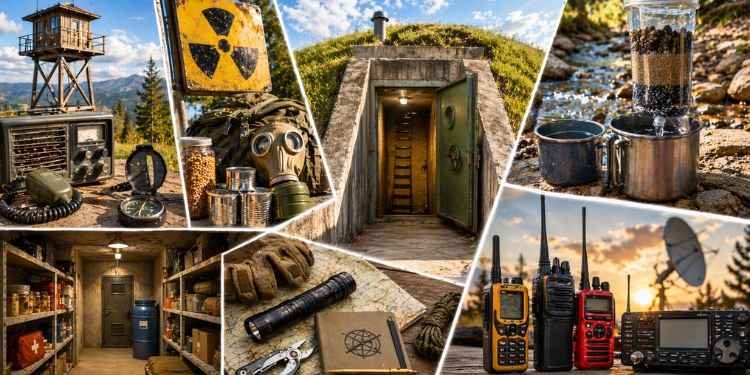

For about forty years, the United States and the Soviet Union spent an absurd amount of money preparing for the end of the world. Both sides built bunkers, stockpiled supplies, trained civilians, and developed survival protocols that most people today have completely forgotten about.
But here’s the thing – the scenarios they were preparing for sound a lot like what you are getting ready for right now. The triggers might be different, but the problems are the same.
The Cold War generated decades of real, government-funded survival research. Most of it gathered dust in declassified archives and forgotten civil defense manuals. Some of it is surprisingly practical, and almost none of it gets talked about anymore.
That changes now.
The Swiss Shelters
 When people think Cold War bunkers, they think of secret government facilities buried inside mountains. Fair enough, but the most impressive civilian shelter program didn’t come from the US or the Soviet Union. It came from Switzerland.
Starting in the 1960s, the Swiss government passed a law requiring every new residential building to include a nuclear fallout shelter.
By the early 2000s, Switzerland had enough shelter space for 114% of its entire population. More shelter spots than actual people.
These weren’t luxury bunkers, but simple concrete rooms built into basements, designed to be sealed and ventilated with hand-cranked air filtration systems.
The takeaway is that you don’t need a massive underground compound. What the Swiss proved is that a reinforced basement room with proper air filtration, sealed entry points, and stored supplies can protect a family from fallout.
After a similar model, I built my own root cellar – a simple, reinforced underground space that doubles as both food storage and emergency shelter. The book that walked me through it was Easy Cellar by Claude Davis. It follows a lot of the same Cold War design logic – proper ventilation, sealed entry points, practical builds with accessible materials.
If the Swiss proved anything, it’s that you don’t need a fortune or a military contract to build real protection. You just need the right guide and the willingness to do the work.
The Soviet Water Trick
Access to clean water was a top priority in Soviet civil defense planning, and for good reason. In any large-scale disaster, municipal water systems are among the first things to fail. The Soviets knew this and trained civilians on field water purification methods that didn’t rely on electricity or commercial filters.
One technique was a combination of boiling and soil filtration. The process used layers of sand, gravel, and charcoal packed into a container to create an improvised filter. Water would pass through the layers, which removed sediment and many contaminants, and then get boiled to kill biological pathogens.
How to Turn Air Into Water Using the Same Technology Dubai Bet Billions On
This isn’t some lost secret, but basic science. What’s worth noting is how seriously the Soviets drilled this into their civilian population. School children practiced building these filters, while factory workers ran through the procedures during civil defense drills. The idea was that if infrastructure collapsed overnight, ordinary people should be able to produce drinkable water by using materials found in any rubble pile.
Activated charcoal was the key component, and as you might already know, it can be made from hardwood burned in a low-oxygen environment.
How the US Government Planned to Feed 200 Million People
 In 1961, the Kennedy administration launched a massive civil defense initiative that included something called the Office of Civil Defense shelter provisioning program.
The goal was to stock public fallout shelters across the country with enough food and water to sustain the population for at least two weeks after a nuclear attack.
The food they chose tells you a lot about what actually works for long-term emergency storage. The shelters were stocked with a cracker called “bulgur wafers” and hard candy.
They had an extremely long shelf life, required no preparation, provided a reasonable caloric baseline, and could be stored in metal containers for years.
The program also stockpiled water in 17.5-gallon metal drums treated with preservatives to prevent bacterial growth during storage.
Most of those supplies sat in basements of schools, churches, and government buildings for decades. Some were discovered untouched in the 2000s, and testing showed that the sealed water containers were often still viable after 40+ years.
Of course, you don’t have to rush to buy bulgur wafers. But you should understand what the government learned when they were genuinely planning for the worst. Their approach boiled down to a few core principles:
- They planned for zero infrastructure – every single item had to be consumed bare-handed, straight from the container, by someone who might be injured, elderly, or a child.
- They deliberately chose a starvation-adjacent calorie target – the ration was roughly 700 calories per person per day. Research showed that a healthy adult can function for two weeks at that level without serious cognitive or physical decline.
- They rejected every food that needed rotation – canned goods, MREs, freeze-dried meals, all of these require inventory cycling. The government specifically chose foods that could be sealed once and forgotten for a decade or more. The bulgur wafers were designed to survive temperature swings from freezing basements to 120°F attics without degrading.
- They treated water as a sealed product. It water was chemically treated, sealed in steel, and considered done. You could do the same by installing this H20 system in your own backyard.
- Metal was king – the containers were metal because metal creates a true oxygen and moisture barrier that plastic and Mylar simply don’t over long timeframes. Plastic is permeable at the molecular level. Over 5, 10, 20 years, plastic slowly breathes, metal doesn’t.
- They deliberately eliminated choice – two items total. Bulgur wafers and hard candy. They knew that in a real crisis, simplicity is reliability. I haven’t tried the wafers recipe yet, but I made vitamin candy at home by following this recipe. It’s easy and you can make it on a Saturday afternoon.
The Communication System That Doesn’t Need the Internet
 During the Cold War, both superpowers invested heavily in communication systems that could survive a nuclear strike.
One of the solutions the US developed was CONELRAD (Control of Electromagnetic Radiation), later replaced by the Emergency Broadcast System. But on the civilian side, something more interesting happened.
Amateur radio, also known as ham radio, became a critical part of civil defense planning. The government actively recruited and trained ham radio operators through programs like RACES (Radio Amateur Civil Emergency Service), which was established in 1952.
The reasoning was simple. Ham radio operates on frequencies that don’t depend on cell towers, internet infrastructure, or satellites. A decent HF (high frequency) radio setup can communicate across hundreds or even thousands of miles using nothing but atmospheric skip propagation. Just a radio, an antenna, and a power source that can be as simple as a car battery or a small solar panel.
This is arguably the single most underrated prep in the modern prepper community. When the grid goes down and cell networks overload within hours (as they did during Hurricane Katrina and the 2003 Northeast blackout), ham radio still works. A basic license and used equipment can be found for under $100.
If you’re wondering how to get an amateur radio license or the PACE Plan for Emergency Communication, check out this link.
The KGB’s Gray Man Doctrine
This one comes from the intelligence world rather than civil defense, but it’s directly applicable to SHTF scenarios.
Soviet intelligence trained operatives in what’s sometimes called the “gray man” concept, although they didn’t use that term. The idea was to move through hostile or unstable environments without drawing attention. KGB field manuals emphasized blending with the local population in dress, behavior, pace of movement, and emotional expression. The goal was to be completely forgettable.
How to Become an Online Ninja (While Still Using the Internet)
The core principles were documented in training materials that have since been partially declassified and analyzed by Western intelligence historians.
They included things like never being the fastest or slowest person in a crowd, avoiding eye contact that lasts longer than what’s normal in the local culture, wearing clothing that matches the economic level of the area, carrying items that look ordinary for the context, and never displaying visible signs of preparedness or wealth.
The Dosimeter Strategy
 Radiation was the Cold War’s signature threat, and the US government distributed millions of dosimeters and survey meters to public shelters and civil defense offices across the country.
But the strategy behind how they used them is more interesting than the devices themselves.
Civil defense planners developed something called the “rate of decay” protocol. It was based on the “7-10 rule,” which states that for every sevenfold increase in time after a nuclear detonation, radiation intensity drops by a factor of ten.
So if radiation one hour after a blast is 1,000 roentgens per hour, after seven hours it drops to about 100, after 49 hours to about 10, and after two weeks to about 1.
The civil defense coordinators didn’t need sophisticated equipment to estimate when it was safe enough to leave shelter for supply runs, medical evacuations, or relocation. They needed a clock, a basic radiation reading, and this formula.
A basic civil defense dosimeter (CDV-700 or CDV-715 models from the Cold War era) can still be found at surplus stores and online, often for very little money, and many of them still work after being recalibrated.
Fallout Shelter Ventilation
The US Army Corps of Engineers published detailed specifications for shelter ventilation systems that could be operated manually. The standard was a minimum of 3 cubic feet of fresh air per minute per person, filtered through high-efficiency particulate filters. Hand-cranked blower systems were designed to maintain this airflow without any electricity.
5 Electricity-Free Ventilation Methods Used by the Amish
The engineering details are available in declassified documents like the “Shelter Design and Analysis” manuals published by the Office of Civil Defense in the 1960s. They include specifications for filter types, airflow calculations based on occupancy, and even instructions for improvised ventilation using commonly available materials.
And while we’re mining Cold War engineering, don’t sleep on ventilation. The US Army solved this problem decades ago:
- 3 cubic feet of fresh air per minute per person – that was the hard spec, not a guideline. It accounts for CO2 buildup, humidity, and body heat in enclosed spaces. The math is already done. Use it!
- Manual operation was the primary system, not the backup – hand-cranked blowers were the standard. They assumed power wouldn’t exist from the start.
- Filtration wasn’t optional – unfiltered airflow was considered worse than no ventilation, because you’d be pumping radiological dust into a sealed space full of people.
- The airflow specs scale to any group size – the manuals tell you exactly how to adjust ventilation, whether you’re sheltering 4 people or 40.
- They documented improvised builds from hardware store parts – they knew that most communities wouldn’t have military-grade equipment.
Cold War Thinking in a Modern World
The Cold War ended over three decades ago, but the survival problems it addressed haven’t gone away. Clean water, breathable air, secure shelter, reliable communication, food storage, situational awareness, and environmental hazard assessment are the same challenges you are working on right now.
But every one of those plans assumed the same thing: eventually, the lights come back on.
What if they don’t?
When the stockpile runs dry and there’s no resupply coming, you’re not a prepper anymore. You’re a pioneer. And pioneers didn’t survive on government manuals. They survived on knowledge that’s been passed down for generations – the same knowledge most of us have completely lost.
Dr. Nicole Apelian didn’t lose it. She spent years living with the San Bushmen in the Kalahari – one of the last tribes on Earth still living entirely off the land. She survived 57 days alone on Vancouver Island with a knife and what she knew about wild plants.
Then she put all of it into one book: the Wilderness Long-Term Survival Guide is the part of your prep plan that starts after the bunker runs empty.

Shelters that last years. Traps that catch game while you sleep. Wild plants turned into food, medicine, rope, salt. Fires that burn 14 hours without touching them. And how to become a gray man when other desperate people show up.
Cold War research gets you through the disaster. This book gets you through everything after. 👉 Get Your Copy Now!
You may also like:
 The Incident that Almost Ended America
How to Hide Your House from Google Maps (VIDEO)
CIA’s 10 Most Bizarre Survival Tricks You Need To Know
SHTF-Proof Food Secrets You Should Know Before It’s Too Late
The Secret U.S. Military Plan for Handling Civil Unrest
Read the full article here