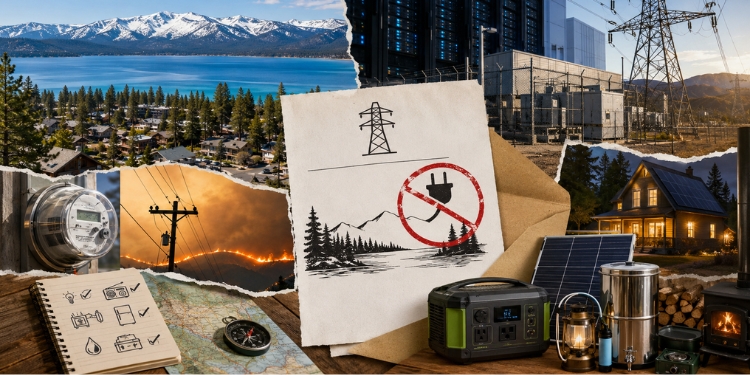

There’s a town on the California side of Lake Tahoe where people just got handed a letter that essentially said: “Sorry, your electricity is going somewhere more profitable. Good luck.”
Three-quarters of their entire power supply, gone by next May.
The reason? AI data centers in Nevada need that electricity more than the families who’ve been paying for it for decades. Google, Apple, and Microsoft are building so much computing capacity near Reno that NV Energy, the Nevada utility that’s fed the Tahoe basin for years, told the local provider it can’t keep up anymore. Liberty Utilities has until May 2027 to figure out where 49,000 customers are going to get their lights, heat, and water pumps from.
And here’s the thing that should make you sit up straight: the Government can’t fix it. The mayor wrote a letter. The Sierra Club wrote a letter. A nonprofit filed a formal protest. State commissioners are openly admitting they’re not even sure what they’re legally allowed to do.
If you’ve ever wondered what it actually looks like when the system you depend on stops working in your favor, this is it. A slow, paperwork-driven decision in some boardroom that rerouted the lifeblood of an entire mountain community.
The Way a Town Lost Its Power
Here’s the timeline, stripped to the bone:
- 2009: NV Energy sells its California assets to Liberty Utilities but agrees to keep selling them wholesale power. A handshake deal, basically.
- 2015, 2020, 2025: That arrangement gets extended three times. Each time, Liberty hasn’t found an independent supply yet.
- Late 2024: NV Energy’s own internal planning documents show that 75% of new major-project demand growth is coming from data centers. The writing is on the wall.
- 2025: Liberty asks California regulators for a 19.1% revenue increase. They get 11.4%. Electricity prices in the region have already gone up roughly 77% since late 2022, according to Bloomberg.
- May 2026: Word goes public. NV Energy is pulling the plug. May 2027 is the deadline.
Notice something? This was a planned, decade-long unwinding that almost nobody outside the utility offices was watching. And still, 49,000 people woke up one morning and realized they had twelve months to find a new power supply for an entire region.
“It’s Like We Don’t Exist”
 That’s what Danielle Hughes told Fortune. She lives on the north shore, runs a nonprofit called Tahoe Spark, and works as a supervisor inside the California Energy Commission’s Efficiency Division.
Meaning she’s not some random person yelling at a wall. She’s an energy professional who can read the filings, and she’s saying her own commission is asleep at the switch.
South Lake Tahoe Mayor Cody Bass sent a letter in April warning the California Public Utilities Commission that residents and businesses were panicking.
He used the phrase “great deal of concern.” Polite government language for “we are scared.”
The Sierra Club’s Tobi Tyler wrote her own letter saying any decision affecting 49,000 ratepayers in a high-wildfire region needs a full public proceeding, not a fast-tracked rubber stamp. Tahoe Spark filed a separate protest pointing out that California regulators don’t even produce a specific demand forecast for Liberty’s customers. Forty-nine thousand people, and the state hasn’t bothered to model what their grid actually needs.
The reason none of these letters has produced action is something every prepper should write on the inside of their bug-out bag:
There is no single agency in charge. Liberty answers to California regulators. The wires it uses belong to a Nevada utility. The wholesale power market is regulated by the federal government. The data centers pulling all the juice are getting permits from Nevada counties that don’t care about Tahoe.
Hughes said it plain: “They’re basically trying to decide what to do right now, or even what they legally can do.”
Let that sink in. The regulators are still figuring out whether they have legal authority to intervene, with twelve months on the clock.
They Knew This and Didn’t Care
Liberty Utilities and NV Energy already have a tool they use to shut off power to entire chunks of the basin. It’s called a Public Safety Power Shutoff, or PSPS. The state lets them de-energize whole communities when winds get high and fire risk spikes.
Last November, residents of Markleeville, Woodfords, Hope Valley, Topaz, Coleville, and Walker had their power cut for over 36 hours. The year before, the same towns got hit again. NV Energy has a parallel program for the Nevada side called Public Safety Outage Management. They give you 48 hours’ notice and then you’re on your own.
DIY Bicycle Generator – The Weekend Project You Don’t Want to Miss!
Now picture this: a power grid where the utility already has legal authority to cut you off whenever they decide conditions warrant it, and that same utility just lost three-quarters of its energy supply.
What happens when the new replacement contracts come in expensive and unstable? What happens during the first big heat wave or wildfire warning after May 2027?
What You Should Take Away From This
This isn’t a story about Lake Tahoe. It’s a story about every grid-connected community in America. Northern Virginia, central Texas, parts of Georgia, the Phoenix suburbs, Ohio’s Columbus corridor – wherever the data centers are landing, the same pressure is building.
They Don’t Care
And the Tahoe situation proves it in cold print. State commissioners admitted on the record they don’t know what they’re legally allowed to do. The mayor sent letters and got polite acknowledgments. The Sierra Club filed protests through the proper channels and got a procedural runaround.
If 49,000 California ratepayers in a famous mountain region, with media attention and three different advocacy groups working their case, can’t get the system to protect them in time, what do you think happens to a county of 12,000 in flyover country when the same crisis hits?
Before we go further – if you’re reading this and feeling that tightness in your chest, the one that says “I should have started this years ago” – there’s one thing I want you to see.
Tahoe didn’t lose its power to a storm. It lost it to AI. Every ChatGPT query, every Gemini search, every AI image someone generates for fun is draining a grid built for families. And the next wholesale contract on the chopping block could be the one feeding your town.
That’s why I want to recommend to you an eye-opening short documentary going around right now that lays out the whole thing – and it’s free to watch. Real footage. The data center sites. The substations getting rerouted. The internal forecasts showing exactly which regions are next on the list after Tahoe. The kind of footage you won’t see on CNN or Fox. They can’t afford to bite the hand that signs their ad checks.
Most of the people watching it finish the video and immediately check their last electric bill for the three warning signs the engineer flags in the first ten minutes.
You can watch it below:
 This is yet another proof that no agency, commission, or senator is coming to save us when the system fails. Just ask the thousands of Tahoe folks who asked for help and got nothing back. This is America in 2026.
Wholesale Decisions Beat Retail Promises Every Time
Liberty had a contract. That contract got extended four separate times over sixteen years. Then it didn’t. The wholesale supplier upstream of your local utility has more power over your daily life than your local utility does, and most people don’t even know who that supplier is.
Find out. Look up your utility’s annual report or integrated resource plan. Find the section labeled “power purchase agreements” or “wholesale supply.” See who’s actually generating the electricity that ends up at your meter. Then look at what’s growing in that region – data centers, crypto mines, industrial loads, EV factories. Your grid is being reshaped by buyers you’ll never meet.
I did this exercise myself three years ago, back when the data center boom was still a footnote. What I found in my utility’s filings stopped me cold – I wasn’t going to out-lobby Microsoft, so I built the only thing left: a household that needed less of what they were buying up. Eighteen months later my power bill was down by 80%, and it’s stayed there through two rate hikes that hammered everyone else on my block.
I wrote down exactly how I did it, step by step, right here.
Track Your Region’s Grid Stress Signals
You don’t need to be an energy economist. You just need to know where to look. Three signals will tell you when your area is heading for trouble:
- Rate increases above 10% in any 12-month window. Liberty’s customers saw a 77% jump in roughly three years. That’s not a glitch, that’s a warning siren.
- Public Safety Power Shutoffs becoming routine. If your utility starts running tabletop exercises and sending you 48-hour outage notices “as a precaution,” they’re telling you the grid can’t be trusted during stress.
- Major industrial load announcements within 200 miles of your home. Data center campuses, lithium plants, hydrogen facilities, anything that pulls hundreds of megawatts. Those projects don’t show up alone. They reshape the grid for everyone within their balancing zone.
Off-Grid Capability Has Stopped Being a Hobby
Five years ago, talking about solar panels and battery banks felt like prepper fringe stuff to your neighbors. Today it’s mainstream news. Electrek ran a piece this week directly tying the Tahoe story to the residential solar surge, saying out loud what we’ve been saying for years: distributed power isn’t a backup plan anymore, it’s the plan.
If you’re starting from scratch, the priority order matters:
- A solid backup heat source first. Wood stove, kerosene heater, propane unit you can run without grid electricity. In a Tahoe-style winter, this isn’t optional, it’s how you survive a week without lights. No backup heat in your house yet? Take this amazing course and learn how the Amish have done it for 300 years, without a power bill.
- Water independence second. If your local water district runs on grid power and their backup generators, like South Tahoe’s openly admits, you’re one extended outage from having no water. The Water Smart Box – a worldwide bestseller – solves this at the household level and gives you drinkable water on demand, regardless of what the grid is doing.
- Cooking and food preservation fourth. Propane camp stove, rocket stove, dutch oven over open fire, manual canning gear. Anything that doesn’t require electricity to feed your family. These 10 forgotten canning methods might be of great use one day, but also today.
Also, don’t underestimate the importance of solar with batteries. Even a modest setup – 2-4 panels, a small lithium battery bank, a quality inverter – keeps you running lights, charging phones, running a fridge in short cycles, and powering critical medical devices.
On the other hand, it’s important to know that the battery bank is the part that dies first, usually 3-5 years in, right when you need it most. Luckily, there’s a reconditioning method a former battery engineer shared online – brings dead and weakened batteries back to life in about 20 minutes, works on car, marine, solar, and laptop batteries alike. If you want to learn his method, visit his website here.
The Price of Turning the Lights Back On
 According to the latest reports, the Tahoe folks won’t freeze this winter. Liberty will scramble together a replacement contract from out-of-state suppliers, and the lights will mostly stay on. But this comes at a price.
Out-of-state power costs more – sometimes 30, 40, even 60% more – and every cent gets passed straight to the same 49,000 people the system just walked away from.
The trust is gone. The mayor and the energy commissioner admitted it on the record. Once you see how this machine actually works – who it serves, who it sacrifices – you can’t unsee it.
The Only One You Can Count On Is Yourself…
That’s the lesson Tahoe just paid 49,000 tuitions to learn. And it’s the same lesson I quit fighting years ago, the day I stopped trusting the grid to be there when my family needed it.
I sleep better now. Not because I’m paranoid, but because I built it that way, one piece at a time. And every piece on this list earned its spot in my house before I’d recommend it to yours:
- The Ultimate Off-Grid Generator is the first one I built. Tesla-inspired, runs off ambient energy with no fuel and no fumes. If you’ve never built anything more complicated than a birdhouse, this is your starting point – the blueprints walk you through it like you’re nine years old, and once it’s running, your power bill starts shrinking the first month.
- Ron’s Modular Backyard Generator is the one I tell my buddies about over coffee. Ron Melchiore has lived off-grid for over 40 years and built this thing to outlive every blackout he’s ever seen. Zero emissions, zero maintenance, no carbon monoxide nightmares. Once it’s up, it just runs.
- The Liberty Generator is the one that surprised me most. It’s a backyard biogas digester – runs on grass clippings, kitchen scraps, even animal waste. The stuff you throw out becomes the stuff that powers your house. When the gas lines wrap around the block at the Shell station, I’m not standing in them.
- The Home Power Shield, also known as a Pocket Generator, is based on flywheel technology, the same principle NASA uses for energy storage, scaled down for a regular guy with a garage. Portable, fits in your pocket and works in any weather, day or night. Mine’s been running for years and I almost forget it’s there. That’s the point.
- The Power Grid Generator is my backup to the backup. Thermal-energy DIY, around $150 all-in for parts and the guide. Because two is one and one is none, and the Tahoe folks just got a brutal lesson in what happens when you only have one source of power.
And then there’s the Blackout Protocol – the playbook that ties all of this together. Everything I wish someone had handed me ten years ago, in one place. The kind of book you read once and never throw out. Some nights I open it just to sleep better.
The letter came for 49,000 Americans this month. It’ll come for the next batch soon enough. When this lands in your mailbox, you want to be the one who laughs at it and walks back inside – because none of it can affect you.
You may also like:
 9 Out of 10 Americans Wouldn’t Survive This Type of Blackout
Why Your Backup Generator Will Fail You When SHTF (VIDEO)
What They’re Not Telling You About Wildfires
Read the full article here