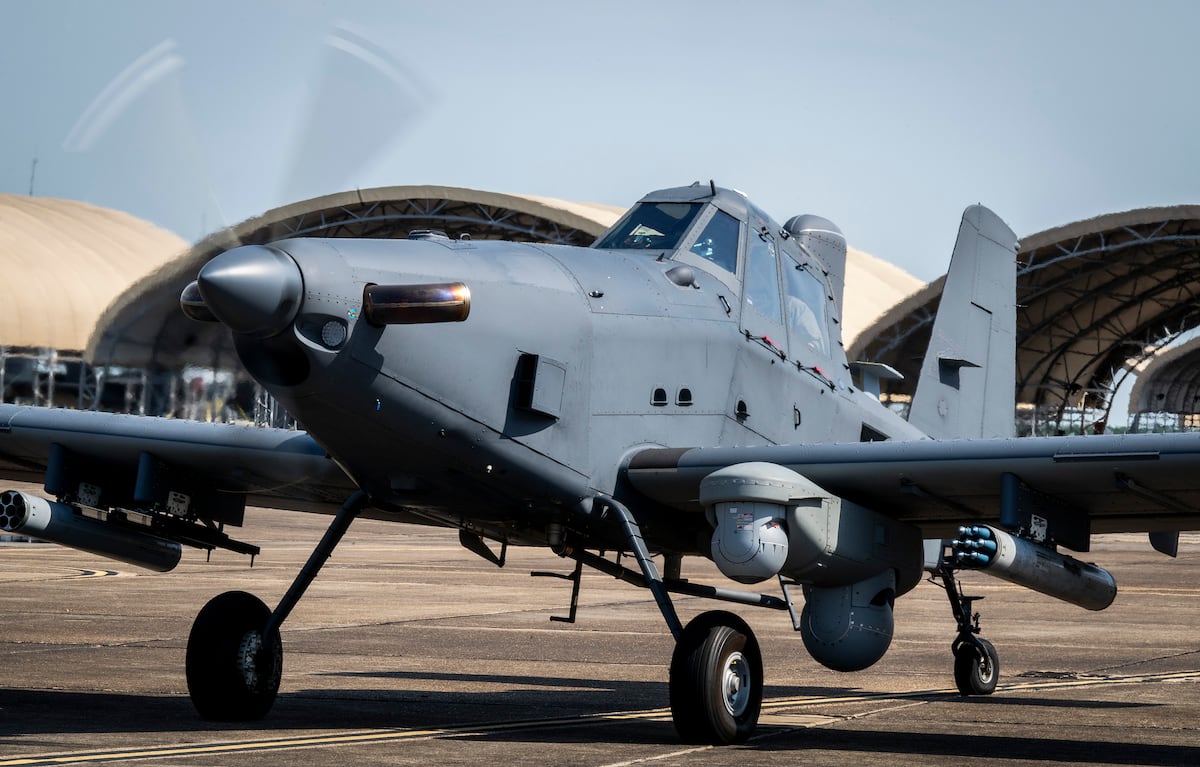

Air Force Special Operations Command is testing whether it can take its new Skyraider II apart, pack it inside a cargo jet and put it back together in the field, officials said this week at Special Operations Forces Week.
The single-engine, prop-driven OA-1K, a militarized version of the Air Tractor AT-802 crop duster, is built to give isolated special operations teams eyes overhead and firepower on call from rough dirt strips with little support.
“It is essentially a Swiss Army Knife of airborne capability,” Lt. Col. Robert Wilson, AFSOC’s armed overwatch requirements branch chief, told reporters.
“Rapid disassembly and reassembly means, in a matter of hours, the aircraft can be loaded into mobility aircraft like a C-5 or C-17 for worldwide deployment,” Wilson said in an AFSOC release. “With the OA-1K, ‘any place, any time, anywhere’ is not just a motto, but an actual capability.”
Lt. Gen. Mike Conley, AFSOC commander, added in the release that the OA-1K “offers a unique and modular solution for a wide range of operations, including armed overwatch, at a fraction of a cost of other platforms.”
The cost case rests on platform consolidation. A 2023 Government Accountability Office report noted SOCOM refers to the mix of close air support, strike and intelligence, surveillance and reconnaissance aircraft flown over a single special operations mission as “the stack.” AFSOC has pitched the modular Skyraider II as a cheaper airframe that can do the work of many.
The Air Force now flies 18 Skyraider IIs and expects “a handful more” by October, Wilson said.
The aircraft, named for the Vietnam-era A-1 Skyraider, currently operates out of Will Rogers Air National Guard Base, Oklahoma, and will eventually operate from Cannon Air Force Base, New Mexico, and Davis-Monthan Air Force Base, Arizona.
The program of record is 75 aircraft, but the Pentagon has cut the funded total to 53. The same GAO report found that SOCOM had not justified the 75-aircraft fleet and urged a slowdown.
The cuts align with a broader Pentagon shift toward a potential high-end fight with China, where a slow, low-flying turboprop with no ejection seat is a hard sell.
“The 75 quantity figure is the program record,” Wilson said. “I would say, as the capability sponsor, less than 75 is not desirable. We would like to see it at the program record of 75, but … just being pragmatic, obviously, with resource constraints that could potentially limit the program less than that.”
Read the full article here