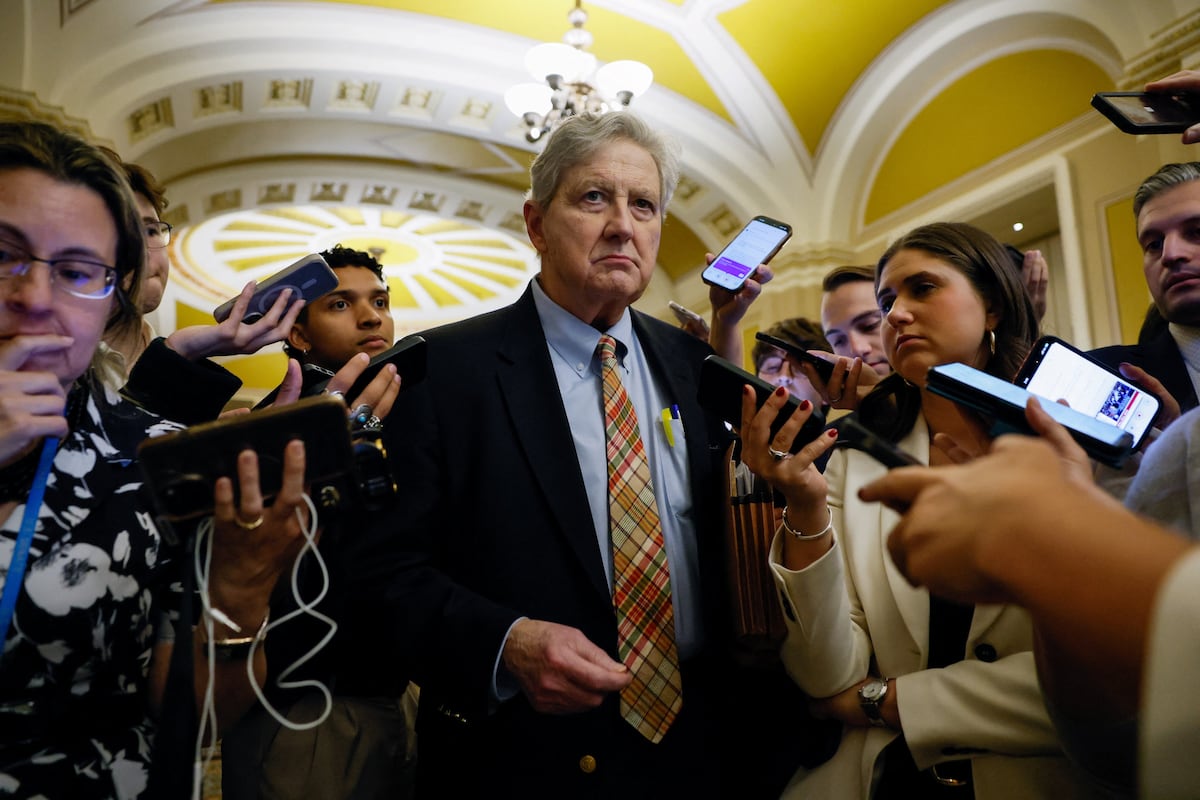

U.S. lawmakers across the aisle disagree about how much of a funding increase is necessary for the military during the next fiscal year, leading to at least one senator foreseeing another government shutdown.
As the Senate Armed Services Committee continues to work through its version of the National Defense Authorization Act for fiscal 2027, Sen. John Kennedy, R-La., said during a Tuesday hearing that America has a defense crisis, but Republicans and Democrats do not currently see eye to eye on the amount of funding required to mitigate the challenge.
During a Senate Committee on Appropriations hearing about the Department of the Air Force’s budget request, Kennedy said that President Donald Trump’s request for a 42% increase will be difficult to deliver. Currently, Republicans are weighing the possibility of a 20% to 27% increase for the defense budget, even though the lawmakers have not settled on a final number yet.
The president’s fiscal 2027 defense budget request is a historic $1.5 trillion that includes an increase in funding for each service branch, with the Air Force recommended to receive a 33.6% rise in appropriations.
Kennedy claimed that Democratic senators have said privately that instead, they wish to spend additional money on welfare.
The senator did not refer to a specific welfare service to which Democrats wish to allot additional money. Services could include child welfare, housing assistance or Supplemental Nutrition Assistance Program, or SNAP, benefits.
“Now they’re smart people, they know that we can’t do that, and we’re not going to do that,” Kennedy said during the hearing. “If nothing else, it would explode the deficit, and besides that, as they know, we don’t have a crisis in welfare like we have a crisis in defense.”
The Louisiana senator clarified that he is not against assisting the less fortunate but that he supports standing up to adversaries like China and North Korea.
“That tells me that the Democrats have no intention of helping us pass a budget, and I also predict, if I’m wrong, I will apologize, that my friend Senator [Chuck] Schumer is going to shut down government tight as Dick’s hatband first chance he gets before the midterms,” Kennedy said.
The government will be shut down eventually for a period of time until there is a continuing resolution, Kennedy asserted, saying that his Democratic “friends” want to “play politics” ahead of the midterms in November.
RELATED
In response to how a shutdown without a reconciliation bill or continuing resolution would effect the Air Force, Secretary of the Air Force Troy Meink said that it would significantly impact readiness.
“A lot of the investments we’ve just been talking about to meet the threats, from the unmanned vehicles as well as the increased readiness for weapon systems to increase that [F-35] readiness, as well as ammunition procurement, all that is substantially impacted if we stayed at $890 [billion] without a reconciliation or other mechanism,” Meink said at the hearing.
Meink was referring to the fiscal 2026 NDAA that authorized a budget of $890 billion for the Department of Defense, National Nuclear Security Agency and related agencies.
Kennedy said that he believes Meink should prepare for a possible shutdown.
“You’re going to hear a lot of happy talk from senators about how we need to spend more money on defense, but I think a lot of my colleagues have no intention of voting for a budget under any circumstances,” Kennedy said.
“They want [the] government to be shut down, and I think Senator Schumer is going to accommodate them,” he concluded.
During Trump’s second administration, there has been two government shutdowns, with a complete one lasting a record number of 43 days in 2025 and a partial shutdown of 76 days in 2026.
The House Armed Services Committee advanced its version of the fiscal 2027 NDAA last week. The measure includes a historic $1.15 trillion for the Defense Department after Democrats on the committee failed to reduce the amount authorized by $150 billion. The bill is expected to go to the full House for a vote in mid-July.
The Senate has not yet released its version to the public.
Cristina Stassis is a reporter covering stories surrounding the defense industry, national security, military/veteran affairs and more. She previously worked as an editorial fellow for Defense News in 2024 where she assisted the newsroom in breaking news across Sightline Media Group.
Read the full article here