Residents and airmen in the Washington, D.C., area will soon miss the familiar “whomp whomp” sound of UH-1N “Hueys” flying overhead as the aging aircraft depart Joint Base Andrews in the coming years.
The U.S. Air Force recently selected Andrews to receive 26 HH-60W Jolly Green IIs, an advanced combat search and rescue helicopter, to replace the base’s 26 aging medium utility Hueys. The new aircraft are expected to reach initial operational capability by 2029, with full operational capability by 2030.
In the meantime, the base will prepare for the additional aircraft through standing up the 5th Helicopter Squadron on Thursday as the first unit on base to receive the Jolly Green IIs. As part of the transition to the “Whiskey” mission, the base will gain 60 active-duty manpower positions.
By 2030, both the 1st Helicopter Squadron, the unit that operates the base’s Hueys, and the 5th will be flying the HH-60Ws full time, completing the mission, Katrina Cheesman, JBA 316th Wing public affairs chief, told Military Times on Monday.
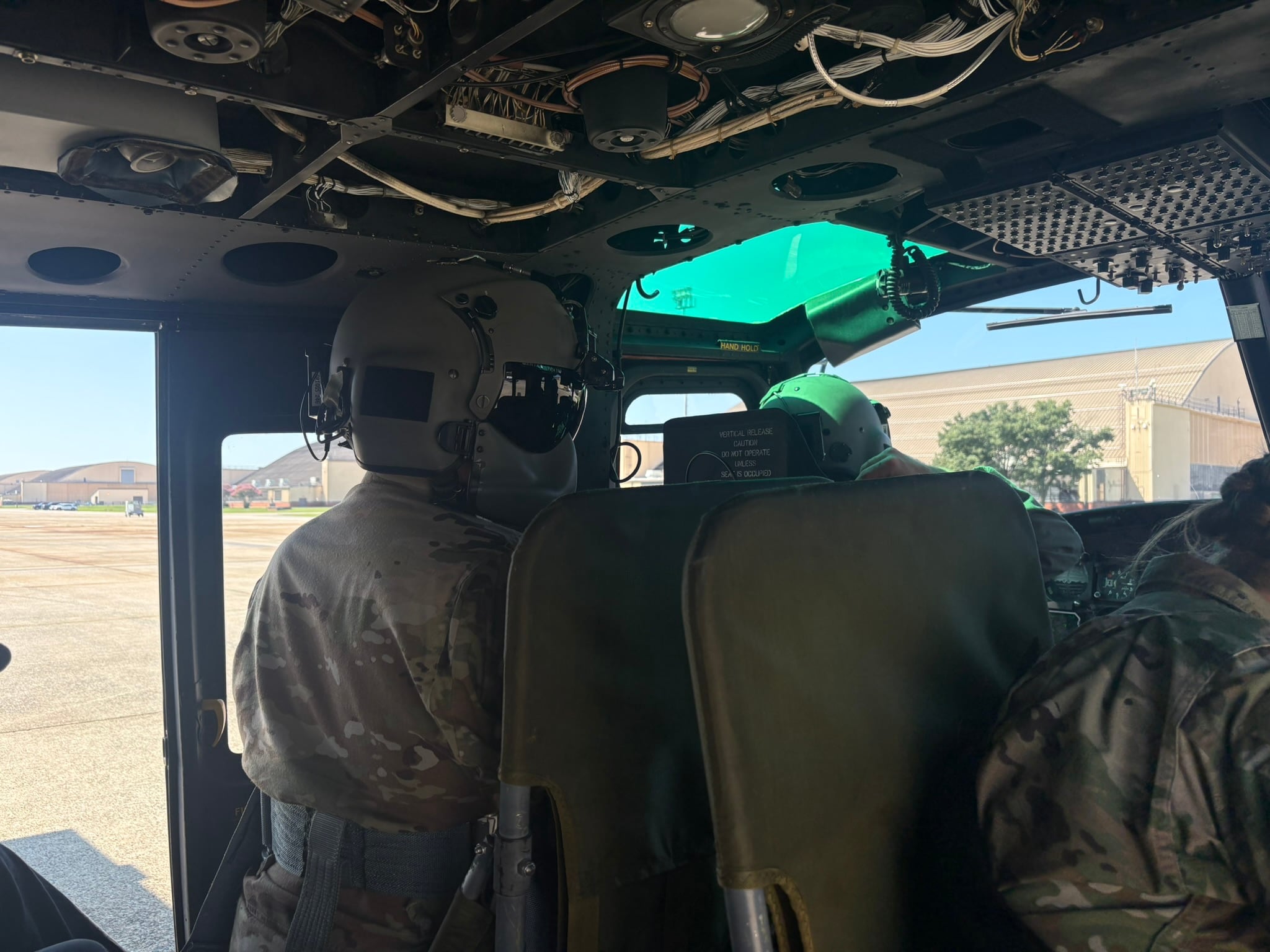
Ahead of the transition, Military Times had a chance to fly on a Huey during a media flight and speak with its crew to gain a sense of what this switch entails and what it means to them.
The 30-minute flight with three crew members took passengers from Andrews across the National Mall, northbound to Virginia, south toward Springfield and back toward the base, giving all a view of the Washington Monument, the Capitol and more from above.
Like cars, different makes and models bear similarities, lessening the learning curve for airmen, Lt. Col. Kristopher Schmautz, 1st Helicopter Squadron director of operations, told reporters after Monday’s flight.
The Jolly Green IIs are more modern, with updates involving their avionics systems and how the crew can operate the aircraft. Schmautz compares flying the Hueys to driving a 1970s Cadillac with its old gauges and demanding flight control systems.
The HH-60W has flight control systems that aid the pilot in operating the aircraft, prompting Schmautz to compare it to a Tesla. It has a four-axis autopilot system, allowing operators to focus more on the facets of the mission as the aircraft essentially flies itself.
The Huey’s Legacy
Schmautz said there are some mixed emotions regarding the transition from the Hueys to the Jolly Green IIs given the aircraft’s storied 60-year legacy. Several of the aircraft are from 1966, giving them 60 years of service dating back to the Vietnam War. Three of the Hueys at JBA still in service were actually flown in Vietnam.
JBA and its Hueys were some of the first aircraft to respond on 9/11, providing support to senior leaders after the Pentagon was struck and assisting with aid and medical evacuations in the area.
“They have seen decades of supporting missions both here and overseas, so from that it is the end of an era,” Schmautz said. “The aircraft are very visible. People hear the sound from miles off, and they know that’s a Huey.”
Given the aircraft’s unique two-blade structure, the sound profile is distinct. With four blades, the HH-60Ws will offer a sound profile change, possibly leading residents to believe there are fewer aircraft flying nearby because it will be quieter.
“For our generation that served in Vietnam, some of them, it stops them in their tracks because they remember that sound,” Schmautz continued. “It’s so noticeable, and to be part of a crew that has gotten to fly this storied aircraft it’s something I never could have imagined when I first enlisted 24 years ago.”
The transition to the Jolly Green IIs offers “great excitement” for the crew, given the aircraft’s increased payload capacity, maximum airspeed and mission range. The Jolly Green IIs will be able to carry 11 passengers as opposed to the Hueys’ ability to carry nine.
The Transition
The 1st will continue to fly the Hueys until it converts to the Whiskey mission. All airmen in the 5th will be dual-qualified on the aircraft and currently fly the Hueys. They will begin the transition to the Jolly Green IIs first.
Even though some details still need to be ironed out, Schmautz said that it will be a “slow transition” as the 1st will hold down the mission while the 5th works to be able to take on part of it. The two squadrons will work together to transfer different pieces of the mission, allowing members of the 1st to transition to the new aircraft.
“Day to day, it’ll be a balancing act as we figure out the exact dynamics of how fast and how we go ahead and convert the crews from one squadron or from one aircraft to the other,” Schmautz said.
Master Sgt. John Griggs, a 1st Helicopter Squadron flight engineer and senior enlisted leader of the 5th Helicopter Squadron, said that the switch is a big change in the right direction since the newer airframe will provide better capabilities and features, including a glass cockpit, allowing crews to execute the mission more effectively.
For Griggs, the transition hits close to home.
“Ever since I’ve been in aviation for about a decade, this is the only aircraft that I’ve known and operated,” Griggs said. “So it’s a little bittersweet to move from something I have such a tenure with and such a legacy across all the conflicts, but I am excited to learn something new.”
In response to a question regarding the Hueys’ age, Griggs said that the helicopter is still as effective as it’s always been at an operational level, and he’s never had worries about its ability to complete its mission.
But the larger aspect is sustainment, and even the best aircraft can’t last forever. He said the base is approaching a point in the 60-year-old aircraft’s operations where they are beginning to run into that detail.
“It’s very humbling to be able to see what this helicopter has done for the Air Force, and to be a part of transitioning to a newer airframe to uphold the same mission,” Griggs said.
“This is my favorite aircraft in the Air Force,” he said. “Lots of good memories on it. Lots of time, but it is time for something new, something with better modernization to be more effective in the area.”
Cristina Stassis is a reporter covering stories surrounding the defense industry, national security, military/veteran affairs and more. She previously worked as an editorial fellow for Defense News in 2024 where she assisted the newsroom in breaking news across Sightline Media Group.
Read the full article here