
STANDING ON a brushy knoll, looking meaner and madder by the minute, loomed the biggest black bear I’d ever seen in the Maine woods. He was searching for the rotting cow’s head he had hidden among some rocks, and he wasn’t pleased over its absence.
When I walked into the area earlier in the day, armed with a 60-pound bow and a quiver of broadhead arrows, I noticed that the cow’s head had been moved from the pile of bait near my tree stand to the top of the hill. So, using a heavy branch as a pry bar, I had rolled it back down the slope to its former location. Now the bear was looking for it, and his angry grunts seemed to say, “Who took it?” Suddenly he spotted it. Charging down, he grabbed the head in his jaws as if it weighed no more than a stick of chewing gum and scrambled back up the hill. It all happened so fast that I hardly had time to draw the bow back and let drive hastily with one arrow. It slammed into a branch, and the bear, unscathed, disappeared over the top of the knoll.
This encounter took place in the spring of 1963 and was the sixteenth time I had seen bear in the Maine woods.
These meetings had ranged from close-up views with chances for a bow-and-arrow shot, such as this one, to fleeting glimpses at dusk or at great distances.
For the past seven years I’ve been a writer in the advertising department of Atlas Supply Company in Springfield, New Jersey. I’m 40, married, and the father of three children—Jon, Jenny, and Linda. Fortunately for me, my wife Nancy understands my love of hunting. I’ve done a lot of bowhunting for deer and small game, and I had made nine spring hunts for bear with bowhunting groups outfitted out of Patten, Maine. The first eight had been outfitted by Art Sharpe and the ninth by Harold D. Smith. These were exciting trips, and they’d been productive for some of the others, though not for me.
I helped Harold Hill of Newton, New Jersey, find the first of his arrow-killed bears in 1957 and helped him drag out his second two years later. I was also along on the trip in 1961 when three bears were downed in three days, each with a single arrow. Two were taken by Baltimore hunters Boyd Engle and Harold Schmidt.
The third, and largest of the three, was bagged by my hunting partner of that year, Charlie Kronyak of Carlstadt, New Jersey. His bear, with a score of 17 5/8, currently ranks No. 52 in the North American Big Game Competition of the Pope and Young Club. But, so far, I’d drawn a blank.
And now, for a while, it looked as though I’d had my last chance in Maine. The wilderness territory lying north of Baxter Park—one of the best areas in the state for bowhunting—was fast becoming inaccessible to vehicular travel.
The difficulty began in 1960 when an old log-and-plank bridge over Webster Brook collapsed and floated away in the spring floods. With it went our access to a vast primitive area north of Grand Lake Matagamon. The next year spring-thaw waters washed away the rock and gravel footings of another log bridge some six or seven miles to the southeast, this one across Trout Brook. Charlie Kronyak, outfitter Art Sharpe, myself, and others managed to replace the footings that year after the high waters receded, but ours was only a delaying action. By 1963 the Trout Brook bridge was washed downstream, and vehicular entry to bear country came to an end. That was disheartening enough,
but in 1966 the situation was further complicated by new state legislation closing the season on bear from January 1 to June 1. Until 1957 black bears had a $15 bounty on their heads. In that year, however, bounties were lifted statewide, and in 1966 the black bear became a game animal protected by law. In prior years of no closed season, bowmen hunted the spring period, April and May. They tried to be the first into the woods after ice-out, before fishing, rifle hunting, or camping activity made the bears overly cautious and before they shifted from a meat to a plant diet.
A 1964 biological study of bears’ stomach contents revealed a consumption of insects and animal matter totaling 33 percent from April to June 15, but merely four percent from June 15 to September 15. So a June start for bear hunting might well coincide with the animal’s switch to a vegetable diet because of the plentiful, more widely distributed food supply.
Hunting bears over bait had developed as the best method for bow-and-arrow hunting. Bears could be effectively attracted to an area that was selected to meet bowhunting requirements, where the bowman constructed a tree stand or camouflaged blind to cover his movements. This system produced a remarkable frequency of bear sightings, but it required large quantities of slaughterhouse remnants for bait, as much as 100 gallons per stand each week.
The biggest disadvantage of this method was the constant hunting pressure at every bait, which made the bears overly cautious. They frequently darted in and out, offering difficult bow-and-arrow shots, or they remained out of sight entirely during the daylight hours, appearing, to our dismay, only after dark.
The archer needs a close shot at a bear—under 35 yards—if the chances of hitting are to be in his favor. He’s shooting at a small target—10 inches across—vital organs only. There is no bone-crushing shock to help him, only hemorrhage. He tries to avoid risky head, shoulder, rump, or neck hits. He wants a broadside or slightly angled shot. Ideally, he wants a still or slowly moving target, for the odds mount against him as the speed of the game increases.
Operating under the additional handicap of a changed season, would archers be able to get close enough to the bears again? I didn’t know the answer to this question, and I didn’t know whether to switch my 10-year search for bruin to another method or another state. Then the fired-up enthusiasm of two friends early last year helped me overcome my uncertainties.
One of these friends is Jack Howard, 40, who is manager of the tire department at Atlas Supply. A veteran gunner with several deer and an upper-peninsula Michigan bear to his credit, he had just tried his first bow-and-arrow hunting in New Jersey, and he was hooked.
The other friend, my Somerset neighbor, George Wilson, 31, who is an agent for the Prudential Insurance Company of America, had already bagged a buck with bow and arrow. Despite my pessimistic comments about the growing obstacles, both Jack and George insisted they wanted to try some Maine bear hunting with the bow. And Jack Howard Jr., 15, when he heard his father’s plans, made it known that he didn’t want to be left home. So it was decided. We should start off at the end of June, just as soon as school classes were over in Westfield, New Jersey, where the Howards live.
During midwinter planning sessions we established some basic objectives for ourselves.
First, we would hold expenses to the minimum. As it turned out, we managed to average less than $75 per man. This included $35.50 for a hunting-and-fishing license, $2 for bear bait, $8 for transportation, $15 for food, and $14.50 for sundry expenses.
Second, this would be a do-it-yourself project without frills. We’d all done our share of batting around in the woods, and because of my familiarity with the area we could dispense with guide service. Also we would camp out and avoid the cost of lodging or trailer rental.
Third, despite the missing bridges, we were determined to get back into the remote Trout Brook area away from traveled roads and people. We hoped that after a four-year suspension of hunting and baiting in the back country, the place would be fairly crawling with bears.
Our original plan was to drive as far as Trout Brook, then ford or float the stream and set up camp somewhere on the other side. But state authorities advised us that camping is not allowed there. The only permissible site is all the way out to Webster Brook. So it was there or nowhere.
We considered the possibility of having ourselves flown in but decided against it to keep down costs. This meant we would have to pack our supplies in all the way. And in addition to the usual camping gear, we would have to pack in our rather cumbersome bow-and-arrow equipment, fishing tackle, and bear bait.
Recognizing the need for bait of maximum drawing power and minimum bulk, we started collecting, bagging, and freezing smoked bacon rind. While this might not provide bear with a main course, we hoped it would draw them like children to candy. Before we were done, we were on a first-name basis with every pork store and rendering outlet in North Jersey. We planned to supplement our bait with any trash fish we could catch.
We would need at least 40 to 60 pounds of bait, but how were we going to carry it together with the rest of our gear? We were still wrestling with that problem when a Texan came to our rescue. One day Jack Howard’s younger brother, Dale, 38, a tax accountant in Fort Worth, telephoned.
“I just can’t stand thinking about you Yankees wandering around the wilderness all by yourselves,” he said. “I guess I’d better come along to keep an eye on you.”
Dale’s welcome contribution to the hunt, besides an endless assortment of hilarious campfire jokes, were his pickup camper and his 14-foot aluminum boat with trailer and 10-horsepower motor. We also took along a surplus life raft to tow additional duffel that wouldn’t fit into the boat.
To practice for his first bow-and-arrow hunt, veteran rifleman Dale shot 100 arrows a day for several weeks, an ambitious pace even for a practiced archer with calloused string fingers. He removed the bandages just in time to start his drive to New Jersey where he was to pick us up.
Finally the great day arrived. Dale had navigated his pickup camper and trailer some 1,500 miles to New Jersey without incident, but the addition of four hunters and their camping gear caused several minor mishaps on the way north. The trailer-hitch emergency chain came loose and dragged on the road, the forward camper window was accidentally broken, and a bracket holding one boat-trailer fender split in half en route.
“Maybe if we have all our bad luck now,” Dale suggested, “it’ll mean good luck on the hunt.”
Early Saturday morning we passed the seaplane landing at Shin Pond on the Baxter Park road. At Eastern Landing on the southern end of Grand Lake Matagamon we parked the truck, slid the boat and raft into the water, and loaded up with five men and a veritable mountain of gear.
The water phase of the trip through the lake was brutally slow because of our overloaded condition and the unknowns of strange waters and an uncertain course. The Matagamon Lake, viewed from the air, appears as a number of narrowly connected lakes with many complex fingers, false coves, and islands of all shapes and sizes.
We fouled the propeller once or twice on lake grass while we tried to find the devious S-shaped channel that would lead us from the lake to the spot where the East Branch of the Penobscot River and Webster Brook converge. But then, suddenly, I saw a familiar sight, the crumbled ruins of the old bridge.
“There it is!” I shouted, pointing. “Our campsite is just a short distance up Webster Brook.”
Within minutes our boat grounded on the shore of the evergreen-bordered clearing that was to be our wilderness home for the next seven days.
The primary camp rule was immediately established with the declaration that the first guy to gripe about the cooking would inherit the job. Everything was delicious.
We spent the first day trying to locate some of the old blinds and tree stands for several miles on both sides of Webster Brook. The past few years of uninhibited forest growth had covered the area so completely, however, that we found only two former stands with any degree of certainty. The others we had to build from scratch, merely approximating the site of earlier blinds near the old bear trails. With a precious five days in which to attract the quarry, one of our first jobs was to divide and strategically place our supply of bacon rind. While we were doing so, we came across fresh droppings in two localities, a most encouraging sign.
The days that followed were busy, and some of the most pleasant we’d ever spent—fishing early in the day, batting the breeze over campfire coffee, enjoying the comforting glow of red embers after the evening supper, listening to a loon splashing far off in the lake, and on one occasion seeing a bull moose striding across a meadow.
Mornings were taken up with camp duties, and later we fished, roamed the woods, and shot practice arrows at stumps and darting red squirrels. During our frequent fishing trips we caught plenty of perch and chubs, but trout and other gamefish seemed nonexistent. In a pothole off Webster Brook, young Jack found a real wilderness style whirlpool bath. And one evening, after spotting bobcat or lynx droppings, we readied our bows and tried some varmint calling—thrilling though unsuccessful.
From midafternoon to dusk, each man was at his bait, hopefully, quietly watching and waiting. It was difficult to sit quietly because of the swarms of blackflies and midges that attacked at dusk. I don’t know what effect the scent of insect repellent has upon bears, but I do know that a man can hardly endure life in the Maine woods at this time of year without some kind of fly dope.
Busy days have a way of flying. Before we realized it, we were past midweek without any sign of bear at the stands. Not one of the baits had been touched. On Thursday morning we heard the scraping of canoe paddles and scattered war whoops around the bend.
“It’s an Abnaki war party!” Dale warned hoarsely. “Nock arrows and prepare to defend your scalps.”
But, instead of Indian warriors, there shortly appeared six bronzed boys on a four-week canoe trip with their guide—a group that Jack Jr. enthusiastically joined, although he still kept watch at his bait each afternoon. So taken were the boys by the beauty of the spot that they decided to share it with us for a few days of canoe-pole practice, log riding, white-water racing, and general frolicking around the woods. Uninhibited teen-age enthusiasm is refreshing to see, but we did wonder what effect humans rampaging through the area from morning till night would have on the bear hunting.
The afternoon watch on Thursday ran its course with nobody’s seeing a bear. No bait had been touched or even approached. We were drawing a complete blank. Whether because of human activity or bear inactivity, things didn’t look promising, and we came to a decision. Jack Howard put it into words.
“Let’s make tomorrow the last day of hunting,” he suggested, “and get away first thing Saturday morning.”
“We might as well,” George Wilson agreed. “We’ve had a lot of fun, but I guess the bears aren’t going to cooperate.”
And so on Friday afternoon, a little earlier than usual, I hiked to my favorite bear stand for my last fling. The stand was in a wooded grotto that was formed by rocky knolls on two sides covered by a dense roof of evergreen branches that admitted no sunlight. It was dark even at midday. The floor of the miniature valley was a bowhunter’s dream, a clearing cluttered only with light brush and some blown-down trees, strewn about like counters in a game of giant jack straws.
I followed the same route as always, walking in from the tote road, giving the bait a wide berth to avoid leaving more of a scent trail than was absolutely necessary. My stand, constructed in a sloping tree, was one of the old hideouts, still intact. Six times in this very spot in the early 1960’s, I’d had exciting meetings with bears, culminating in the encounter with the biggest bruin of all, the one that came charging down the hill to grab the cow-head bait in 1963.
I walked up the leaning tree, hooked the quiver over a branch, and took my position on a triangle of short planks several yards above the ground. From my perch I inspected the area for sign.
A patch of woods never looks exactly the same twice. The wind, foliage, sunlight and shadows, or even an overnight rain can produce subtle differences.
One thing caught my attention. I’d deposited the bacon-rind strips in several neat little piles on the ground, tied some strips higher up in trees, spiked a couple of fish to twigs, and wedged an open jar of honey in the crotch of a stump. Neither the fish, the honey, nor the tied-up rind had been touched, but one of the mounds of rind looked strangely flattened.
“Darned if that pile doesn’t look as though a bear sat his big fat rump smack down in the middle of it,” I told myself. Once I saw a bear sit right on top of his dinner that way. Could another have done the same thing, or was this wishful thinking?
As the afternoon moved on, I had plenty of time to debate the appearance of that little mound of rind. Was it or wasn’t it? Could I trust my recollection of its appearance? Could it be that in the heat of the sun the bacon had just slithered down flat of its own accord? I couldn’t be sure. My imagination worked overtime.
About 40 yards away down a woods trail leading from the bait, I thought I saw a patch of light brown, perhaps a square of rind dropped there by a departing bear—or perhaps just one pressed patch of winter leaves in a spotlight of sun. I strained my eyes, but I couldn’t tell for certain.
Many times I fought off the inclination to climb down for a closer look but convinced myself that shuffling through dry leaves or creating foot scent on the ground wouldn’t help my cause. So I just sat tight, my thoughts becoming more pessimistic with every passing hour, 6 o’clock . . . 6:30 . . . 7:40 . . . 8:20 . . . The sun dipped lower into the treetops as I checked my watch.
“Only fifteen or twenty minutes more,” I thought. “Then I might as well give it all up for another year.”
One fiberglass arrow was on the bowstring, held to the arrow rest by a flexible plastic tab; another was stuck loosely in a knothole of the tree. The rest were in the quiver. I started to pick up the arrow in the knothole, and then I was snapped alert by the slight cracking of twigs, hardly audible at first. Something was moving toward me from the direction of the road.
“Perhaps it’s Dale,” I thought, “coming from another stand to walk back to camp with me.”
As the sound continued, I was certain it was something large, either a man, a bear, a moose, or a deer. More and more I imagined that it sounded the way a bear might sound when he’s neither crashing nor sneaking through brush, but moving in a lazy, unconcerned way, swaying from side to side, and pausing between steps.
Then I saw it, at first just a blur of something black in the underbrush, but unmistakably a bear. Nothing in nature, neither shadows, burnt stumps, nor rocks, quite duplicates the velvet-black of a black bear. It was coming in, following nearly the same route I had taken in getting to my tree. Would it smell my tracks?
It looked larger and rounder the closer it came, cautiously step by step right toward the base of my tree. It paused only a yard from the trunk, and I could almost feel it staring up at me with beady eyes. This would be an awkward angle for a shot, so I froze, scarcely breathing, waiting.
The bear moved past the tree into obscuring brush and then turned at right angles toward the clearing and the squashed pile of bait below me. Inch by inch I swung the bow and drew back the string, ready for the moment the bear entered the clearing. And when it took the next slow steps I released the arrow, practically without realizing I had done so.
The steel broadhead hit slightly behind the neck, clearing the backbone to the right side. The bear sprawled in its tracks, rolling over on its back, clawing wildly at the arrow, half growling, half bawling. I knew it was hit hard. My only thought now was to end things quickly, to be sure that this bear would not get away.
The second arrow—the one from the knothole—was already on the string, and I released it instinctively, almost unaware of the nocking-drawing-releasing motions. I quickly shot three more arrows from the quiver. All sounds stopped. The bear had rolled farther into the cover of brush and the rapidly enveloping darkness.
The stillness was absolute when I climbed down from the tree and peered across the lower end of the clearing, trying to spot the bear. Resisting an impulse to claim immediately the trophy of 10 years of bear hunting, I decided not to poke around before I was certain the bear was dead.
So in my half-dazed state of joyous excitement I hurried back to camp intending to mount a full-scale expedition of men, lights, ropes, and dressing knives. Supper was nearly ready when I arrived with my news. Of course no one believed me when I first told them, for we had joked about this happening so many times before.
“Who do you think you’re kidding?” George Wilson demanded.
“The spaghetti’s ready,” Jack added. “Sit down and eat.”
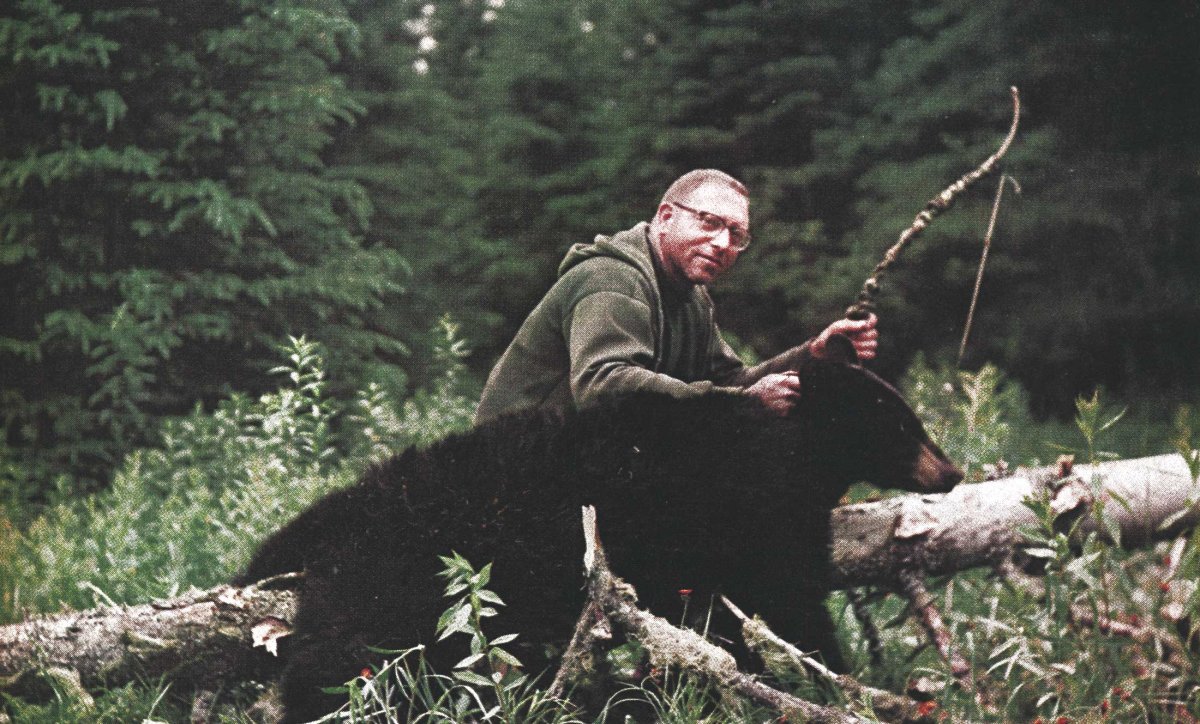
I had to repeat my story several times before I could convince them. Then pandemonium broke loose. The entire camp turned out to follow me back to the scene of the action. The bear lay dead at the edge of the clearing, and all that remained was the arduous job of woods-dressing it, lashing it to a pole, and lugging it a mile back to camp. The teen-age boys, who had come along, eagerly vied for turns at carrying the bear pole, two pairs of shoulders at either end, back to Webster Brook. There we hung the bear up to cool. It was a female, three or four years old, live weight about 200 pounds.
“Well, we’ve finally got a bear in camp,” Dale said, “and the last night of the trip. It’s a storybook ending to a wonderful week.”
I hardly slept all night, reliving the climax of this hunt at least a thousand times. The next morning, Saturday, July 2, after having breakfast and taking pictures, we broke camp and started for home. With the bear lashed to the bow of the boat, we held a slow but steady course down the lake, and for me it was a triumphal progress, the culmination of 10 long years of waiting for my first bow-and-arrow bear.
This story was originally published in the July 1967 issue of Outdoor Life.
Read the full article here