
FRED THORNE and I stood on a Newfoundland hillside glassing a pine and spruce-covered valley. Fred called the place The Lookout.
A small bull moose was feeding below us in sparse cover. He was in plain sight 600 yards away, and I’d been watching him for five minutes through my Empire 7 x 50 binoculars. Fred knew I wasn’t interested in stalking the animal, but I was getting a kick out of watching the bull feed.
That all changed with Fred’s startled whisper. You can tell when Fred is excited, he always begins his statement with a special form of address.
“My son,” he said, “two giant bull moose are on the hillside above us. You can take your pick if we can get close to them.”
Fred pointed toward the animals, but I couldn’t see anything that faintly resembled a moose. It was a dark day and it was drizzling, and that whole mountainside was a puzzle of muddy green and brown. Then I picked out two black spots near a marsh-grass bog 1,000 yards away.
I lifted my binoculars and focused. The two bulls were side by side, standing and looking down into the valley. Even in the dim light, I could see the heavy beams of their antlers and the serried points. It was a sight I’d dreamed of for years.
“There’s my bull—either one of them,” I told Fred. “They’ll spot us if we try going straight up,” Fred cautioned. “We’ll have to go back in the brush and around the mountain till we get behind them. Then we’ll work through the timber to the lower end of that bog. Let’s hustle. We’ll have to make a couple miles.” It’s impossible to hike fast in that part of Newfoundland. Thick spruce branches are constant obstacles, and tangles of berry bushes make the going tough. Much of the area has been logged, and lumbermen’s slashings complicate the maze of ground cover and windfalls. I’m only 32 and in good condition, but I was hard pressed to keep up with my 38-year-old guide, who seemed to ghost through that jungle as quick as a deer.
We stayed in thick cover all the way. It took two hours to reach our destination. When we neared the edge of a spruce thicket, Fred motioned me to move ahead. Those two bulls shouldn’t be more than 100 yards away. I’d slip the rifle through the last of the branches and nail one.
Then the dream ended. I saw part of the bog first, then all of it, and finally the whole mountainside. There wasn’t a moose in sight.
“That’s moose hunting,” Fred said matter-of-factly. “They’re unpredictable critters, but I had a hunch those two old boys would stay put. They must have heard us.”
I had never shot a moose, and I should have been disappointed. Strangely, I wasn’t. I’d seen many moose in the last few days, and I’d seen some fair bulls. From a trophy standpoint, those two bulls had given me my best opportunity, but I reasoned that I’d get another chance.
“Fred,” I said, “I’ve come quite a long way to hunt moose and caribou. From what I’ve seen so far, I guess I can get a moose almost any time. I’m not so sure about a caribou, and I want a good one. I’ve only got four days left. Let’s forget about moose and get on with the caribou hunt.”
That may sound crazy, but, as it turned out, I was making the right decision.
I’m a heavy-equipment operator in Janesville, Wisconsin, where I live with my wife Norma Jean and our two boys and three girls. I was born on a nearby farm, smack in the middle of top squirrel, rabbit, and pheasant country. In those days, my brother didn’t care much for hunting, and my dad couldn’t spare the time. I had all that game to myself, but I had to learn how to hunt the hard way. On my 10th birthday my dad bought me a new .22 rifle, and it seemed as though he had bought me heaven on earth.
I killed my first Wisconsin whitetail with a 16-gauge slug when I was 14. Since then, I’ve taken 13 more, and two of those bucks were 12-pointers.
In 1953 I made my first out-of-state hunting trip—to Wyoming for mule deer and antelope. That kind of hunting really opened my eyes, and I went back for nine straight years. I became trophy conscious, and I soon determined that I would shoot a representative head of every big-game species I could afford to pursue.
In 1963 I hunted elk in Montana and was fortunate enough to take a fine 12-point bull. The next year, I shot a wild boar on a hunting preserve in Indiana. My oldest son, who was 10 then, went with me on that trip, and he killed a boar too. I was mighty proud.
My 1965 hunt grew out of a family visit to the West Coast. I’d read an Outdoor Life story about hunting Spanish goats on Catalina Island off the southern coast of California. I made a reservation to hunt on the island and bagged a regular brown-coat billy and a rare silvertip.
That trip to Catalina was actually only a substitute for a hunt I’d set my heart on. I’d planned on going to Newfoundland. That hunt began when I read another story in Outdoor Life—”Ox Hunt For Moose,” September 1964. The story dealt with a Newfoundland moose hunt, but it also mentioned caribou. If a man could hunt moose and caribou in the same area, I reasoned, he could add two animals to his list at once. I was especially excited about the thought of bagging a caribou, but I estimated how much a trip like that would cost and decided to wait awhile.
My lucky break came in October 1965. Maynard Peck, a 56-year-old Janesville taxidermist, started the ball rolling.
“Bob,” he said to me over the phone, “four Rockford, Illinois, hunters were just in here with moose heads they want mounted. They got them with bows and arrows in Newfoundland. They recommended an outfitter named Harry Newhook. I’m going to check it out.” Maynard called Harry in February of 1966. He found out that nonresident caribou licenses would cost $100 each and that they would be issued on a first-come, first-served basis to a limited number. Moose licenses were also limited and were priced at $75.
Harry suggested we apply for our licenses immediately. He said he could book six hunters for a week in September at $150 a man. That would include everything except sleeping bags and personal gear.
The price was too good to pass up, so we began preparations for the trip. Besides Maynard and myself, our group included Bob Bartell, 31; Larry Kettle, 28; Gary Huber, 33; and Dr. Don Springer. Don is a 42-year-old surgeon from Monroe, Wisconsin. The rest of us are from Janesville. Bob and Larry are both single and work at the local Chevrolet assembly plant. Gary heads a family, like Maynard and myself, and makes his living as a stock chaser at a Fisher Body plant.
In a way, we were a strange group. Maynard limits his hunting to archery. He’s a crack rifle shot, and proves it by winning trophies in statewide target competitions, but he thinks taking game with a rifle is too easy. His bow-and-arrow kill to date includes 30 deer, five antelope, two bears, a wild boar, dozens of pheasants, and hundreds of rabbits.
Gary Huber is an archer too, but he isn’t a purist. He spends most of his time on a hunt with archery tackle, but if his time is running out, he makes an attempt with his .30/06 Winchester Model 70. The rest of us are riflemen.
We spent the summer ironing out details. Don and I could spare only a week, so we decided to make the trip by plane. The rest of the group scheduled a two-week trip in Larry’s pickup camper. We built a 6 x 12-foot box trailer in which to haul meat home. We lined it with plastic to seal out road dust and fitted it with a snapdown canvas cover. By early fall, we were ready to roll.
The boys in the pickup pulled out of Janesville on September 7. Don and I boarded a jet in Chicago three days later, and we were in a hotel room in Gander, Newfoundland, 7½ hours later. My plane fare was $218, round trip.
We met our outfitter the next morning. Harry Newhook, 48, is a Newfoundlander who has never been off the island. His main occupation is guiding hunters, but he works as a carpenter during the off season. His cousin, John Newhook, and the other guide, Fred Thorne, were scheduled to meet the rest of our group in Millertown, a small village 135 miles from Gander. All of us would rendezvous there and then drive another 50 miles to Harry’s camp, where we would stay in an old logging-company cabin.
Newfoundland roads are a far cry from superhighways, and we had plenty of time to discuss our hunt during the ride. Harry told us that killing a bull moose with a rifle would be no problem at all. “Caribou come harder,” he added. “They’re up on the muskeg plateaus, and they’re tough to stalk.”
That kind of talk interested me. I’d read a lot about caribou, and I wanted one badly. I could go moose hunting within 700 miles of home, but I might never get another chance at caribou. I was joking when I told Harry, “I want a double-shovel rack with about forty points. Something like that would be a real trophy.”
Harry’s answer was surprising. He wasn’t kidding a bit when he said, “You can get a double-shovel rack where we’ll hunt. A few are taken every year, but they’re scarce, and thirty points is about the best you can expect.”
The last few miles of our journey to camp took the rest of the day. A logging company owns all the surrounding property, and there’s only one way in and one way out. That’s by tramway across the company’s dam on the Red Indian River.
Two railroad flatcars powered by a small diesel locomotive carry cars and equipment over 800 feet of track. Each flatcar has space for two vehicles. You drive up a loading ramp onto a flatcar and stay in your car during the trip with your foot pushing against the brake to hold your vehicle in position.
When you reach the other side of the river, the flatcars are backed up to an unloading ramp. You back your car down the ramp and continue on your way.
You must show your car insurance in order to make the crossing, and logging-company employees check it before allowing you to do so. You can’t hurry the train. The tramway is open to others only when there is a break in company business. We waited four hours to make the 10-minute trip. Across the river, there are only dirt roads and rocky tracks used in logging operations. We arrived at Harry’s camp after driving 45 miles on a trail that snaked its way through wilderness.
We rolled out of our sleeping bags at 4:30 next morning. Outside, drizzle and a 40° temperature promised a dreary day. By 5:30 Bob Bartell, John Newhook, and I were deep in the bush. For Bob and myself, it was tough going the first couple of hours. We had to learn how to walk in the tangled brush and dense evergreens. Most of the time, we couldn’t see 20 yards ahead, but then we’d break out on a point or a ridge and glass the countryside for miles around. That was the way we hunted—hike and glass new country for moose. At about 8 o’clock we spotted a small bull and a cow on a hillside 700 yards below us.
“Forget him,” John said. “We’ll find better racks.”
That afternoon, we spotted a bigger bull, but not big enough to interest either Bob or me. John guessed his antler spread at a little better than 30 inches. Everybody in the group saw bulls that day, but nobody fired a shot. Harry and Maynard stalked to within point-blank arrow range of a bull with antlers wider than 30 inches, but Maynard decided he’d take his chances on something better. All of us had the same thought.
The next morning dawned bright and clear. Fred guided Bob and myself. We hadn’t walked 200 feet from the road when we came out on a hillside vantage point. A big valley spread out 1,000 yards below us. We began glassing the terrain and we spotted game within minutes.
“There we go,” Fred said. “That’s a good bull. Look him over.”
Fred pointed to an open hillside near the bottom of the valley.
“There’s a cow with him,” he added. “They’re moving this way, toward that marsh-grass flat. Let’s just sit down and see if they keep coming.”
We watched those animals for 10 minutes. They kept feeding toward us, moving slowly. I guessed the antler spread of the bull at over 45 inches.
“Good guess,” Fred said. “He’s a big one, and we’ll get him. When they get into the brush, we’ll sneak down there and . . . My son, my son, look right here below us!”
I looked straight down the hillside. Two bull moose were in plain sight, no more than 75 yards away, and they were completely unaware of us. At first glance, they appeared huge, but a second look told me that the best bull’s antlers were in the 40-inch class.
“It’s up to you, Bob,” I whispered. “Take him if you want him.”
Bob answered by raising his scoped .300 Weatherby Magnum. The rifle roared, and the moose went down in his tracks. We caped out the head, field-dressed the animal, and spent the rest of the day hauling moose meat.
Next morning, Fred and I encountered the two big bulls I described at the start of this story. By then I’d passed up three moose and had come within a whisker of getting a shot at a good one. You can see why I didn’t think bagging a moose would be much of a problem, and why I wanted to get on with the caribou hunt.
Back in camp at noon we all discussed the situation, and my partners agreed with me. We loaded Larry’s pickup with sleeping bags, cooking gear, and a few days’ supply of food. With four-wheel drive, we managed to go a mile up the mountain on a long-abandoned logging road. From there, it was a four-mile, uphill hike to our destination, a 14 x 16 outpost cabin that Harry had built a few weeks before on the edge of plateau country.
We were nearly up to tundra altitude when John Newhook turned to me and made a suggestion.
“Let’s drop our packs right here,” he said, “and hunt awhile. There’s some valleys and ridges off to our left. It’s all top game country.”
What started out to be a short hike turned into a cross-country expedition. After we glassed a valley, we’d move on to the next ridge. Finally, John mentioned that we were running out of time.
“Let’s take one last look over that next ridge,” I said, “and then go back.” We went down into a cut full of thick brush and then scrambled up a piney hogback. When we topped out, we were looking into a relatively open, broad valley. A forest fire had swept that valley years before, and the blackened trunks of pines, still standing, contrasted sharply with the green ground cover. A river wound through the bottom of the valley, and rocky knolls showed white and gray.
I caught a flash of movement before I raised my binoculars. I didn’t say anything, because I had seen gray and white, and I thought my eyes might be playing tricks. When I found the moving object with my glasses, I couldn’t say anything.
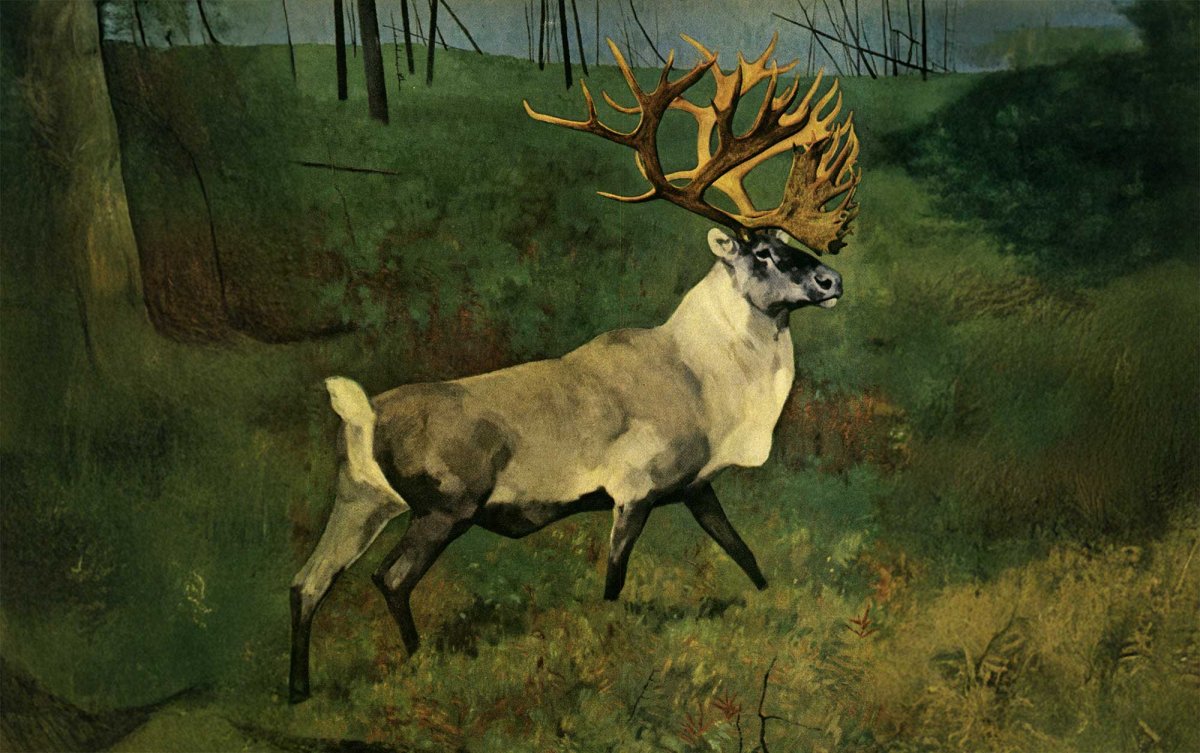
I’d never seen a caribou before. I knew their antlers had great beams and many points, but the animal I was looking at didn’t seem real. The caribou was 200 yards below us, broadside, and he seemed to be mostly antlers. The enormous brown rack thrust points out in just about every direction.
Finally I stammered, “Caribou down there!”
“Rock,” John answered. “It fooled me for a minute too.”
John’s answer was enough to bring my breath back.
“Rock, hell,” I whispered. “That’s a bull caribou, and he’s big as a barn!”
Then John looked in the right spot. “Shoot!” he said.
I had already leveled my Model 721 Remington .300 Magnum. The crosshairs of the 8X Weaver scope wavered but then settled on the bull’s shoulder. I touched the trigger, and the 180-grain factory-loaded bullet was on its way. I was sure my aim had been true, but the caribou reacted to the roar of rifle as though untouched. He bolted to our right and ran flat out. I remembered to lead him with the second shot, but he never missed a step.
“Slow down,” John yelled. “Take your time. You’re missing him!”
I knew I hadn’t missed that first shot, and I didn’t think I had missed the second one. I held for the same place and fired again. This time the animal piled up as if he’d been sledged. He never moved a muscle after he hit the ground.
We didn’t go down there right away. We wanted to be sure he was dead. Once we started down through the brush, we would lose sight of the animal.
Suddenly there was more excitement. Another bull caribou walked into view from behind a knoll within 75 feet of my trophy. He stopped dead still and stared in our direction. We watched him for a few minutes, but then John yelled and clapped his hands. The heavy-antlered bull bolted and disappeared behind a knoll. We never saw him again.
We went down the hill through a jungle of brush, windfalls, and rocks. I thought I was moving fast, but John ran right away from me. He got to the caribou, lifted the antlers, and began yelling.
“This is the biggest thing I’ve ever seen,” he said. “Isn’t this something though! Isn’t this something!”
John kept on saying that over and over. I was so excited I didn’t know what to say. We finally calmed down enough to discover that all three of my bullets had slammed into the heart area. We took some pictures and then hiked toward the outpost cabin for help.
When we got there, I told Harry I had my caribou.
“Fine—is it a good bull?” he asked.
“He has fifty-two points,” I answered. “We counted them three times to make sure.”
Harry fixed me with a stare.
“Fifty-two points!” he echoed. “There ain’t no such a thing. They don’t have that many.”
John verified the count, but Harry still wasn’t convinced.
“Let’s go look at that animal,” he said.
Everybody made the three-mile hike, and there was a lot of handshaking and picture taking. Harry couldn’t take his eyes off my trophy.
“I’ve seen thousands of caribou,” he exclaimed. “I’ve seen many of the best heads ever killed in Newfoundland. But I’ve never seen anything like this one. I think you have a world record.”
As far as I was concerned, my hunt was over. I was too excited to think about moose hunting. By the next day, however, I began to calm down. I still had three days to hunt. Fred and I went down to the main camp while the rest of our group stayed up in caribou country.
The following morning was clear as a bell, the temperature was in the high 40’s, and I got a look at a trophy bull moose. We’d hunted most of the day without sighting game. Late in the afternoon, we walked into a valley and glassed the hillside above us. The sun had dropped behind the ridge, making it difficult to inspect the shadowed timber, but Fred caught a flash of movement.
“My son!” he exclaimed. “There’s one as big as a mountain!”
The bull moose was standing in the brush 900 yards away, alternately grazing and lifting his head to inspect his surroundings. The hillside was so dark that it was hard to see his body, but whenever he threw his head up, I saw the mass of brown antlers with no trouble at all. That was a tremendous rack, 50 inches or so, by far the best I’d seen yet.
If it had been earlier in the day, we could have made a proper stalk. As it was, daylight was fading fast, and Fred decided on a shortcut. We went down a hill, across a creek, through a valley, and up another hillside. We sneaked around a knoll and looked for the bull. He was in sight, but he had grazed in the wrong direction. Fred figured our cause was lost.
Though the range was long, I knew I could drop the bull if I could put a bullet in the right spot.
“Fred,” I said, “this is a big rifle with an 8X scope. I think I can kill him.”
“Try if you want to. We can’t get any closer.”
My rifle was sighted in for 250 yards. I held well over the bull’s shoulder and fired. The big animal wheeled and disappeared into nearby brush. I knew I’d missed, but we walked over and examined the spot where the bull had stood. The distance wasn’t as great as I’d figured. I’d held too high, and the bullet had gone over his back.
The next day we passed up some small bulls. After that, I had one day left. I knew I couldn’t be choosy any longer.
On the last afternoon, Fred and I saw a young bull bed down in a small valley. I sneaked down there and was wondering what had happened to the animal when he jumped up and bolted. I dropped him with one shot in the heart area.
Everybody in our group killed a moose and a caribou, except Dr. Springer and Bob Bartell. Bob was only interested in moose. He didn’t apply for a caribou license, but he got his moose. Dr. Springer had killed trophy moose on other hunts, so he confined himself to dropping a caribou.
Maynard dropped his bull caribou with a single 700-grain fiberglass arrow from a 55-pound Bear bow. Gary Huber, using a 55-pound Ben Pearson bow, whanged an arrow into the heart of a trophy caribou. That one bolted 20 yards, then piled up dead. Careful measurements indicate Gary’s trophy will score 310 points in the current Pope and Young Club competition. At this writing, that’s good enough to rank fourth in the all-time archery records for woodland caribou, and the rack should also qualify for listing by the Boone and Crockett Club.
Read Next: Barren Ground Caribou Hunts Are Disappearing — or Getting Outrageously Expensive
I had my giant caribou scored by two official measurers of the Boone and Crockett Club. Their individual scores came out 2/8 of a point apart. The lowest total score was 407 6/8 points. I won’t know my official standing in the Boone and Crockett Club record book until that score is verified after the current competition closes on December 31.
The present world-record woodland caribou scored 419 5/8 points. That animal was killed before 1910 by an unknown hunter. If my score is confirmed by the Boone and Crockett Club panel of judges, my trophy will rank No. 2 in the record book. More than that, it will be the best woodland caribou ever taken by a known hunter. When I remember that I killed the giant only a few hours away from New York City by plane, I realize that almost nothing is impossible in the exciting sport of trophy hunting.
This story was originally published in the July 1967 issue of Outdoor Life.
Read the full article here