
IT WAS UNLIKE any eve before deer season I had ever known. We were camped above 11,000 feet, and that was certainly a novelty. It was August 27 of last summer— that’s right, August. But here’s the topper. As I sat in camp with my back against a big spruce and binoculars to my eyes, I saw three elk walk out onto a knob above the lake and stand there looking around. Presently, they walked in single file toward a mountain meadow, and two more cows appeared on the knob. Sure, they were nearly a mile away. But watch game from camp? This was new to me in the United States and a wonderful experience.
“As long as you’re up, get me a cup of tea with a splash of whisky in it,” I said to my wife Pris. I didn’t want to quit watching those elk.
“If we can see spooky game like elk from camp,” I said later to Harry Crow, our packer, “there ought to be deer up here too.”
“You’d better believe it,” he answered.
Harry was dipping fresh-caught native trout in batter for supper and his enthusiasm was high. So was ours. I had ridden in here the day before with him and my family, Pris and my son Steve, in the hope of sampling some good mountain fishing and deer hunting.
The results of a successful joust with the trout were about to go into the frying pan, and tomorrow was the date that Steve and I had been anticipating since spring. It would be August 28, opening day of what Colorado calls its “quality deer hunting.” For bucks only, this special season ended on September 19 last year and, together with similar affairs in California and Alaska, provided the earliest deer hunting in the 50 states.
Colorado had three areas open in 1965, all on national forest land in high, rugged country in the southcentral part of the state. Taken from the top, they were West Elk, in the wild area of that name about 18 miles west of Gunnison; La Garita, spanning the Continental Divide roughly 10 miles north of Creede; and San Juan, largest of all, embracing the upper Rio Grande and San Juan primitive areas about 30 miles north of Vallecito Reservoir and 15 miles north of Bayfield.
We were in the San Juan area. We’d ridden in some 23 miles from Mickey Craig’s Wilderness Trails Ranch on the Pine River just above Vallecito Reservoir, an ideal entrance point, and mostly followed the river until we turned west to tiny Elk Lake.
A hobbled horse went clump, clump outside the tent as we lay in warm sleeping bags. Somewhere in the distance, a packmule’s bell tinkled.
“Do you think we’ll see many?” Steve asked drowsily.
“I hope we’ll be able to look over some good bucks.”
This was to be Steve’s first deer hunt, and I knew that in his imagination there’d be a buck on every peak and a few feeding on steep slopes. In fact, I had a few staked out in my own mind, not one with less than four towering points, Western count. But big-game hunts seldom turn out as you expect them to, and this was to be no exception.
I’ve often wondered how many deer watched us as we rode through the high country that day, keeping just below the crest of the Continental Divide most of the time. Harry Crow was in the lead along with Darrell Newton, a Ute Indian whose home was at Ignacio, some 40 miles to the southwest. Harry had hunted and fished in this area before and knew it well, and Darrell had herded sheep up here and was intimate with every draw, basin, and wooded pocket.
Every now and then we’d pass the site of an old sheep camp of Darrell’s, usually at the edge of some high meadow, and I’d watch him reminisce with Harry. What makes this part of the country ideal for sheep and deer is that timberline goes to 11,000 feet and a bit beyond, and only a few peaks are more than 1,000 feet higher. Often the ridges are no more than 200 feet above the firs and spruces. So the game has plenty of vantage points only a short dash from concealment and good protection against the sudden storms which are common along the Divide.
It was a pleasure to be riding. The scenery was staggering, and for once I wasn’t so out of breath from climbing that I couldn’t enjoy it fully. Many of the protected slopes above timberline gleamed with long drifts of old snow, giving the illusion that we were on a fall hunt.
“Did you really expect to see a buck down there?” Steve asked, as we poked our heads over some rimrock and looked downward. “Right out in the open?”
Steve, who had turned 14 three days earlier, has a lively curiosity about hunting and guns. We have fished together for more than half his life, but lately shooting had begun to fascinate him. Steve had graduated from a .22 rimfire for targets and supervised plinking to his first centerfire rifle, a .222 Remington with which we had made several memorable woodchuck hunts. Now he was out with his first big-game rifle, a .30/06, on his first deer hunt.
We’d tethered the horses and gone to the edge of a great basin for maybe the fifth time that morning. I’d first look immediately below, then use binoculars to scan the bottom, the far side, and finally the opposite ledges and high benches.
“Someday you’re going to peek down into a pocket like that one and see a buck bedded down,” I said.
“Did you ever find a bedded buck?” Steve asked.
“Well, no.”
“Then how come all this pussyfooting around and looking over ledges? Why don’t we just ride down the slope and keep our eyes open?”
I explained that other hunters had found deer this way. And besides, there is a considerable advantage to being above the game because it seldom looks up.
“One day Ted Trueblood was hunting by himself and stopped on a high bench to have lunch,” I went on. “There was some low brush straight down the hill about 30 or 40 yards. He finished lunch, and though he’d made no particular attempt to be quiet he decided to toss a rock into that brush below. A big buck bounced out and went steaming downhill. Ted nailed it when it paused a moment on the flat below.”
A gleam came into Steve’s eyes. “You mean I can throw rocks down there?” he asked. “Yes.”
Steve grabbed a rock and whanged it into some brush.
“Try that patch over there,” I suggested. He did, and though no deer appeared, I could see that the day held more promise for Steve.
As we remounted I gave him a final piece of advice: “Always take a good look around before throwing a rock. A buck lying down is a lot easier to hit than one running scared.”
By lunchtime we’d ridden perhaps eight or 10 miles, looked over a big chunk of country, but had not seen a head of game. Harry Crow began unpacking the saddle bags for lunch. He is the only happy packer I’ve met. Even when he’s soaking wet and the mules have run off into the timber, Harry can manage a grin.
“We didn’t get away early enough this morning,” he said. “But we’ll see a buck for sure this afternoon. It’s almost impossible to ride all day up here without seeing game.”
Steve ate moodily and was obviously disappointed. “Have you seen many deer walking around below you?” he asked me at last.
“Oh sure,” I replied. “On that last hunt in the Idaho high country a couple of years ago it was nothing to see a few deer moving in the timber every time we stopped to rest. Once you see a deer first, particularly when it’s below, you have a tremendous advantage.” “Should I always be looking down then?”
“No. A buck could just as well be on the same level or even above you. Harry and Darrell are watching ahead and above as we ride, you’ll notice. But when we dismount and ease over to some rim, everybody looks down because sooner or later this is going to pay off.” On an impulse, I dug out the Colorado Game, Fish and Parks Department area map and handed it to Steve because there was something in the short text I knew he’d take in. “This special hunt for buck deer only was set up to give the sportsman a chance to bag one of those large timberline bucks which are seen in the high country wilderness areas during the early fall,” it stated, “but which are seldom found during the regular big-game season later on.”
“That’s us,” I said. “Trophy hunters.”
We rode into a glorious afternoon. Suddenly we were twisting in our saddles to see what was making the drumbeat of hoofs. Elk. Surprised cows were plunging upward in nearby timber.
When we finally topped out half an hour later, Darrell pointed urgently up at a rocky escarpment. I saw an animal move and grabbed my binoculars. What a buck! It was as red as a fox, as mule deer often are in their summer coats. The branching antlers in full velvet seemed as thick as baseball bats.
The buck was at least 600 yards away, moving at a brisk walk. Plainly he had spotted us. We were all in such a state of astonishment that no one thought of taking a shot, which no doubt was just as well. In a short time, the buck walked behind some big rocks and disappeared. We spent the rest of the afternoon trying to find the animal again in boulder-strewn canyons. Stars were beginning to show by the time we returned to camp.
Saddle weary, we took our rifles off the horses and went to our tent. I fired up the sheepherder stove and we all flopped on our sleeping bags.
“Meanwhile, back at the ranch, hot baths,” Steve said wistfully.
The living was easy at Wilderness Trails. There were guest cottages, and at the ranch house there were unusual facilities for children—separate dining room, a huge playroom with a pool table and such so youngsters and grownups didn’t have to mix unless they had a mind to. And later, when snow moved the elk down out of the mountains, hunters could easily fill on the ranch grounds.
But this was a very different situation. It looked as if our shots would be long ones and maybe hurried. Still, I wasn’t too worried. If a boy can bust chucks with his big-game rifle at 200 yards, he ought to be able to kill a buck at 300 or so.
We awoke to the drum of rain on canvas and gratefully slept in. There was sleet and some hail when we had a late breakfast at the cook tent. A vigorous wind boiled clouds in constant procession over the mountaintops. Typical Continental Divide weather.
During a lull I noticed a flicker of movement in a big rockpile about 100 yards from our tent and went over to investigate. I took my camera along. It was a pika or “rock rabbit.” He was so busy cutting greens that he let me approach to within 15 feet. Pikas are usually mighty spooky. They are the bane of sheep hunters because they’ll whistle piercingly at the approach of someone. I once had a pika ruin a stalk I was making on a bighorn ram.
This one concentrated on food. He’d cut a big leaf, grab it by the butt, and hurry off, skipping from boulder to boulder until he disappeared under a ledge. Then back he’d come for more. I know he must have seen me and I wondered if his urgency foretold a long spell of bad weather. But it cleared by midafternoon.
I went to the tent for my rifle and announced I was going to walk back of camp and hunt for a deer. Steve looked up. He was wearing every scrap of clothing he had in camp, though it wasn’t really cold, and reading a book. “Got to kill this.” He waved the book.
Pris and I interested Darrell in our project and we climbed the ridge beyond the cook tent, following him along a trail until we came to the upper end of a huge canyon. I’d guess we were less than a mile from camp when we stopped on a rocky outcrop to look.
“Good place for big bucks,” Darrell said.
We started to look. The canyon widened to give a view of a spectacular reach of the Rockies, the slopes green and mist-hung in the late-afternoon sun. Our side of the canyon was nearly precipitous and gave onto small grassy patches among tall spruces.
We sat at 11,000 feet waiting for a mule-deer buck to make a mistake on the day after the season opened. All we needed was a little luck, for everything else was in our favor—elevation, the light breeze in our faces, clear weather after a storm, the lateness of the day.
I swept the far slopes again with my binoculars. Nothing. Then I looked into the bottom on our side. The little parklike openings were empty. Darrell borrowed the glasses and scoured the canyon. Then he did something I’ve kicked myself a thousand times since for not having done myself. He crawled forward on hands and knees to the rim and peeked straight down. Instantly he withdrew a little, and when he turned he had a big grin on his face.
I snatched off my hat and eased to the edge. I slowly poked my head over and saw a buck lying on a lush green ledge no more than 45 yards away. He was looking below, swinging his head back and forth slowly. I counted six points on one side, and the other side matched it.
Pris handed me the .257 Roberts. It took an age to put a cartridge quietly into the chamber. Then I inched forward on the seat of my pants, desperately hoping the buck was still there. When I saw him again, I was struck by the strange silhouette a deer makes when seen from almost straight above. The neck seemed barely four inches across, and it was in constant movement as the buck scanned the terrain below.
I decided to shoot at the base of an ear, and I raised the rifle. Darrell tugged at my pants and pointed at the muzzle which, unseen in the scope, was in line with the edge of our rock. I shifted my position.
In the scope, I found where the right ear stopped when the buck glanced to the right. I steadied the crosshairs there. A moment later the ear appeared again, and I shot. The buck slumped.
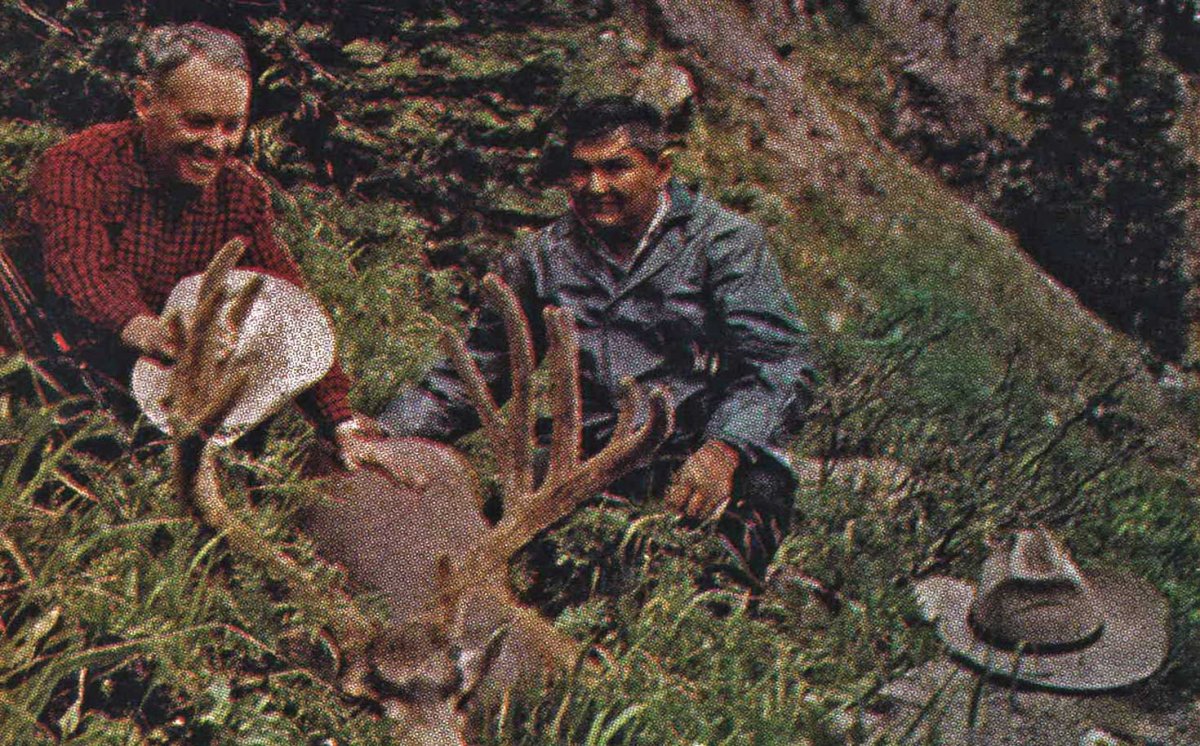
It had happened so quickly we could hardly believe our good fortune. It took 10 minutes to find a safe way down to the buck. It was a handsome six-pointer still in velvet, and there were only traces of its gray winter coat showing beneath the long, reddish-brown hairs of summer.
“You’ll never shoot a better-eating deer,” Darrell said as we struggled to hang the dressed carcass from a limb. We were to agree with this later. Meanwhile, we clawed up the slope with the liver and were soon in camp.
At this point, you may be wondering what a trip like ours costs. A nonresident Colorado big-game license punched for deer, with tag attached, is $40, and a boy must be 14 or over to take out such a license. If we got shut out on this hunt, which is open to all comers, the licenses would still be good for regular-season hunts. If both of us filled, we could take another deer apiece in the regular season on payment of $7.50 each for a second license with a tag. Wilderness Trails charges $30 a day per person for parties of three or less on summer packtrips. The rate for four or more is $25 a day.
You may also wonder which way of hunting high country for deer is best—riding around or sitting in a likely area. Harry Crow told me he thinks it’s a toss-up and cited his experiences with Mickey Craig. The two had ridden up from Wilderness Trails to our campsite and hunted only with horses, ranging far each day. They saw nine deer the first day. The next day, they jumped two bucks among some rocks and Mickey took a shot at one but missed. The third day produced another pair of bucks which got up from their beds near a saddle in late afternoon. These deer stood still long enough for Mickey to pile off his horse and nail one with a long shot.
Probably the fickle weather of approaching fall, especially in areas near the Continental Divide, will determine how a man must hunt from day to day. That’s how it was with us. We left camp early next morning with horses and a pack mule, expecting to get my buck back to camp in a couple of hours, after which we planned another horseback hunt to new country for Steve. But the deal took all morning because the country proved hard to get into with our mounts and, in addition, we had two snow squalls.
“Let’s try the lucky canyon,” I said to Steve after lunch. It was well into the afternoon by now, too late for a long ride among the peaks.
“We’ll ride,” Darrell said. So once again we headed for the ridge behind the cook tent on an adventure that turned out far differently from the way I expected.
It wasn’t long before we’d passed the scene of my hunt. Darrell kept on for a mile or so, finally tethering the horses near a rocky point overlooking a wide part of the canyon. Careful searching, including straight down, revealed no deer.
“I know other places,” Darrell said, getting up.
We plunged down the mountainside on foot. The skies had almost cleared, as on the afternoon before, and weak sunlight filtered through the spruces. The forest had a certain cathedral quality and, since I was no longer under hunting pressure, I began to slow down and enjoy the scenery.
Presently I lost sight of Steve and Darrell. I concentrated on not falling down a bad, steep stretch. At last it gave onto a bench knee-deep in grass and weeds. I looked around for their trail. How could two persons have passed without a sign?
They’d been bearing left, so I turned left and hurried down the mountain on a faint game trail. Twenty minutes later I began to get the feeling I wasn’t going to find them, so I returned to the grassy bench. Now I went to the opposite side of it and looked down the mountain. There were two spurs, and they could have gone down either.
Read Next: “You Can’t Eat Antlers.” One of the Biggest Bucks Ever Taken in Colorado Was Nearly Lost to History
I decided they’d eventually return to this spot, so I built a fire and got comfortable. How were they doing? If they saw a mule deer, would Steve get buck fever with his new rifle? Actually, it was an old ’03 Remington Springfield which he’d bought a year ago with birthday money and savings, but together we’d brought it to the finest state of its career.
First had come a 4X scope in a top mount. Steve shot the rifle at the range and got only fair accuracy with factory .30/06 ammunition—groups of around four inches at 100 yards. That Christmas, I’d given him a Bishop inletted and shaped stock with recoil pad. We spent hours polishing away the barrel steps, fitting the rifle to the wood, then putting an oil finish on it. A gunsmith reblued the metal, and by now the rifle looked handsome. It also fitted Steve perfectly.
But the military trigger pull was dreadful, so at last we got a new trigger assembly installed, creepless and crisp at 3½ pounds. Now we turned to working up a handload for 165-grain Nosler bullets. By the end of a couple of long sessions, the rifle was grouping just under two inches.
I looked at my watch. It would be dark in a half hour. Intrepid tracker that I was, I could well miss those horses if I started back now. Hurriedly, I laid in a big heap of wood for a long night fire, then threw in a small green spruce in case anyone could still see the smoke.
Then I heard a faint shout. I yelled, then listened. They were at the horses. I grabbed my cameras and began to climb.
In the half-light they looked somber. A bust, I thought. Then I noticed that Darrell’s hands were covered with dried blood.
“You got one.” I said.
“Yep, a good buck.”
“How many shots?”
“One at about 150 yards.”
They had both spotted the buck on a steep slope when it walked into the sunlight, feeding and quartering away. Steve sat down fast, got into his sling, and aimed for the ribs to break the far shoulder, which he did.
“He really fell,” Steve said. “Then he rolled about 50 yards down the mountain.”
Still gabbing, we climbed aboard the horses and headed for camp. Two bucks in two days with two shots. I felt proud.
“Four big points a side,” Steve said. “Good head,” said Darrell.
When I saw it the next day I realized they were both being modest. The head was much more symmetrical than mine and when we scored it later it almost made Boone and Crockett. Steve decided to leave the velvet on, though it could be easily stripped off with a knife. But right now I was concerned with something else.
“Darrell,” I said. “On your way back, how come you didn’t pass that big bench where I had the fire?”
“I always take the shortest way,” he said. And with that he took a shortcut through the trees for camp and a big celebration.
Read the full article here