
Over a decade after Syria agreed to dismantle its formidable chemical arsenal, international inspectors have uncovered scores of previously hidden chemical weapons materials as the country enters a fragile new phase marked by a shifting security landscape.
The discoveries, announced in a late May report by the Organisation for the Prohibition of Chemical Weapons, or OPCW, include chemical munitions — such as aerial bombs and rockets — as well as production materials and thousands of pages documenting the deadly program under ousted Syrian president Bashar al-Assad.
The findings come amid a nationwide power reshuffle as a patchwork of security players, including the U.S. and allies, struggle to secure a country devastated by years of war wrought by the government and extremist groups.
A recent Pentagon watchdog report described the transition as increasingly unstable, acknowledging that the new Syrian government forces quickly consolidated control over territory once held by the Kurdish-led Syrian Democratic Forces, or SDF, who had been allied with the U.S. military in the region’s fight against the Islamic State.
By mid-April, U.S. troops closed and withdrew from several American bases, handing over control to government forces and ending a 10-year presence in the country.
That same report warned that Syria’s new authorities would likely struggle to exercise control over the nation’s fragmented security apparatus, especially as the SDF — which has controlled and governed much of northern Syria for years — integrates into a national armed force.
Meanwhile, the chaos creates conditions ripe for militant groups like the Islamic State to once again flourish.
Against that fraught backdrop, OPCW investigators caution that the full extent of Syria’s chemical weapons enterprise may remain unknown.
The agency said information gathered since the December 2024 collapse of the Assad government indicated that more than 100 additional sites may be linked to the administration’s chemical weapons program, a stark increase beyond the 26 locations that were previously known.
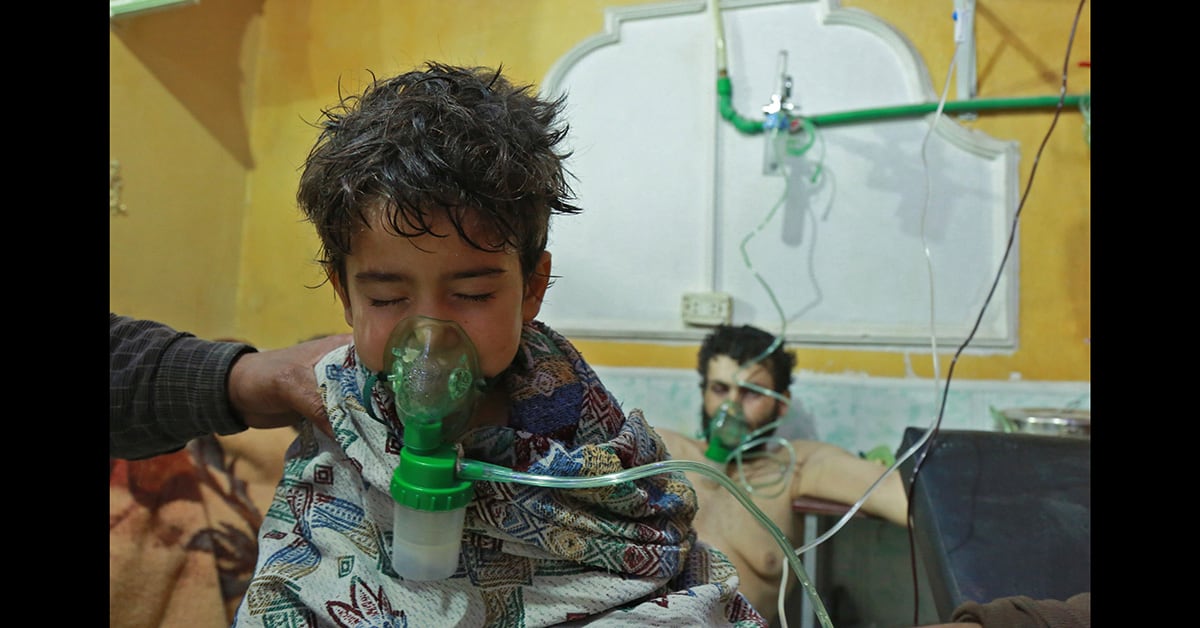
The OPCW also found the same variety of aerial bombs used in chemical attacks on the towns of Ltamenah in March 2017 and Khan Shaykhun in April 2017. Earlier investigations found that jets dropped sarin and chlorine in Ltamenah and sarin in Khan Shaykhun.
In addition, investigators discovered the same type of rockets used in the 2013 chemical attack in Ghouta.
UNCERTAIN SECURITY
The new information adds a layer of uncertainty to the security tribulations already faced by Syria’s new president, Ahmed al-Sharaa, as he seeks regional stability after leading the armed group known as Hayat Tahrir al-Sham to topple Assad.
Since March 2025, inspectors have visited over 20 sites across Syria, many of which were inaccessible during Assad’s administration but have since been opened as military control has shifted.
In addition to questions about where other chemical weapons may be hidden, one expert said the question of exactly who has knowledge of — and access to — where those items are located could be equally troubling.
Randa Slim, the director of the Middle East program at the Stimson Center, said the discovery of previously undeclared sites raises concerns that former Assad-era officials tied to the program may retain access to materials or information.
“There is definitely an economic benefit to them to sell these materials to non-state actors — like Hezbollah or ISIS,” she said, adding that black markets for such items exist and that ISIS had used chemical weapons in the past.
The combination of military transition, combined with incomplete information about the location of chemical weapons materials, can create a “proliferation risk” given the militant groups still operating in the region.
Though Al-Sharaa’s administration vowed to rid the country of chemical weapons, the country’s transition to a unified military has given way to other security gaps.
The Pentagon watchdog assessment said at least 150 ISIS fighters escaped detention facilities during the now-Syrian government’s offensive as SDF fighters, who were guarding the prisons, redeployed to the front lines as their territorial autonomy was threatened.
The report also described mounting disorder at camps and detention centers that contained families once involved in the terror group’s short-lived caliphate.
The U.S. transferred over 5,700 ISIS detainees to facilities in Iraq but roughly 20,000 people living in al Hol, a camp for displaced persons, which included thousands of ISIS families and partners, left the settlement without any monitoring.
Slim also said that the departure of U.S. forces from Syria earlier this year could complicate efforts to track militant activity and monitor the movement of dangerous materials.
While American troops were largely based in northern Syria, she said the military was able to provide intelligence that helped monitor ISIS and other extremist networks.
“With them out of there, that kind of situational awareness that the U.S. forces could provide — on movement of material, movement of ISIS — is no longer there,” she said.
It remains unclear, Slim cautioned, whether Syria’s transitional authorities can independently maintain that level of monitoring while simultaneously trying to consolidate control over a fractured security apparatus.
Eve Sampson is a reporter and former Army officer. She has covered conflict across the world, writing for The New York Times, The Washington Post and The Associated Press.
Read the full article here