
Some battlefield wounds are inherently deadly. Others, like tibia or ankle fractures, become deadly when a wounded soldier cannot send firepower downrange.
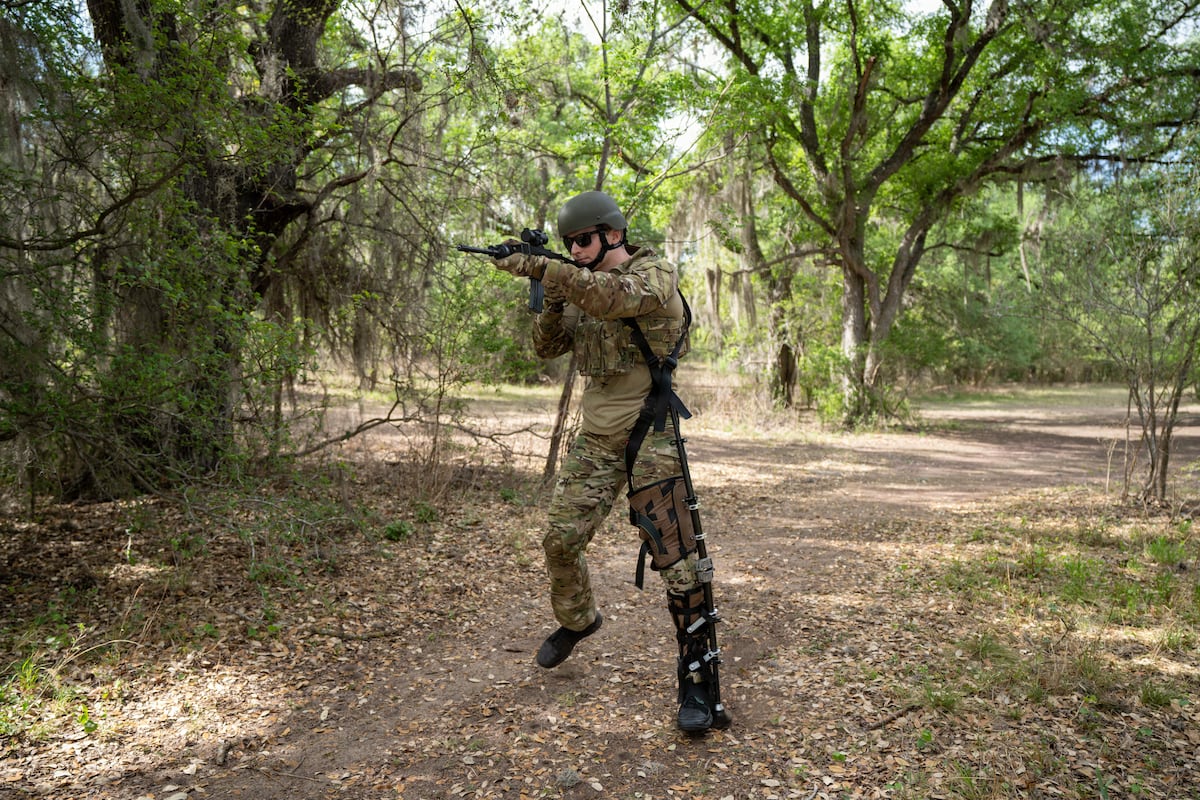
The U.S. Army Medical Research and Development Command is looking to change that with its new Intrepid Battlefield EXoskeleton, or IBEX, system, a shoulder-to-foot brace that can be worn to allow injured troops to stand, walk and shoot when evacuation is impossible or delayed.
The device was designed to make an injured soldier more self-sufficient, so they can move themselves to safety instead of relying on the two-to-four additional troops it takes to carry a victim on a litter. The goal, the Army said in a release Wednesday, is to keep more soldiers firing until help arrives.
“In combat, troops suffer tibia fractures, torn knee ligaments, high-grade ankle sprains, and foot fractures; these are the most common but survivable battlefield injuries,” said Dr. Lee Childers, a senior scientist at Brooks Army Medical Center in San Antonio, Texas.
“The IBEX enables more walking wounded, which means more warfighters putting bullets downrange while providing a smaller target for enemy drones to attack,” he said.
Figure C: Close-up of telescoping frame and knee joint. (EACE Military Performance Lab)
Drone warfare has dramatically changed the nature of combat and thus changed the way the military medical community must prepare to treat battlefield injuries.
In Ukraine, drones are routinely inflicting devastating limb injuries and drone swarms can cause high numbers of casualties in a short amount of time, overwhelming traditional field medicine tactics.
Weighing just seven pounds, the IBEX can fold into the size of a one liter bottle and be carried quickly to an injured soldier. It relieves the pressure on soft tissue, nerves and blood vessels, and is able to bear body weight.
Lower-leg injuries are often from gunshots or bomb blasts, the Army said, and soldiers suffered many such injuries during the wars in Afghanistan and Iraq. They can also be injured operating in rough terrain or bad weather.
Troops deployed to combat zones sustained over 22,000 non-amputated lower leg injuries between 2001 and 2018, according to the National Library of Medicine, which also reported that 68% of extremity injuries were fractures or open wounds.
The project was initiated in 2020 and has been tested by the Army, Navy and Marine Corps. It is now on its third round of funding and has been licensed by a commercial partner.
Eve Sampson is a reporter and former Army officer. She has covered conflict across the world, writing for The New York Times, The Washington Post and The Associated Press.
Read the full article here