
This story, “19 Terrible Hours,” appeared in the February 1965 issue of Outdoor Life.
On the morning of August 26, 1962, Bert Doughty, a fishing partner of mine, my 12-year-old boy Danny, and I rode on horseback away from the Sierra Pack Station in the rugged, high country of the Sierra Nevada Mountains in west-central California a few miles southeast of Yosemite National Park, We were starting a pack trip for four days of fishing on the Middle Fork of the San Joaquin River. I had made annual fishing trips there for seven or eight years, and Bert and I had gone in together the last three. This was the second time for Danny. We had found wonderful trout fishing, and the year before I had come out with a 21-inch brown trout that weighed a hefty four pounds.
I was 42 at the time, married and the father of four, living at Oildale, California, a suburb of Bakersfield, and working as superintendent of an oil company. I’d been a trout fisherman most of my life, though I never cared much for lake fishing. I had also done a lot of hunting for deer, doves, quail, and pheasants.
Bert, who was four years younger than I, lived in Bakersfield, worked as a salesman for an oil-well pump company, and was an enthusiastic outdoorsman.
We had 15 miles to ride that Sunday morning. Our campsite was on the San Joaquin a few miles above Mammoth Pool, an impoundment on the river northeast of the town of Bass Lake, and only a couple of miles upstream from the place known as the Devil’s Hole. That’s the deep gorge where two other fishermen, Keith Oveson and John McClary, were to be marooned for seven days only a week or two later. Oveson told the story of their ordeal in “Trapped in Devil’s Hole,” in OUTDOOR LIFE for September, 1963. I can’t recall that I’ve ever started out on a trip in higher spirits. The weather was fine, the ride was a pleasant one through beautiful mountain country, I was glad to have Danny along, and we were looking forward to great fishing.
Milt Hershfelt, who ran the Sierra Pack Station, had furnished our three saddle horses and two pack mules and had sent one of his guides in with us. We’d have no need for horses during the four days of fishing, so the guide was to see us to our campsite, drop us off there with our supplies, and take all the stock back to the station. He’d return for us on Thursday. That plan to stay in camp without horses was to prove fateful for me, but I had no inkling of that when we began the ride. We were starting on just a routine fishing jaunt. I didn’t dream I was making what, in all likelihood, would be my last ride to those beautiful pools and rapids on the San Joaquin, or that this trip would come within a hair’s breadth of ending my life.
It’s odd that the major events of a man’s life so often depend on such trifling and meaningless decisions.
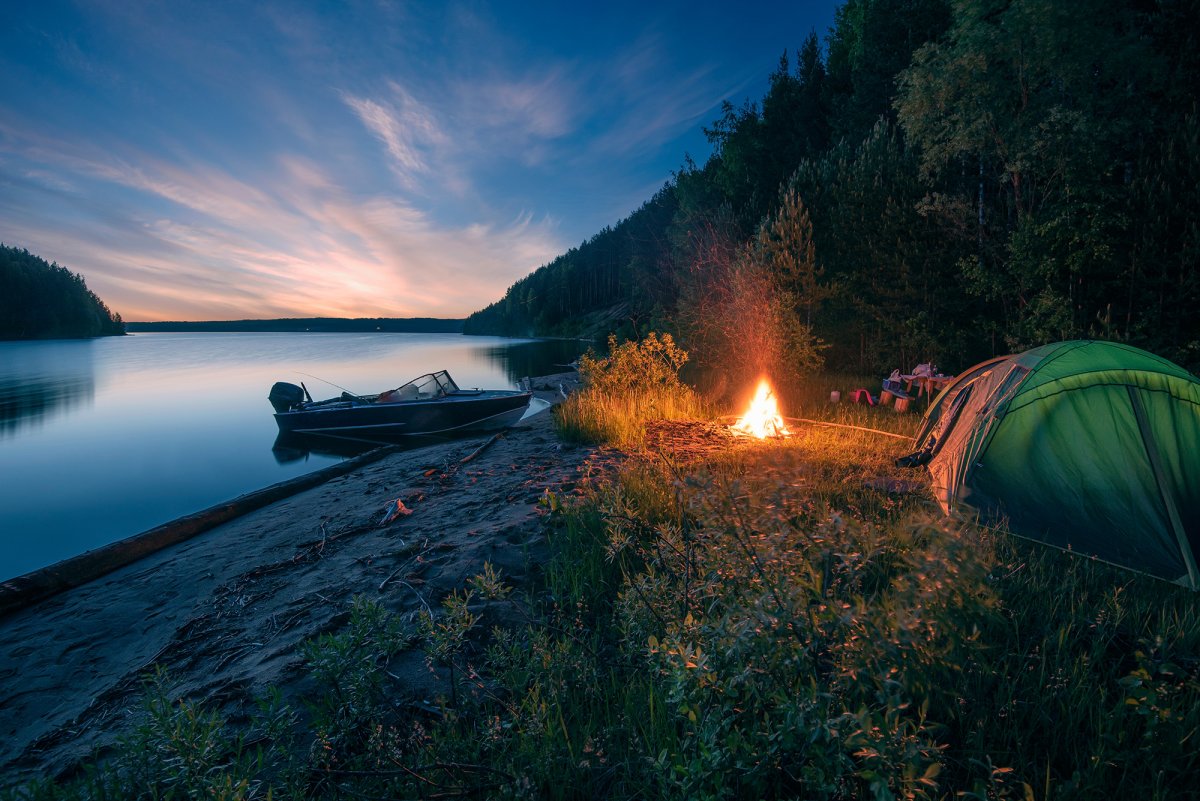
We reached the camp area about an hour after noon, unpacked, and said goodbye to the guide. We had brought no tent since the weather is good there at that season. We had rough pole bunks that we’d built in previous years, and we unrolled our bags on them, sorted and arranged our gear, and lay down to nap for an hour after the 15-mile ride.
About 3 o’clock we got up and headed for the river to wash off the trail dust. Then we’d go fishing.
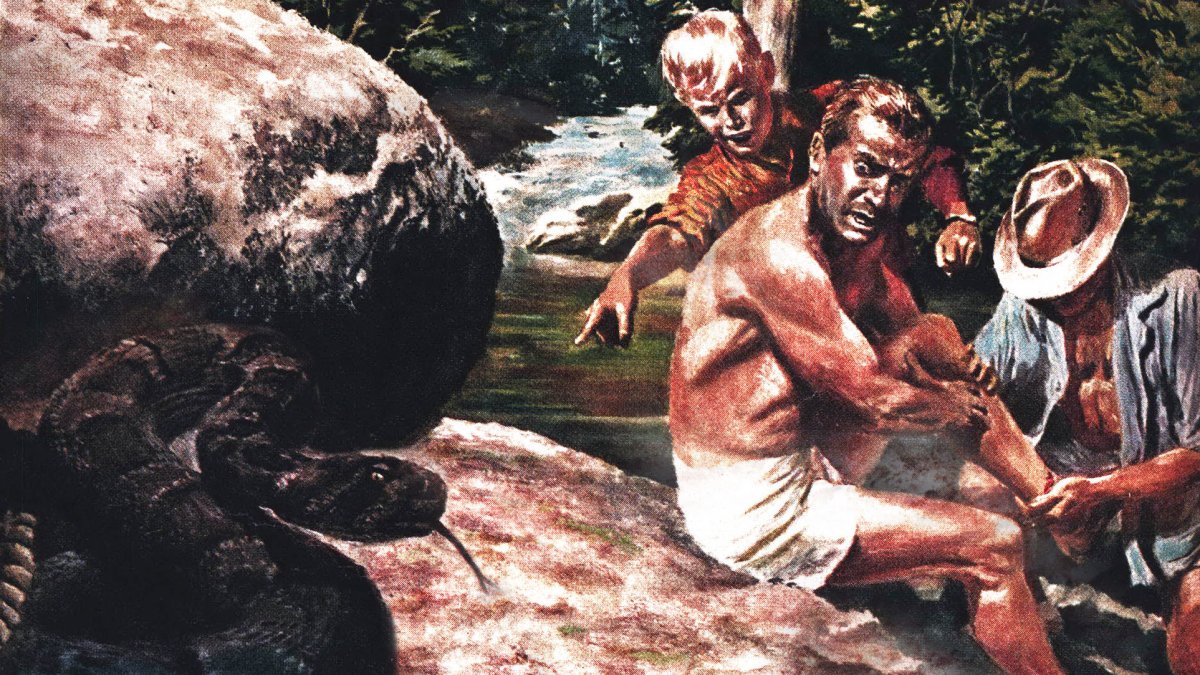
We had about 200 feet to walk to a pool where we could wash up. The day was sunny and warm, and I had taken off my outer clothing and was wearing only shorts and a pair of loafer shoes. We came to a big, flat rock about 30 feet wide that sloped toward the river, and we started over it. A loose, flat boulder three or four feet in diameter Jay in the middle of it. Bert and Danny walked around the upper side of the boulder, I went the other way. It’s odd that the major events of a man’s life so often depend on such trifling and meaningless decisions as that. If I had followed them, none of the rest would have happened.
I had no warning. As I rounded the rock I felt a sharp, painful blow on the front of my left leg just above the ankle, and the knowledge went through me, swift and jarring as a lightning bolt, that I had been struck by a snake.
I have been asked many times since what snakebite feels like, and I have read statements by other victims that it resembles a severe bee sting. But, speaking only from my own experience, I can say mine hurt a lot more at the instant of the strike than any bee sting. To me it felt like the shock from a 110-volt electric current.
The snake had been lying under the edge of the boulder, hidden from sight. It had not moved, rattled, or made a sound, and neither Bert nor Danny, only three or four steps from me, were aware that anything had happened. I took about six steps and sat down.
“I’ve been bitten by a rattlesnake,” I told them.
“You’re kidding,” Bert cried.
“I’m not kidding,” I retorted, and held my foot out to show them the two fang punctures, which were starting to ooze a little blood.
When they came down to me we could all see the snake lying in a sullen coil under the overhang of the flat boulder. It was the kind we call a valley rattler. Actually its correct name is Pacific rattler. Near relatives of prairie rattlers found on the dry plains east of the Rockies, these are medium-size snakes reaching a length of about four feet and ranging through the mountains from southern California to southern British Columbia.
Occasionally they are found as high as 11,000 feet. We were camped at about 5,000, in an ideal location for them, but we had never encountered one on any of our fishing trips and had not given them much thought. That is a mistake in snake country.
The snake had delivered a good, solid bite. One fang had gone in over the shinbone, the other in muscle toward the outside of the leg. We had a snake-bite kit in our gear, with suction cups and a small scalpel for making cuts, and Danny ran to get it. He was back in a minute with the kit and a .22, and while Bert and I went to work on the bite, he shot the rattler. It was a big one, 42 inches long, and it had 13 rattles. From the time it struck me until the boy killed it, it did not give a single tick of warning.
Bert and I tied a cord around my leg just above the knee and tightened it for a tourniquet, but very lightly, applying only a little pressure. We knew that a tight tourniquet could do more harm than good. Next I made a vertical cut over the fang punctures and Bert put his mouth to it and sucked out all the blood and venom he could. We did not apply the suction cups, thinking there was little left for them to do.
I was in a tough spot. seriously bitten by a deadly snake, in remote mountain wilderness 15 miles from the nearest highway, and without horses or any way to get out. Men had died within an hour from such a bite, and I knew it. But there was another thing I knew, too. I had almost as much to fear from panic as from the bite. I resolved in those first few minutes that I’d keep my head no matter what happened and stay conscious as long as I could.
There was no possibility of walking out. To attempt that would have been certain death, and, in any case, I couldn’t even have made a start. There was little pain, but my foot was numb, swelling fast, and would hardly bear my weight. Bert picked me up, carried me the 200 feet back to camp, and put me in my bunk.
We knew there was another party of fishermen camped about a mile downriver from us. They had horses, and Bert left at once to get their help. Danny settled down to assist me with what little additional first aid we could manage.
At 1O-minute intervals he loosened the tourniquet for one minute to allow free circulation of the blood in my leg. After a little while, each time he did this my ears, the tip of my nose, and the area around my lips got numb, and I realized the venom was spreading rapidly through my body. But I still felt very little pain and no nausea, and, except for my rapidly swelling leg, I was fairly comfortable.
Bert had left me at 3:30. He got back around 5:30 with two men from the other fishing party, Burns Box of Madera, California. and Joe Amormino of Los Angeles. There had been four in their camp. They had caught up their horses, and the other two, Tom Porter of Los Angeles and Henry Box of Madera, had ridden out for help, heading for the Clover Meadow ranger station, the nearest outside contact point. We knew they’d have a hard ride, for it would be dark in another hour and the country they had to go through was rough and wild.
We kept the tourniquet on about two hours and then decided it would be better to remove it. By that time the swelling had extended up the leg almost to the knee and the swollen part was turning black. As the skin stretched tighter and tighter, the pain finally began. Before morning we were rubbing cooking oil on the feverish leg trying to ease the torment.
The night was cool, and my companions built a good fire and stayed up to take care of me, all but Danny. Worn out by all that had happened, he finally crawled into his bunk for a few hours of sleep.
hat was a Jong and terrible night, with nothing to do but count hours and wait, wondering what the morning would bring. Unlike most snakebite victims, I was not nauseated, and I drank quite a lot of water. A couple of hours before midnight I got hungry. Bert and the other two men mixed eggs in canned milk, added some sugar, and came up with a fishing-camp eggnog. I drank about a pint of it. It stayed down, too.
What we didn’t know all through the lagging hours of that night, and it was a merciful thing we didn’t, was that the two fishermen who had ridden out for help had got lost. It was a pitch-black night and they wandered around for hours. They finally reached Clover Meadow after daylight, and Virgil Bishop, the ranger there, put out a call for a rescue operation.
We grew more and more anxious after daybreak. It was about 8:30 a.m. when we finally heard the whining drone of a helicopter flying upriver.
We were down in a fairly deep gorge, and the whirlybird, a private craft leased to the U. S. Forest Service, missed us on the first pass. It was discouraging to lie there helpless, with my leg throbbing and burning and the certain knowledge beating in my mind that I couldn’t live many more hours without medical help, and watch the copter go its unhurried way on up the San Joaquin and disappear from sight.
My partners built up a big smoke signal. Half an hour later we heard the aircraft coming back, and this time the pilot spotted us and carefully settled down into the canyon.
The pilot, Harry Rodgers of Clovis, California, brought the chopper to a landing on a rock beside the river only a short distance from our camp. It was a very neat piece of airmanship.
Accompanying Rodgers was Dr. Walter Snyder, a physician from Bass Lake who had responded to the emergency call. He found me in shock and gave me a hypodermic shot at once to ease things up for me. He had brought two vials of rattlesnake antivenin, but before injecting it he took the precaution of making a skin test to learn whether I might be allergic to horse blood.
The antivenin is prepared from the blood of horses that have been given repeated and increasingly large doses of snake venom until they build up sufficient immunity to withstand a dose many times that normally needed to kill them. Now and then a person is found sensitive to the horse-blood preparation, and there have been cases where the reaction to the antivenin was almost as bad as the snakebite.
I did not react, however, so Dr. Snyder gave me the two vials, injecting one in the leg above the swollen area. the other in my hip. It was then almost exactly 19 hours after the snake had struck me, and it was a miracle I was still alive.
Next, the men bundled me into my sleeping bag and made ready for the flight out. There wasn’t enough room for me in the helicopter, so I was placed in a steel basket lashed to one of the landing skids, and we lifted off the rock. The plane stopped once at a gas dump in the mountains to refuel, and in about half an hour we were over Fresno and ready to land.
Police had cleared an area around the ambulance entrance of Sierra Hospital, and the pilot set his chopper down almost at the door. Two or three doctors and several nurses were standing by, and they rushed me into emergency.
I was still conscious, but barely so. and in very bad shape. My leg was swollen almost to bursting and had turned black all the way up to the groin. I learned days later that the doctors had debated amputating the entire leg then and there in the rather slim hope of saving my life.
Dr. Snyder turned me over to a Fresno medic, Dr. J. V. L. Bradley, and then left. I’m a little hazy as to the details of my treatment for the next day or two, but I know I was given antivenin, water and feedings in the veins, and plasma and whole blood totaling five pints. Also an oxygen tube was put down my nose. I guess I must have been teetering on the brink of death when I was unloaded from that basket under the helicopter. I was in the hospital two weeks.
Then I managed to get up on crutches and was allowed to go home. I thought the worst was over, but I couldn’t have been more wrong. Three weeks later necrosis showed up. That’s a medical word for the dying, decay, and sloughing away of tissue, something that often happens following snakebite. In my case, it started around the area where the fangs had gone in and developed into a hole some two inches across that went deep into my foot. destroying flesh, nerves, tendons, and blood vessels. And at the same time, it also started creeping up my leg from the site of the bite.
I returned to a hospital, Mercy in Bakersfield this time. When Dr. Lewis Larson finished cleaning up my wound I could sec all the way through my foot, and I could also see the bare leg bones above the ankle. I hope all who read this, and who go afield in snake country, will remember that the consequences of snakebite can be that terrible.
“That leg will have to come off.” Dr. Larson told me. He called in an orthopedic surgeon and the specialist agreed.
It was no easy decision to make, but I had been in terrible pain all this time and that made it a little less difficult. Also, I knew I had no choice. There was no hope the flesh would ever grow back, and I certainly couldn’t live with a leg and foot in that condition. My wife and I talked it over and agreed to the operation.
The surgery took only about 20 minutes. The doctors started to remove the leg just below the knee, found dead tissue there, and had to complete the job above the knee.
I was operated on October 10, and I left the hospital in early November. By that time my weight had dropped from a normal 152 pounds to 120. I was nothing but skin and bones, and I looked as if I were dead. But I came back fast.
I was fitted with an artificial leg and put it on for the first time December 24. By late spring I was able to go dancing. Today, as I told a friend recently, I’m back in good condition and I now weigh, with the artificial leg, exactly what I weighed with my own before I was bitten.
There’s one thing I’ve had to give up, however. That’s stream fishing. I’ve tried it a couple of times, but getting around on the rocks is too rough for me to manage. I miss it like the devil, for it was one of my favorite pastimes, but I guess that’s not too high a price for a man to pay who stared death square in the eyes for 19 terrible hours. The doctors who took care of me and saved my life were amazed at tile outcome. I don’t think any of them would have given a wooden nickel for my chances at the outset. They did a great job and I’ll be everlastingly thankful to them.
I’d like to wind up with a word of warning to every hunter, fisherman, and camper who goes into areas where poisonous snakes are found, especially remote, backcountry places where it may take hours to get help or reach a doctor or hospital.
Antivenin kits or packages are available and can be carried in any sportsman’s outfit. They are a standard item at many drug stores in snake country, and any drug store in the United States can get them within 24 hours. They cost around $10 apiece. but some druggists will rent them out at a nominal charge for a period of days, weeks, or even months.
Each kit contains a vial of the powdered serum, sterile water for dissolving it, a hypodermic syringe for injecting the solution. and iodine for sterilizing purposes. Because the anti-venin comes in the form of a dry powder, it remains effective for years.
Read Next: We Caught Rattlesnakes for Extra Credit
Every sportsman going into a snake area should have at least one of these kits in his creel or tackle box or in a pocket of his hunting coat. In an emergency such as mine, the serum can be injected by the snakebite victim himself or by a companion.
Without antivenin, late as I got it, I would surely have died. If I’d had with me a kit containing even one vial, the doctors told me, in all likelihood I would not have lost my leg. And in that case, right now I’d be looking forward to my next trout fishing trip, maybe back to the San Joaquin.
Editor’s note: Snake bite treatment has changed since this article was published.
Read the full article here