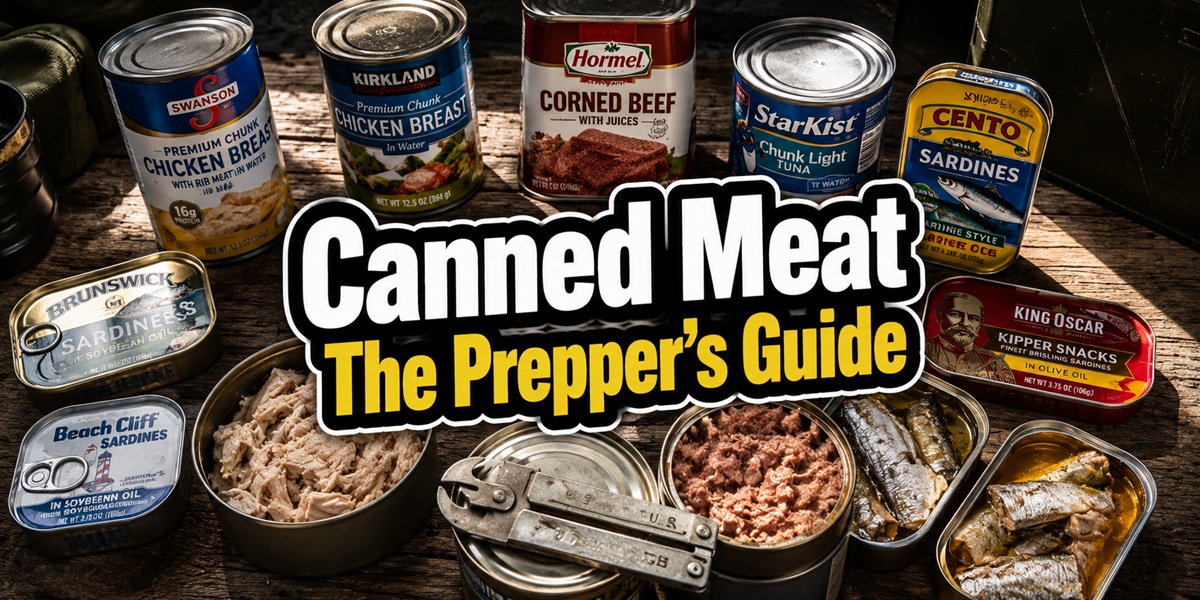

Protein is the hardest macronutrient to store long-term. Grains, legumes, sugar, and salt are relatively straightforward. Meat is not. Fresh meat spoils within days. Frozen meat depends entirely on power staying on. Freeze-dried meat works but costs a premium that puts it out of reach for many preppers building a serious supply on a budget. Canned meat sits in the middle of that spectrum in the best possible way: it is affordable, shelf-stable without refrigeration or power, ready to eat straight from the can, and available in enough variety to prevent the food fatigue that makes people abandon their preps when things get hard.
This guide covers everything a serious prepper needs to know about canned meat. How to evaluate it, which types earn a place in your rotation, how long it actually lasts, how to store it correctly, how to home can your own supply, and how to cook with it when the grid is down and your options are limited.
Why Canned Meat Belongs in Every Prepper’s Storage
The case for canned meat starts with a simple reality: in any genuine emergency lasting more than a few days, your body’s protein needs do not disappear. Protein drives immune function, wound healing, muscle maintenance, and cognitive performance. In a high-stress situation where you may be doing physical work you are not accustomed to, protein demand actually increases. A survival diet built on carbohydrates alone will keep you alive in the short term but will leave you mentally foggy, physically weakened, and increasingly vulnerable over weeks and months.
Canned meat solves this problem reliably. A well-stocked shelf of commercially canned chicken, tuna, salmon, sardines, beef, and pork gives you complete protein, meaningful caloric density, and enough variety to rotate through a usable meal plan. Most commercially canned meats carry a shelf life of two to five years on the label, and independent testing consistently shows they remain safe and nutritionally intact well beyond that window when stored correctly.
The USDA Food Safety and Inspection Service states that shelf-stable canned foods, including canned meats, remain safe to eat indefinitely as long as the can remains in good condition. Quality and texture may decline over time, but safety is not time-limited for properly sealed, undamaged cans stored at stable temperatures.
Commercial Canned Meat: What to Buy and What to Skip
Canned Chicken
Canned chicken is the most versatile option in the category and should anchor any canned meat stockpile. It works in soups, stews, rice dishes, pasta, wraps, and salads, and its mild flavor blends into virtually any recipe without demanding special seasoning. Look for chunk chicken packed in water rather than broth if you want maximum flexibility. Kirkland (Costco), Swanson, and Valley Fresh are consistently reliable brands with good meat-to-liquid ratios. Avoid store-brand options that are heavily diluted with water or contain fillers. Check the sodium content if you are managing intake, as it varies significantly by brand.
Canned Tuna
Canned tuna is the highest-protein option per dollar in the canned meat category and has earned its place as a prepper staple. Albacore provides more omega-3 fatty acids and a milder flavor; skipjack and light tuna are more affordable and have lower mercury content, which matters if tuna makes up a large portion of your protein rotation. Oil-packed tuna has higher caloric density and better flavor, while water-packed is lower in calories and more versatile in cooking. Both work. Stock both if budget allows.
Canned Salmon
Canned salmon is underused in most prepper pantries and deserves more attention. Pink salmon is the most affordable and still delivers excellent protein and omega-3 content. Red sockeye is richer in flavor and commands a slight premium. Both typically contain soft, edible bones that add meaningful calcium to your diet, which is worth noting for long-term nutritional planning. Canned salmon works well in patties, chowders, pasta, and anywhere you would use tuna.
Canned Sardines and Mackerel
Sardines and mackerel are the most nutritionally dense options in the canned fish category. They are high in protein, extremely high in omega-3 fatty acids, rich in vitamin D, calcium from the bones, and B12. For preppers thinking about nutrition across an extended emergency, these small fish punch far above their weight. The National Institutes of Health Office of Dietary Supplements identifies canned sardines and mackerel as among the best dietary sources of long-chain omega-3 fatty acids, which support cardiovascular health, inflammation management, and cognitive function.
Flavor is the main barrier for people who have not grown up eating them. Sardines packed in olive oil with added mustard or hot sauce are significantly more palatable than plain sardines in water, and they integrate well into pasta dishes, grain bowls, and crackers. If your family will not eat them straight, build them into recipes where the flavor is less prominent.
Canned Beef and Pork
Canned beef options include corned beef, roast beef, beef stew, and chili with beef. Corned beef is the most common and most practical: high protein, high fat, good caloric density, and long shelf life. It reheats well and works as a standalone protein or as an ingredient in hash, stew, and fried rice. Canned roast beef has a better texture for applications where you want identifiable meat pieces. Spam and similar canned pork products are high in sodium and fat but are shelf-stable, calorie-dense, and acceptable to people who would refuse most other canned proteins. In an emergency, palatability matters as much as nutrition. Stock what your family will actually eat.
Canned Meats to Approach Carefully
Vienna sausages, potted meat products, and similar highly processed canned meats are low in quality protein and high in sodium, fillers, and mechanically separated meat. They have their place as calorie-dense emergency rations and trade items, but they should not make up the bulk of your protein storage. Prioritize whole-muscle canned meats first and fill gaps with processed options if needed.
Shelf Life: What the Label Says vs. Reality
Commercial canned meat labels show a best-by date, not an expiration date. This distinction matters enormously for prepper planning. Best-by dates represent the manufacturer’s estimate of peak quality, typically ranging from two to five years from production. They say nothing about safety past that date for intact cans stored in good conditions.
Long-term testing conducted by food scientists and documented in survival preparedness research consistently shows that canned meats remain safe and substantially nutritious years beyond the printed date. Taste tests on ten-year-old commercial canned chicken showed acceptable flavor and full protein content. The primary changes over extended storage are textural softening and some degradation of fat-soluble vitamins, particularly vitamin A and some B vitamins. The protein itself is stable.
Research from Brigham Young University’s food storage program, referenced by the Utah State University Extension found that commercially canned meats stored at stable temperatures below 75 degrees Fahrenheit maintained quality and nutritional adequacy well beyond labeled dates in controlled testing. The key variables are temperature stability, humidity, and can integrity, not the date printed on the label.
How to Store Canned Meat Correctly
The single biggest threat to canned meat longevity is temperature fluctuation. Heat accelerates every chemical reaction that degrades food quality, and cycling between hot and cool repeatedly is more damaging than stable elevated temperatures. The ideal storage temperature for canned goods is between 50 and 70 degrees Fahrenheit, consistent year-round.
This rules out garages in most climates, attics in virtually all climates, and any space that gets direct summer sun through windows or walls. A basement, interior closet, or dedicated storage room with insulated walls is the right location. If you do not have a cool interior space, insulated storage containers or buried caches can extend the effective storage life in warmer climates.
Keep cans off concrete floors, which transfer ground moisture and can cause bottom rust over time. Wire shelving or wooden pallets work well. Inspect your stock regularly for swelling, rust, dents along the seam, or any sign of leakage. A swollen can indicates bacterial gas production and must be discarded without opening. Deep dents along the side seam or the top and bottom seams compromise the seal and should be discarded. Surface rust that wipes off cleanly does not affect the interior seal. Rust that pits the surface or appears along seams is a reason to discard.
How Much Canned Meat to Store
A useful baseline is targeting one protein serving per person per day, with a serving defined as roughly three to four ounces of cooked meat or fish. One standard 5-ounce can of tuna, one 12.5-ounce can of chicken split across two servings, or one tin of sardines each delivers approximately one serving. For a family of four targeting a 90-day supply, that works out to roughly 360 cans of protein across the rotation, a number that sounds significant but spreads across a few dozen cases and can be built gradually. The FEMA Ready.gov food storage guidelines recommend a minimum two-week emergency food supply as a starting point, with longer-term storage increasingly advisable as a preparedness baseline.
Build your stock through the store-sale-rotate method: buy extra whenever your preferred brands go on sale, rotate older cans to the front and new ones to the back, and consume from the front so nothing sits past its quality window. This keeps your stock fresh without requiring a single large investment.
Home Canning Meat: A Force Multiplier for Serious Preppers
Home canning your own meat is one of the most powerful and cost-effective things a serious prepper can do. It lets you preserve bulk meat purchased on sale at a fraction of commercial canned prices, control exactly what goes into each jar, and can cuts and preparations that do not exist commercially. A jar of home-canned pulled pork, seasoned your way and shelf-stable for years, is a significantly more useful emergency protein than a can of Spam.
Meat must be pressure canned, not water bath canned. This is non-negotiable. Water bath canning does not reach the temperatures required to destroy Clostridium botulinum spores in low-acid foods like meat. A pressure canner that reaches 240 degrees Fahrenheit under 10 to 15 pounds of pressure is required. Dial gauge and weighted gauge pressure canners both work; follow the manufacturer’s specifications for your altitude.
All meat canning procedures should be followed exactly from tested recipes published by the USDA Complete Guide to Home Canning or the National Center for Home Food Preservation. Processing times, jar sizes, and headspace requirements in these guides are based on scientific testing. Deviating from tested procedures introduces botulism risk, which is not a risk worth taking.
Raw pack and hot pack are both acceptable methods for most meats. Raw pack is faster: pack raw meat into clean jars with the required headspace and process immediately. Hot pack involves partially cooking the meat first, which allows you to pack more into each jar and often produces a better texture after processing. Both methods produce safe, shelf-stable product when processed correctly.
Cooking with Canned Meat When Resources Are Limited
One of the underappreciated advantages of canned meat is that it is already cooked. In a grid-down scenario where fuel for cooking is rationed, this matters. Canned tuna, chicken, and sardines can be eaten directly from the can without any heating. This makes them uniquely practical for situations where fire or stove fuel is unavailable or tactically inadvisable.
When cooking resources are available, canned meat integrates into a wide range of simple, high-calorie meals. Canned chicken with rice and dehydrated vegetables makes a complete one-pot meal over a camp stove or rocket stove. Corned beef hash with canned potatoes and dried onion requires only a single pan and minimal water. Canned salmon mixed with crackers, oil, and dried seasoning requires no cooking at all. Building a recipe library around your actual canned stock before an emergency gives you confidence and reduces the cognitive load of meal planning when stress is already high.
Think through your can opening situation as well. A quality manual can opener is a piece of gear that often gets overlooked until it fails. Keep two, store one with your canned stock and one in your bug-out bag, and replace them before they wear out. A P-38 military can opener is an inexpensive backup that takes up essentially no space and never fails.
Canned Meat as a Trade and Barter Item
In a prolonged emergency, canned protein becomes one of the most valuable trade commodities available. People who did not prepare and are several weeks into food scarcity will trade significant resources for reliable protein. Stocking a modest surplus of canned meat beyond your family’s calculated needs gives you a barter asset that can be exchanged for skills, labor, fuel, medications, or other supplies you lack. Keep this portion of your stock separate, clearly labeled, and in smaller package sizes that allow fractional trades without opening a large container.
The Amish Learned Food Security Long Before Modern Prepping Existed
Most people stockpile food without ever learning the deeper skills that made traditional communities resilient for generations. The Amish approach was different. They built entire lifestyles around preservation, self-reliance, practical storage, and knowing how to feed a family through hard seasons without depending on fragile modern systems.
That is exactly why The Amish Ways has become such a valuable resource for homesteaders and preparedness-minded families today.
Inside the book, you will discover traditional methods for food preservation, root cellar storage, home butchering, pantry organization, gardening, off-grid cooking, and long-term self-sufficiency practices that helped families thrive long before grocery stores and freezers existed. These are the kinds of systems that make canned meat, preserved foods, and emergency supplies far more useful because you learn how to build an entire resilient lifestyle around them.
If you want to move beyond simply buying survival food and start learning the forgotten skills that created true food independence, this is worth exploring.
👉 Click here to learn more about The Amish Ways and see why so many people are rediscovering old-school self-reliance now.
Final Thoughts on Building a Canned Meat Supply
Start with what your family already eats. If no one in your household will eat sardines in a normal week, stocking a hundred tins of sardines is a planning failure, not a success. Survey your current eating habits, identify the canned proteins that already appear in your regular meals, and scale those up first. From there, add variety systematically, introducing less familiar options gradually through your regular meal rotation so that unfamiliar foods become normal before you need to depend on them.
Canned meat is not glamorous prepper gear. It sits quietly on a shelf and does nothing until the moment it matters completely. Stock it seriously, rotate it consistently, know how to cook with it, and you have solved one of the hardest problems in long-term food storage.
You may also like:
 Best Canned Foods To Stockpile
Battle-Tested Army Survival Tactics You Can Rely On When Crisis Strikes (VIDEO)
5 Pressure Canned Meals in a Jar
Canning Supplies: The Ultimate Guide for Preppers
Amish Canning: Myths Debunked
My First Batch Of Canned Cheese
Read the full article here