
There are more air rifles on the market than ever before, which makes finding the best pellet gun a challenge. Especially if you’re new to the sport, the selection can be overwhelming. As you research options you’re flooded with claims, specifications, and dubious expert opinions. In this article, let me make the task easier by selecting the best pellet guns for different applications, and breaking down how to choose the best pellet gun for you.
All the air rifles in this article are for the new air gun shooter, one who is either just getting into the sport or maybe buying a purpose-built gun for the first time. My intention is to present guns that offer the performance required to fulfill a specific role for hunting, target practice, general plinking, and improving marksmanship, at a more budget-friendly price point.
Keep in mind that you can expect to find a springer with good performance at $250, but it’s not reasonable to expect it to compete with a $2,000 precision air rifle in performance and workmanship.
And while your dream gun—when you decide what it is—maybe aspirational, you don’t need to break the bank to get a rifle that will do what you need it to do. I believe that the guns I’ll present offer the performance to not only get you started, but also keep you going as experience is gained, and will grow with the shooter.
Read Next: PCP Air Rifles 101: A Beginner’s Guide to Modern Airguns
The Best Pellet Guns: Reviews & Recommendations
Best Spring Piston: Beeman R9
See It
Pros
- One of the best spring piston triggers ever produced
- High level of fit and finish
- Outstanding ergonomics
- One of the most accurate spring piston airguns ever built
- Great balance of accuracy and power
- Easy to cock
Cons
- Incorporate a resettable safety (can’t be reset after releasing)
- It’s on the heavy side, but to be expected with this type of gun in wood.
- This is almost the perfect springer, if such a thing exists.
Test Results
-
25-Yard Group Average:
.59 inch -
Pellet Used:
JSB 15.89 -
Trigger Pull Weight:
2 lbs 14 oz -
Average Speed:
605 fps
Key Features
-
Powerplant:
Conventional Spring-piston -
Length Overall:
43.25 inches -
Length of pull:
14.25 inches -
Weight:
8.5 pounds -
Single shot break barrel -
Barrel Length:
16.5 inches -
Trigger:
two-stage adjustable Rekord trigger -
Cocking effort:
40 pounds -
Sighting:
Open sights, adjustable rear sight, 11mm Dovetail for scope
The R9 was by far the best spring airgun we tested. It had the smoothest shooting cycle, the best trigger, and yielded the best accuracy. But you’ll pay $530 for that level of performance, which is more than double the price of the others tested.
The Rekord trigger on the R9 is a two-stage adjustable design that came out of the box at 2 pounds 14 ounces. I liked its predictable uptake and crisp break.
In our 25-yard accuracy testing, the smallest group was .21 inch, the largest was 1 inch, and the four group average was .53 inch. That’s some good shooting for a springer, but most notably, the accuracy came easily. Other spring rifles we tested were finicky and needed specific holds to shoot well. The R9 just performed without fuss.
This gun was set up at low power, generating 605 fps with the 15.89 grain JSB Diabolo pellet. The R9 was producing a power output just a little above the UK legal limit of 13 ft-lbs. I know that to firearms shooters this seems very low, but for context consider the British have been bagging small game with sub 12 ft-lb guns for decades.
The R9 uses a wood Monte Carlo stock with a subtle cheekpiece that allows it to be shot comfortably right-handed or left-handed. We all gave the R9’s ergonomics high scores. “This gun is an absolute pleasure to shoot, and it would make a fantastic hunting, pesting, or plinking gun,” said Einsmann. “The firing cycle is smooth throughout, with a very tame recoil, especially considering the power output.”
With a cocking effort of approximately 38 pounds, this rifle fell somewhere between the Swarm and the Model 95 in terms of effort and would be manageable for most shooters.
Read Next: PCP Air Rifles 101
Gamo Swarm Maxxim 10x Gen 2
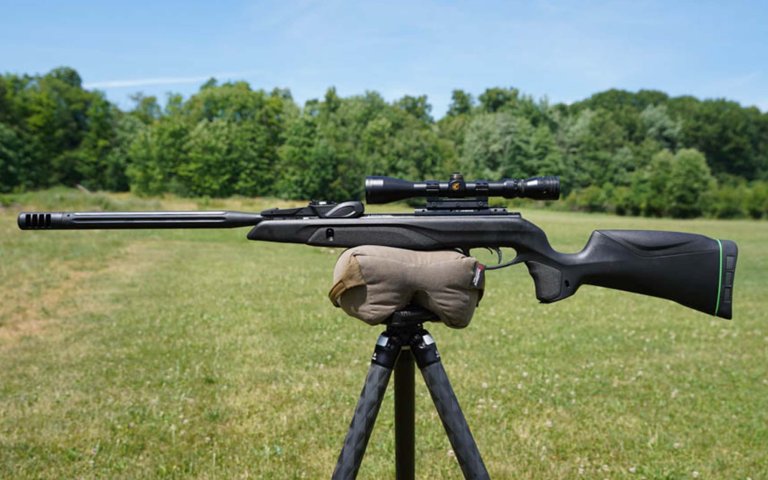
See It
Pros
- Multi-shot magazine
- Low cocking effort
- Smooth shooting cycle
- Ergonomic
Cons
- Bundled scope is low quality
- Trigger out of box has a lot of creep
- Only one magazine included
Test Results
-
25-Yard Group Average:
1.13 inch -
Pellet Used:
JSB Exact 18.13 grain -
Trigger Pull Weight:
3 lbs 12.3 ounces -
Average Speed:
611 fps
Key Specifications
-
Break barrel action -
IGT Inert Gas Technology Gas Piston power plant -
Magazine with 10 shot capacity (Horizontal orientation) -
Two-stage adjustable trigger -
Whisper Maxxim sound suppression system -
Shockwave Absorber recoil pad
The Swarm Maxxim 10X Gen 2 was a pleasant shooting rifle with a fairly tame firing cycle, and the multi-shot magazine worked flawlessly during testing. The cocking effort was low, and the overall ergonomics were good.
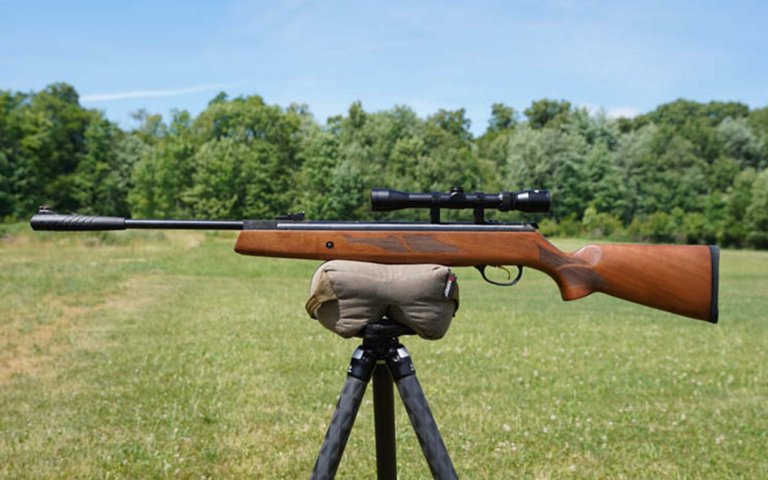
Hatsan Model 95
See It
Pros
- Beautiful Turkish Walnut stock
- Available in.117, .22, and .25 calibers
- Powerful
- Budget friendly
Cons
- Big and heavy rifle
- Cocking effort is high
Test Results
-
25-Yard Group Average:
1.79 inch -
Pellet Used:
JSB 15.89 grain -
Trigger Pull Weight:
6 lbs 15.2 ounces -
Average Speed:
698 fps
Key Specifications
-
Vortex Gas Piston power plant -
Quatro 2-stage adjustable trigger -
Adjustable TruGlo front and rear sights -
SAS recoil reduction system -
Anti-beartrap mechanism
The Model 95 was the most challenging rifle for all three of us to shoot. It has a nice walnut stock and handles well, but it’s heavy and requires considerable cocking effort. The trigger is quite heavy, at about 7 pounds, which makes it difficult to shoot accurately.
I think this rifle would have been much more accurate if we had adjusted the trigger, but we were testing all the air rifles with the factory set up. I like that this rifle is a well-built, solid rifle with a sub-$200 price point. But it’s not ideal for shooters unfamiliar with properly shooting a spring-powered airgun.
Best Entry-Level PCP Pellet Gun: Umarex Komplete NitroAir
See It
Pros
- PCP with no additional fill gear required
- Cartridge powered PCP
- Low cost of entry to PCPs
- Powerful and accurate
- Regulated for approximately 45 shots per cartridge
Cons
- Value proposition varies depending on usage
- Included scope quality is suboptimal
Test Results
-
45-Yard Group Average:
0.86 inch -
Pellet Used:
JSB 10.4 -
Trigger Pull Weight:
1 lb 3.3 oz -
Average Speed:
935 fps
Key Specifications
-
Powered by the NitroAir NCR cartridge system -
Side lever cocking -
Two stage trigger, adjustable take up, 2.25 lb pull weight -
Internal (non-adjustable) Regulator -
SilencAir noise suppression -
Available in .177 and .22
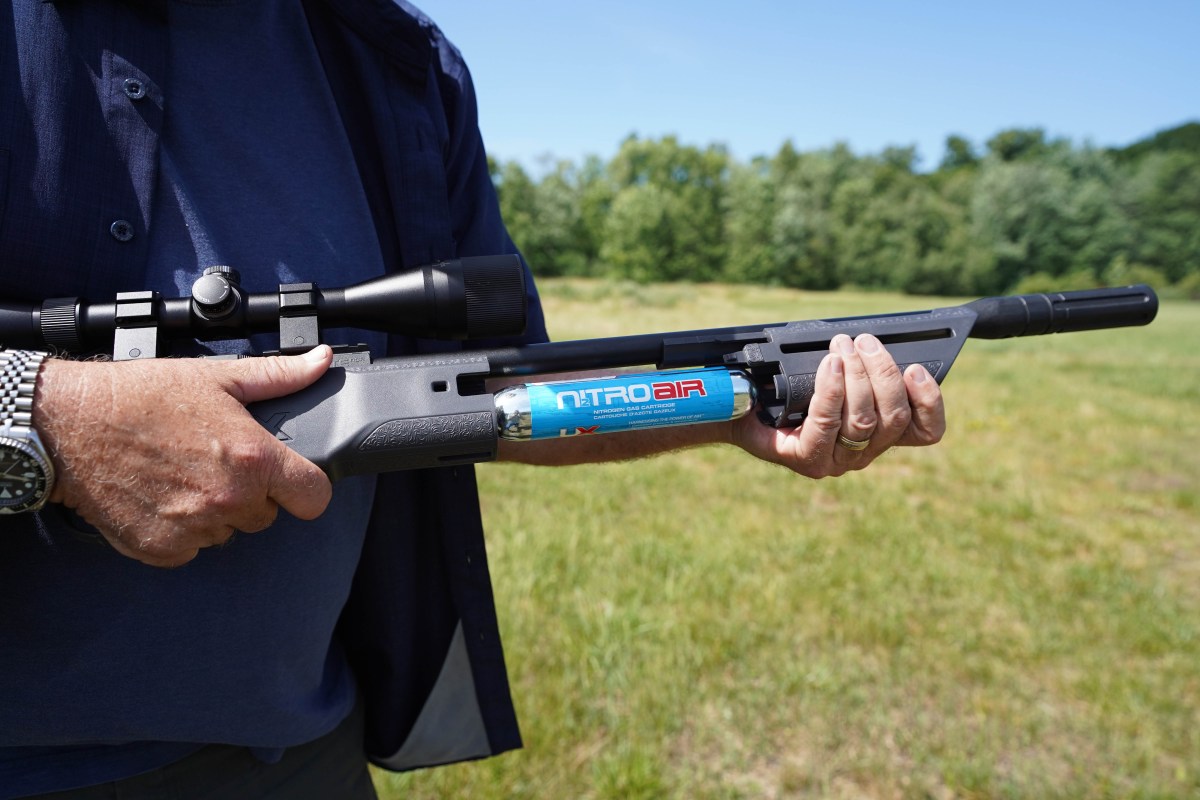
The Komplete NitroAir is unique because it doesn’t require a huge investment to get all the benefits of a PCP pellet gun. It uses a cartridge that resembles a large CO2 cartridge, but a CO2 cartridge is only filled to 800 psi. The NitroAir cartridge is charged to 3600 psi, which is enough juice for about 45 shots.
The Komplete is the least expensive PCP in terms of startup costs, but the cost could be higher if you shoot a lot. The cartridges cost about $10 (sold in packs of two). After 1,900 shots, you’ll spend $400 on 20 boxes of cartridges, which is about the cost of a small compressor. That’s why this airgun isn’t ideal for high-volume shooters, but it does make a lot of sense as a backyard pest rifle, plinker, or small game airgun.
See It
Pros
- Regulated
- Smooth side lever action
- Adjustability
- Accurate
Cons
- Leaving the tank filled to max pressure can cause issues
Key Features
-
Calibers:
.177, .22, and .25 -
Weight:
6.4 pounds -
Speed:
1,000 fps in .22 caliber -
20 shots per fill -
Repeater -
300 BAR tank capacity -
Adjustability
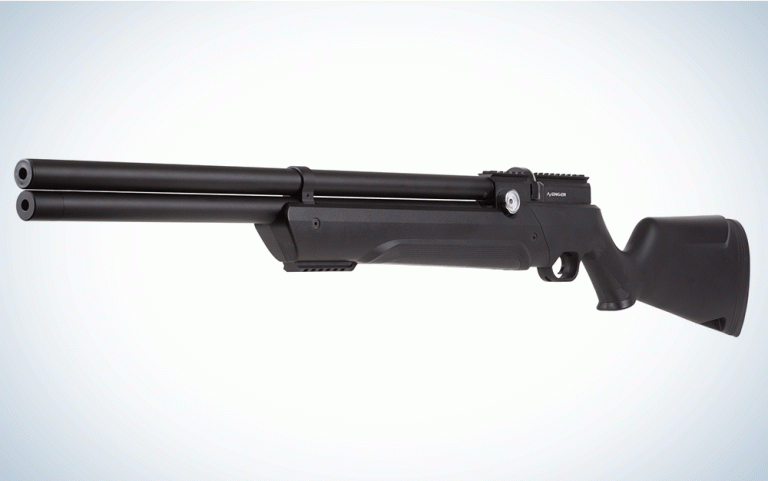
My pick for the best PCP pellet rifle for small game hunting is the Air Venturi Avenger, available in .177, .22, and .25. I chose this rifle because it provides so much upside at such a low price point. First are the features, and this rifle is feature rich: it is regulated and between the regulator and hammer spring adjustments can be fine-tuned for a particular application or projectile.
Even though the regulator can be set to operate at a range of pressures, the tank can be filled to 300 BAR (4,350 psi). This high-pressure air charge on the Air Venturi Avenger can provide a high shot count, a lot of power, or let the operator select the right balance. The ambidextrous synthetic stock is ergonomic, the side lever cocking and auto-indexing magazine are fast and reliable, and the rifle is intrinsically accurate and powerful (up to 45 foot-pounds).
See It
Pros
- Very close replica of Sig MCX rifle, great training tool
- Inexpensive ammo
Key Features
-
Caliber .177 -
Weight:
7.86 pounds -
Max velocity:
545 fps -
Uses CO2 88/90 gram cartridge -
Unique 30 round rapid fire magazine
Plinking is an application where CO2 guns rule because it is an inexpensive system to operate, the guns are fairly quiet, the power is low, accuracy can be quite good, and the technology lends itself to being incorporated into traditional firearm replicas.
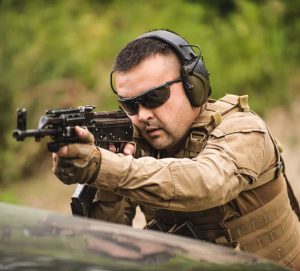
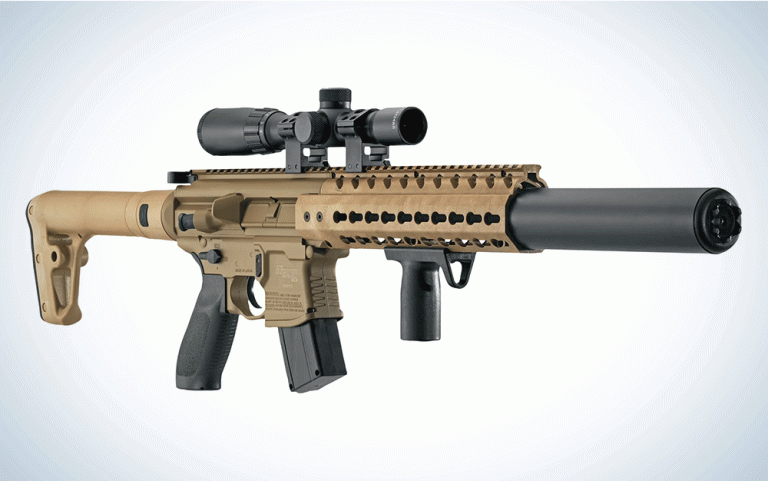
The CO2 pellet gun that I’ve had the most fun with is the Sig Sauer MCX pellet rifle. The cosmetics of this CO2 replica are based on the Sig MCX short-stroke rifle. It uses a 30 pellet Roto Belt magazine to support semi-auto shooting as fast as you can pull the trigger. Set up some metal spinners in the backyard and don’t look back, this gun is a blast.
Read Next: Best BB Guns
How to Choose the Best Pellet Guns
I would say that there are a few considerations when choosing the rifle that is best for you. The first is deciding how you’ll use your air rifle. Will you be shooting targets and plinking in the backyard? Will it be used for small game hunting?

Five Reasons to Hunt with Spring Piston Airguns
Features
This will also help you decide how to weigh features and specifications like power, speed, and sound signature. If you’ll be shooting in the basement or backyard, I’d recommend a quiet and low power rifle that has a high shot count. If this rifle will live in the field hunting rabbits, squirrels, or turkey (where legal), you might opt for power, accuracy, and a multishot capability and not care too much about the sound level.
Caliber: .177 vs. .22 vs. .25
I believe that caliber selection depends on how you’ll use the pellet gun. If I was to buy a gun for plinking in the backyard, I’d probably go with a .177, because ammo is less expensive and more available. If my primary application was shared between plinking and small game hunting, I’d gravitate towards the .22. Ammo is still cheap and available, but the .22 is more effective on small game. But if it’s primarily a hunting pellet rifle, I’ll almost always choose the .25. Ammo is more expensive and availability a bit more limited, but this caliber has substantially more power than the smaller calibers.
And my last point is that if I really found a small game rifle that I loved in every other respect, but it was only available in .22, I would be happy with it. Use the guidelines as suggestions and not hard fast rules while deciding on your gun.
Fit
Next, I’d look at the physical attributes of the gun and the shooter because the gun should fit you. Some things to look for are: Can you mount the gun and reach the controls easily and quickly? Is the cocking mechanism, especially with spring piston guns, manageable for you? Does the length of pull, and tactile feel of the trigger suit you?
And lastly, think about what other gear will be required. For example, if the gun is a PCP, like the Benjamin Marauder, you will need either a hand pump, high pressure air tanks, or compressor to keep the rifle supplied with air.
Optics are another thing to consider. You can shoot the iron sights or lower-quality scope that comes with the rifle. Or you can upgrade to a high quality air rifle scope.
Springer vs. PCP Air Rifle
What’s better: a springer or PCP pellet rifle? This is probably one of the most frequently asked questions from new airgun shooters and is not an easy one to answer. There are some simple facts to consider with each. And how these facts are weighted depends on your application, situation, or the environment in which the gun will be used, individual requirements, intended use, budget, etc.
Starting with springers, the rifles themselves tend to be less expensive than PCPs, and they are fully self-contained. They can provide the level of performance and accuracy required for almost any application, but they are harder and more demanding to shoot accurately. On the flip side, when you have practiced enough to be a proficient springer marksman, you will have dialed in your shooting technique and will be a solid marksman overall. Spring piston airguns rarely fail, it is not unknown, but they are generally a more reliable and rugged platform requiring less servicing.
PCPs on the other hand, tend to be more expensive and once you’ve acquired the gun, you’re only halfway there. You still need to buy filling equipment, at the very least a hand pump, but more likely you’ll want a carbon fiber tank and a compressor which may cost as much as the rifle. PCP rifles tend to be magazine fed repeaters, while most springers are single shots that must be manually loaded as the rifle is cocked. As a rule, PCP rifles are intrinsically more accurate, but more importantly they are easier to shoot accurately. There is no hold sensitivity or bidirectional recoil as is almost invariably the case with a spring piston gun. And though not a hard fast rule, spring piston airguns, especially the more powerful models, tend to be quite large and heavy, and require significant cocking effort.
Each of these characteristics has an impact that will vary depending on the individual and the situation, and for some the springer will make more sense while for others the PCP may be a clear choice. Personally, I hunt more with PCPs these days, but do enjoy getting out with springers as well—and there is no law saying you can’t do both.
FAQs
Pellet guns can be loud, but shrouded or moderated air rifles are very quiet.
A .177 caliber pellet gun is better for target shooting because the ammo is cheaper and more available. A .22 caliber pellet gun is better for small game hunting because it generates more energy.
Pellet guns are used for target shooting, hunting, and pest control.
Final Thoughts on the Best Pellet Guns
An honest assessment and answering all these questions before you start your search, will help ensure you get the rifle that is “best” for you. Read reviews, ask for input from others, look at specifications, develop a short list of the rifles you think suit your needs, and make a choice. In the end, the “best” rifle is the rifle you decide is “best” for you. Approach the decision-making process armed with the information I’ve laid out, and odds are good you’ll make a good decision. I believe that the rifles I’ve identified above are a good place to start, but in the end, you need to decide what is best for you.
Read the full article here