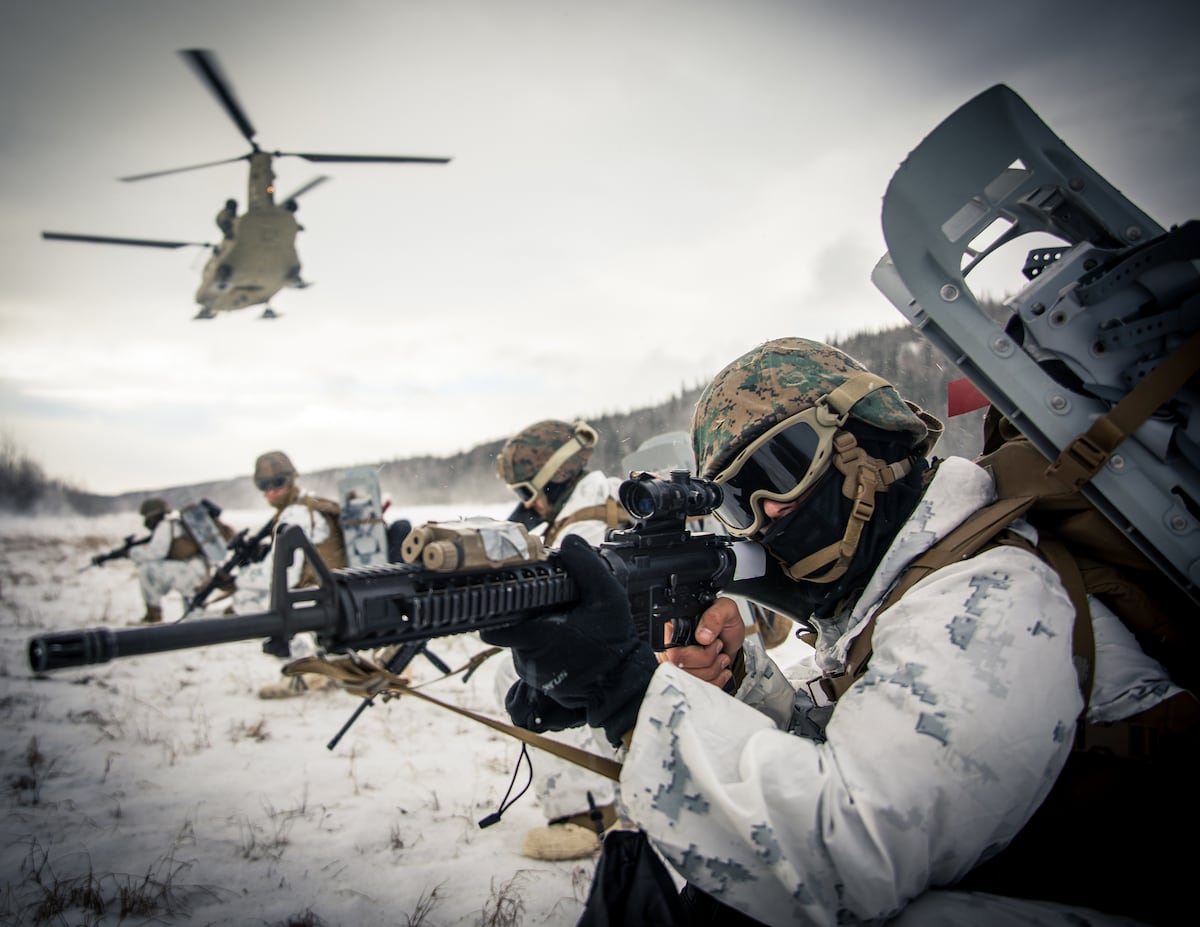

The Marine Corps is moving deeper into Alaska with an initiative designed to build a more persistent presence in the Arctic and prepare service members for extreme cold-weather operations.
The effort, called “Campaign – Alaska,” will establish a new rotating force that will train and experiment in the frigid conditions, the Corps announced Saturday, in a move it said was a result of the region’s increasing geopolitical importance.
“In this era of strategic competition, Alaska is critical to homeland defense and a vital theater for global power projection in the Arctic,” said Lt. Gen. Roberta “Bobbi” Shea, the commanding general of the Marine Forces Northern Command. “The Marine Corps Campaign – Alaska is a deliberate and necessary step to ensure we provide the Joint Force with a combat-credible force to support the National Defense Strategy,” she said in a statement.
The new rotational force is aligned with the Pentagon’s 2026 National Defense Strategy, the service said, which focuses on the Western Hemisphere as key to homeland defense.
The campaign will establish the Marine Rotational Force — Alaska, or MRF — Alaska, and a permanent Supporting Arms Liaison Team — Alaska, known as SALT — Alaska.
The service did not say where the rotational unit would be located, but it said the permanent force will be based out of Joint Force Elmendorf-Richardson by fiscal year 2027 and include service members from the 6th Air Naval Gunfire Liaison Company. It will also work with joint forces, allies and the community.
As climate change thaws ice and opens Arctic maritime access, policymakers have increasingly looked to the region as an arena of political and military competition. Defense officials have warned that after Ukraine, Russia’s military could turn its attention to the Arctic.
Alaska’s proximity to the Arctic — and to Russia — have made it a key military location for power projection and extreme cold training.
The Army is looking to create doctrine for landing helicopters on ice and one Alaska-based unit started trialing an Arctic combat course.
Eve Sampson is a reporter and former Army officer. She has covered conflict across the world, writing for The New York Times, The Washington Post and The Associated Press.
Read the full article here