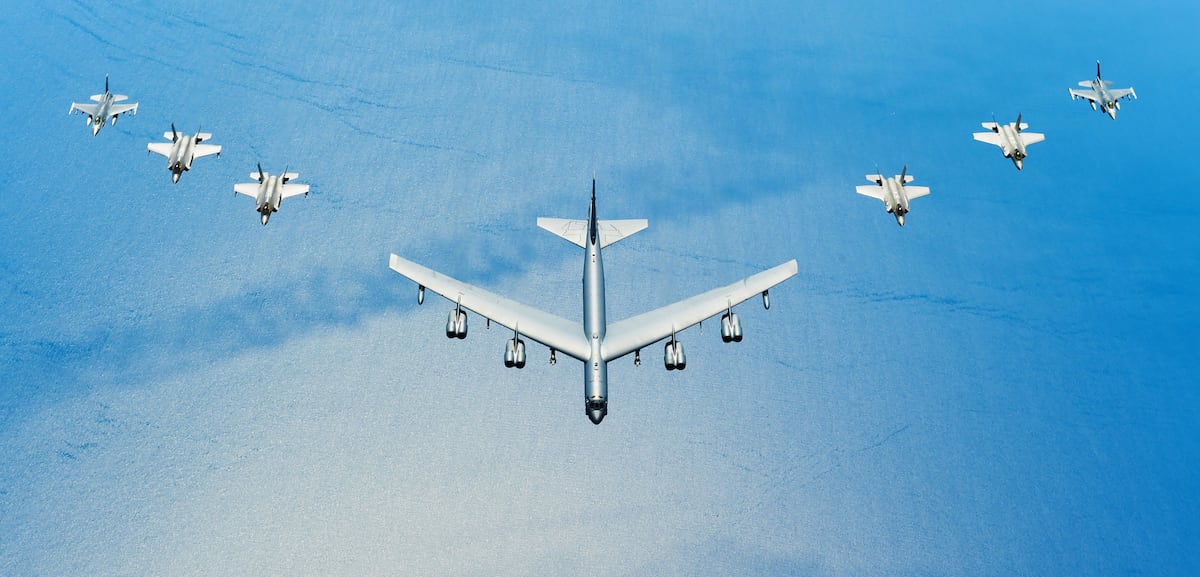

The Air Force’s program to replace the B-52H Stratofortress’s 1960s-era engines cleared its critical design review, the service announced May 4, setting the stage for Boeing to begin modifying the first two aircraft into the B-52J configuration later this year.
The Commercial Engine Replacement Program will swap the bomber’s eight Pratt & Whitney TF33 turbofans for Rolls-Royce F130 engines on each of the 76 B-52Hs in the active fleet.
As the original TF33s from the early 1960s continue to wear down and spare parts become increasingly scarce, the Air Force says the engines will be “unsustainable” beyond 2030. The new engines offer better fuel efficiency, longer range, lower sustainment costs and additional electrical power for modern weapons and sensors.
The Air Force launched CERP in 2018 and selected the F130 in 2021 after a three-way competition that also included GE Aviation and Pratt & Whitney.
The F130, built in Indianapolis, is derived from Rolls-Royce’s BR725, the engine that powers the Gulfstream G650 business jet and has accumulated more than one million flying hours since entering service in 2012.
The upgrade underpins the Air Force’s plan to shrink its bomber force to two types, the B-52J and the B-21 Raider, with the B-1B Lancer and B-2 Spirit retiring as B-21 deliveries ramp up.
The B-52, a key part of the U.S. nuclear triad’s air leg, is expected to fly into the 2050s, which would push some individual airframes toward 100 years of service.
“This CERP critical design review is the culmination of an enormous amount of engineering and integration work from Boeing, Rolls Royce, and the Air Force that will enable the B-52J to remain in the fight for future generations,” Lt. Col. Tim Cleaver, the program manager within the Air Force Life Cycle Management Center’s Bombers Directorate, said in the release. “It’s that point that you go from having a concept turned into a design, to then turning that design into something physical.”
Boeing, the integration prime contractor, will perform the modification work at its San Antonio facility, the release said.
“CDR is a milestone that showcases the kinds of complex systems engineering, propulsion integration, structural analysis and electrical architecture challenges our teams get to dive into every day,” Jamie Burgess, vice president and general manager of Boeing Mobility, Surveillance & Bombers, said in a statement. The work, he said, “puts us one step closer to modifying the first two B-52H aircraft into the B-52J configuration in San Antonio later this year.”
The milestone arrives years behind the original schedule.
The CDR was originally scheduled to occur three years earlier, Air Force Life Cycle Management Center confirmed to The War Zone. Integration work on the first aircraft is now set to begin in fiscal 2027, with modification of the second aircraft starting in fiscal 2028. Ground and flight testing follow in fiscal 2029. The Air Force is targeting fiscal 2033 for initial operational capability, three years later than originally planned.
The Pentagon awarded Boeing a contract worth more than $2 billion in December 2025 to finish integration work and to modify and test the first two aircraft. The total program is now expected to cost roughly $15 billion, and the Defense Department inspector general estimates that a dozen B-52 modernization programs combined will run $48.6 billion.
A 2023 Director of Operational Test and Evaluation report warned that the program’s buying strategy carries significant risk.
Two of the 76 B-52s will serve as test aircraft. The Air Force plans to award low-rate production contracts for 51 of the remaining 74 before operational testing finishes in fiscal 2032. That concurrency could make problems discovered late in testing considerably more expensive to fix.
The engine swap is only part of the B-52’s enduring story. The BUFF also gets new generators, modernized subsystems and a new radar under a separate program already in testing at Edwards Air Force Base, California.
Fleet readiness has slipped in recent years: the B-52’s mission capable rate fell from 59% in 2021 to 54% in fiscal 2024, according to Air Force data analyzed by Defense News. The engine swap and broader B-52J upgrades are expected to reverse that trend.
Read the full article here